 Olu
Online Body Doubling: Apps, Websites and How It Helps With ADHD
What body doubling is, why many people with ADHD use it, what the research really says, and the body doubling apps and websites to try, including free ones.
Updated 19 November 2026 · 8 min read
On this page
You know exactly what you need to do. You've known all morning. But the email stays unwritten and the laundry stays on the chair, until someone else walks into the room. Suddenly it's easy to start. That effect has a name: body doubling.
Body doubling is one of the best-known ADHD strategies, and many apps and websites now offer it online. This guide explains what it is, what the evidence does and doesn't say, which body doubling apps and websites exist, and how to try it for free.
The short answer: body doubling means working while another person is present, usually doing their own task. Online, you join a video session (one-to-one or in a group), say what you'll work on, work quietly, and check in at the end. Focusmate, Flow Club, FLOWN, dubbii and StudyStream are popular options, and most have a free plan or trial. Many people with ADHD say it helps them start tasks, but research is still limited, so treat it as a strategy to test, not a treatment.
Open a text Focus room and work beside someone now
Olu is an independent site, not affiliated with Focusmate, Flow Club, FLOWN, dubbii, StudyStream or any service named here. Features and prices change; check each one yourself.
What is body doubling?
Body doubling is doing a task while another person is with you. The other person, the "body double", doesn't help with your task and doesn't need to do the same thing. Their job is to be there.
It can be a friend at the kitchen table while you do your tax return, a video call where you both work on mute, a group of strangers who say their goals and work for 50 minutes, or a text: "I'm starting my essay now, check on me at 3?" People have always worked better in libraries and shared offices. Online body doubling just makes a partner available at any hour.
Why people with ADHD use body doubling
Experts quoted by CNN in May 2024 gave a few reasons it may help:
- An outside motivator. ADHD often makes it hard to start or finish tasks that aren't interesting. Another person's presence can act as external motivation to stay on task.
- Structure. ADHD affects executive function: planning, starting and managing time. A session with a start time, a stated goal and an end time supplies some of that structure.
- Not wanting to let someone down. Dr J. Russell Ramsay of the University of Pennsylvania's ADHD Treatment and Research Program explained that people with ADHD often find it easier to act when someone else is counting on them.
There's also older research on "social facilitation": people often perform simple, familiar tasks better when others are working nearby. That fits with what many people report, that body doubling works best for boring, routine or overdue tasks, and less well for complex new work.
What the research actually says
Be careful with big claims here. The evidence is mostly what people report, plus a few small studies.
- Surveys. A 2024 survey study by Eagle and colleagues, summarised in the preprint below, asked 220 people how, when and why they body double. It describes perceived benefits, not a controlled test.
- Small experiments. A 2025 study by Ara and colleagues, published as a preprint and not yet peer reviewed, tested 12 adults with ADHD in virtual reality. They finished a task faster with a human or AI body double than alone, and reported better attention, but accuracy didn't change. The same paper notes that no peer-reviewed controlled trials have tested body doubling in adults with ADHD, and that two other studies it reviews found no clear effect.
- Company studies. Some services publish their own results. FLOWN, for example, reports findings from its own study of adults with ADHD. These are useful to read, but the company ran the study on its own members, so they aren't independent.
- Clinicians. The experts in the CNN piece said there doesn't seem to be extensive research on body doubling itself, but that external motivation is a long-standing way to manage ADHD.
So: it's a popular, low-risk strategy that many people find helpful, with weak formal evidence so far. It isn't a treatment. If you think you might have ADHD, or your current support isn't working, talk to a doctor or a qualified professional.
Body doubling apps and websites compared
| Service | Format | Session length | Free option | Paid |
|---|---|---|---|---|
| Focusmate | One-to-one video with a matched partner, camera on | 25, 50 or 75 min | 3 sessions a week | Plus: $8/month yearly or $12/month |
| Flow Club | Hosted group video, up to 9 people; chat-only sessions too | 30 min to 3 hours | A free way to try | $40/month or $400/year; 50% off for students |
| FLOWN | Facilitated group sessions, 24/7 silent drop-in room, peer sessions | Varies by session | 30-day trial, free plan available | Paid membership; student discount |
| dubbii | App with live body doubling sessions, a quiet focus room and follow-along cleaning videos | Live sessions every 3 hours | Free download | In-app purchases |
| StudyStream | Silent video focus rooms, everyone muted; small Spaces add voice | As long as you like | Up to 1 hour a day | Premium: unlimited room time |
| YouTube "study with me" / "work with me" | Pre-recorded or live video of someone working | Often 1 to 3 hours | Free | None |
| Olu (University students planet) | Text "Focus room": say your task, someone abroad joins, check in at the end | 25-minute ritual; room stays open 1 hour | Free, no ads | No paid plan |
All details are from each service's own website or app store page in November 2026.
Focusmate
The best-known body doubling website. You book a slot and are matched with one person somewhere in the world. On video, you each say your goal, work, then check in at the end. Focusmate says it has hosted over 12 million sessions. Good if you want a firm appointment and a real person expecting you.
Catch: your camera needs to be on so your partner can see you working, which some people find stressful.
Flow Club
Hosted groups of up to 9. You share your goal at the start and how it went at the end, with little talking between. It's the most expensive option here.
FLOWN
Facilitated sessions run by hosts, with more than 350 sessions a week according to its pricing page, plus a drop-in room open 24/7 where you work silently with others, no booking needed. It also has "work with me" films for focusing without a camera. FLOWN is built with ADHD in mind.
dubbii
A body doubling app made by ADHD Love, aimed at housework and everyday tasks more than desk work. Its App Store listing describes live sessions with hosts every three hours, a 24/7 quiet focus room, follow-along cleaning videos and gentle reminders. If your hardest tasks are at home (dishes, laundry, admin), start here.
StudyStream
Silent video rooms where people study on camera together, with up to 1 hour a day free.
YouTube "study with me"
Long videos of people working, often with a timer. Free, but nobody sees you, so there's company without accountability.
How to do online body doubling
- Pick one task. Small and specific: "reply to the three emails from Monday", not "catch up".
- Choose a length. 25 minutes is a good first try. Longer once you know it works for you.
- Say it out loud or type it. Telling another person what you'll do is the core of it.
- Set everything up first. Water, charger, the document already open, other tabs closed.
- Work. Don't chat. If you get stuck, write down why and keep going on something related.
- Check in at the end. Done, partly done, or not done. All three are fine. Say what's next.
- Track a week. Note which tasks got done in sessions and which didn't. That tells you if it's working for you.
Tip: it tends to work best for tasks you know how to do but keep avoiding. If a partner makes you anxious, try a bigger group or a silent room.
Free body doubling options
- Focusmate free plan: 3 sessions a week.
- StudyStream free plan: up to 1 hour a day in focus rooms.
- FLOWN: 30-day free trial and a free plan.
- A friend, a library or a café: the oldest body doubling setups there are.
- Olu: free text check-ins, explained below.
Text-only body doubling on Olu
Olu is a free text chat site for meeting people in other countries, for adults 18+, in your browser. It isn't a video co-working room, and it's not an ADHD service. But its University students planet has a simple ritual that covers the check-in side of body doubling.
It's called Study together: you say what you're working on for the next 25 minutes, a member in another country answers, and you check in with each other when the time is up. To start right away, you open a Focus room, a live request that stays open for an hour. It's on the students planet, but the task can be anything: an essay, a report, a pile of admin.
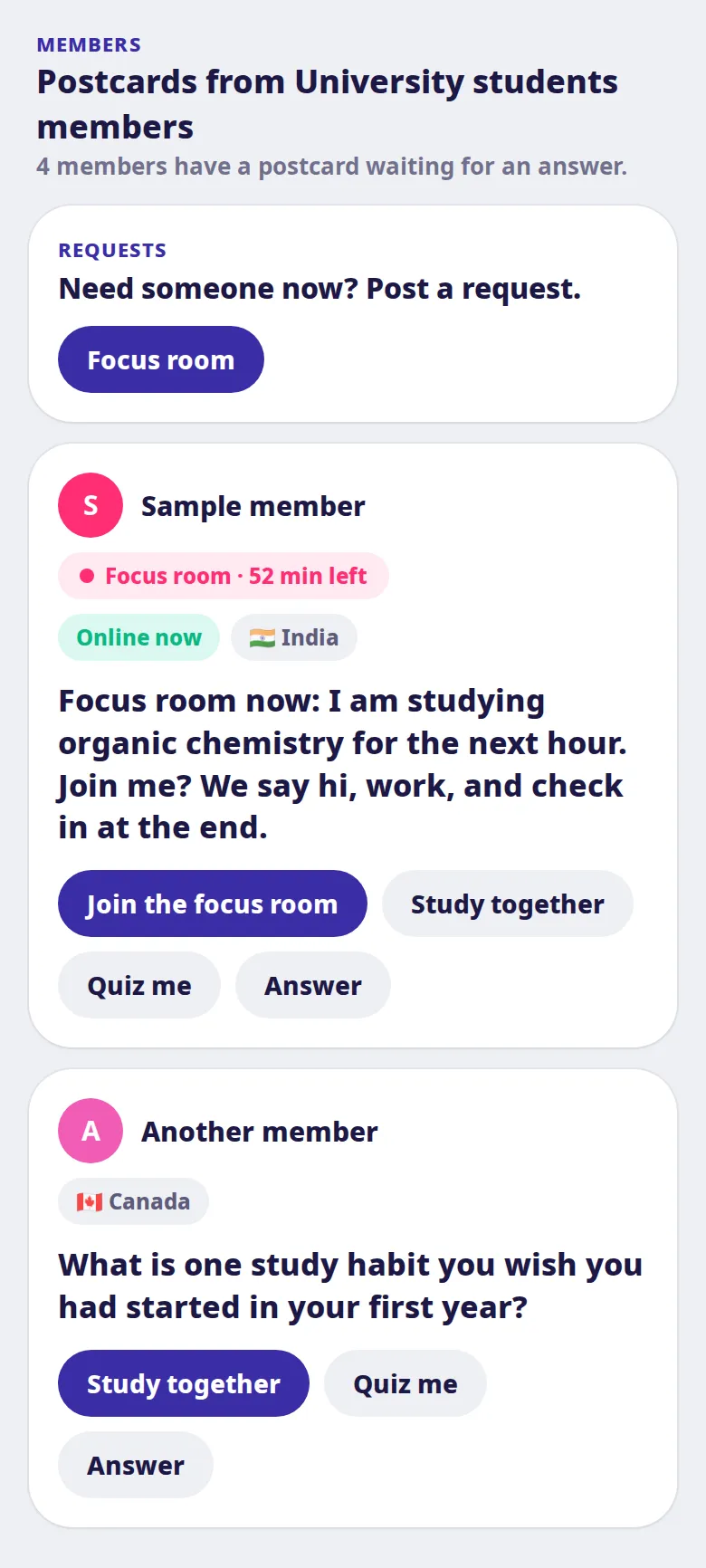 Example screen with sample members, not real people.
Honest limits:
- Text only. No camera, no voice. You won't see anyone working. If seeing another person is what helps you, Focusmate, Flow Club or FLOWN will suit you better.
- Small community. At quiet hours, your Focus room may wait a while for someone to join.
- Translated chat. Every message is translated both ways with the original visible, so your partner can be anywhere.
- Safety. Report and block are in every chat, and contact details are stopped before delivery. See random text chat safety tips.
If cameras drain you, apps to make friends for introverts lists other low-pressure options.
When body doubling doesn't help
It isn't for everyone. Some people find another person distracting, or feel watched and freeze. If you spend sessions worrying about the camera, chatting instead of working, or feeling worse afterwards, try another format first: silent rooms, text, or a pre-recorded video. If none help, that's useful to know too. And if the problem is bigger than one stuck task, if you feel low or isolated most days, apps for lonely people may help, and talking to a professional is a good step.
Questions people ask
+What is body doubling?
Body doubling means doing a task while another person is present, in the same room or online. The other person usually works on their own task. Their job is just to be there, which many people find makes it easier to start and keep going.
+Does body doubling work for ADHD?
Many people with ADHD say it helps them start and finish tasks, and clinicians recommend it as a practical strategy. The research is still thin: surveys and a few small studies, and no large controlled trials yet. Treat it as a tool to try, not a treatment, and talk to a professional about diagnosis or treatment.
+What is the best body doubling app?
It depends on what you need. Focusmate pairs you one-to-one on video, Flow Club and FLOWN run hosted group sessions, dubbii focuses on housework and everyday tasks, and StudyStream has silent study rooms. Try two or three and keep the one you actually return to.
+Is there a free body doubling website?
Yes. Focusmate's free plan includes 3 sessions a week, StudyStream's free plan gives up to 1 hour a day in its focus rooms, FLOWN has a free plan, and YouTube 'study with me' videos are free. Olu is free with no paid plan, but it's a text check-in, not a video room.
+Can body doubling work over text?
For some people, yes. A text check-in (say what you'll do, work, report back) gives you the accountability part without a camera. It gives you less of the feeling of someone being present, so if seeing another person is what helps you, choose a video option.
Keep reading
Boarding pass · free
Tap, fly to a random country, and chat with someone who lives there.
Text first, translated both ways, no video, no coins to meet people. Works in your browser.
Take off on OluNew here? Read Ablo App: The Complete Story of the Chat App That Let You Fly Anywhere (2019–2022), the full history in one place.