 Olu
What Is an Accountability Partner? How to Find One and Check In Every Week
What an accountability partner is, what makes a good one, where to find one, and how to run weekly check-ins, with a copy-ready template and app options.
Updated 19 November 2026 · 8 min read
On this page
You set the goal on Sunday. Run three times a week, finish the course, stop scrolling at night. By Wednesday it's slipping, and nobody notices but you. That's the gap an accountability partner fills: someone who will ask on Friday, "So, did you do it?"
This guide explains what an accountability partner is, what makes a good one, where to find one, and how to run weekly check-ins that last longer than a fortnight. There's a template you can copy at the end.
The short answer: an accountability partner is a person you check in with on a regular schedule about a specific goal. You say what you'll do, they ask whether you did it, and you plan the next step together. The best partners are reliable, honest and working on a goal of their own. Weekly check-ins of 10 to 15 minutes are enough for most goals.
Find a Friday check-in partner in another country
What is an accountability partner?
An accountability partner is someone who helps you keep a commitment or keep making progress on a goal. Wikipedia's definition puts it simply: a person who supports another in keeping a commitment. Usually it's a trusted friend or acquaintance who checks in regularly, though paid coaches offer the same service.
The idea works because of a small social cost. When you know someone will ask, skipping the workout means telling another person "I didn't do it." That's uncomfortable enough to get many of us out the door.
There are a few common setups:
| Type | How it works | Best for |
|---|---|---|
| Mutual partner | You each have a goal and check in on both | Most people; it's fair and lasts longer |
| One-way partner | One person reports, the other only asks | Short goals, or a friend helping you through something |
| Small group (3 to 5) | Everyone reports in the same check-in | Running clubs, study groups, writing groups |
| Coach | A paid professional holds you to a plan | Complex goals, or when friends are too soft on you |
An accountability partner is not the same as a workout buddy. A workout buddy trains with you. An accountability partner may live in another country, train at a different time, and only meet you in a message on Friday. You can have both.
Does having an accountability partner work?
The evidence is encouraging, but read it carefully.
- Weekly reports to a friend. Psychologist Gail Matthews at Dominican University in California randomly assigned 149 adults to five groups for a four-week goal. The group that wrote their goal, made action commitments and sent weekly progress reports to a friend rated their achievement highest: a mean score of 7.6, against 4.28 for people who only thought about their goals (research summary). Scores were self-rated and the study was short, so treat it as a strong hint, not proof.
- Exercising with a partner. In a Michigan State University study of 58 young women on exercise bikes, those who worked as a team with a virtual partner, where the team score depended on the weaker person, cycled about 22 minutes on average, against about 11 minutes for those exercising alone (ScienceDaily summary).
- Not always. A randomised trial on skin self-checks, summarised on Wikipedia, found that assigning an accountability partner did not clearly increase checks, and that group was the least satisfied. A partner you didn't choose, for a goal you don't care about, adds little.
The pattern: accountability works best when you chose the goal, chose the partner, and report regularly.
What makes a good accountability partner
| Quality | Why it matters |
|---|---|
| Reliable | Check-ins only work if they happen. A partner who forgets Friday teaches you that Friday doesn't matter |
| Honest | You need someone who will say "that's the third week you've skipped" |
| Kind | Honest isn't harsh. A good partner helps you plan the next week, not feel bad about the last |
| Similar commitment | If one of you is serious and one isn't, resentment builds |
| Their own goal | Mutual partners are more invested than one-way helpers |
| No stake in your result | A partner who gains or loses from your goal can't be neutral |
Duke University's recreation team suggests looking for similar goals, similar commitment and reliability, and agreeing goals, check-in frequency and how you'll communicate at the start. For what makes people good to have around in general, see traits of a good friend.
Who to avoid: a partner who only cheers and never asks hard questions, someone whose schedule is chaotic, and often a close family member, because it can turn into nagging.
Where to find an accountability partner
- Friends and colleagues. Ask someone who has a goal of their own: "Want to check in with each other every Friday?" It's an easy ask because it helps them too.
- Your gym, running club or sports team. People who already train regularly make strong partners. Many clubs have a group chat; post there.
- Classes and courses. A weekly class gives you people with the same goal and a natural check-in day.
- Online communities. Forums, subreddits and Discord servers for running, lifting, writing and studying often have threads for finding a partner.
- Apps. See below.
- People in other countries. Your partner doesn't need to be near you. Someone in a different time zone, with a different goal, can still ask you every Friday.
If you're new in town, how to make friends in a new city covers clubs and classes that double as places to find partners.
If you meet in person
When a partner from an online group suggests training together, keep it safe: meet in a public place like a busy park or gym, tell a friend where you're going, keep chatting by text first until you feel sure, and never send money to someone you've only met online.
How to run weekly check-ins
Most partnerships fade within a month for the same reasons: no fixed time, vague goals, and check-ins that drift into small talk. Fix those three and the rest is easy.
- Pick a fixed day and time. Friday at 6 pm. Put it in your calendar as a repeating event.
- Make each goal specific. "Run three times this week, at least 20 minutes each" beats "get fitter".
- Ask the same questions every time. Predictable is good. It takes 10 to 15 minutes, or a few messages.
- Write it down. A shared note or one message thread, so you can both see last week's promises.
- Be honest about misses. A missed week is information, not failure. Ask what got in the way.
- Review monthly. Is the goal still right? Is the partnership still helping? Change either if not.
Weekly check-in template
Copy this into your chat or shared note every Friday:
WEEKLY CHECK-IN: [date]

1. Last week I committed to:
2. What I actually did:
3. Done / partly / not done:
4. What helped:
5. What got in the way:
6. Next week I will (specific, measurable):
7. The one thing most likely to stop me, and my plan for it:
8. How can you help me this week?
Then the partner asks one follow-up question and does their own check-in.
Example: a fitness check-in
Last week: run 3 times, 5 km each. Did: 2 runs, 5 km and 4 km. Partly done. Helped: laying out kit the night before. In the way: late shift on Wednesday. Next week: 3 runs, one before work on Wednesday. Risk: rain. Plan: treadmill at the gym if it rains.
Short, specific, honest. That's all a good check-in needs.
Accountability partner apps
| App | What it does | Cost |
|---|---|---|
| HabitShare | Habit tracker where you choose which habits each friend can see | Says it's 100% free |
| Strava | Tracks runs, rides and walks; friends see and cheer your activities | Free to join; paid subscription for extras |
| Focusmate | Matches you with a partner for live video work sessions | Free plan: 3 sessions a week |
| A shared note or chat thread | Your template, your rules | Free |
| Olu Fitness and sport planet | Matches you with someone abroad for a Friday check-in by text | Free, no ads, no paid plan |
Details are from each app's own site in November 2026. No app replaces the core habit: a fixed time and an honest answer.
A check-in partner abroad on Olu
Olu is a free text chat site for meeting people in other countries, in your browser, for adults 18+. Its Fitness and sport planet has a ritual called Check-in partner: you say what you're training for, someone with a goal of their own answers, and you check in with each other every Friday to keep each other honest.
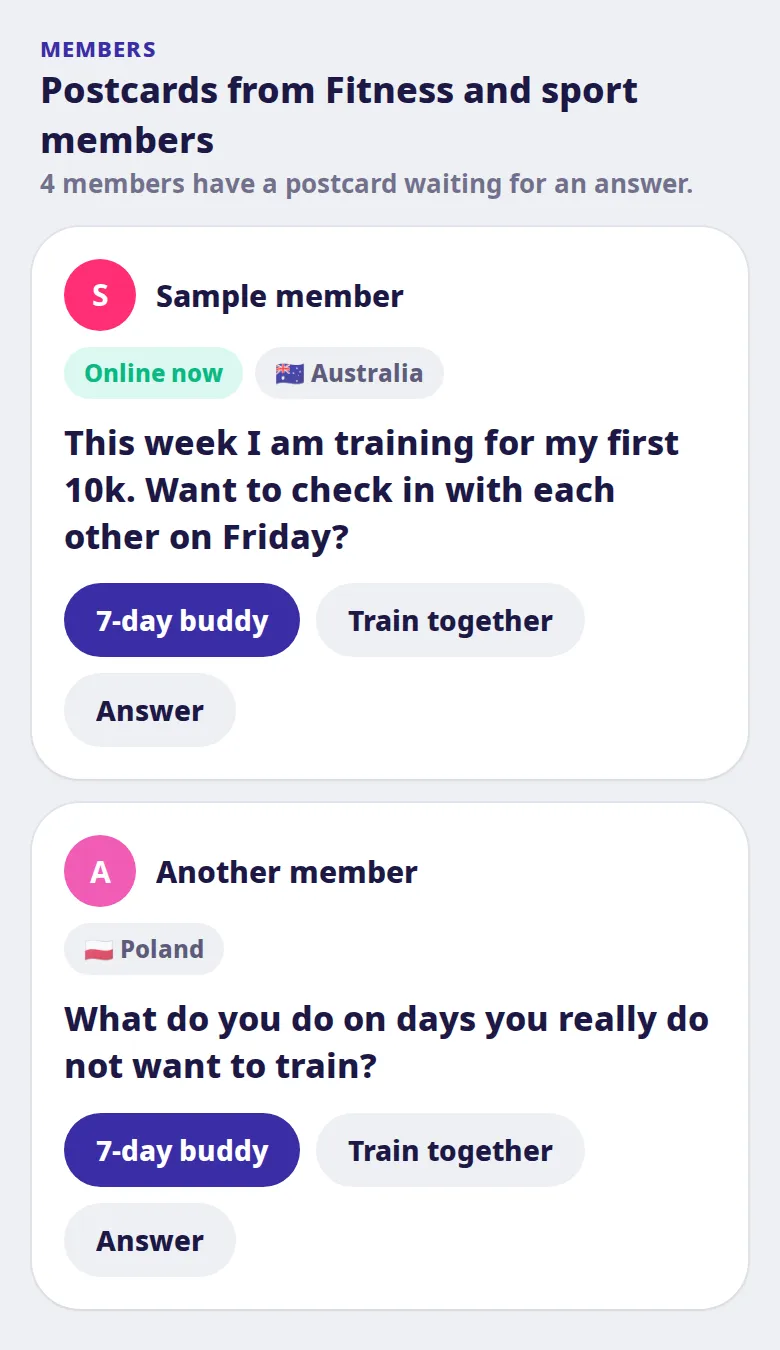 Example screen with sample members, not real people.
A partner abroad doesn't know your excuses, and a weekly report to someone new feels like a real appointment.
Honest limits:
- Text only. No calls and no video, so it's for check-ins, not training together.
- Translated. Every message is translated both ways with the original visible, so your partner can speak another language.
- Small community. It may take a while for the right partner to answer.
- Safety. Report and block are in every chat, and contact details are stopped before delivery. It's for friendship, not dating; see make friends online, not dating and our random text chat safety tips.
Common problems and fixes
- Check-ins stopped. Restart with a calendar invite and a smaller goal. One missed week isn't the end.
- It's all small talk. Use the template. Questions first, chat after.
- One person always misses. Say it plainly once. If nothing changes, find a new partner; it's not personal.
- Your partner is too harsh or too soft. Tell them what helps you: "Ask me what got in the way, not why I failed."
- The goal changed. Update it out loud. A good partnership adapts.
Questions people ask
+What is an accountability partner?
An accountability partner is someone who checks in with you regularly about a goal you've set, so you're more likely to follow through. It can be one-way, but it usually works best both ways: you each have a goal and keep each other honest.
+What does an accountability partner do?
They agree a check-in time with you, ask what you committed to and whether you did it, give honest feedback, and help you plan the next step. They don't do the work for you and they don't need to be an expert in your goal.
+Does having an accountability partner really work?
There's some good evidence. In a study by Gail Matthews at Dominican University, people who sent weekly progress reports to a friend rated their goal achievement highest of five groups. Exercise studies have found people exercised longer with a partner. But it isn't guaranteed; one medical study found an assigned partner made no clear difference.
+Where can I find an accountability partner?
Ask a friend or colleague with a similar goal, look in a running club, gym class or sports team, post in an online community for your goal, or use an app. For fitness goals, Olu's Fitness and sport planet pairs you with someone abroad for a Friday check-in.
+How often should you check in with an accountability partner?
Weekly suits most goals, in a short check-in of 10 to 15 minutes, or a few messages. Daily check-ins help for new habits in the first weeks. Pick a fixed day and time and keep it.
+Is there an accountability partner app?
Several. HabitShare is a free habit tracker that lets you share chosen habits with friends, Strava lets friends see your training, and Focusmate pairs you with a partner for live work sessions. Any shared note or chat thread also works.
Keep reading
Boarding pass · free
Tap, fly to a random country, and chat with someone who lives there.
Text first, translated both ways, no video, no coins to meet people. Works in your browser.
Take off on OluNew here? Read Ablo App: The Complete Story of the Chat App That Let You Fly Anywhere (2019–2022), the full history in one place.