 Olu
72 Book Club Questions That Work for Any Book
72 book club discussion questions that work for any book, fiction or non-fiction: openers, characters, themes, style and closing, plus tips for hosting.
Updated 19 November 2026 · 9 min read
On this page
- How to use these questions
- Opening questions (warm-up)
- Questions about characters
- Questions about plot and structure
- Questions about themes and ideas
- Questions about writing style
- Personal connection questions
- Questions for non-fiction books
- Questions for an online or virtual book club
- Closing questions
- How to run a good book club discussion
- How to write your own book club questions
- Talk about books with readers in other countries
- The short version
Someone says, "So, did everyone like it?" Three people nod, one shrugs, and the room goes quiet. Most book clubs don't need a better book. They need better questions.
These book club questions work for almost any book, fiction or non-fiction, so you can use them when a title has no reading guide. They are grouped by what they are for.
The short answer: pick 8 to 12 open questions before the meeting. Start with a quick round everyone can answer, move to characters and themes, add one or two personal questions, and close with what the group will remember. Ask "why?" after every answer.
Find a reader abroad to talk books with
How to use these questions
- Choose, don't march through. A thriller needs plot questions; a quiet novel needs character and style questions.
- Open, not yes-or-no. "Did you like the narrator?" gets a nod. "When did you start trusting the narrator, or stop?" gets a story. Book Riot's list of dead-end questions makes the same point.
- Point to the page. Specific scenes beat general feelings.
- Share the list early, so slower readers can think and mark pages.
Opening questions (warm-up)
Quick, easy, and everyone answers. Go round the circle.
- In one sentence, how would you describe this book to a friend?
- Out of ten, what score would you give it, and what is the one reason behind your number?
- Did you finish it? If not, where did you stop, and what made you stop?
- What did you expect from the cover and the title, and was it what you got?
- Where and when did you read most of it?
- Which moment or page did you mark, photograph or fold down?
- Was this a fast read or a slow one for you, and why?
- Did you read it, listen to it, or both? Did the format change how it felt?
Questions about characters
- Which character would you most like to have dinner with, and which would you avoid?
- Who changed most from the beginning to the end, and what changed them?
- Was there a character you understood but didn't like? What made you understand them?
- Whose point of view was missing? How would the story look told by them?
- Did any character make a choice you thought was wrong? What would you have done in their place?
- Which character felt most real to you, and which felt like a type?
- If the narrator tells the story, can you trust them? When did you start to doubt, if ever?
- Which relationship in the book was the most interesting, and why?
- Where do you imagine the main character is five years after the last page?
Questions about plot and structure
- Which scene was the turning point for you?
- Was there a moment you wanted to stop reading? What kept you going, or didn't?
- How did the pace feel? Which parts dragged and which flew past?
- How did the opening chapter set up the rest? Would you change where it starts?
- If the book jumps in time or between narrators, did that help or get in the way?
- Were there scenes that felt too convenient? Did it bother you?
- How did you feel about the ending? If you could rewrite it, what would change?
- What question does the book leave open on purpose? What's your answer?
Questions about themes and ideas
- What do you think the book is really about, under the plot?
- How does the title connect to the story or the main idea?
- Which themes still matter in the world today? Where do you see them?
- Are there objects, places or images that keep coming back? What might they stand for?
- Did the book take a side on a big question, or leave it to you?
- How does the setting (time and place) shape what happens? Could it happen anywhere else?
- What does the book say about family, power, money or belonging?
- Did the book change how you think about anything, even a little?
Questions about writing style
- How would you describe the author's voice in three words?
- Was there a sentence or passage that stopped you because of how it was written?
- Did the style suit the story? Would it work told more simply, or with more detail?
- How did the author use dialogue? Did people sound like real people?
- What did the author leave unsaid, and did it work?
- If you have read other books by this author, how does this one compare? If not, would you read another?
- If this book was translated, did you notice it? What do you think might have been lost or gained?
- Would this book work as a film or series? What would be hardest to adapt?
Personal connection questions
These get the deepest answers. Go first yourself.
- Which character reminded you of someone you know?
- Did any part of the book connect with something in your own life?
- What did you learn about a place, time or way of life you knew little about?
- What surprised you about your own reaction to the book?
- Would you have liked this book at 20? Will you like it at 70?
- Is there a choice in the book you would have made differently ten years ago?
- Who in your life would you give this book to, and why them?
- What would you ask the author if you could ask one question?
- Did the book make you want to do anything: travel, call someone, read about a topic?
Groups that have become friends can add a round from our questions to get to know someone deeply or philosophy questions.
Questions for non-fiction books
Memoir, history, science, self-help and essays need a slightly different set.
- What did you already know about this subject before you started?
- What is the most useful or surprising thing you learned?
- Did the author convince you? Which part of the argument was strongest, and which was weakest?
- How well did the author back up their claims? Did any of it need more evidence?
- Whose voice or view was missing from the book?
- For memoir: how honest did the author seem? What do you think they left out?
- Did the book read more like a story or like a report? Which parts worked best?
- Will you do anything differently after reading it?
- Which other book, podcast or film would you pair with this one?
Questions for an online or virtual book club
Calls and chat groups need easy turn-taking, and members in different countries add something a local group can't.
- Where in the world were you when you read this, and did your surroundings change how you read it?
- Would this book be read differently in your country? What would people there notice first?
- Is there a book from your own country that you would pair with this one?
- Post one line or one page number that stayed with you, and say why in a sentence.
- In the chat, write one word for how the ending made you feel. Then let's talk about the most different word.
- If you read in a second language or a translation, what was hard and what was easy?
Closing questions
Finish here, then pick the next book.
- What will you still remember about this book in a year?
- Did talking about it tonight change your opinion? How?
- Would you recommend it, and to which kind of reader?
- Has your score out of ten changed since the start of the meeting?
- What kind of book should we read next, based on what we liked or missed here?
- Would you read more by this author?
- In one word, how do you feel about the book now?
How to run a good book club discussion
- Prepare 8 to 12 questions. A great one can fill 20 minutes.
- Start with a round. A one-line review or a score gets the quiet ones talking early.
- Agree a spoiler rule. Some members won't finish. Decide whether the ending is open.
- Follow the energy. If a question sparks a debate, let it run. Your list is a backup, not a script.
- Draw people in by name, gently. "Sam, what did you make of the last chapter?" Never push anyone on personal matters.
- Let people disagree. Ask each side to point to the text.
- Watch the clock. Leave 10 minutes for closing questions and choosing the next book.
- Rotate the host to keep the talk fresh.
How to write your own book club questions
No reading guide? Write five questions as you read:
- Mark three moments that surprised or moved you. Turn each into "What did you make of the moment when...?"
- Pick one character and ask why they did the hardest thing they did.
- Ask about the title and the last page.
- Add one "you" question: "Has anything like this happened to you, or to someone you know?"
Keep each question short and about one thing.
Talk about books with readers in other countries
Some of the best book talk comes from someone who read the same book in another country. On Olu, a free text chat site for meeting people in other countries, readers join the Book lovers planet. Its ritual is the Book swap: you trade one book from your country for one from theirs. You can also post a Read together request, which stays open for 72 hours, so a reader somewhere else can join you in reading a book a chapter at a time and talking about it.
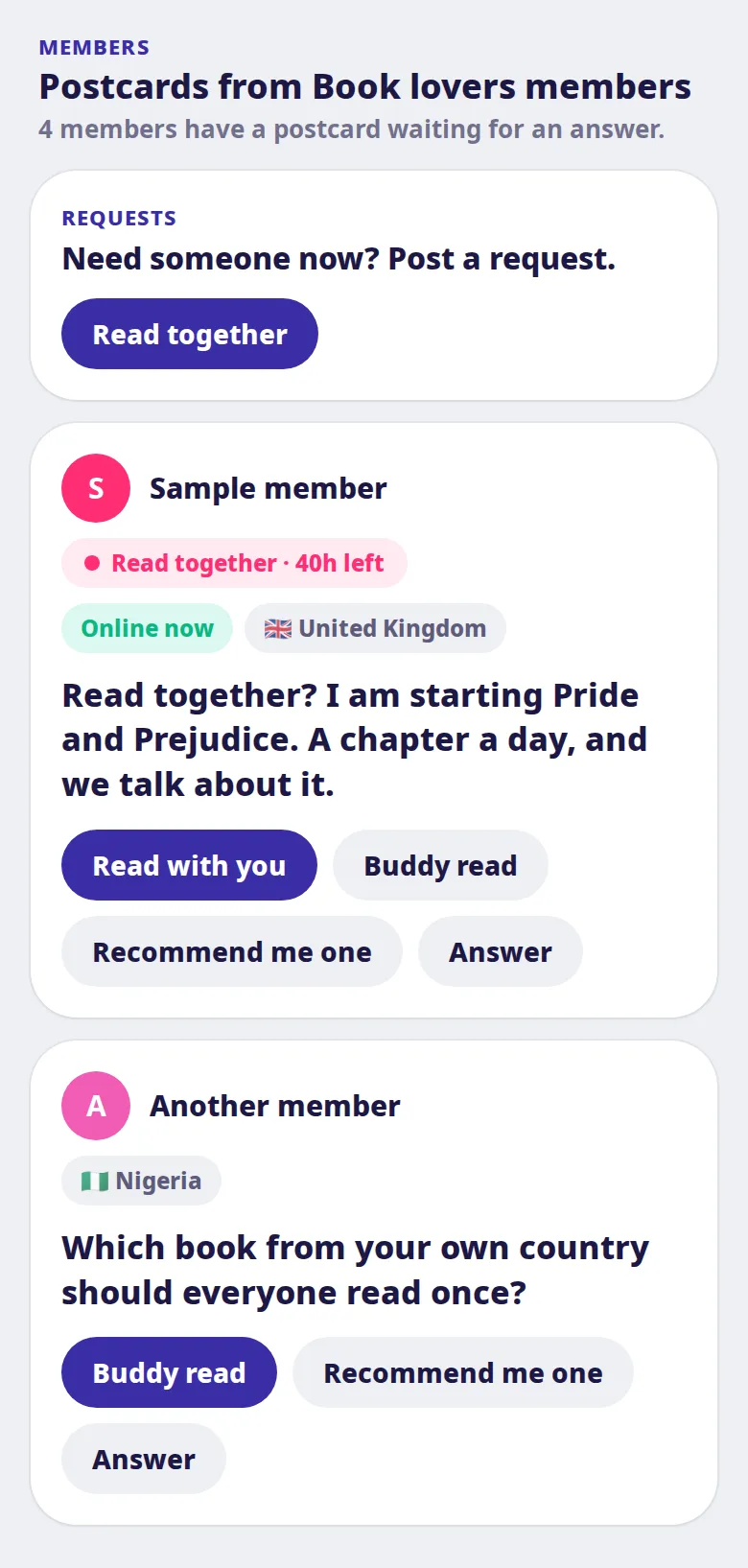 Example screen with sample members, not real people.
Members also write postcards with a question for readers abroad to answer, such as "Which book from your own country should everyone read once?"
Honest limits: it's text only, with no voice or video, so it won't replace your group's meeting. It's for adults 18+, free with no ads and no paid plan, and every message is translated both ways with the original visible, so a reader in Lagos and one in Lyon can talk in their own languages. The community is small, so at quiet hours you may wait. You can report and block anyone, and contact details are stopped before delivery. For a longer-term reading friend abroad, see how to make friends from other countries online and our pen pal questions.
The short version
Choose 8 to 12 open questions, start with a quick round, and ask "why?" after every answer. The best book club questions point people back to the page, then to their own lives.
Questions people ask
+What are good general book club questions?
Open questions that work for any book: what surprised you, which moment stayed with you, how the title fits, what the author wanted you to feel, and whether the book changed your mind about anything. Ask why after every answer.
+How many questions should you prepare for a book club?
About 8 to 12 for a meeting of one to two hours. A good question can fill 20 minutes, so you rarely use them all.
+How do you start a book club discussion?
Go round the group once with a quick, easy question, such as a one-line review or a score out of ten with one reason. Everyone speaks early, including quieter members.
+What questions should you avoid at book club?
Yes-or-no questions and ones with one right answer, such as 'did you like it?' or 'did you see the twist coming?'. Add 'why' or 'how', or ask people to point to a moment in the book.
+Can you use the same questions for non-fiction?
Many of them, yes: openers, writing style, personal connection and closing questions work for both. Add questions about evidence, what you learned and what you would do differently after reading.
Keep reading
Boarding pass · free
Tap, fly to a random country, and chat with someone who lives there.
Text first, translated both ways, no video, no coins to meet people. Works in your browser.
Take off on OluNew here? Read Ablo App: The Complete Story of the Chat App That Let You Fly Anywhere (2019–2022), the full history in one place.