 Olu
Online Forums for Teachers: Where Teachers Talk Online and How to Get Value
The online forums and communities where teachers talk: Reddit, A to Z Teacher Stuff, ProTeacher, edWeb, eTwinning and more, plus how to get useful answers.
Updated 19 November 2026 · 8 min read
On this page
Teaching is a job done in a full room that can still feel lonely. You make a hundred decisions before lunch, and the person best placed to tell you whether you got them right is usually teaching in the room next door, too busy to talk. That's why so many teachers end up in an online forum at 10 pm, asking strangers how they handle the last lesson on a Friday.
This guide lists the online forums and communities where teachers really talk, what each one is good for, how to get useful answers rather than noise, how to stay professional, and how to compare notes with teachers in other countries.
The short answer: the busiest online forum for teachers is r/Teachers on Reddit, with subject and country subreddits beside it. For classic forums organised by grade and topic, use A to Z Teacher Stuff or ProTeacher. For professional learning with webinars, edWeb. For support groups, TeachersConnect or a private Facebook group like We Are Teachers HELPLINE. In Europe, eTwinning connects school staff across countries. Use one place to vent and one place to learn, and never post anything that could identify a student.
Swap one lesson idea with a teacher abroad
Why teachers look for an online community
Two reasons come up again and again: stress and a lack of support.
In RAND's 2025 State of the American Teacher survey, 53% of US teachers reported burnout, against 39% of similar working adults, and 62% reported frequent job-related stress, against 33%. Those are US numbers, but teachers elsewhere describe the same pressures.
New teachers in particular have long gone online for help. A 2016 Education Week report found that only 15 US states required support for teachers in their first two years, so many new teachers turned to online communities such as Reddit's teacher forum, Twitter chats like #ntchat and private social media groups. One person quoted in the piece observed that new teachers' questions are often very basic, like what kind of lesson plan to use, and that online communities tend to give specific, concrete answers.
The same report noted the weakness of informal forums too: a question can sit unanswered for days. Choosing the right place, and asking well, makes a big difference.
What to look for in a teacher forum
- Activity. Look at the dates on the latest posts. A forum with replies from this week is worth your question. One whose last post was in 2019 isn't.
- Your level and subject. A forum organised by grade or subject gives better answers than a general board.
- Moderation. Clear rules and active moderators keep discussions useful and kind.
- Privacy. Can you use a username? Is the group public or private?
- Tone. Some spaces are for venting, some for lesson planning. Both are useful, but know which one you're in.
The main online forums and communities for teachers
| Community | Type | Best for |
|---|---|---|
| r/Teachers (Reddit) | Large subreddit, username-based | Quick advice, venting, seeing how other schools work |
| A to Z Teacher Stuff Forums | Classic forum | Grade and topic discussions, job and exam questions |
| ProTeacher Community | Classic forum | PreK-8 teachers, by grade and subject |
| edWeb | Professional learning network | Webinars and topic communities |
| TeachersConnect | Online community | Support and well-being, especially newer teachers |
| Google Educator Groups | Local and online groups | Teachers using Google tools in class |
| We Are Teachers HELPLINE | Private Facebook group | Peer support with everyday problems |
| eTwinning | EU school community | Finding project partners in other European countries |
Communities change. Check how active each one is before you invest time.
r/Teachers and other subreddits
Rutgers' New Jersey Alternate Route programme lists r/Teachers among its 12 support groups and forums for educators, describing it as a place where teachers share hard situations and get empathy and practical strategies. It's busy and blunt. Expect a lot of venting alongside real advice. Search for subreddits for your subject, your country and your role too; smaller, focused ones often give calmer, more specific answers. Read each subreddit's rules before posting.
A to Z Teacher Stuff Forums
A long-running forum with boards for general education, each age range, special subjects, job hunting and teacher tests, plus an off-topic "Teacher Time Out" area. When we checked in November 2026, it had new posts that month, though it is quieter than Reddit and many older boards are kept as read-only archives. Good for searchable, threaded answers on classroom management and practical questions.
ProTeacher Community
A forum for school teachers in grades PreK-8, with discussion areas by grade and subject. Rutgers' list notes it was established in 1999, and its members include working teachers, people training to teach and retired teachers. A good fit if you teach younger children and want conversation with experienced colleagues.
edWeb, TeachersConnect and Google Educator Groups
These are professional networks rather than open forums. Rutgers' list describes edWeb as a professional learning network with online communities, archived webinars and professional development, TeachersConnect as focused on teacher well-being and impact with community, free resources and webinars, and Google Educator Groups as communities and programmes for peer connection, webinars and events. They're a better place for structured learning than for a quick question at 10 pm.
Facebook groups
Private groups such as We Are Teachers HELPLINE give peer support with day-to-day problems. Groups exist for most subjects, countries and roles. They usually show your real name, so post as if your head teacher could read it.
How to get real value from a teacher forum
- Search before you post. Behaviour management, first-year survival and interview questions have been answered hundreds of times.
- Give context, not identities. Say the age group, subject, class size and what you've tried. "Year 8 maths, 30 students, last lesson on Friday, seating plan didn't help" gets far better replies than "my class is a nightmare".
- Ask one clear question. "How do you start a lesson so they're working in two minutes?" is answerable.
- Give back. Answer one question for every one you ask. Regulars notice, and you'll get better help.
- Separate venting from planning. Venting has its place. If you want a strategy, say so.
- Check advice against your context. A tip from a different country, school system or age group may not fit your rules. Your own school's policies come first.
- Look for patterns. One reply is an opinion. Five teachers suggesting the same approach is worth trying.
A Tes article by three Scottish teachers who set up their own online support group makes a simple point about what makes these spaces work: basic decency, room for honest talk about hard days, and conversations about interests outside teaching too.
Privacy and professionalism
Teachers are held to a higher standard online, and students, parents and employers can all find what you post. Keep these rules:
- Never share student data. No names, photos, work samples, or details that could identify a child, a family or your school.
- Follow your school's social media policy. It may cover what you can say about your workplace, even anonymously.
- Assume nothing is fully anonymous. Small details add up.
- Don't post about colleagues or managers in a way you couldn't defend.
- Be careful with paid "resources" and links from accounts you don't know.
Talking to teachers in other countries
A teacher in another country can be the most useful colleague you'll ever have. They'll show you a different school day, a different exam system and a dozen lesson ideas you'd never see at home. And they're far enough from your school that you can talk honestly.
eTwinning, part of the European Commission's European School Education Platform, is a well-known structured option. Its own pages describe it as a safe and free platform; school staff in eTwinning countries can find partners for projects, join moderated groups and take online courses and seminars. Class projects there run inside eTwinning's own platform, under its rules on protecting pupil data.
Outside Europe, international teacher groups on Reddit and Facebook are the usual route. They work, but they tend to be big and busy, and one-to-one conversations are hard to start.
Olu is a free text chat site for meeting people in other countries, in your browser, for adults 18+ only. Its Teachers planet is for teachers from every country comparing notes: how a school day works where they teach, lesson ideas, classroom stories and the questions only another teacher would understand. Its ritual is Lesson swap: you share one lesson idea that works in your class, and a teacher in another country answers with one that works in theirs. Member postcards have buttons to Swap a lesson idea, Answer, or Class exchange, which is for two teachers to talk through and plan an exchange between themselves.
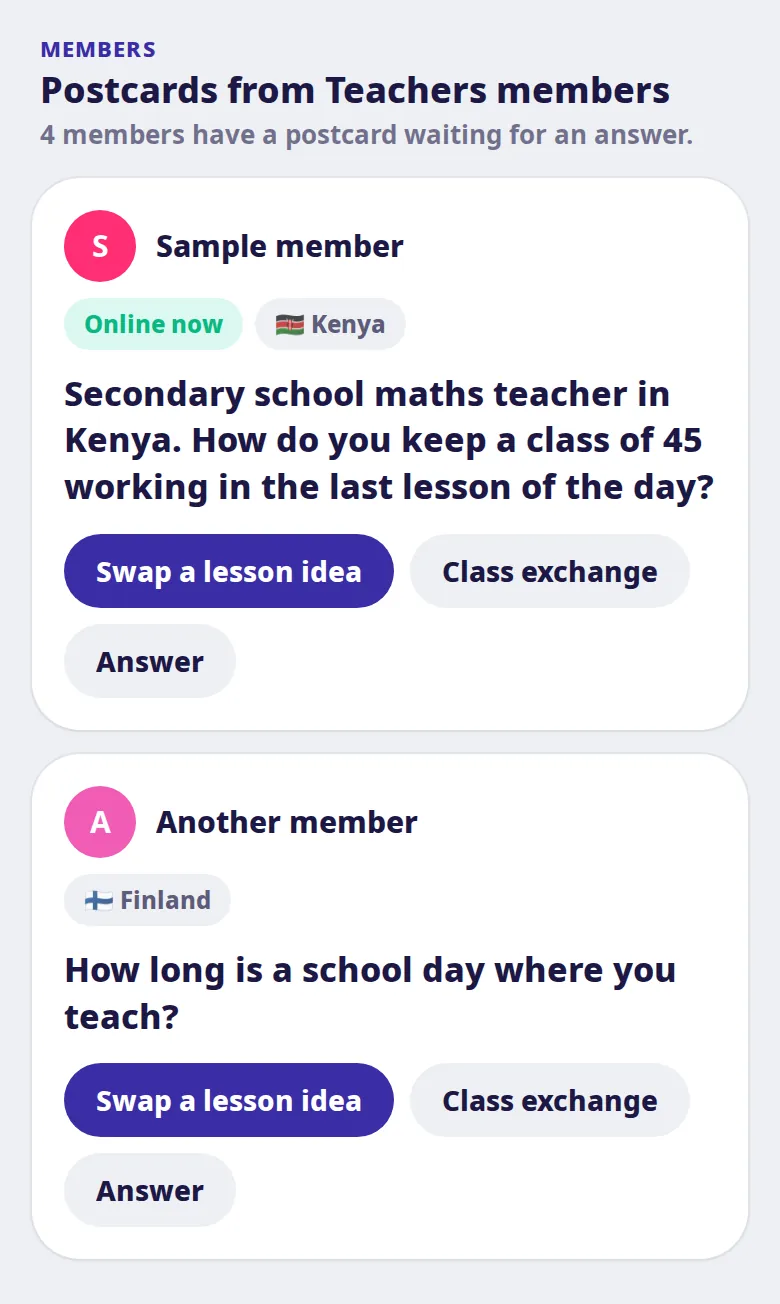 Example screen with sample members, not real people.
A few honest details:
- It's for teachers only. Olu is adults 18+ and teacher to teacher. Students don't join or chat there. If two teachers decide to link their classes later, do it through a school-approved platform and your school's rules.
- No student details, ever. No names, photos or work.
- It's text only. No voice or video.
- Every message is translated both ways, with the original visible, so you can swap ideas with a teacher who doesn't share your language.
- It's a small community. At quiet hours, nobody may answer straight away.
- Report and block are in every chat, and contact details are stopped before delivery.
If a lesson swap turns into a regular conversation, international pen pals for adults has ideas for keeping it going. If you're not sure how to open, conversation starters for online chat helps, and random text chat safety tips covers the basics of talking to people you meet online.
Picking your communities
You don't need all of them. Most teachers who get real value use two:
- One for quick help and company, like r/Teachers, a subject subreddit or a Facebook group.
- One for depth, like a classic forum, edWeb, or a regular conversation with a teacher abroad.
Try them for a month. Keep the one you open without thinking, and drop the one that leaves you more tired than you started.
Questions people ask
+What is the best online forum for teachers?
It depends on what you need. r/Teachers on Reddit is the busiest place for venting and quick advice. A to Z Teacher Stuff and ProTeacher are long-running forums organised by grade and topic. edWeb suits professional learning with webinars. In Europe, eTwinning connects teachers across countries for projects.
+Where do teachers talk online?
On Reddit (r/Teachers and subject or country subreddits), in classic forums like A to Z Teacher Stuff and ProTeacher, in private Facebook groups such as We Are Teachers HELPLINE, in professional networks like edWeb, TeachersConnect and Google Educator Groups, and in subject association groups.
+Are online teacher forums anonymous?
Some let you use a username, like Reddit and most classic forums. Facebook groups and professional networks usually show your real name. Either way, assume a post can be traced back to you, and never share anything that could identify a student, a colleague or your school.
+How can I talk to teachers in other countries?
In Europe, eTwinning lets school staff find partners for projects and join online groups. Teacher subreddits and international Facebook groups also have members from many countries. On Olu's Teachers planet, adult teachers swap lesson ideas one to one, with every message translated.
+Can I post about my students in a teacher forum?
Only in general terms, and only within your school's rules. Never post names, photos, work samples, or details that could identify a child, a family or your school. Ask about the situation, not the person: 'a Year 9 student who refuses to start work' rather than anything identifying.
Keep reading
Boarding pass · free
Tap, fly to a random country, and chat with someone who lives there.
Text first, translated both ways, no video, no coins to meet people. Works in your browser.
Take off on OluNew here? Read Ablo App: The Complete Story of the Chat App That Let You Fly Anywhere (2019–2022), the full history in one place.