 Olu
Parenting in Different Countries: Leave, School, Sleep and Independence Compared
Parenting in different countries compared with real data: parental leave, school starting ages, how far kids go alone, bedtimes, grandparents and styles.
Updated 19 November 2026 · 10 min read
On this page
- Parenting around the world at a glance
- Parental leave in different countries
- When children start school
- How much independence children get
- Bedtimes and sleep around the world
- Grandparents and the wider family
- Parenting styles in different cultures
- Comparing notes with parents in other countries
- Questions worth asking a parent abroad
Ask parents in Stockholm, Tokyo, Texas and London when their child started school, how long they stayed home after the birth and what time bedtime is, and you'll get four different answers. Some of that is choice. A lot is shaped by laws and school systems.
This guide compares parenting in different countries using things you can check: leave rules, school starting ages, how far children go alone, toddler bedtimes, grandparents and parenting styles. Practices vary within every country, so treat national figures as a starting point, not a description of any family.
The short answer: parenting differs most where laws and systems set the rules. Paid leave ranges from none at the national level in the US to well over a year in Estonia or Sweden. Compulsory school starts anywhere from 3 (France) to 7 (Estonia). In a 16-country study, Finnish children had the most freedom to get around alone. Toddler bedtimes in one survey ran from 19:27 in New Zealand to 22:17 in Hong Kong. No single parenting style is "best" everywhere, though warmth looks good in every culture studied.
Compare notes with a parent in another country
Parenting around the world at a glance
Five countries side by side. Sources are linked in the sections below, and rules change, so check before you rely on a detail.
| Country | Leave after a birth (headline rule) | Compulsory school starts | One thing that stands out |
|---|---|---|---|
| Sweden | 480 days of parental benefit per child, 90 reserved for each parent | 6 | One of 4 countries in a 16-country study where children of any age were allowed out after dark |
| Japan | About 30 weeks of paid leave earmarked for fathers (OECD data, 2018, via Pew) | 6 | A walking-to-school practice in place since 1953 |
| United Kingdom | Up to 52 weeks of maternity leave, 39 weeks of statutory pay | After the 5th birthday in England (most start reception at 4) | Placed 7th of 16 countries for children's independent mobility (England) |
| United States | Up to 12 weeks unpaid under federal law, for eligible workers | 5 to 8, set by each state | Only country of 41 in a 2019 Pew analysis with no national paid leave |
| Estonia | More than a year and a half of paid leave, the most of 41 countries (Pew, 2019) | 7 | With Croatia, the latest compulsory school start in Europe |
Parental leave in different countries
Leave rules shape the first year: who stays home, for how long, and whether the family can afford it.
Sweden. The Swedish Social Insurance Agency sets out 480 days of parental benefit per child. With two parents, each has 90 days that can't be handed to the other. Both can be home on the same day for up to 60 "double days" in the child's first 15 months.
United Kingdom. Statutory Maternity Leave is 52 weeks, with at least 2 weeks compulsory after the birth. Statutory Maternity Pay runs for 39 weeks: 90% of average weekly earnings for 6 weeks, then £194.32 a week or 90% of earnings, whichever is lower.
United States. The federal Family and Medical Leave Act gives eligible employees up to 12 workweeks of unpaid, job-protected leave, including for a birth. The Department of Labor notes state law may give more. A 2019 Pew Research Center analysis of OECD data found the US was the only one of 41 countries with no mandated paid leave for new parents.
Estonia and the long-leave countries. In the same analysis Estonia offered the most, more than a year and a half of paid leave. Bulgaria, Hungary, Japan, Lithuania, Austria, Slovakia, Latvia, Norway and Slovenia also offered more than a year.
Japan: rules versus practice. Pew noted Japan earmarked about 30 weeks of paid leave for fathers. Few used it. Government survey figures reported by Nippon.com show 30.1% of eligible fathers took childcare leave in fiscal 2023, and 86.1% of them took under 3 months. By fiscal 2025 the rate reached 50.9% for men, against 88.3% for women.
What the law allows and what parents actually take can be very different. Ask a parent abroad "how long did you take, and did your partner take any?"
When children start school
In Europe, the Eurydice network's Compulsory education in Europe 2023/2024 gives the picture:
- 6 is the most common age to start full-time compulsory education.
- France and Hungary start earliest, at 3. France also has the longest compulsory period, 15 years, from 3 to 18.
- Estonia and Croatia start latest. Children there are not obliged to start before 7.
- Some countries start with a pre-primary year, so "compulsory" doesn't always mean a classroom with desks. Greece, Luxembourg and Switzerland (in most cantons) start at 4, and Belgium, the Netherlands and several others at 5.
Outside that table:
| Country | Starting age | Source |
|---|---|---|
| England | Most children start reception full-time in the September after they turn 4. Compulsory school age comes on the first of 31 December, 31 March or 31 August after the fifth birthday. | GOV.UK |
| Japan | All children who have reached 6 must attend elementary school for six years. The school year starts on 1 April, per NIC-Japan. | MEXT, Japan's education ministry |
| United States | Set by each state. In a 2017 federal table, 10 states and Washington, D.C. required attendance from 5, 25 states from 6, 13 from 7 and 2 (Pennsylvania and Washington) from 8. | NCES |
So a 5-year-old in England may already be in their second school year, while a 6-year-old in Estonia may not have started at all.
How much independence children get
The best cross-country data comes from a Policy Studies Institute study funded by the Nuffield Foundation, published in 2015. It surveyed more than 18,000 children aged 7 to 15 in 16 countries between 2010 and 2012:
- Finland gave children the most freedom on almost every measure. A majority of 8-year-olds there were allowed to cross main roads, travel home from school and go out after dark alone.
- Going out after dark was the most restricted freedom. Only in Finland, Sweden, Japan and Denmark were children of any age allowed out after dark.
- England came 7th of the 16 countries, behind Finland and Germany.
- Fear of traffic was the biggest factor in parents' decisions.
Japan is a well-known example. A 2012 paper in the American Journal of Public Health describes Japan's walking-to-school practice, in place since 1953: most urban schools are within walking range of home, and parents, school staff and local volunteers help supervise. CBS News reported in 2015 that Japanese children are expected to commute alone by about age 6, some on the subway.
Because traffic was the main worry, the study's recommendations focus on roads, such as cutting car dependency and road casualties, not on blaming parents. A child's freedom depends a lot on the street outside the front door.
Bedtimes and sleep around the world
In Cross-cultural differences in infant and toddler sleep (Mindell and colleagues, Sleep Medicine, 2010), parents of 29,287 children aged 0 to 3 in 17 countries and regions across Asia-Pacific, North America and the UK answered an online sleep questionnaire. Results included:
| Measure | Lowest | Highest |
|---|---|---|
| Average bedtime | 19:27 (New Zealand) | 22:17 (Hong Kong) |
| Total sleep in 24 hours | 11.6 hours (Japan) | 13.3 hours (New Zealand) |
| Bed-sharing with parents | 5.8% (New Zealand) | 83.2% (Vietnam) |
| Parents who felt their child had a sleep problem | 11% (Thailand) | 76% (China) |
Daytime naps differed much less. Two cautions: parents were recruited online, so they may not represent every family, and large parts of the world were not included. Notice too that the share of parents who saw a "sleep problem" varied far more than the sleep itself. What counts as normal is partly cultural. For advice on your own child's sleep, or on safe sleeping arrangements, talk to your doctor, nurse or health visitor.
Grandparents and the wider family
A 2023 study in the European Journal of Ageing, using the Survey of Health, Ageing and Retirement in Europe across 26 countries, found the share of grandparents who provide any childcare ranges from about 24% to 60% by country. Southern Europeans were less likely to provide care, but those who did tended to provide more of it. Central and southeastern European countries looked similar to Mediterranean ones. Grandmothers provided care more often than grandfathers.
Sweden shows how law can make room for this: its parental benefit rules let parents transfer up to 45 days to another carer, such as a grandparent.
"It takes a village" is real for many families, but in every country some have grandparents next door and others have none nearby.
Parenting styles in different cultures
Most articles on this turn into stereotypes. The research is more careful.
A 42-country survey. The University of Zurich's World Parenting Survey asked around 48,000 parents in 42 countries about their style, grouped as authoritarian (strict, using punishment), authoritative (explaining reasons and setting reasonable limits) and permissive (lenient). Permissive parenting was most common in the Netherlands and Finland. Authoritative parenting was widespread in Europe and North and South America.
A nine-country study that follows the same families. Since 2008, researchers led by Jennifer Lansford have interviewed children and parents every year in China, Colombia, Italy, Jordan, Kenya, the Philippines, Sweden, Thailand and the United States. Their findings: parental warmth looks positive across cultures, while control varies much more between cultures. Both warmth and control tend to fall as children move into their teens.
A gap in the research itself. SBS reported that regions holding about 85% of the world's population contribute less than 3% of the participants in developmental psychology research. Much of the parenting advice you read was tested on a narrow slice of the world's families.
Countries differ on average, families within each country differ a lot, and warmth seems to matter everywhere.
Comparing notes with parents in other countries
Statistics tell you what is common. A parent who lives there tells you what it feels like.
Olu is a free text chat site for adults 18+ to meet people in other countries, in your browser. Its Parents planet says it plainly: raising kids looks different everywhere, so compare notes on bedtimes, schools, food, screen time and grandparents around the world. Its ritual is called Awake at 3am: find a parent who is awake right now, say what time it is where you are and who is awake with you. Late nights and early mornings look the same in every country. Buttons let you Wave, Ask a parent or Answer someone else's question.
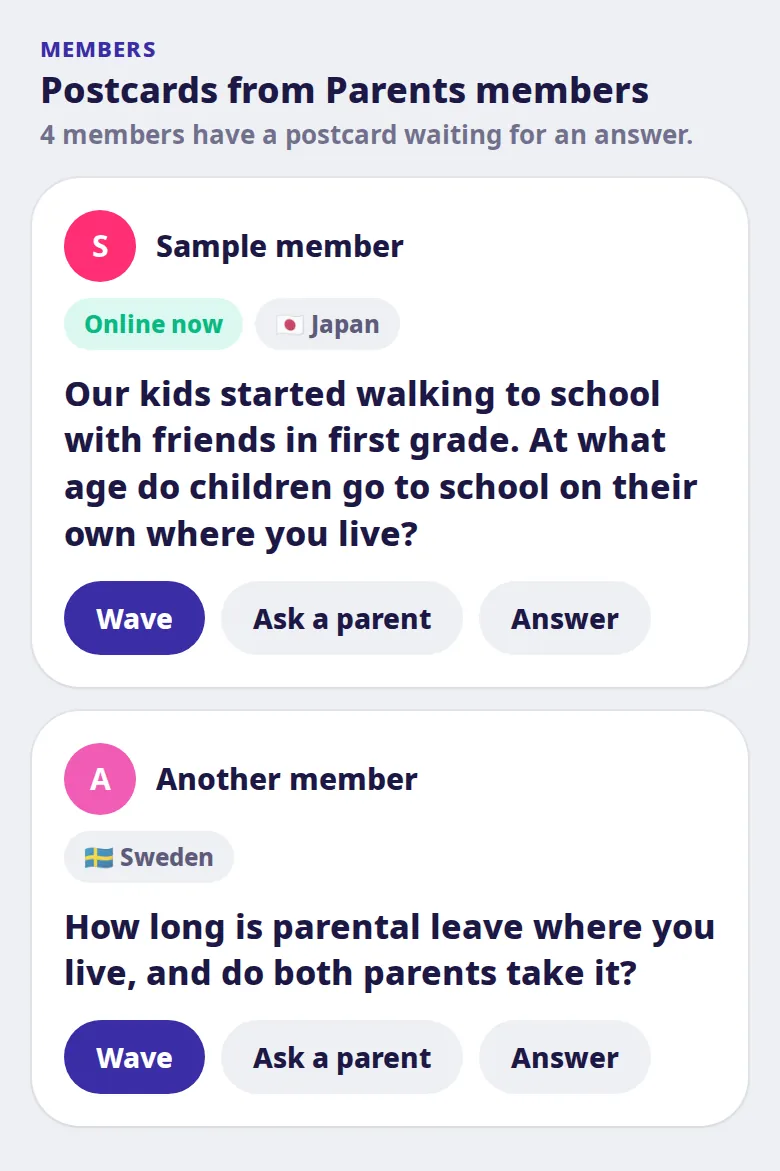 Example screen with sample members, not real people.
A few honest details:
- Adults only. Birth year is asked at join and anyone under 18 is refused. There's no ID check.
- Never share your children's names, photos or schools. The planet says this plainly, and it's a good rule everywhere online.
- No medical advice. Compare routines and experiences, and take health questions to a professional.
- Every message is translated both ways, with the original visible, so a parent in Japan and a parent in Sweden can each write in their own language.
- It's text only. No voice, no video, and contact details are stopped before delivery.
- The community is small. At quiet hours nobody may answer right away. Report and block are in every chat, and there are no ads and no paid plan.
If you're also looking for parent friends closer to home, how to make mom friends covers playgrounds, parent groups and meeting safely.
Questions worth asking a parent abroad
- How long did you and your partner stay home after the birth, and was it paid?
- At what age did your child start school, and how long is the school day?
- At what age do children walk to school or take the bus alone where you live?
- What time is bedtime, and does anyone think that's early or late?
- How much do grandparents help, and how close do they live?
Keep it about routines and customs, not about anyone's individual child. For more on talking across languages, see chatting with people from other countries with translation and how to make friends from other countries online.
Questions people ask
+Which country has the best parental leave?
It depends on what you value: length, pay or time for both parents. In a 2019 Pew Research Center analysis of OECD data, Estonia offered the most paid leave of 41 countries, more than a year and a half. Sweden gives 480 days of parental benefit per child, with 90 days reserved for each parent. Check the official agency of the country you care about, because rules change.
+Does the United States have paid parental leave?
Not at the national level. The federal Family and Medical Leave Act gives eligible workers up to 12 weeks of unpaid, job-protected leave for the birth of a child. Pew's 2019 analysis found the US was the only one of 41 countries that did not mandate any paid leave for new parents. State law may give more.
+At what age do children start school around the world?
In Europe the most common age to start full-time compulsory education is 6. Children in France and Hungary must start at 3, while in Estonia and Croatia they are not obliged to start before 7. In Japan elementary school starts at 6. In England most children start reception in the September after they turn 4, though compulsory school age comes after the fifth birthday.
+In which country do children have the most independence?
In a 16-country study of over 18,000 children aged 7 to 15, published in 2015 by the Policy Studies Institute, Finland gave children the most freedom on almost every measure. A majority of 8-year-olds there were allowed to travel home from school alone. Fear of traffic was the biggest reason parents everywhere held children back.
+Is there one best parenting style?
Researchers don't agree on a single best way for every culture. A long-running study in nine countries found parental warmth looked positive across cultures, while rules and control varied much more from place to place. Practices also vary a lot within every country, so a national average never describes a single family.
Keep reading
Boarding pass · free
Tap, fly to a random country, and chat with someone who lives there.
Text first, translated both ways, no video, no coins to meet people. Works in your browser.
Take off on OluNew here? Read Ablo App: The Complete Story of the Chat App That Let You Fly Anywhere (2019–2022), the full history in one place.