 Olu
38 Photo Walk Ideas: Themes, Tips and How to Plan a Photowalk
38 photo walk ideas and themes: colour, shadows, textures, doors, signs, reflections, one-lens and golden hour walks, plus how to plan a photowalk with respect.
Updated 19 November 2026 · 10 min read
On this page
A photo walk is the simplest photography plan there is: go outside, walk slowly, and look. The trouble is that "just walk and shoot" often ends with fifty photos of nothing much. A theme fixes that. When you are only looking for shadows, or doors, or the colour yellow, the street you know by heart suddenly fills up with pictures.
Below are 38 photo walk ideas, grouped by colour, light, texture, city details, limits, nature and walks to do with a friend in another country. Then: how to plan a walk, how to treat the people and places you photograph, and how to stay safe.
The short answer: pick one theme per walk and stick to it. Good starters are one colour, shadows, reflections, doors, signs and golden hour. Plan one to two hours, go early morning or late afternoon for softer light, carry one lens or just your phone, and walk slower than feels normal. Never photograph a stranger's face without asking, and respect private property and local law.
Ask a photographer where the best light is in their city
What is a photo walk?
A photo walk is a walk where taking photos is the whole point. You can go alone, with a friend, or with a group that meets at one spot and splits up along the same route. Group walks usually end over coffee, comparing how differently everyone saw the same few streets.
The WordPress Photo Directory's guide to organising a photo walk suggests about one to two hours, ideally early morning or late afternoon, with a backup date if the weather turns. There is also a yearly global version: the Worldwide Photo Walk, led by Scott Kelby, is held on the first Saturday of October, with local walk leaders in cities around the world.
A theme is optional, but it is what turns a stroll into practice. Digital Photography School's piece on themed walks recommends one theme rather than several, because a single idea builds a more detailed series.
38 photo walk ideas and themes
Use one per walk. Each works with a phone or any camera.
Colour walks
- One colour. Only things that are yellow, or red, or blue. You'll be surprised how much there is.
- Rainbow in order. Red first, then orange, yellow, green, blue and purple. You can't shoot the next colour until you find the last one.
- Colour pairs. Two colours side by side: blue against orange, red against green, white on black.
- Black and white. Set your camera or phone to monochrome before you leave. Without colour you start to see shape, contrast and texture.
- Neon and shop lights. Go out after dark for glowing signs, lit windows and colour reflected on wet streets.
Light and shadow walks
- Golden hour. The period shortly after sunrise or before sunset, when light is warmer and softer. Wikipedia's golden hour article notes it has no fixed length: it changes with season and latitude, and near the equator it lasts less than an hour.
- Blue hour. Just before sunrise or just after sunset, when the sun is below the horizon and the sky turns blue. Street lights coming on against a deep blue sky is the classic shot. Check the exact times for your city and date.
- Shadows only. Photograph the shadow, not the thing that casts it: railings, bicycles, leaves, your own outline.
- Silhouettes. Put the light behind your subject: a tree against the sky, a bridge against bright water.
- Light through things. Sun through leaves, blinds, fences or a glass bottle.
- Midday hard light. The hour photographers are told to avoid. Use it for strong contrast and black shadows.
Texture, pattern and shape walks
12. Texture. Wood, stone, rust, peeling paint, fabric. Fill the frame so the texture is the whole picture. 13. Repetition. Rows of windows, tiles, fence posts, chairs stacked outside a cafe. 14. One shape. Only circles one day, only triangles the next. 15. Lines. Stairs, rails, kerbs and road markings that lead the eye. If you shoot road lines, watch the traffic. 16. Looking down. Point the camera at the ground for the whole walk: drain covers, paving, fallen leaves, painted arrows. 17. Looking up. Ceilings, balconies, treetops, wires against the sky.
City detail walks
- Doors. Old doors, painted doors, door knockers, numbers. A series of twenty doors looks great in a grid.
- Windows from the street. Shutters, flower boxes, frames. Keep to the outside: never shoot into someone's home.
- Signs and letters. Find every letter of the alphabet in signs, or spell your name.
- Reflections. Puddles, shop windows, car doors, still water. Hunting for them makes any city walk feel like a game.
- Old next to new. A shiny tower behind an old roof, a modern sign on an old wall.
- Desire paths. The shortcuts people wear into grass where there was no path. They tell you how a place is really used.
- Street furniture. Benches, lamp posts, post boxes, bins, bus stops. Every city's are a little different.
- Bridges and stairs. Great for lines, layers and a sense of height.
- Market details. Fruit stacked in pyramids, hand-written price tags, baskets. Ask the stallholder before close-ups of their stall.
Limit walks
- One lens, one focal length. No zoom, no swapping. Move your feet instead.
- Phone only, no zoom. Walk closer to everything.
- Only 24 or 36 frames. Shoot as if you had one roll of film. You stop pressing the button out of habit.
- One street, one hour. Don't leave the block. You'll notice things you've walked past a hundred times.
- Ten from one spot. Stand in one place and take ten different photos without moving your feet.
- Close-up walk. Dewdrops, insects, flower centres, the grain of a bench. Get as close as your camera allows.
Nature and season walks
- Same route, four seasons. Walk the same loop once a season and shoot the same five spots.
- Trees. Bark up close, branches against the sky, one tree from six angles.
Walks to do with a friend abroad
- Twin walk. You and a photographer in another country pick the same theme and walk at the same local time, then compare.
- Best light swap. Each of you says when the light is best where you live, shoots then, and explains why.
- The route I walk every day. Shoot your normal daily walk and describe it to your friend; they do the same.
- Guide's choice. Your friend picks your theme; you pick theirs. You'll end up shooting things you would never choose.
Want a prompt for every day of the month instead of every walk? See our photo challenge ideas, including a 30-day list.
How to plan a photo walk
- Pick a route that's easy to walk. Good pavements, lighting, and a mix of streets, a park or a waterfront. Free to enter, open to photography.
- Choose the time for the light. Early morning means softer light and fewer crowds. Late afternoon runs into golden hour. Look up sunrise and sunset for your date.
- Choose one theme. Write it down. If it turns out to be impossible on that route, switch to another rather than giving up.
- Pack light. One camera or phone, a spare battery and memory card, water, sunscreen or a rain layer. Shotkit's photo walk tips make the same point: bring only what you need, wear comfortable shoes, and don't rush.
- For a group, set a meeting point and a regroup point. Halfway through, everyone meets at one spot to swap notes. Say when and where the walk ends.
- Walk slower than normal. Stop at corners. Turn around. Look up and down.
- Review the same day. Pick your best five and ask what made them work. Put the series side by side: themes look strongest as a set.
Tips on the walk
- Shoot first, delete later. But think before every frame: what is the subject?
- Try one new technique per walk, such as a slower shutter on moving water or a lower angle.
- Dress plainly and stay relaxed. A calm photographer draws less attention.
- Leave space for luck. The best photo of a walk is often off-theme. Take it anyway.
Photographing people and places with respect
This is the part that matters most, especially when you are a visitor.
No photos of strangers' faces without asking. If a person would be the main subject, ask first. A smile and a raised camera is often enough, but if someone hesitates or looks uncomfortable, lower the camera. Digital Photography School's advice on asking permission adds to research local customs before you travel, and to get a parent's permission before photographing a child. Many themes above, from doors to shadows, need no people at all.
Keep private details out. The WordPress guide asks walkers to avoid identifiable people without written consent, plus licence plates and home addresses. It's a good rule even if you never publish.
Laws differ by country. What is allowed in one place can be an offence in another. As one example, the Law Handbook of South Australia says there are no general restrictions on taking photos in or from a public place in that state, and nothing stops you photographing private property from a public place outside it. It also says a venue can make "no photography" a condition of entry, and it lists limits such as indecent images and photos of children. Other countries and states have their own rules, so check the law where you are, and look for signs at stations, museums, shopping centres and government buildings.
Private property is the owner's call. If you are on someone's land or inside a building and they ask you to stop, stop. Shoot from the public side.
Be a good guest. At religious sites, markets and neighbourhoods where people live, follow posted rules, keep your voice down and don't block doorways.
Staying safe on a photo walk
- Walk with someone, at least the first time on a new route, or tell a friend where you're going and when you'll be back.
- Stay aware. It's easy to drift into traffic when looking through a viewfinder. Step off the road before you shoot.
- Don't carry much cash or flash expensive gear in busy areas. One small bag is enough.
- Plan for the weather and bring water.
- After dark, stick to lit, busy streets, especially for blue hour and neon walks.
- Meeting a photographer from online? Meet in a busy public place in daylight, tell a friend where you'll be, chat in text for a while first, and never send money to anyone you met online.
Find a photographer abroad to swap photo walk ideas
Olu is a free text chat site for meeting people in other countries. It runs in your browser, has no ads and no paid plan, and is for adults 18+. Its Photographers planet is for people who see the world through a lens, and its ritual is Best light: you ask a photographer where and when they shoot in their city, and tell them about yours. That's a natural way to find a partner for the twin walk or best light swap ideas above.
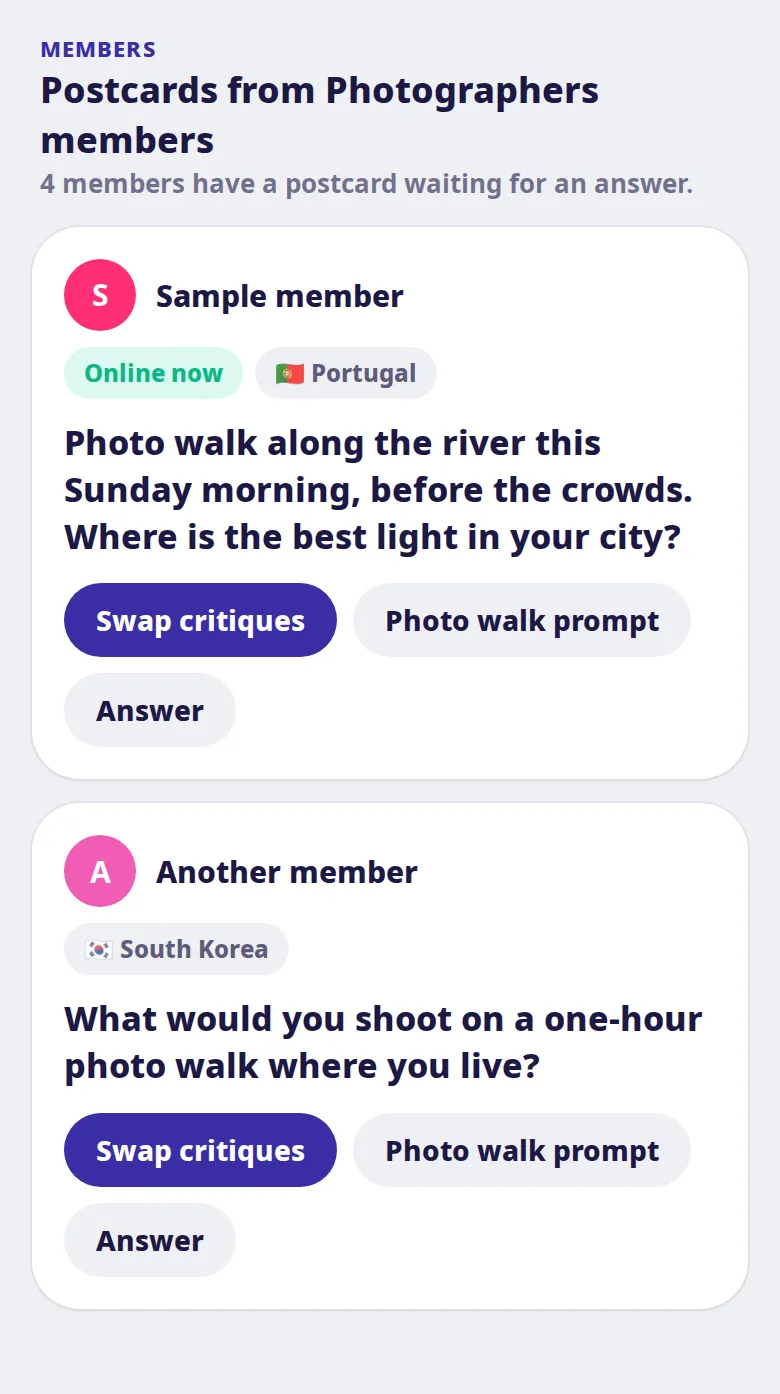 Example screen with sample members, not real people.
The planet's rules: say what you shoot with, share only photos you took, and no photos of strangers' faces. Some honest limits:
- It's text chat only. No voice, no video. It suits planning walks, trading themes, and talking about light, places and settings. To get notes on the photos themselves, see these online photography communities.
- Every message is translated both ways, with the original visible, so you can plan a twin walk with someone who doesn't share your language.
- It's a small community, so at quiet hours you may wait for an answer.
- Report and block are in every chat, and contact details are stopped before delivery.
The short version
Pick one theme, walk slowly for an hour or two, and go when the light is soft. Start with one colour, shadows, reflections or doors, then try a limit walk like one lens or 36 frames. Ask before you photograph anyone, keep strangers' faces out of your shots, and respect private property and local law. And if you want fresh eyes on your own streets, plan a twin walk with a photographer in another country.
Questions people ask
+What is a photo walk?
A walk where the point is to take photos, alone or in a group. You pick a route, often a theme, and spend an hour or two looking slowly. Group walks usually end with everyone comparing what they saw on the same streets.
+What are good photo walk themes for beginners?
Themes with one clear rule: one colour, only shadows, only reflections, doors, signs and letters, or looking down at the ground. They work with any camera or phone and give you something to look for on every street.
+How long should a photo walk be?
One to two hours is the usual length. The WordPress Photo Directory's guide to organising a walk suggests about that, in early morning or late afternoon for better light. Short enough to stay curious, long enough to slow down.
+Can I photograph people on a photo walk?
Ask first. Don't photograph strangers' faces without their clear OK, take extra care with children (ask a parent), and stop if anyone looks uncomfortable. Many of the themes here need no people at all. Laws differ by country, so check local rules.
+What should I bring on a photo walk?
Less than you think: one camera or a phone, a charged spare battery, comfortable shoes, water and clothes for the weather. One lens is plenty. Light gear keeps you walking and looking instead of changing settings.
Keep reading
Boarding pass · free
Tap, fly to a random country, and chat with someone who lives there.
Text first, translated both ways, no video, no coins to meet people. Works in your browser.
Take off on OluNew here? Read Ablo App: The Complete Story of the Chat App That Let You Fly Anywhere (2019–2022), the full history in one place.