 Olu
Recipe Exchange: How to Host a Recipe Swap (Plus Templates)
What a recipe exchange is, from the chain-letter swap to office and family cookbook swaps, how to host one with invite and card templates, and online options.
Updated 19 November 2026 · 8 min read
On this page
A recipe exchange is the simplest way to get out of a cooking rut: you give one recipe you love and get several back from people you know, or people you've never met. It's been done by post, by email, at office parties and around family tables for decades.
This guide covers every kind of recipe exchange: the chain-letter swap, recipe and cookie swap parties, family cookbook exchanges and online swaps, with an invite you can copy, a recipe card template, theme ideas and the unwritten rules.
The short answer: a recipe exchange is a planned swap of recipes. To host one, pick a theme, invite 6 to 12 people at least two weeks ahead, ask each to bring one dish (or a tasting plate) plus printed or shared copies of the recipe, and collect everything into one shared file afterwards. Online, a shared document, a group chat or a swap with a cook abroad works just as well.
Swap a recipe with a home cook abroad
The main kinds of recipe exchange
| Type | How it works | Best for |
|---|---|---|
| Chain letter or email | Send one recipe to the name at the top of a list, forward to a few friends | Low effort, a few surprise recipes |
| Recipe swap party | Everyone brings a dish and copies of its recipe | Friends, neighbours, clubs |
| Cookie or holiday swap | Everyone bakes a batch, guests leave with a mix | December, office parties |
| Family cookbook exchange | Relatives send in recipes and stories, one person compiles them | Reunions, weddings, keeping recipes alive |
| Online or long-distance swap | Shared doc, group chat, or a chat with a cook in another country | Friends far apart, trying new cuisines |
The chain-letter recipe exchange
This is the version most people mean when they search the phrase. It arrives by email or social media and goes like this:
- Send one favourite recipe to the person in position 1 on the list. Only to them.
- Remove that name, move the sender up, and add your own name at the bottom.
- Forward the message to a set number of friends.
- In theory, dozens of recipes come back to you.
It's older than email. A paper "recipe tree" from 1986, held in an online chain letter archive, asked you to post one recipe to the first name, make six copies and send them to six friends, and promised about 36 recipes back. The email version came back in a big way during the 2020 lockdowns. The Takeout spoke to people who joined in: several got only a few recipes back, not the promised 36, and some felt guilty for letting the email sit.
How to do it kindly:
- Send it only to people you think will enjoy it, and say "no pressure" in your own words.
- Put addresses in BCC so you're not sharing everyone's email with strangers.
- Send something quick with easy-to-find ingredients. That's what people actually cook.
- Don't send the chain to anyone who has asked not to get them. A personal "send me your best soup recipe?" often works better anyway.
How to host a recipe swap party
- Pick a theme. It makes choosing easier and the collection more useful (see ideas below).
- Invite 6 to 12 people. Fewer and there's not much variety; many more and it's a lot of copies. For cookie swaps, Homes & Gardens suggests about 8 to 10 guests, each bringing 12 to 24 cookies plus a few for tasting.
- Set clear rules in the invite: what to bring, how many recipe copies, and a request to list allergens.
- Ask for a tasting portion, not a full meal, so the table has many small things to try.
- Label every dish with its name, the cook and its main allergens.
- Give each cook two minutes to say where the recipe comes from. This is the best part.
- Collect everything into one shared file or a stapled booklet and send it to everyone afterwards.
Invite template you can copy
You're invited to a recipe swap! Saturday 5 December, 4 to 6pm, at my place. Theme: soups and stews from home. Bring: a small pot or tasting plate of your dish, plus 10 printed copies of the recipe (or email it to me by Thursday). Please list any allergens (nuts, gluten, dairy, egg, shellfish) on your card. Everyone leaves with a full set of recipes. Reply by 28 November so I know how many copies to ask for.
Recipe card template
Dish: ___ From: your name, and who taught you (grandmother, a cookbook, a friend) Serves: ___ Prep: ___ min Cook: ___ min Ingredients: with amounts, in the order you use them Method: numbered steps, one action per step Allergens: ___ Why I love it: one or two lines, the story behind it Swap tip: what to use if you can't find an ingredient
If a recipe comes from a cookbook or a blog, credit it on the card. It's polite, and it helps people find the original.
Recipe exchange theme ideas
- Soups and stews from where you grew up
- Five ingredients or fewer
- 30-minute weeknight dinners
- One pot, one tray or one pan
- Recipes from a grandparent
- Cheap and filling: meals for under a set budget
- Bread, flatbread and dumplings
- Holiday cookies or festival sweets
- Lunchbox and make-ahead meals
- Vegetarian or vegan dishes for meat eaters
- What you cook when you're sick
- A dish from a country you've never been to
Office and holiday recipe swaps
Workplace swaps work best when they're easy. Hold it at lunch in a shared room, ask for tasting portions rather than full trays, and keep it optional. Allergen labels matter more at work, where people don't know each other's needs. A shared folder or an email to the team with every recipe saves printing.
For December cookie swaps, give everyone the numbers in advance (guests times cookies each), and ask people to bring a container to take their mix home.
Family cookbook exchanges
A family recipe exchange keeps dishes alive after the person who made them is gone. A simple way to start:
- Ask the oldest cooks first, for the dishes everyone associates with them.
- Ask for the story too: where the dish comes from, when it was made, who loved it.
- Cook it together, or film it. Many family cooks measure by eye, so watching beats a written card.
- Pick one editor and one shared folder or document, and set a deadline, such as the next reunion.
- Write every recipe in the same format (the card template above works), then print and bind copies.
Online recipe exchange ideas
- A shared document or folder with one page per recipe, the easiest long-term collection.
- A group chat with a weekly theme: everyone posts one recipe and a photo by Sunday.
- An email swap with friends, without the chain: one round, one theme, one compiled file at the end.
- A cook-along: everyone makes the same recipe in the same week and shares how it went.
- A swap with someone in another country. This is where you get recipes no cookbook in your country has.
Swap a recipe with a home cook abroad
The most interesting recipes come from kitchens far away, told by the person who cooks them. On Olu, a free text chat site for meeting people in other countries, cooks join the Home cooks planet. Its ritual is Same dish, two kitchens: you name tonight's dish and a cook abroad tells you how their kitchen does it. You can also post a Swap a recipe request, which stays open for 48 hours, and a cook in another country answers with one of theirs.
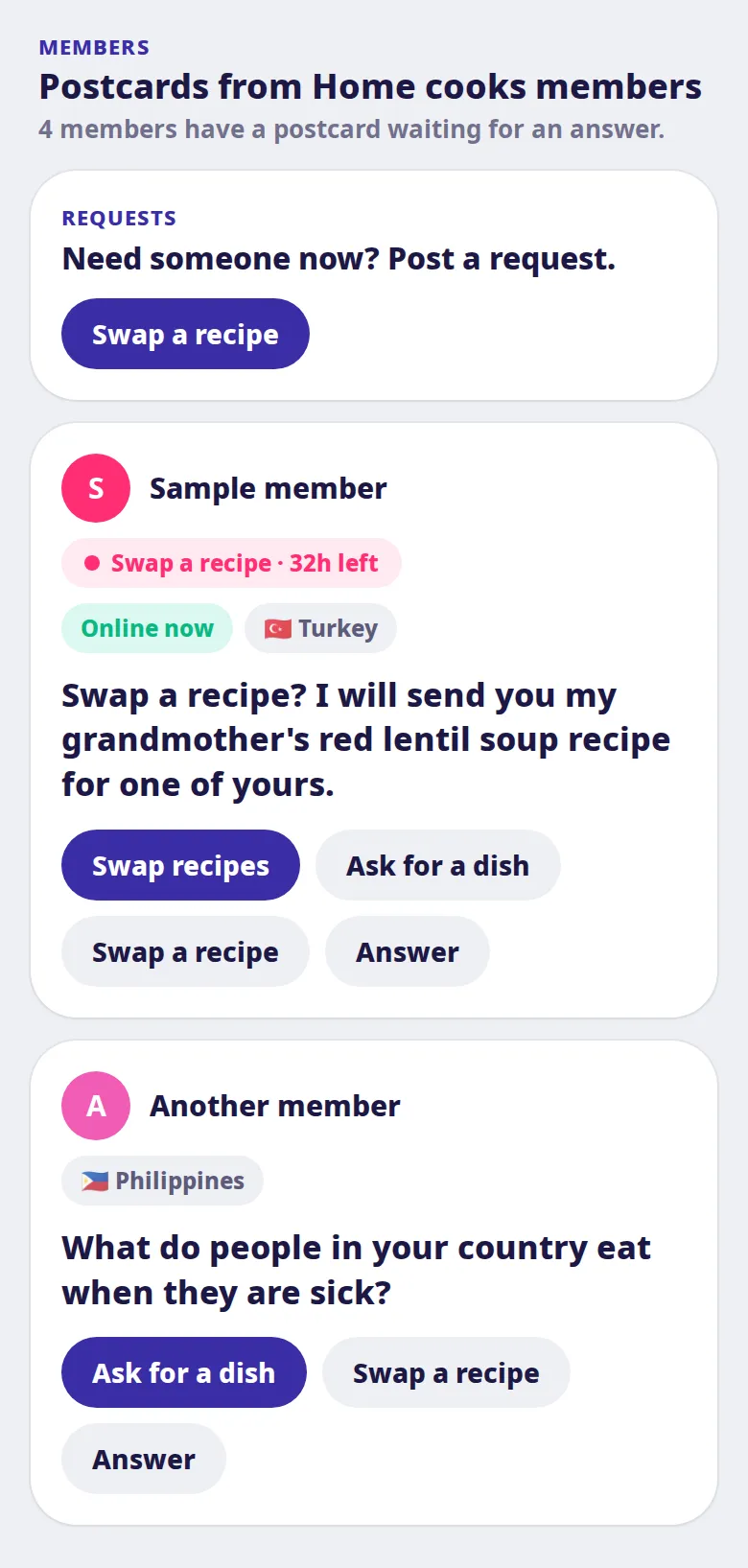 Example screen with sample members, not real people.
Members also leave postcards with a question for cooks abroad, like "What do people in your country eat when they are sick?", which is a good theme for any swap.
Honest limits: it's text only, so no video cook-along, but you can type a recipe step by step. Every message is translated both ways with the original visible, which helps with ingredient names, though do double-check amounts and units (cups, grams, spoons). It's for adults 18+, free with no ads and no paid plan, and the community is small, so at quiet hours you may wait for a reply. Contact details are stopped before delivery, and you can report and block anyone. For more ways to meet people abroad, see how to make friends from other countries online and, if you like swapping things by post, Postcrossing alternatives.
Recipe exchange etiquette
- Share recipes you've actually cooked, and more than once.
- Write it so a stranger could follow it. Amounts, temperatures, pan sizes, and what "done" looks like.
- List allergens, every time.
- Credit the source, whether it's a cookbook, a blog or your aunt.
- Say thank you and report back. "I made your soup, my family loved it" is the best reply a cook can get.
- Ask before sharing a family recipe further. Some families like to keep one or two to themselves.
- When swapping with someone abroad, ask about ingredients they can't find, and suggest swaps for yours. Keep personal details, like your address, out of the chat. For a good first message, see how to start a conversation with a stranger from another country.
The short version
A recipe exchange is a planned swap: by chain email, at a party, at work, in a family cookbook or online. Pick a theme, invite a small group, ask for one recipe each in the same format with allergens and a short story, and compile everything at the end. And for recipes you won't find anywhere near you, swap with a cook in another country.
Questions people ask
+What is a recipe exchange?
Any planned swap of recipes between people. It can be a chain email where you send one recipe and hope to get many back, a party where everyone brings a dish and its recipe card, an office or holiday cookie swap, a family cookbook project, or an online swap with someone in another country.
+How does the recipe exchange chain letter work?
You send one recipe to the person at the top of a short list, then copy the message to a handful of friends with your name added. In theory you get dozens of recipes back. In practice many people break the chain, so expect a few, and only send it to people who will enjoy it.
+What do you say in a recipe exchange invitation?
The date, time and place, the theme, what to bring (one dish or a sample to taste, plus copies of its recipe), how many copies to print, and a request to list allergens. Keep it short and friendly, and give at least two weeks' notice.
+What should be on a recipe exchange card?
The dish name, who it's from, servings, prep and cook time, ingredients with amounts, numbered steps, allergens, and one line on why you love it or where it comes from. The story is often what people remember.
+Can you do a recipe exchange online?
Yes. Use a shared document or folder, a group chat with a theme each week, an email swap, or a recipe swap with someone in another country on a chat site. Ask everyone to write recipes in the same format so the collection is easy to use.
Keep reading
Boarding pass · free
Tap, fly to a random country, and chat with someone who lives there.
Text first, translated both ways, no video, no coins to meet people. Works in your browser.
Take off on OluNew here? Read Ablo App: The Complete Story of the Chat App That Let You Fly Anywhere (2019–2022), the full history in one place.