 Olu
Study Buddy: What It Is, How to Find One and Make It Work
What a study buddy is, why studying with one helps, where to find one at uni, online or in an app, and a simple session plan with timers and check-ins.
Updated 19 November 2026 · 8 min read
On this page
Studying alone is hard for a simple reason: nobody notices when you stop. You open the textbook, check one message, and an hour is gone. A study buddy changes that. Someone else knows what you planned to do, and you'll tell them at the end whether you did it.
This guide covers what a study buddy is, what a good one looks like, where university students and adult learners find one, and how to run sessions that actually get work done.
The short answer: a study buddy is another learner you study with on a fixed schedule, in person or online. Pick someone with similar goals and a similar work ethic, agree on a time and a plan, work in timed blocks (25 or 50 minutes), and check in at the end of each block: "What did you finish? What's next?" You can find one through classmates, your university's study buddy scheme, online study rooms, or apps like Focusmate and StudyStream.
Say what you're studying and find a study buddy now
What is a study buddy?
A study buddy is someone you meet with, in person or online, to learn and revise. Saint Leo University's student blog describes it as someone you meet with in person or virtually to learn and retain material from your classes.
In practice there are two kinds of study buddy session:
- Active sessions. You study the same material together: quiz each other, explain topics, compare answers to practice questions.
- Quiet sessions. You each work on your own thing, side by side. You say what you're doing at the start and check in at the end. This is close to what people call "body doubling".
Your buddy doesn't have to take your course. Victoria University's guide points out that buddies don't need the same course, and that a classmate is often better than a close friend, because friends can be a distraction.
Why study with a buddy
The benefits are practical, not magic:
- Accountability. When someone expects an update, skipping the session costs you something. That small social cost is often enough to start.
- Explaining is learning. If you can't explain a topic out loud to another person, you don't know it yet. Your buddy will find the gap faster than rereading will.
- Better practice questions. Two people guess more exam topics than one. Oxford Learning's tips suggest writing a practice test for your partner and swapping.
- Shared workload. Split the flashcards or summaries: one chapter each, then teach it to the other.
- Less isolation. Long revision periods are lonely. Even a short check-in with another student helps the day feel less heavy.
A study buddy doesn't replace studying. It makes it easier to start and harder to quit.
What makes a good study buddy
| Look for | Why it matters | Warning sign |
|---|---|---|
| Similar goals | You both want the same thing from a session | One wants a top mark, the other wants to pass and chat |
| Similar work ethic | Nobody carries the other | They often skip or arrive unprepared |
| Reliable timing | Sessions only work if they happen | Frequent last-minute cancels |
| Honest feedback | You need to hear "that's not right" | Agrees with everything you say |
| Focus | Sessions stay about the work | Every session turns into a long chat |
| Different strengths | You can teach each other | Neither of you understands the hard parts |
Charles Darwin University asked its students what makes a good study buddy. Their answers included someone who keeps you to your schedule, nudges you back when breaks run long, and tells you to switch off when you're overwhelmed. That last one matters. A good buddy also knows when to stop.
Where to find a study buddy
At university
- Ask a classmate. After a lecture or seminar: "Want to revise for this together on Thursday?" Most people say yes.
- Post in your course forum or group chat. Say the module, the exam date and when you're free.
- Check for a study buddy scheme. Some universities match students for you. Florida Atlantic University, for example, runs one where students request a buddy online and meet in study spaces on campus. Ask your learning centre or library.
- Use the library. Book a group room and invite one or two people from your course.
Online
- Course communities. Online courses and distance-learning programmes often have forums and group chats. Post the same message there.
- Study servers and subreddits. Many Discord servers and Reddit communities exist for studying together. Rules and quality vary, so read the rules first.
- Study rooms and apps. These match you with people working right now, often strangers in other countries. See the table below.
Study buddy apps and online options
| Option | How it works | Free? |
|---|---|---|
| Focusmate | One-to-one video sessions of 25, 50 or 75 minutes with a matched partner. You say your goal, work, and check in at the end | Free plan: 3 sessions a week. Plus: $8/month billed yearly or $12/month |
| StudyStream | Silent video focus rooms where everyone studies on camera; small "Spaces" add voice and chat | Free plan: up to 1 hour a day in focus rooms. Premium: unlimited |
| Flow Club | Hosted group sessions of up to 9 people, 30 minutes to 3 hours, camera encouraged | $40/month or $400/year; 50% off for students |
| FLOWN | Facilitated focus sessions plus a 24/7 drop-in room | 30-day free trial, free plan available, student discount |
| YouTube "study with me" videos | Someone studies on camera, often with a timer. Nobody sees you | Free, but no real partner |
| Olu University students planet | Text "Focus room": say what you're studying, a student abroad joins, you check in when time is up | Free, no ads, no paid plan. Text only |
Prices and limits are from each service's own site in November 2026. They change, so check before you rely on them.
Which one fits? If you need a face on screen to stay honest, Focusmate or StudyStream. If you want a host running the session, Flow Club or FLOWN. If cameras make you tense, a text check-in is lighter.
How to run a study session that works
Most failed study buddy arrangements fail on structure, not on people. Agree on these rules before the first session.
Ground rules
- Fixed start and end time. "Tuesday, 7 to 9 pm" beats "sometime this week".
- One goal each, stated out loud. "Finish questions 1 to 10 of the statistics past paper." Not "do some stats".
- Timer on, phones away. Use a 25-minute block with a 5-minute break (the Pomodoro method), or 50 and 10 for deeper work.
- Chat only in breaks. Social time is fine. It just goes in the break, not the block.
- Same check-in every time. Short and predictable.
- Cancel early. If you can't make it, say so a day ahead, not five minutes after the start.
A simple check-in script
At the start (1 minute each):
- "This block, I'm working on ___."
- "I'll know I'm done when ___."
At the end of each block (1 minute each):
- "Done / partly done / not done."
- "What got in the way?"
- "Next block, I'll ___."
At the end of the day, add one line: "What's one thing I understand now that I didn't this morning?" It sounds small, but saying it out loud is a quick form of revision.
For active revision sessions
- Each person prepares one topic and teaches it in 10 minutes, without reading from notes.
- Swap five practice questions and mark each other's answers.
- Keep a shared list of "things we both got wrong". That list is your next session's plan.
- Keep graded work your own. Check your course rules before sharing answers to assessed work.
An online study buddy in another country
You don't need a buddy in your own city, or even your own time zone. A student who is studying while you are is enough, and sometimes it helps that they're far away: there's no gossip about your course, and nothing to talk about except the work and how it went.
Olu is a free text chat site for meeting people in other countries, in your browser, for adults 18+. Its University students planet has a ritual called Study together: you study beside another student for 25 minutes, say what you're studying, a student in another country answers, and you check in with each other when the time is up. When you're ready to start right now, you open a Focus room, a live request that stays open for an hour.
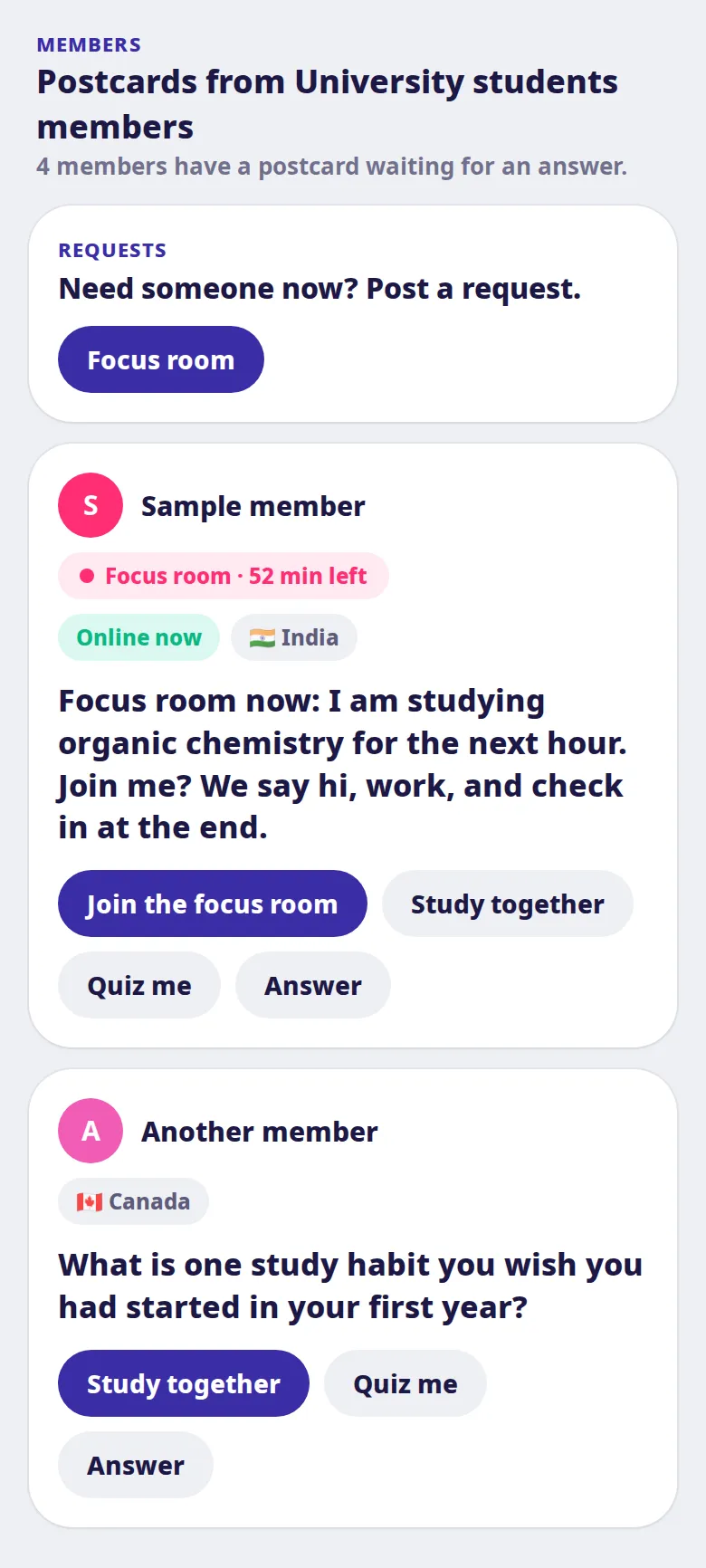 Example screen with sample members, not real people.
A few honest details:
- It's text only. No camera and no voice. You say hi, you work, you check in by message. If you need to be seen to stay focused, a video room is a better fit.
- Every message is translated both ways, with the original visible, so your buddy doesn't need to share your language.
- It's a small community. At quiet hours, nobody may answer your Focus room right away.
- Safety is built in. You can report and block in every chat, and contact details are stopped before delivery. More tips are in random text chat safety tips.
If you're shy about the first message, conversation starters for online chat has easy openers. And if a study buddy turns into a friend, good. Many do. For more on that, see make friends from other countries online.
When a study buddy isn't working
- Sessions keep becoming chats. Move social time to the end, and keep the timer.
- One person always cancels. Talk once, kindly. If nothing changes, find another buddy. Victoria University's guide gives the same advice: try a gentle talk first, then move on if it continues.
- You're at very different levels. It can still work for quiet sessions. For active revision, find someone closer to your level.
- You feel judged. Try a quiet format, a group room, or a text check-in. Shy students often find one-to-one video tiring; apps to make friends for introverts covers lower-pressure options.
Questions people ask
+What is a study buddy?
A study buddy is another learner you study with on a regular schedule, in person or online, to keep each other on track. You might quiz each other and explain topics, or simply work side by side on your own tasks and check in at the end. You don't need to take the same course.
+Is it better to study alone or with a study buddy?
It depends on the task. Reading and first drafts often go better alone. Revision, practice questions, explaining hard ideas and simply getting started tend to go better with a buddy. Many people mix both: a shared session with quiet focus time and a short check-in.
+How do I find a study buddy?
Ask a classmate, post in your course forum or group chat, check whether your university runs a study buddy or peer learning scheme, or join an online study room. Apps like Focusmate and StudyStream match you with strangers who are working at the same time.
+Is there a free study buddy app?
Yes, with limits. Focusmate's free plan includes 3 video sessions a week, and StudyStream's free plan gives up to 1 hour a day in its focus rooms. Olu's University students planet is free with no paid plan, but it's a text check-in, not a video room.
+What should you not do with a study buddy?
Don't let sessions turn into long chats, don't pick someone whose goals are very different from yours, and don't split graded work in a way your course doesn't allow. Agree on a start time, an end time and what each of you will finish.
Keep reading
Boarding pass · free
Tap, fly to a random country, and chat with someone who lives there.
Text first, translated both ways, no video, no coins to meet people. Works in your browser.
Take off on OluNew here? Read Ablo App: The Complete Story of the Chat App That Let You Fly Anywhere (2019–2022), the full history in one place.