 Olu
Writing Buddy: What It Is, Where to Find One and How to Make It Work
What a writing buddy is, how it differs from a critique partner or beta reader, where to find one now NaNoWriMo is gone, and how to run sprints and check-ins.
Updated 19 November 2026 · 8 min read
On this page
- What is a writing buddy?
- Writing buddy vs critique partner vs beta reader
- Why writers use a writing buddy
- What happened to NaNoWriMo
- Where to find a writing buddy
- How to run writing sessions with a buddy
- How to give feedback to a writing buddy
- A writing buddy in another country
- When a writing buddy isn't working
Most writing doesn't stop because of a lack of ideas. It stops because nobody notices. You skip a day, then a week, and the draft goes quiet. A writing buddy is someone who notices: they know your goal, they ask how it went, and you ask them the same.
This guide covers what a writing buddy is, how it differs from a critique partner or a beta reader, where to find one now that NaNoWriMo has closed, and how to run sessions and give feedback that keep you both writing.
The short answer: a writing buddy is another writer you check in with on a fixed schedule to keep each other writing. Agree on a weekly goal (words, pages or hours), check in on the same day each week, and write together in timed sprints if you like. Look in critique communities like Critique Circle and Scribophile, writing-session groups like Shut Up & Write! and Writers' Hour, local library or university writing groups, or swap progress with a writer abroad.
Find a writing buddy abroad and swap progress
What is a writing buddy?
A writing buddy is a fellow writer you pair up with for accountability and support. K.M. Weiland, who has run a writing buddy link-up on the Helping Writers Become Authors blog for years, describes a writing buddy as someone who can offer feedback, accountability and support.
Not every buddy needs to read your work. Author Jessica Brody writes that an accountability partner has one job, holding you to your goal, and doesn't need to read your pages at all. That's useful to know: you can have a buddy who writes poetry while you write a thriller, as long as you both care about showing up.
In practice, writing buddies do some mix of:
- Weekly check-ins: "I said 3,000 words, I wrote 2,200."
- Writing sprints: writing at the same time for 25 or 50 minutes, then reporting.
- Encouragement: someone who understands why chapter 12 is hard.
- Swapping pages: if you both want it, and only if you agree on the format.
Writing buddy vs critique partner vs beta reader
People use these terms loosely. The differences matter, because each one needs a different agreement.
| Role | What they do | When you need one | How often |
|---|---|---|---|
| Writing buddy | Keeps you accountable; checks in, sprints with you | Any time you're drafting or stuck | Weekly or more |
| Critique partner | Reads your pages and gives craft notes, in a swap | While you revise chapters or stories | Regular swaps, often weekly or monthly |
| Beta reader | Reads a finished draft as a reader and says how it felt | After you have a complete, revised draft | Once per draft |
Say which one you're asking for. "Can you check in with me on Sundays?" is a small ask. "Can you read my 90,000-word draft?" is a big one.
Why writers use a writing buddy
- It's harder to skip a goal someone else knows about. A small social cost is often enough to start.
- Goals get more realistic. Saying "50,000 words this month" to a person makes you check whether you can.
- Problems surface sooner. When you report "zero words, again", your buddy will ask why. That question often finds the real problem: the plot, the schedule, or fear.
Writing-World's Buddy System article describes a simple version: share weekly and monthly goals, report against them, and swap pieces for critique on a set day. That structure still works.
What happened to NaNoWriMo
For years, the default answer to "where do I find a writing buddy?" was NaNoWriMo, National Novel Writing Month, where writers aimed for 50,000 words in November and added each other as buddies on the site.
That's no longer an option. In an email to its community, reported by Lit Hub on April 1, 2025, the nonprofit said it was shutting down. It cited financial problems and falling participation, along with troubles over moderator and volunteer conduct and the backlash to its statement on AI. When we checked on November 19, 2026, nanowrimo.org showed a parked domain page.
You don't need the organisation to do the challenge. Pick a month, agree on a goal with a buddy or a small group, and check in daily or weekly.
Where to find a writing buddy
| Place | How it works | Best for |
|---|---|---|
| Critique Circle | Critique others' work to earn credits, spend credits to submit your own | Regular critique swaps |
| Scribophile | Earn karma points by critiquing, spend them to post your work; free to join, with a paid upgrade | Detailed feedback, finding critique partners |
| r/BetaReaders (Reddit) | Writers post requests and offers for beta reading | Beta readers for a finished draft |
| Shut Up & Write! | A free global writing community with in-person and online writing sessions | Writing alongside others on a schedule |
| London Writers' Salon | Writers' Hour: daily online group writing sessions; free to try, paid membership | A daily writing habit |
| Local library or bookshop groups | Write-ins and writing groups that meet in person | Face-to-face accountability |
| University writing groups | Writing centres and student societies, for university students and adult learners | Academic and creative writers on campus |
| Olu Artists and makers planet | Text chat with makers in other countries; swap progress and notes | A one-to-one buddy abroad |
How to use these well:
- Critique communities (Critique Circle, Scribophile) are built on give-and-take. Critique for a few weeks before posting your own pages. The people whose notes you like are your future critique partners. Ask one of them to swap privately.
- r/BetaReaders is for finished drafts. Read the rules and pinned posts before posting, and say your genre, word count and what feedback you want.
- Writing-session groups (Shut Up & Write!, Writers' Hour) give you structure without a fixed partner. After a few sessions you'll recognise regulars. Ask one to check in weekly.
One warning. K.M. Weiland's 2026 writing buddy post turned off comments because email addresses people posted there were scraped and sent spam. Don't post your email address in public comment threads or forums. Use the site's private messages until you trust someone.
How to run writing sessions with a buddy
Most writing buddy pairs fade because they never agreed on the details. DIY MFA's advice on accountability partners is to set realistic expectations at the start: how often you'll meet, in what format, and whether it's about word count or feedback. Settle these in the first conversation:
- The goal unit: words, pages, hours, or scenes. Revising doesn't fit a word count, so hours often work better.
- The rhythm: a weekly check-in on a fixed day is the easiest to keep.
- The channel: chat, email, or a shared doc.
- Feedback or not: "accountability only" is a fine answer.
- The exit: agree that either of you can pause or stop with one message.
Writing sprints
A sprint is a set time you both write, then report. Say "go", write for 25 minutes (or 50 for deeper work), then share your word count and one line about how it went. Rest 5 minutes, repeat. Two or three sprints is a solid session.
Sprints work best for drafting. For editing, report what you did instead: "fixed the timeline in chapter 4".
A weekly check-in script
Keep it short and the same every week:
- "This week I planned ___. I did ___."
- "What got in the way: ___."
- "Next week I'll ___."
- "One thing I'd like your help with: ___." (optional)
Reply within a day.
How to give feedback to a writing buddy
If you do swap pages:
- Ask what they want first. "Just tell me where you got bored" is a different job from a line edit.
- Start with what works, specifically: "the argument in the kitchen felt real".
- Give two or three main notes, not forty. Pick the ones that matter most.
- Describe your reaction, don't rewrite. "I lost track of who was speaking here" is more useful than your version of the line.
- Ask questions. "Is she lying in this scene?" shows the writer what came across.
- Be kind and honest. Vague praise doesn't help.
When receiving feedback, say thank you and take a day before replying. You don't have to use every note.
A writing buddy in another country
Your buddy doesn't have to live near you, or share your first language. A writer in another country brings a different eye, and a time-zone gap can help: their check-in arrives while you're asleep, and it's waiting when you sit down to write.
Olu is a free text chat site for meeting people in other countries, in your browser, for adults 18+. Writers fit in its Artists and makers planet, where the ritual is Show your work: you swap works in progress with a member somewhere else and trade honest notes. Members also leave postcards, short questions you can answer, such as what someone does when they have no ideas.
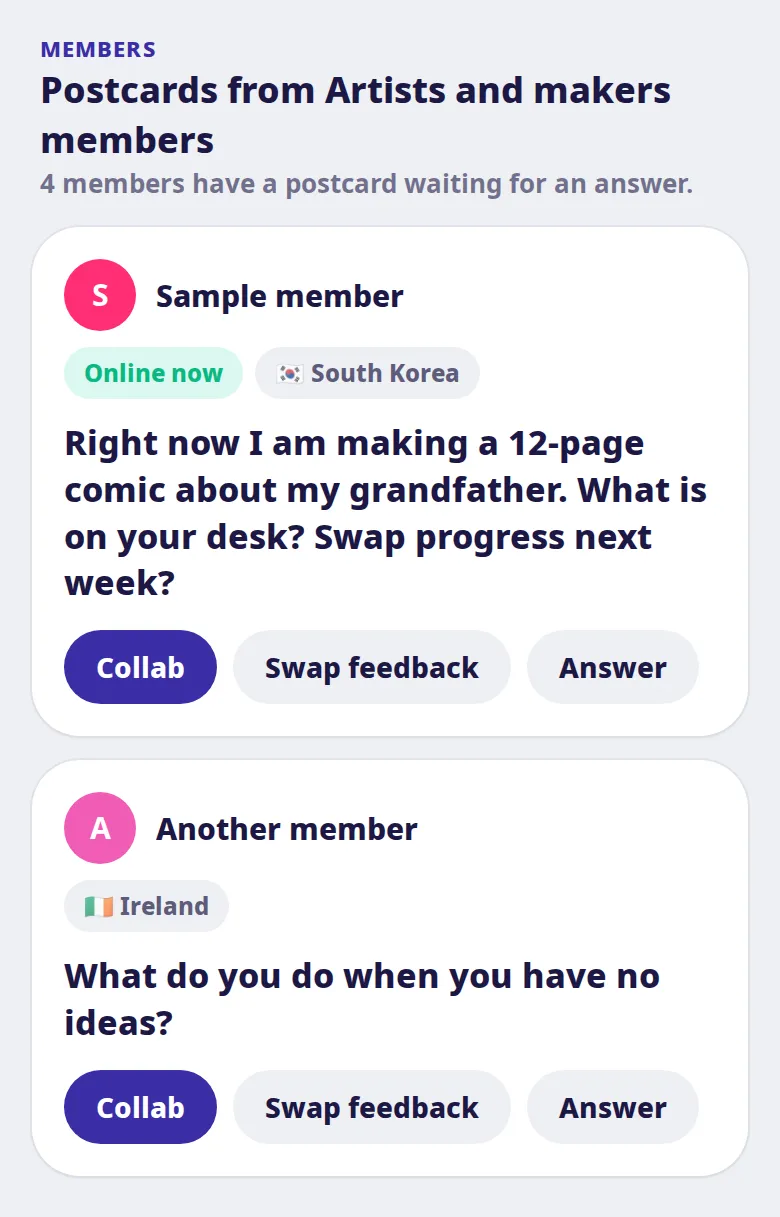 Example screen with sample members, not real people.
A few honest details:
- It's text only. No voice or video, which suits check-ins and talking through a scene.
- Every message is translated both ways, with the original visible. That helps with chat; for line-level notes on your prose, a buddy who reads your language well is better.
- It's a mixed group. You'll meet illustrators, crafters and makers as well as writers.
- It's a small community. At quiet hours, nobody may answer right away.
- Report and block are in every chat, and contact details are stopped before delivery. More tips are in random text chat safety tips.
If a buddy becomes a longer-term friend, how to get a pen pal covers keeping a slower letter-style exchange going, and apps to make friends for introverts has lower-pressure ways to meet people.
When a writing buddy isn't working
- Check-ins stop. Send one friendly nudge. If nothing comes back in a week, find another buddy.
- Your goals drift apart. One of you is drafting daily, the other writes once a month. Switch to a lighter rhythm or part ways kindly.
- Feedback hurts more than it helps. Go back to accountability only.
Questions people ask
+What is a writing buddy?
A writing buddy is another writer you pair with to keep each other writing. You set goals, check in on a fixed day, and often write at the same time in sprints. Some buddies also swap pages and give feedback, but accountability is the core of it.
+What is the difference between a writing buddy and a critique partner?
A writing buddy mainly keeps you accountable: did you write this week? A critique partner reads your pages and gives detailed notes on craft, usually in a regular swap. A beta reader reads a finished draft as a reader would and tells you how it felt. One person can play more than one role.
+Is NaNoWriMo still running?
No. The nonprofit behind National Novel Writing Month announced it was shutting down in an email to its community, reported by Lit Hub on April 1, 2025. When we checked on November 19, 2026, nanowrimo.org showed a parked domain page. Writers still set their own November goals with a buddy or a group.
+Where can I find a writing buddy online?
Critique Circle and Scribophile for critique swaps, r/BetaReaders on Reddit for beta readers, Shut Up & Write! for in-person and online writing sessions, and London Writers' Salon's Writers' Hour for daily group writing. Olu's Artists and makers planet lets you swap progress with a writer in another country by text.
+How often should you check in with a writing buddy?
Once a week is the most common rhythm and is easy to keep. Agree on a day, a goal for the week (words, pages or hours), and a short message format. Add shared writing sprints if you both like writing at the same time.
Keep reading
Boarding pass · free
Tap, fly to a random country, and chat with someone who lives there.
Text first, translated both ways, no video, no coins to meet people. Works in your browser.
Take off on OluNew here? Read Ablo App: The Complete Story of the Chat App That Let You Fly Anywhere (2019–2022), the full history in one place.