 Olu
Breakfast Around the World: What People Eat in 30 Countries
Breakfast around the world in 30 countries: what people really eat in the morning, from Turkish kahvaltı to Japanese rice and miso, each checked in a source.
Updated 19 November 2026 · 10 min read
On this page
Ask ten people in ten countries what they ate this morning and you will hear about rice and soup, beans and eggs, a whole table of cheeses, or just a coffee and something sweet on the way out the door. Breakfast is the meal where home habits run deepest, because many people eat it at home, half awake, the way their family always did.
This guide lists breakfast around the world in 30 countries, grouped by region. Every dish is checked against a source: tourism boards, UNESCO, encyclopedias and food and travel publications. Habits vary by region, family and day of the week, so read each row as "a common breakfast there", not "what everyone eats".
The short answer: breakfast around the world falls into a few patterns. Much of Europe, the Middle East and the Americas builds the meal on bread: open sandwiches in Sweden and Germany, a big spread of cheese and olives in Turkey, a croissant and coffee in France. Much of Asia builds it on rice, porridge or noodles: rice and miso soup in Japan, congee in China, nasi lemak in Malaysia, pho in Vietnam. Beans are the morning staple in Egypt and Costa Rica, eggs appear almost everywhere, and tea or coffee is on nearly every table.
Ask a home cook abroad what is for breakfast
Breakfast around the world, country by country
East and Southeast Asia
| Country | Common breakfast | Source |
|---|---|---|
| Japan | Steamed rice, miso soup (often with tofu or wakame seaweed), grilled fish, natto (fermented soybeans), pickled vegetables and an omelette, with green tea. Many young city workers and students buy a Western-style bakery breakfast instead. | Kanpai, Babbel |
| South Korea | Traditionally rice and soup, served with banchan side dishes such as kimchi, steamed eggs (gyeran-jjim) and tofu. | Wikipedia |
| China | Varies a lot by province. Congee (rice porridge), youtiao (fried dough sticks), mantou (steamed buns) and douhua (tofu pudding) are common. Dim sum is a morning meal in Hong Kong and Guangdong; jianbing, a filled crepe, is popular in the north. | Babbel, Afar |
| Vietnam | Pho (beef and rice noodle soup), or bánh mì with fried eggs, often with iced coffee and condensed milk. | Afar, Contiki |
| Malaysia | Nasi lemak (coconut rice with anchovies, peanuts, cucumber, a boiled egg and sambal), roti canai and the tea drink teh tarik. | UNESCO, Afar |
| Philippines | Silog plates: garlic fried rice (sinangag) and egg (itlog) with a meat, such as longganisa sausage in longsilog. Pan de sal bread and fruit too. | Wikipedia, Afar |
Malaysia stands out: in 2024 UNESCO inscribed "Breakfast culture in Malaysia: dining experience in a multi-ethnic society" on its list of the intangible cultural heritage of humanity. It covers breakfast eaten at home and out, in towns and villages.
South Asia
| Country | Common breakfast | Source |
|---|---|---|
| India | Depends on the region. In the south, idli, vada or dosa with chutney and sambar. In the north, paratha or roti with a vegetable curry, curd and pickles. In Bihar, litti chokha and dahi chura. Puri with potato curry and chai is another northern favourite. | Wikipedia, Afar |
| Pakistan | Paratha or roti with an omelette or fried eggs and tea. Halwa puri is a weekend treat. | Wikipedia, Afar |
Middle East and North Africa
| Country | Common breakfast | Source |
|---|---|---|
| Turkey | Kahvaltı, a spread of small dishes: white cheese (plus kaşar and others), olives, tomatoes, cucumbers, eggs, fresh bread and simit, honey with kaymak (clotted cream), jam, and Turkish tea. Menemen, eggs cooked with tomato and green pepper, is a common hot dish. | Go Türkiye, Afar |
| Israel | Israeli salad, cheese, hummus, tahini, pita and olives, and shakshuka: eggs poached in a pepper and tomato sauce. | Babbel |
| Egypt | Usually a light meal. Ful medames, stewed fava beans with olive oil, cumin and lemon, is typical, eaten with bread and often eggs. Ta'meya (Egyptian falafel) is another favourite. | Wikipedia, Tasting Table |
| Morocco | Bread, harcha (semolina griddle cakes) or msemen (layered flatbread) with olive oil and honey, olives, jben (fresh cheese) and mint tea. | Wikipedia, Afar |
Go Türkiye's own guide says white cheese is "the only cheese that is more or less required", and that regional differences are broad.
Sub-Saharan Africa
| Country | Common breakfast | Source |
|---|---|---|
| Nigeria | Among the Hausa in the north, kosai (fried bean cakes). Among the Yoruba, a corn porridge, often served with evaporated milk. Akara bean fritters with pap (corn porridge) are a well-known pairing. | Wikipedia, Tasting Table |
| Kenya | Simple: chai with bread or fruit. In some regions, mandazi, fried dough flavoured with coconut, cardamom and nutmeg. | Babbel |
| Uganda | The rolex: eggs fried with onion, cabbage and chili, rolled up in a chapati with tomato. It is street food eaten at any time of day, breakfast included, and costs less than a dollar. | CS Monitor, Afar |
Europe
| Country | Common breakfast | Source |
|---|---|---|
| UK and Ireland | The full breakfast: eggs, bacon, sausage, baked beans, tomatoes, mushrooms and toast, sometimes black pudding, with tea. | Babbel, Wikipedia |
| France | Small and mostly sweet: a cup, often a small bowl, of café au lait, with tartines (bread with butter and jam) or a croissant. | Wikipedia, Babbel |
| Italy | A caffè latte or cappuccino with a cornetto, biscotti, or bread and rolls with butter and jam. | Wikipedia, Babbel |
| Spain | In central Spain, generally sweet: coffee with milk or Cola Cao with a pastry, or churros. Toast with olive oil and tomato is another favourite. | Wikipedia, Tasting Table |
| Germany | Bread or bread rolls with butter, jam, ham and cheese, soft-boiled eggs, and muesli with yogurt or milk. | Wikipedia, Contiki |
| Netherlands | Sliced bread with butter and a topping, including hagelslag (chocolate sprinkles). | Wikipedia |
| Switzerland | Birchermüesli, created around 1900 by Swiss doctor Maximilian Oskar Bircher-Benner. Today yogurt, milk or cream often replace the original condensed milk. | About Switzerland |
| Sweden | An open sandwich on soft bread or crispbread with cold cuts, cheese or smörgåskaviar. Filmjölk with cloudberries or lingonberries too. Norway also favours open sandwiches. | Wikipedia, Afar |
| Russia | Kasha (porridge), blini (thin pancakes), syrniki (fried curd cheese pancakes) with sour cream or jam, bread with butter, and tea. | Babbel, Wikipedia |
The original recipe, per the Swiss government's guide, was oat flakes soaked overnight in water, sweetened condensed milk, lemon juice, a large grated apple (skin and core included) and chopped nuts.
The Americas and Oceania
| Country | Common breakfast | Source |
|---|---|---|
| Mexico | Usually generous. Chilaquiles (fried tortilla pieces in salsa, often with eggs), huevos rancheros, quesadillas, tamales and pan dulce. | Babbel, Wikipedia |
| Costa Rica | Gallo pinto, rice and beans with cilantro, served with eggs and coffee poured from a chorreador. Nicaragua eats gallo pinto too. | Visit Costa Rica, Afar |
| Venezuela | Arepas, flat maize-flour patties of indigenous origin, filled with scrambled eggs, ham and cheese, black beans or avocado. Also a breakfast staple in Colombia. | Babbel, Afar |
| Brazil | Lighter: pingado (coffee with a splash of milk), pão francês rolls with butter, cheese or ham, pão de queijo (cheese bread) and fruit. | Afar, Wikipedia |
| United States | The traditional plate, often on weekends: eggs, bacon or sausage, potatoes, pancakes or waffles, toast and coffee. Many people grab something quick instead. | Babbel, Wikipedia |
| Australia | At home, cereal with milk or yogurt, or toast with jam or Vegemite (a yeast extract spread). Coffee such as a flat white, with avocado toast or eggs, is popular too. | Wikipedia, Afar |
What changes from one country to the next
Three differences explain most of these 30 breakfasts.
Bread or rice. The base of the meal follows the staple grain. Bread, rolls and flatbreads run from Sweden to Morocco to Brazil. Rice and noodles lead in Japan, Korea, the Philippines, Malaysia and Vietnam. Maize leads in Venezuela (arepas) and Mexico (tortillas), and beans in Egypt and Costa Rica.
Sweet or savoury. France, Italy and central Spain lean sweet and small: coffee and a pastry. Japan, Turkey, Egypt and Mexico lean savoury: beans, eggs, cheese, rice, fish or salsa.
Big table or quick bite. Turkish kahvaltı and a Swedish table of open sandwiches are meant to be shared at a table. A rolex in Kampala or a bakery bun in Tokyo is eaten on the move. Many countries have both, one for weekdays and one for days off.
Weekday breakfast vs weekend breakfast
Most lists show the classic version; the everyday one is often smaller. In the US, the traditional cooked plate is often a weekend meal. In Pakistan, halwa puri is a weekend treat. In Japan, many young city workers and students buy a Western-style breakfast from a bakery or coffee chain instead of a rice breakfast. In Switzerland, the official guide says it is hard to imagine a breakfast table or Sunday brunch without muesli.
So the best way to learn what breakfast really looks like somewhere is to ask someone who lives there what they ate this morning.
How to try a breakfast from another country at home
A few that work with everyday ingredients:
- Birchermüesli (Switzerland). Soak oats overnight, then stir in yogurt or milk, lemon juice, a grated apple and chopped nuts in the morning.
- Gallo pinto (Costa Rica). Fry leftover rice and cooked beans together with onion and cilantro. Serve with an egg.
- Shakshuka (Israel). Simmer peppers and tomatoes into a thick sauce, make small wells and poach eggs in it.
- Ful medames (Egypt). Warm cooked fava beans and mash them lightly with olive oil, cumin and lemon. Eat with bread.
For the way a real kitchen makes it, ask a cook from that country. If you like collecting recipes, our guide to hosting a recipe exchange has templates for swapping them.
Ask a home cook abroad: the Home cooks planet
Olu is a free text chat site for adults 18+ to meet people in other countries, in your browser. Its Home cooks planet is for "real home cooking from real kitchens". The planet has three simple laws: say where the dish is from, real home cooking only, and never mock a recipe from someone's home.
Its ritual is called Same dish, two kitchens. Name tonight's dish (or this morning's breakfast), and a cook in another country tells you how their kitchen does it, and what they would never change. Buttons let you Ask for a dish, Swap a recipe or Answer someone else's question. A Swap a recipe request stays open for 48 hours, so cooks in other time zones can see it.
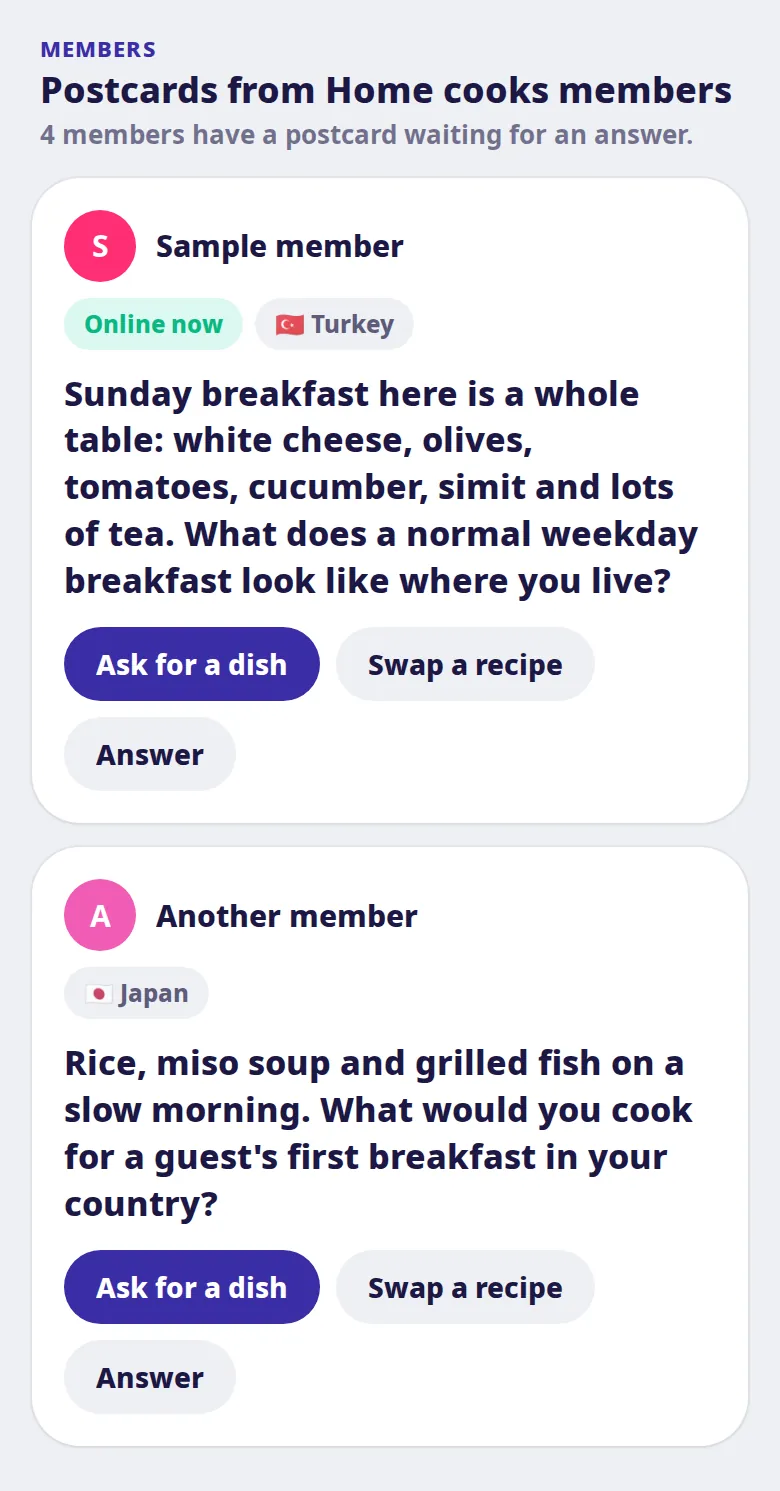 Example screen with sample members, not real people.
A few honest details:
- Every message is translated both ways, with the original visible, so each cook can write in their own language.
- It is text only. No voice and no video. Contact details are stopped before delivery, and report and block are in every chat.
- Adults 18+ only. Birth year is asked at join; there is no ID check.
- No ads and no paid plan. The community is small, so at quiet hours an answer may take a while.
If the conversation turns into a morning greeting, good morning in different languages is a nice way to open, and bon appétit in different languages a nice way to close.
Questions to ask someone about breakfast in their country
- What did you actually eat this morning?
- What does a weekday breakfast look like, and how is a weekend one different?
- What would you cook for a guest's first breakfast in your country?
- Which breakfast from your childhood would you never change?
Questions people ask
+What is the most common breakfast around the world?
There is no single answer, but a few building blocks repeat. Bread with something on it is the base in much of Europe, the Middle East and the Americas. Rice, rice porridge or noodles are the base in much of East and Southeast Asia. Eggs turn up almost everywhere, and tea or coffee is the drink in nearly every country on this list.
+Which countries eat savoury breakfasts?
Many. Japan (rice, miso soup, grilled fish), Turkey (cheese, olives, tomatoes, eggs), Egypt (ful medames), Malaysia (nasi lemak), Costa Rica (gallo pinto), Vietnam (pho), Mexico (chilaquiles) and the UK and Ireland (the full breakfast) are well-known savoury examples.
+Which countries eat a light or sweet breakfast?
France, Italy and central Spain are known for small, mostly sweet breakfasts: coffee with milk plus a croissant, cornetto, biscotti, toast with jam or a pastry. In the Netherlands, sliced bread with chocolate sprinkles (hagelslag) is a well-known option.
+Where was muesli invented?
In Switzerland. Swiss doctor Maximilian Oskar Bircher-Benner created it around 1900 at a sanatorium above Lake Zurich. The original was oats soaked overnight in water, condensed milk, lemon juice, a grated whole apple and chopped nuts.
+Is breakfast culture ever protected as heritage?
Yes. In 2024 UNESCO added 'Breakfast culture in Malaysia: dining experience in a multi-ethnic society' to its Representative List of the Intangible Cultural Heritage of Humanity. The listing names nasi lemak, roti canai and teh tarik.
Keep reading
Boarding pass · free
Tap, fly to a random country, and chat with someone who lives there.
Text first, translated both ways, no video, no coins to meet people. Works in your browser.
Take off on OluNew here? Read Ablo App: The Complete Story of the Chat App That Let You Fly Anywhere (2019–2022), the full history in one place.