 Olu
Christmas Traditions Around the World: 30 Countries, Dates and Customs
Christmas traditions around the world: how 30 countries celebrate, from Las Posadas and Wigilia to Lucia, the Befana and Genna, with dates from 24 Dec to 7 Jan.
Updated 19 November 2026 · 10 min read
On this page
- How 30 countries celebrate Christmas
- When is Christmas? 24 December, 25 December, 6 and 7 January
- Who brings the presents, and when
- Christmas food around the world
- Where Christmas is a cultural day, or not a holiday
- Spending Christmas in another country as a guest
- Ask a local how Christmas looks where you are going
In Warsaw, a family waits for the first star before anyone eats. In Bogotá, someone lights candles on a balcony. In Tokyo, people collect fried chicken they ordered weeks ago. In Sydney, they head to the beach. All of it is Christmas.
This guide covers Christmas traditions around the world: when each country celebrates and one or two customs you will really see, checked against tourism boards, encyclopedias and national institutions. Customs vary by region, family and faith within every country, and many people do not celebrate Christmas at all. Read each row as "what you will often find", not a rule for everyone.
The short answer: most countries celebrate on 25 December, but in much of Europe and Latin America the main family night is Christmas Eve, 24 December. Orthodox churches in Russia, Serbia and Ethiopia celebrate on 7 January, and the Armenian church on 6 January. The customs differ more than the dates: Las Posadas processions in Mexico, a meatless Wigilia supper in Poland, Lucia processions in Sweden, the Befana in Italy, dawn Masses in the Philippines, fried chicken in Japan and beach barbecues in Australia. In some countries, such as Japan and mainland China, Christmas is not a public holiday at all.
Ask someone who lives there how Christmas looks
How 30 countries celebrate Christmas
The main day or days, then one or two customs, with the source we checked. For the greeting itself, see Merry Christmas in different languages.
| Country | Main day(s) | Customs | Source |
|---|---|---|---|
| Mexico | 16-24 Dec, then 6 Jan | Las Posadas: for nine nights a procession asks for lodging at a different house, then children break a star-shaped piñata. Many families in central and southern Mexico open gifts on Christmas Eve | Wikipedia, Wikipedia |
| Colombia | 7 Dec, 16-24 Dec | Día de las Velitas: candles and paper lanterns on windowsills and balconies. The Novena de Aguinaldos meets at a different home each night, with carols, natilla and buñuelos | Colombia.co |
| Brazil | 24 Dec | Christmas Eve dinner served late, often around 10 or 11 pm, with farofa and rabanada | Wikipedia |
| United States | 25 Dec (federal holiday) | A decorated tree at the centre of the home, Santa Claus. 90% of Americans say they celebrate | Wikipedia, Pew |
| Canada | 25 Dec | Mince pies; in Quebec, the réveillon dinner | Wikipedia |
| United Kingdom | 25 Dec | Christmas crackers and mince pies; the monarch's Christmas message, usually at 3 pm | Wikipedia, Wikipedia |
| France | 24 Dec evening | The réveillon, a long family dinner. In Provence, a meatless "gros souper" and 13 desserts | Wikipedia, France.fr |
| Spain | 24 Dec, then 6 Jan | The Christmas lottery draw on 22 Dec opens the season; 24 Dec is the big family night; the Three Kings parade on 5 Jan and bring children's presents | Spain.info |
| Italy | 25 Dec to 6 Jan | Nativity scenes (presepe); on the night of 5 to 6 Jan, the Befana fills stockings with sweets or coal | Italia.it, Wikipedia |
| Germany | 24 Dec | Christmas markets through Advent; the tree goes up on 24 Dec and presents come that evening | Germany.travel, Germany.travel |
| Netherlands | 5 Dec, 25-26 Dec | Presents usually come with Sinterklaas on 5 Dec. At Christmas, midnight Mass and "gourmetten", a shared table grill | Holland.com |
| Poland | 24 Dec | Wigilia: supper starts at the first star, the opłatek wafer is shared with wishes, twelve meatless dishes, often carp | Wikipedia, Poland.travel |
| Sweden | 13 Dec, 24 Dec | Lucia processions with candles; julbord buffet on Christmas Eve; Donald Duck on TV at 3 pm | Visit Sweden |
| Norway | 24 Dec | Pinnekjøtt (cured lamb ribs) or ribbe (pork ribs), by region; rice porridge, with a bowl left for the barn "nisse" | Visit Norway |
| Finland | 24 Dec | Christmas Peace is declared in Turku at noon, a custom from the 1300s, watched on TV; Christmas sauna | thisisFINLAND |
| Iceland | 24 Dec | 13 Yule Lads; children put a shoe in the window for 13 nights; gifts opened after dinner | Visit Iceland |
| Ukraine | 25 Dec (since 2023) | Sviata Vecheria, the Holy Supper, starts at the first star, with about 12 dishes and kutia served first | Wikipedia |
| Russia | 7 Jan | A meatless 12-dish supper on 6 Jan; the tree and Ded Moroz belong mostly to New Year, the bigger holiday | Wikipedia |
| Serbia | 7 Jan | An oak log, the badnjak, goes on the fire on Christmas Eve; the česnica loaf hides a lucky coin | Wikipedia |
| Armenia | 6 Jan | A public holiday; a fast before Christmas Eve, then the khetum dinner | Wikipedia |
| Ethiopia | 7 Jan | Genna: a 43-day fast, an overnight church service, a white cotton netela, and a hockey-like game also called gena | Wikipedia |
| Nigeria | 25 Dec | Families buy live animals for the meal, jollof rice in the south, and gifts are often money | Wikipedia |
| South Africa | 25 Dec (summer) | Christmas crackers, turkey or a braai, Christmas pudding | Wikipedia |
| India | 25 Dec | "Bada Din" (Big Day) in the north; cribs, lit stars outside homes, sweets for neighbours | Wikipedia |
| Philippines | Sept to Jan; 16-24 Dec | Simbang Gabi, nine dawn Masses; parol star lanterns; Noche Buena feast on Christmas Eve | Wikipedia, Wikipedia |
| Japan | 24-25 Dec (not a national holiday) | Fried chicken ordered weeks ahead, strawberry shortcake, couples' dates | JNTO |
| South Korea | 25 Dec (holiday since 1949) | Church services and going out with friends | Wikipedia |
| China | Not a holiday on the mainland | Mostly commercial and private: cards, gifts, decorations | Wikipedia |
| Australia | 25 Dec (summer) | Beach barbecues; Carols by Candlelight concerts | Tourism Australia, Wikipedia |
| New Zealand | 25-26 Dec | The red-flowering pohutukawa, known as the "New Zealand Christmas tree" | Wikipedia |
When is Christmas? 24 December, 25 December, 6 and 7 January
The first split is Eve or Day. In Poland, Germany, the Nordic countries and Brazil, the big family night is 24 December. Visit Sweden says plainly that 24 December is the main day there. In the US, the UK, Canada and Australia, Christmas Day is the main day.
The second split is the calendar. Churches that keep the old Julian calendar celebrate on 25 December by that calendar, which is 7 January in ours. So Christmas falls on 7 January in Russia and Serbia, and Ethiopia's Genna falls on 7 January, 29 Tahsas in the Ethiopian calendar. The Armenian church celebrates on 6 January. Ukraine changed in 2023: a law signed that July made 25 December the only official Christmas date.
Some seasons are long. In the Philippines, decorations appear in September, the start of the "ber months", and celebrations can run into January. In Italy, the season runs from 8 December to Epiphany on 6 January.
Who brings the presents, and when
Santa Claus is not the only gift-bringer, and Christmas Day is not always the day.
- St Nicholas and Sinterklaas. In Germany, children put polished shoes outside the door on the night before 6 December, and St Nicholas fills them with sweets and small presents (Germany.travel). In the Netherlands, presents usually come on 5 December, and Holland.com says that for many, the Christmas season only starts after that.
- The Christ Child or Father Christmas. In Germany, presents on 24 December come from the Christ Child, mainly in the south, or Father Christmas, mainly in the north.
- The Yule Lads. Iceland's 13 are mostly harmless pranksters who leave small gifts in shoes in the window.
- The Three Kings and the Befana. In Spain, the Kings parade through cities on 5 January and bring the children's presents. In Italy, the Befana fills stockings on the night of 5 to 6 January.
- Ded Moroz. Christmas in Russia was abolished with other religious holidays in 1929, and many traditions moved to New Year. The tree became a "New Year tree" in 1935, and Ded Moroz, with Snegurochka, brings gifts. New Year is still the main holiday.
- New Year in Japan. JNTO notes that most presents and money gifts in Japan come at New Year, not Christmas.
Christmas food around the world
Food is where a guest notices the difference first.
A meatless Christmas Eve. Several countries start with a fast and a supper without meat. Poland's Wigilia has twelve dishes, often carp, and an extra place set for an unexpected guest. Ukraine's Holy Supper has about 12 dishes with no meat, milk or eggs, and kutia, made from grain, honey and poppy seeds, comes first. In Provence, the "gros souper" is meatless, and the 13 desserts that follow stand for Christ and the 12 apostles.
Long fasts. In Ethiopia, Orthodox Christians fast for 43 days without meat, dairy or eggs. The Christmas Eve service runs through the night, usually from about 6 pm to 3 am.
Buffets and roasts. Sweden's julbord brings ham, meatballs and pickled herring. In Norway the main dish depends on the region: pinnekjøtt, cured lamb ribs steamed over sticks, ribbe, pork ribs, or lutefisk.
Fried chicken and cake. JNTO confirms that fried chicken at Christmas "is actually a thing" in Japan, reserved weeks ahead. The Christmas cake is a sponge with whipped cream and strawberries.
Summer food. South of the equator, Christmas comes in the heat. Tourism Australia suggests celebrating "like a true Australian" with a beach barbecue. In South Africa, the meal might be turkey or a braai.
Where Christmas is a cultural day, or not a holiday
Christmas is not a public holiday everywhere. Wikipedia's Christmas worldwide article lists Japan, mainland China, Taiwan, Vietnam, Turkey and Uzbekistan among the places where it is not a formal public holiday. Where it is marked, it is often secular. Japan has adopted "many of the secular aspects of Christmas" with few Christians. In India, millions mark it as a secular day alongside the Christian minority.
Even where most people celebrate, many treat it as a cultural day. In a 2017 Pew survey, 90% of Americans said they celebrate Christmas, but only 46% mainly as a religious holiday.
So don't assume. Many people you meet will not celebrate, and many who do see it as family time rather than faith. A good wish for the holidays or the new year works for everyone: see happy holidays in different languages.
Spending Christmas in another country as a guest
- Check which night matters. In Poland or Sweden, an invitation for 24 December is the main event.
- Expect closures. Christmas Eve, Christmas Day and, in some countries, 6 or 7 January are family days.
- Ask before you bring food. The supper may be meatless, so check before you arrive with ham or a bottle.
- Ask your host what a guest usually brings. Customs vary by family, so a local answer beats any list.
- Learn one greeting. Even a clumsy "Wesołych Świąt" or "Feliz Navidad" lands well.
Ask a local how Christmas looks where you are going
A guide can tell you that Mexico has Las Posadas. It can't tell you what your host's family eats on Christmas Eve, what time things start, or what a guest should bring. Someone who lives there can.
Olu is a free text chat site for adults 18+ to meet people in other countries, in the browser. Its Travellers planet is about where to go and what it is really like, from people who live there. The ritual is Ask a local: skip the list, name the place, and ask a person who lives there what to skip and what not to miss. You can tap Ask a local, Swap trip tips, or Answer a question about how Christmas works in your own country. The laws are short: say which country, be curious and never insulting, and remember that locals know best.
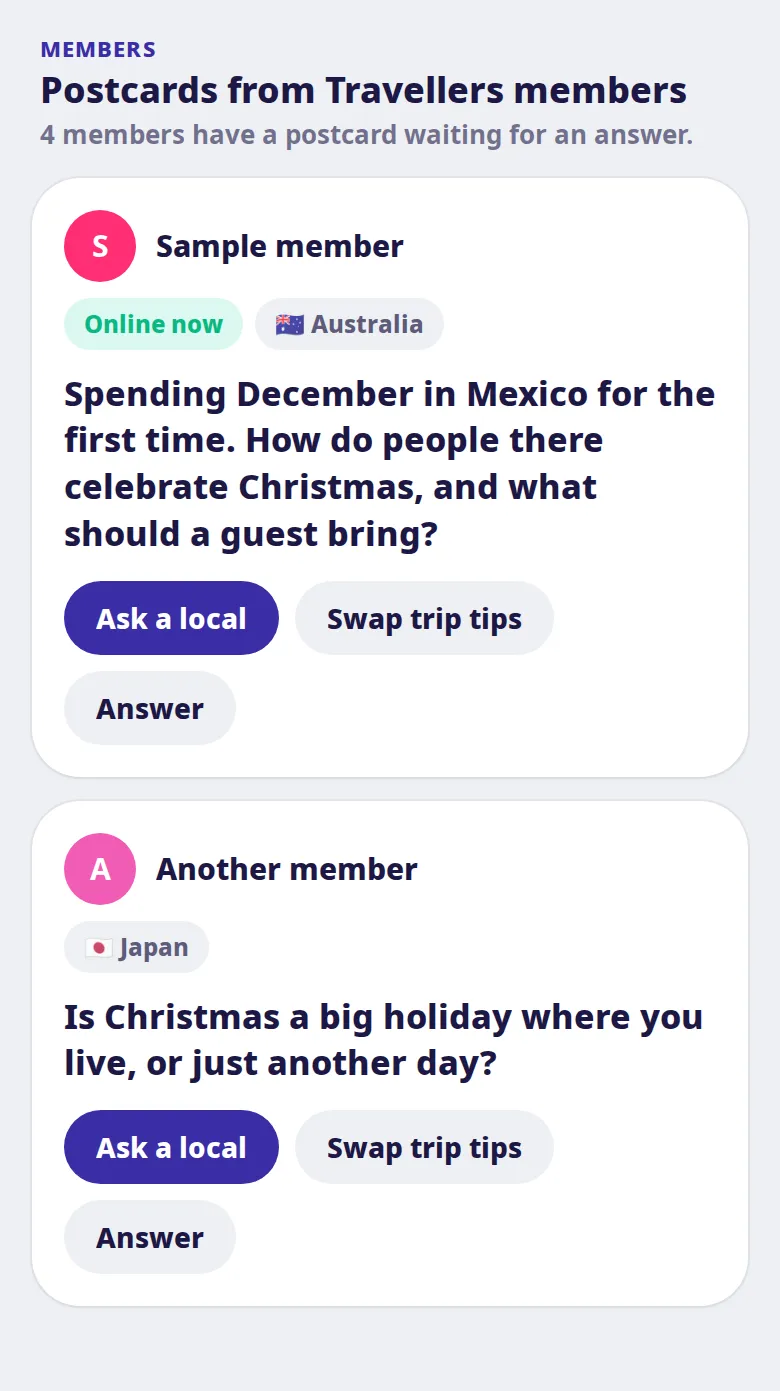 Example screen with sample members, not real people.
- Every message is translated both ways, with the original visible, so you can ask someone in Kraków or Oaxaca in your own language.
- Text only. No voice, no video, and contact details are stopped before delivery.
- Small community. Replies can take time, and fewer people may be online on the holiday itself.
- Report and block in every chat. No ads, no paid plan.
Want to get to know a place before you go? Virtual travel chat explains how.
Questions people ask
+How do different countries celebrate Christmas?
In very different ways. Mexico has nine nights of Las Posadas processions, Poland a meatless Wigilia supper that starts with the first star, Sweden Lucia processions and a julbord buffet, Iceland thirteen Yule Lads, and Japan fried chicken and strawberry cake. In Australia, New Zealand and South Africa, Christmas falls in summer, so beaches and barbecues are common.
+Which countries celebrate Christmas on 7 January?
Churches that follow the Julian calendar mark Christmas on 7 January, including in Russia, Serbia, Ethiopia (where it is called Genna) and among Coptic Christians in Egypt. The Armenian church celebrates on 6 January. Ukraine moved its official Christmas to 25 December in 2023.
+Is Christmas celebrated on 24 or 25 December?
Both, depending on the country. In Poland, Germany, Sweden, Norway, Finland, Iceland and Brazil the main family celebration is on Christmas Eve, 24 December. In the US, the UK, Canada and Australia, Christmas Day on 25 December is the main day.
+How is Christmas celebrated in Japan?
Christmas is not a national holiday in Japan, but it is popular. Many families eat fried chicken, often ordered weeks ahead, and a strawberry and cream sponge cake. It is also a time when couples plan a date. Most presents and the big family gathering come at New Year instead.
+Who brings Christmas presents in different countries?
It depends on the country. Sinterklaas brings presents on 5 December in the Netherlands. In Germany the Christ Child brings them in the south and Father Christmas in the north. In Iceland it is the 13 Yule Lads. In Spain the Three Kings bring presents around 6 January, in Italy the Befana comes on the night of 5 to 6 January, and in Russia Ded Moroz brings gifts at New Year.
Keep reading
Boarding pass · free
Tap, fly to a random country, and chat with someone who lives there.
Text first, translated both ways, no video, no coins to meet people. Works in your browser.
Take off on OluNew here? Read Ablo App: The Complete Story of the Chat App That Let You Fly Anywhere (2019–2022), the full history in one place.