 Olu
Greetings Around the World: How People Greet in 30 Countries
Greetings around the world: how people greet in 30 countries, from handshakes and bows to cheek kisses, namaste, the wai and a hand on the heart, plus titles.
Updated 19 November 2026 · 10 min read
On this page
You land, someone walks over to meet you, and in half a second you have to decide: hand, bow or cheek? Get it slightly wrong and nothing terrible happens. But knowing what to expect makes first meetings less awkward, for you and for the person in front of you.
This guide covers greetings around the world: the gesture people use when they meet, how it changes between strangers and friends, and how to use titles and first names. Every country row comes from a source we opened. Greetings vary by region, age, religion and setting within every country, so read each line as "what you will often see", not a rule everyone follows.
The short answer: the handshake is the most common first greeting worldwide, but not everywhere. People in Japan and South Korea usually bow. In India and Nepal the traditional greeting is palms pressed together with "Namaste", and in Thailand it is the wai. Across much of Europe and Latin America, friends greet with cheek kisses, from one in Mexico to three in the Netherlands and Russia. In many Muslim-majority countries, a spoken peace greeting comes with a handshake between people of the same gender, and sometimes a hand on the heart. When unsure, smile, greet the oldest person first and let the other person lead.
Ask someone who lives there how they say hello
How people greet in 30 countries
The usual greeting at a first meeting, what changes between friends, and how to address people. For the words themselves, see hello in different languages.
| Country | First meeting | Friends and family | Names | Source |
|---|---|---|---|---|
| Japan | A bow, its depth set by the setting; touch, handshakes included, is generally avoided, though many shake hands with visitors | Bow | "-san" after a name | JNTO, Cultural Atlas |
| South Korea | A bow; right-hand handshakes are common too | Bow | Title (Mr, Ms, Doctor) until told otherwise | Cultural Atlas |
| China | A light handshake, held longer; a slight bow or nod when formal | Handshake | Family name and title | Cultural Atlas |
| Vietnam | Men shake hands with a small nod; women often bow or nod | Oldest greeted first | Given name plus an honorific | Cultural Atlas |
| Thailand | The wai; a handshake is fine in international settings | Wai | "Khun" plus first name | Wikipedia, Cultural Atlas |
| India | Palms together with "Namaste" or "Namaskar"; handshakes at work and in cities | Most senior greeted first | Mr, Mrs, Sir, Ma'am with last name | Cultural Atlas |
| Nepal | Palms together with "Namaste"; a right-hand handshake may follow | Namaste | "Didi", "daai", or "ji" after a name | Cultural Atlas |
| Pakistan | "As-salamu alaykum" and a handshake | Well-acquainted men may hug | Last name plus "Sahib" | Cultural Atlas |
| Malaysia | A handshake; formal Malay greetings add a small bow and right hand on the heart | "Salaam" | Mr, Mrs, Doctor | Cultural Atlas |
| Indonesia | Same-gender handshake; some add a hand on the heart | Same | "Bapak", "Ibu" for elders | Cultural Atlas |
| Philippines | A soft handshake | "Mano po" to elders; "beso-beso" cheek to cheek among close women | "Kuya", "Ate" for older peers | Cultural Atlas, Wikipedia |
| Saudi Arabia | "Assalaam 'alaikum" and a right-hand handshake | Same-gender cheek kisses | Titles, especially for elders | Cultural Atlas |
| Turkey | A handshake | One or two cheek kisses; an elder's hand kissed, then touched to the forehead | First name plus "Bey" or "Hanım" | Cultural Atlas |
| Iran | "Salam" and a right-hand handshake | Two or three cheek kisses, same gender | "Agha" or "khanoom" with surname | Cultural Atlas |
| Egypt | A light but long handshake | Same-gender cheek kisses | Mr, Mrs, Dr | Cultural Atlas |
| Nigeria (Yoruba) | A spoken greeting that changes with the time of day and the person | Boys prostrate and girls kneel to greet elders | A plural, more respectful form for elders | University of Georgia |
| Kenya | Spoken greeting, then a handshake | "Jambo" or "Hujambo", answered "Sijambo" | "Mzee" for older men | Cultural Atlas |
| France | A handshake with everyone, arriving and leaving | La bise, usually two kisses | "Monsieur", "Madame" | Cultural Atlas |
| Spain | A firm handshake at work | A kiss on each cheek, left first | "Señor", "Señora"; first names come fast | Cultural Atlas |
| Italy | A handshake, eye contact, a smile | Air kisses on both cheeks, left first | Title and last name | Cultural Atlas |
| Germany | A handshake, arriving and leaving, with each person | Close friends may kiss both cheeks | Surname with "Sie" until "du" is offered | deutschland.de |
| Netherlands | A handshake with a nod | Three kisses, alternating cheeks | First name | Cultural Atlas |
| Russia | A firm handshake, eye contact | Women often kiss three times | First name and patronymic for elders | Cultural Atlas |
| United Kingdom | A firm, not too strong handshake | A hug or cheek kiss among close friends | First names | Cultural Atlas |
| United States | A handshake | Hugs | First names; "How are you?" is a greeting, not a question | Kansas State University, Cultural Atlas |
| Canada | A handshake | French Canadians: a light kiss on both cheeks | First names | Cultural Atlas |
| Mexico | A firm handshake | The abrazo: a loose hug and a kiss on the right cheek | "Señor", "Señora"; "Don", "Doña" for elders | Cultural Atlas |
| Brazil | A handshake | Women kiss each cheek; friends hug | "Senhor", "senhora" plus first name | Cultural Atlas |
| Argentina | A handshake and a slight nod | One kiss on the right cheek | Title and surname | Cultural Atlas |
| New Zealand | A firm handshake | The Māori hongi at formal occasions | First names, even when formal | Cultural Atlas |
The Cultural Atlas is a cultural reference site published by Mosaica. The Yoruba greeting is one custom among many in Nigeria, a country of many peoples and languages.
The main kinds of greeting, explained
The handshake
The handshake is the default first greeting in most of the table, but its style changes. Germans shake hands on arriving and leaving, often with each person in the room. In China the grip is lighter and held longer. In Kenya and South Korea, holding your right forearm or wrist with your left hand while you shake shows extra respect.
Use your right hand: Cultural Atlas says so for South Korea, Nepal, Iran and Saudi Arabia. Between men and women, guides for India, Nepal, Thailand and the Philippines advise waiting for the woman to offer a hand first.
The bow
JNTO, Japan's national tourism organization, says a polite nod or bow when you meet someone or enter a place goes a long way, and visitors are not expected to know every rule. The Cultural Atlas adds that people look at the neck or chin while bowing, not straight into the eyes. In South Korea, business bows are deeper, around 30 degrees at the waist. In China and Vietnam the bow is smaller, from the shoulders, and deeper for someone of higher status.
Palms pressed together
In India and Nepal, people press their palms together, fingers up, often with a slight bow and "Namaste". Wikipedia notes this gesture is used across the Indian subcontinent for relatives, guests and strangers.
Thailand's wai is palms together and a slight bow, with higher hands showing more respect. Always return a wai offered to you, but visitors should not wai someone younger first. A routine wai from a shop cashier is usually answered with a smile or nod. Cambodia's sampeah works the same way: higher hands and a lower bow show more respect.
Cheek kisses, and how many
Cheek kisses are usually for people you already know, and the count changes by country, sometimes by town.
| Kisses | Where (friends and family) |
|---|---|
| One, on the right cheek | Mexico (with a hug), Argentina |
| One on each cheek | Spain and Italy (left first), Brazil, French Canadians |
| Usually two | France; Wikipedia lists three in Provence, four in Nantes, one in Finistère |
| Three, alternating | The Netherlands, Russia (mostly women) |
Who kisses whom changes too. In southern Italy, men generally only kiss family members. In Saudi Arabia, Egypt and Iran, cheek kisses are between people of the same gender. In Germany, close friends may kiss, but not at work.
Hand on the heart
In formal Malay greetings, a small bow is followed by the right hand on the heart, and some Indonesians do the same after a handshake. In Pakistan, someone may put a hand over the heart and nod when they sense the other person is not used to touch, and in Iran men often greet women this way. It is a good choice when you are not sure a handshake is welcome.
Respect for elders
In the Philippines, younger people say "mano po" and press an elder's hand to their forehead, usually for relatives a generation older, godparents and priests. In Turkey, kissing an elder's right hand and touching it to your forehead is especially respectful. Among the Yoruba, a University of Georgia course page describes boys prostrating fully and girls kneeling on both knees to greet elders. In China, Vietnam and India, greet the oldest or most senior person first.
Greetings you may hear about
Some famous greetings belong to certain settings only:
- The hongi (New Zealand). Two people press noses, often foreheads too, and share a breath, at traditional Māori meetings and ceremonies such as a pōwhiri, as Wikipedia explains. Cultural Atlas says Māori are unlikely to greet non-Māori this way outside formal occasions.
- Nose greetings in the Gulf. Men in Oman may kiss each other on the nose after a handshake, and very close male friends in Saudi Arabia may touch noses.
- Clapping. AFAR describes clapping after a handshake in Malawi and rural Zimbabwe.
- Sticking out the tongue (Tibet). AFAR says it is uncommon today.
Don't copy these as a visitor. Wait to be invited.
How to greet someone when you are not sure
- Let them lead. If they offer a hand, shake it. If they lean in, follow. Don't start a hug or kiss yourself.
- Use your right hand.
- Greet the oldest person first.
- Start formal. Title and surname until invited to use first names. In Germany, wait for the older or more senior person to offer "du".
- Say hello in the local language. One word shows respect.
- Don't overthink it. JNTO says visitors to Japan don't need to master bowing. People forgive a clumsy greeting from someone clearly trying.
If a greeting still catches you off guard, you're not alone. Greetings come first in our list of culture shock examples.
Ask a local how people greet where you are going
A guide can only tell you what is common. It can't tell you whether your new office kisses hello, or what a family in Lyon expects at dinner. Someone who lives there can.
Olu is a free text chat site for adults 18+ to meet people in other countries, in the browser. Its Travellers planet is about where to go and what it is really like, from people who live there. The ritual is Ask a local: skip the list, name the place, and ask a person who lives there what to skip and what not to miss. You can tap Ask a local, Swap trip tips, or Answer a question about your own country. The laws are short: say which country, be curious and never insulting, and remember that locals know best.
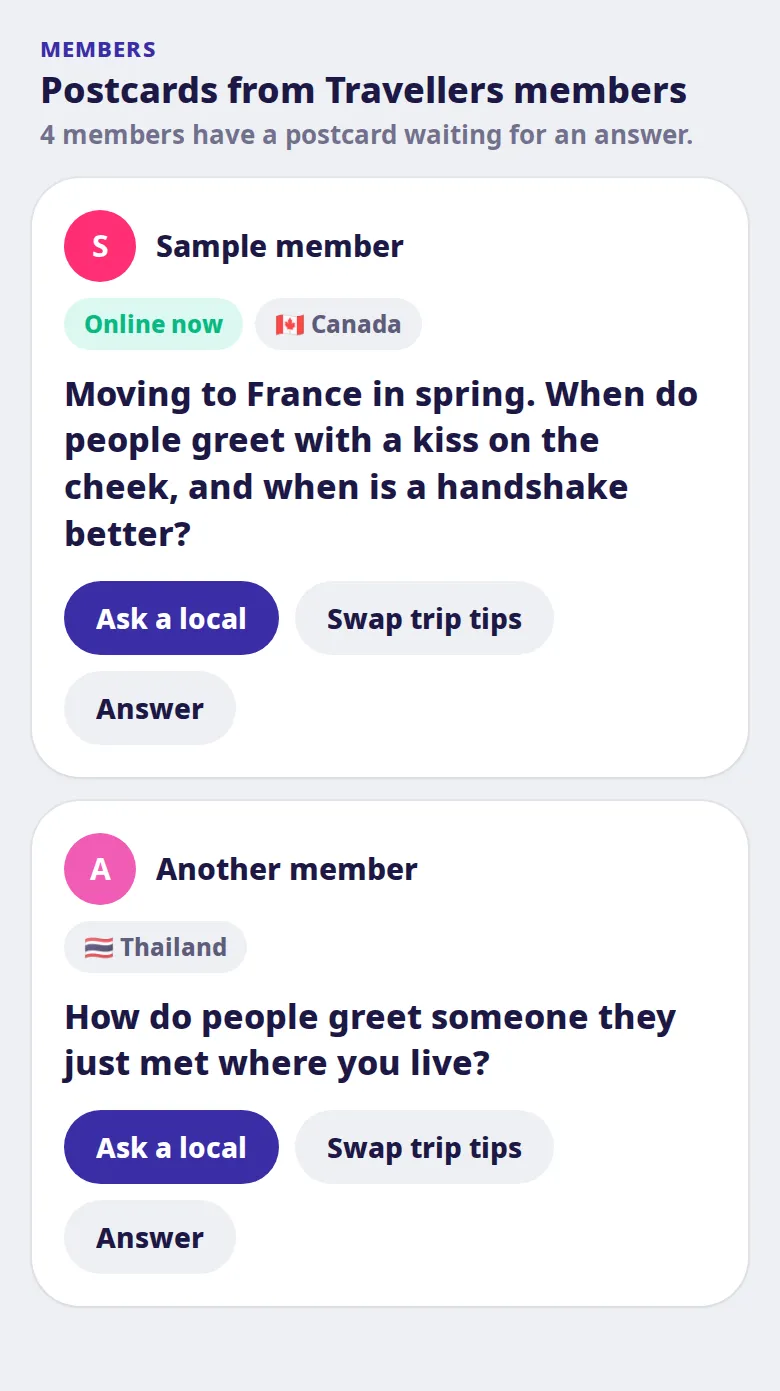 Example screen with sample members, not real people.
- Every message is translated both ways, with the original visible, so you can ask someone in Seoul or Lima in your own language.
- Text only. No voice, no video, and contact details are stopped before delivery.
- Small community. Replies can take time.
- Report and block in every chat. No ads, no paid plan.
Want to get to know a place before your trip? Virtual travel chat explains how.
Questions people ask
+What are the most common greetings around the world?
The handshake is the most widespread first greeting, from the US and the UK to Germany, South Africa and Kenya. Bows are the usual greeting in Japan and South Korea, palms pressed together (namaste, the wai) in India, Nepal and Thailand, and cheek kisses between friends across much of Europe and Latin America. Many Muslim-majority countries pair a handshake or a nod with a spoken peace greeting.
+How many kisses on the cheek do people give in different countries?
It varies. One kiss on the right cheek is common in Mexico and Argentina, a kiss on each cheek in Spain and Italy, and three alternating kisses among friends in the Netherlands and, mostly between women, in Russia. France varies by region: two is most common, but three in Provence and four around Nantes. Cheek kisses are usually for friends and family, not first meetings.
+Which countries bow instead of shaking hands?
Bowing is the most common greeting in Japan and South Korea. In China and Vietnam people often give a slight bow or nod in formal settings, usually from the shoulders. In Thailand, Cambodia, India and Nepal the usual traditional greeting is palms pressed together with a small bow of the head.
+What is the safest way to greet someone in another country?
Smile, say hello in the local language and let the other person lead. If they offer a hand, shake it with your right hand. Greet the oldest person first, use a title and surname until invited to use first names, and wait for the other person to start any hug or kiss. Customs vary by region, age and setting in every country.
+What does a hand on the heart mean as a greeting?
In Malaysia, Indonesia, Pakistan and Iran, placing the right hand over the heart, often with a nod, is a respectful greeting. It is also used instead of a handshake when someone prefers not to touch a person of the opposite gender.
Keep reading
Boarding pass · free
Tap, fly to a random country, and chat with someone who lives there.
Text first, translated both ways, no video, no coins to meet people. Works in your browser.
Take off on OluNew here? Read Ablo App: The Complete Story of the Chat App That Let You Fly Anywhere (2019–2022), the full history in one place.