 Olu
Culture Shock Examples: Real Cases, the Stages and Reverse Culture Shock
Real culture shock examples by theme: greetings, tipping, time, personal space, food and transport. Plus what culture shock is, its stages and how to cope.
Updated 19 November 2026 · 10 min read
On this page
The first days somewhere new feel like a film. Then small things start to rub. Nobody tips, or everybody does. The shops are shut on the one day you planned to shop. Someone greets you with a kiss on the cheek, or stands further away than you expect. None of it is wrong. It is just different, and the differences pile up.
That pile-up has a name. This guide gives real culture shock examples by theme, each checked against an official, university or encyclopedia source, then covers what culture shock is, its stages, how to cope, and reverse culture shock.
The short answer: culture shock is the stress of losing the everyday cues you rely on at home: how to greet people, when to tip, when to eat, how close to stand, how to behave on a train. Typical examples are cheek kisses in France, 15-20% tips in US restaurants versus no tipping in Japan, dinner between 8 and 11 pm in Spain, shops closed on Sundays in Germany and quiet trains in Japan. It usually moves through stages, from excitement to frustration to adjustment, and it comes back in reverse when you return home. Preparing, staying curious and asking locals helps most.
Ask someone who lives where you're going
Culture shock examples by theme
These are real customs that visitors and international students often notice. Customs vary within every country, by region, age and family, so treat each one as "what you may meet", not "what everyone does".
Greetings and touch
- France: the cheek kiss. Greeting with la bise, a kiss on each cheek, is common among friends and family. The number of kisses varies so much by area that people joke you can tell which city you're in by counting. It is very common between men in southern France and less usual between unrelated men in the north.
- The Netherlands, Argentina, Chile and Uruguay. In the Netherlands three kisses are usual, mostly for birthdays. In Argentina, Chile and Uruguay, men may greet each other with a kiss on the cheek.
- Thailand: the wai. The wai is a slight bow with the palms pressed together. A wai offered as respect should be returned, but visitors are advised not to wai someone younger except in return. When a shop cashier gives a routine wai, a smile or a nod is the usual answer.
- Denmark: eye contact. CIEE, a study abroad organisation, notes that eye contact is important when meeting new people in Denmark. If you come from a culture where looking away is polite, this can feel intense.
Tipping and paying
- United States: tipping is part of the bill. The international student office at UMBC tells new arrivals to expect to tip 15-20% for waiters and waitresses, about 15% for taxi drivers and a few dollars for delivery and hotel bellhops. The reason: waiting staff are paid very low wages and earn the rest through tips. Tips are not expected at carry-out restaurants, coffee houses, food trucks or ticket offices.
- Japan: no tip at all. The Japan National Tourism Organization says tipping is not customary and often causes confusion. A thank you and a smile are enough.
Time, meals and opening hours
- Spain: late meals. Spain's official tourism site gives lunch between 1 pm and 4 pm or later, and dinner between 8 pm and 11 pm. Shops are generally open Monday to Saturday from 10 am to 9 pm, and many close between 2 pm and 5 pm, especially in summer. If you're used to eating at 6 pm, that takes some getting used to.
- Germany: quiet Sundays. The DAAD, Germany's academic exchange service, warns international students in its practical guide not to arrive on a weekend: international offices, banks and administrative offices are closed, and shops shut on Sundays. Plan your first big shop for a weekday.
Personal space
How close is too close depends a lot on where you grew up. A study led by Agnieszka Sorokowska asked nearly 9,000 people in 42 countries how far away they'd like a stranger to stand while talking. People in Romania wanted the most space, about 140 cm, followed by Hungary and Saudi Arabia. People in Argentina were comfortable with the least, about 80 cm, followed by Peru and Bulgaria. People in warmer countries tended to prefer smaller distances, and women and older people preferred more space.
These are averages from fairly small samples, so they say nothing about the person in front of you. But they explain why one person steps forward to be friendly while the other steps back.
Food and eating
- Missing home food. The University of Edinburgh lists unfamiliar food, or not finding familiar ingredients, among the everyday sources of culture shock for students, alongside cold weather for people from warm climates.
- Japan: chopsticks. Food in Japan is mainly eaten with chopsticks, but JNTO notes that most restaurants will bring cutlery if you ask.
Transport and public manners
- Japan: quiet trains. JNTO says that on trains everyone keeps their voice down and avoids phone calls, and suggests headphones for music or films. People also queue for almost everything, from trains to shop openings, and no one cuts ahead.
- Singapore: no snacks on the MRT. According to an SBS Transit spokesperson quoted by Mothership, eating and drinking are prohibited in all paid areas of MRT stations, not only on trains. Since 23 September 2026, eating or drinking on public buses is also an offence, with a maximum fine of S$500, in line with the existing rail rules.
- A new language everywhere. CIEE lists signs and transit in a language you can't read, and finding your way on an unfamiliar transit system, among the most common early shocks.
Rules at the door and in the bath
- Shoes off. In Japan you may be asked to take your shoes off at some attractions, restaurants and traditional hotels, and taking them off before entering someone's home is common practice.
- Onsen etiquette. At Japanese hot springs, JNTO asks visitors to wash thoroughly and rinse off all soap before getting in, and not to wear swimwear in the baths.
What is culture shock?
Culture shock is the experience a person may have when moving to a cultural environment that is different from their own, as Wikipedia's overview puts it. It can come from studying or working abroad, emigrating, a long trip, or a move between very different social environments.
James Madison University's international office explains it well. Every culture has countless small cues: when to shake hands, what to say when you meet someone, when and how to tip, how to buy things, when to accept an invitation. At home you never think about them. Abroad they are suddenly missing, your usual actions do not always work, and the effort of working everything out builds up into tension and anxiety. JMU calls this a normal, healthy reaction, not a sign that something is wrong with you. It also notes that culture shock builds gradually, after the first surprise at small differences like clothes and signs.
The stages of culture shock
The model you will see most often comes from Kalervo Oberg. Wikipedia notes that Oberg first proposed it in a 1954 talk to the Women's Club of Rio de Janeiro and later in a 1960 article. The four stages are usually described like this:
- Honeymoon. Everything is new and exciting. Differences look charming.
- Negotiation (sometimes called crisis). Often around three months in, the differences start to grate. Anxiety, frustration, homesickness and irritability are common.
- Adjustment. Often around 6 to 12 months in, routines form and the new culture starts to make sense.
- Adaptation. You can take part comfortably in the host culture. Many people end up bicultural, keeping parts of their old habits.
Other models exist. One international student friendship program, for example, describes stages based on P.S. Adler's model, from early excitement through disorientation and anger to confidence and independence.
Treat the timings as rough. The University of Edinburgh describes the stages without fixed dates and stresses that adjustment takes time, and JMU points out that not everyone experiences culture shock in the same way.
Signs you might be in culture shock
JMU lists anxiety, irritability, crying a lot, homesickness, distrust of hosts, tiredness, boredom, self-doubt, avoiding locals and trouble studying. Sleep can change too, much more or much less. If low mood is heavy, lasts for weeks or includes thoughts of harming yourself, talk to a counsellor, a doctor or your university's support service. You don't have to wait it out alone.
How to cope with culture shock
University and study abroad advice is consistent:
- Expect it. Knowing culture shock is normal makes the bad weeks less frightening.
- Prepare before you go. CIEE suggests learning key phrases, reading about local customs, finding food options on a map and learning how transport works.
- Ask questions. JMU's advice is simple: if you don't understand something, it's okay to ask. Locals are usually happy to explain.
- Get involved. Join a club, a sport or a class. Regular activities give you the same faces every week, which is how friendships start. Our guide on how to make friends in a new city has more ideas.
- Look after the basics. Rest, eat well and cook a dish from home now and then.
- Take time out. A foreign language all day is tiring. Spend quiet time in your own.
- Stay in touch with home. Messages and calls with family and friends keep your support close.
- Set small goals. Buying a train ticket or ordering lunch in the local language counts.
Reverse culture shock
Coming home should be easy. Often it isn't. Reverse culture shock, also called re-entry shock, is the difficulty of readjusting to your own culture after time abroad. Wikipedia notes it can be harder to deal with than the original shock, partly because people idealise home while away and assume nothing there has changed.
UCLA's International Education Office says it can start within a few days, weeks or months of returning, does not affect everyone, and can take from a few weeks to a few years to settle. Common signs are frustration, sadness, withdrawing from friends, poor sleep and feeling critical of home.
Marquette University adds restlessness, boredom and "reverse homesickness" for the place you left, and gives practical advice:
- Keep your travel stories short, and link them to things your listeners know.
- Stay in touch with people who have had a similar experience.
- Keep criticism of home to yourself until you feel more balanced.
Ask a local before culture shock hits
The best cure for culture shock is often one honest conversation with someone who lives there. A local can tell you what visitors always get wrong, what is actually rude and what is just unfamiliar, in a way no list can.
Olu is a free text chat site for adults 18+ to meet people in other countries, in the browser. Its Travellers planet is about where to go and what it is really like, from people who live there. The ritual is Ask a local: skip the list, name the place you're going, and ask someone who lives there what to skip and what not to miss. You can also Swap trip tips or Answer someone else's question about your own country. The planet's rules are short: say which country, stay curious and never insulting, and remember that locals know best.
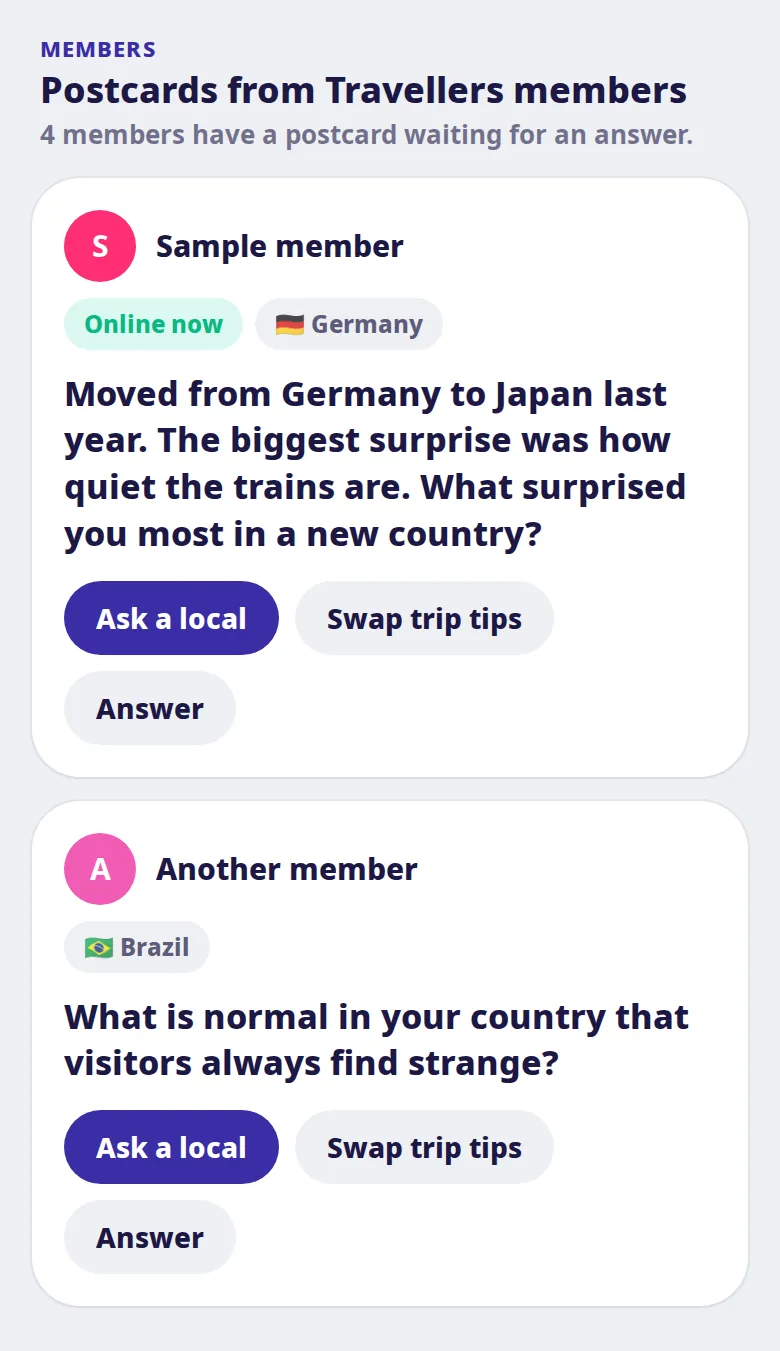 Example screen with sample members, not real people.
A few honest details:
- Every message is translated both ways, with the original visible, so you can ask a local in Tokyo or Madrid in your own language.
- It's text only. No voice and no video, and contact details are stopped before delivery.
- It's small. Not every country has someone online at every hour, so answers can take time.
- Report and block are in every chat. No ads, no paid plan. Birth year is asked at join, with no ID check.
If you want to get to know a place before you book, virtual travel chat explains how, and talk to strangers from other countries has tips for a good first message.
Questions people ask
+What are some examples of culture shock?
Common examples include greetings (cheek kisses in France, the wai in Thailand), tipping (15-20% for waiters in the US, while in Japan tipping is not customary), meal times (dinner between 8 pm and 11 pm in Spain), shops closing on Sundays in Germany, quiet trains in Japan, and the ban on eating and drinking on Singapore's MRT.
+What are the 4 stages of culture shock?
The model most often used comes from Kalervo Oberg, who first described it in a 1954 talk and a 1960 article. The four stages are usually called honeymoon, negotiation (or crisis), adjustment and adaptation. Not everyone goes through them in the same order or at the same speed.
+How long does culture shock last?
It varies. One common description puts the frustration stage at around three months after arrival and adjustment at around 6 to 12 months. Some people feel it for weeks, others for longer. If low mood is heavy or does not lift, talk to a counsellor or doctor.
+What is reverse culture shock?
Reverse culture shock, or re-entry shock, is the difficulty of readjusting to your own country after living abroad. UCLA's International Education Office says it can start within days, weeks or months of coming home, and recovery can take from a few weeks to a few years.
+Is culture shock a bad thing?
Not really. University advisers describe it as a normal reaction to losing familiar cues, and part of learning a new culture. It is uncomfortable, but with time most people adjust, and many end up at ease in both cultures.
Keep reading
Boarding pass · free
Tap, fly to a random country, and chat with someone who lives there.
Text first, translated both ways, no video, no coins to meet people. Works in your browser.
Take off on OluNew here? Read Ablo App: The Complete Story of the Chat App That Let You Fly Anywhere (2019–2022), the full history in one place.