 Olu
Gym Buddy: How to Find One, What to Agree On and How to Stay Safe
What a gym buddy is, what research says about training with one, where to find one at your gym, in clubs or apps, how to ask, and what to do if no one is local.
Updated 19 November 2026 · 8 min read
On this page
Most people don't quit training because the workout is too hard. They quit because nobody notices when they skip it. A gym buddy changes that. Someone is waiting at 7 am, or expecting a message on Friday, and that small promise gets you out of the door on the days motivation doesn't.
This guide covers what a gym buddy is, what the research actually says, where to find one (at your gym, in clubs, in apps), how to ask, what to agree on, how to stay safe meeting someone from an app, and what to do when nobody near you fits.
The short answer: a gym buddy is someone you train with or check in with on a fixed schedule. Look first at your own gym and classes, then running clubs, parkrun, Strava clubs, Meetup and gym buddy apps. Ask for one specific session, not a lifelong partnership. Agree on times, goals and what happens when someone cancels. If no one local fits, a remote check-in partner who expects a weekly update works too.
Find someone to check in with every Friday
What is a gym buddy?
A gym buddy is a training partner. In practice there are three kinds:
- Side-by-side partner. Same session, same place, taking turns and spotting each other.
- Same time, own plan. You arrive together and warm up together, then follow your own programmes.
- Check-in partner. You train separately, maybe in different cities, and report to each other on a fixed day.
The first suits similar goals and levels. The third suits different schedules, or nobody nearby.
Why train with a gym buddy
You're less likely to skip, sessions are more fun, someone can spot you on a heavy lift, and a partner notices when your form slips.
There is some research behind it too, though it's limited, so read it as encouraging rather than proven:
- Training with someone slightly better can make you push longer. In a Michigan State University study of about 200 people doing plank exercises in a video game, people who exercised alongside a virtual partner set to always beat them held the exercise 24% longer than people working alone. That's a lab study, with a virtual partner, on one exercise.
- Encouragement matters more than company. In a study from the University of Aberdeen, people asked to find a new exercise partner exercised more than people who kept their usual routine, and emotional support from the partner was the most effective part. The lead researcher concluded that encouraging each other matters more than doing the activity together.
That second finding is good news if nobody trains at your time: a partner who cheers you on from another city still counts.
What makes a good gym buddy
| Look for | Why it matters | Warning sign |
|---|---|---|
| Similar commitment | You both turn up | Cancels often, always "next week" |
| A schedule that overlaps | Sessions only help if they happen | Only free when you're not |
| Similar or slightly higher level | Push without frustration | One of you waits around every set |
| Compatible goals | You can share sessions | One wants a marathon, the other max deadlifts, and neither will compromise |
| Encouraging, honest | Keeps you going, fixes your form | Mocks you, or agrees with everything |
| Respects boundaries | Training stays about training | Pushes for more than you want to share |
Goals don't need to match. A runner and a lifter can still meet at 6 pm and warm up together.
Where to find a gym buddy
At your gym
The best gym buddy is often someone you already see. Same gym, same time: half the matching is done.
- Notice the regulars. If the same person is there every Tuesday at 7, you already share a schedule. A nod becomes a hello, then a chat.
- Join a class. Classes put the same people in a room every week. Talk to the person next to you after the third session.
- Ask the staff. Trainers and front-desk staff know who trains when, and some gyms keep a notice board or member group for this.
- Bring someone in. A friend who keeps saying "I should start going" may become your most reliable partner.
Clubs, classes and parkrun
If your gym is quiet, go where people train in groups:
- Running clubs. Most towns have one, with groups for different paces.
- parkrun. A free, weekly 5 km event in parks on Saturday mornings in many countries. You register once and can walk, jog, run or volunteer.
- Climbing walls, martial arts, team sports. Anything with a regular session and a social side.
For a wider plan to meet people in a new place, see how to make friends in a new city.
Apps and online groups
- Strava clubs. Strava lets you join or create clubs for its sport types, searched by name or location, with activity feeds and discussions. Local running and cycling clubs often organise group sessions there.
- Meetup. Search your city for running, hiking or fitness groups that meet regularly.
- Local online groups. Your city's subreddit or Facebook group often has "looking for a gym partner" posts. Say your gym, your times and your level.
- Gym buddy apps. Apps such as Actively (matches you with local people for gym sessions, runs, climbing and yoga, and says it's strictly platonic, for adults 18+) and GymBuddy: Gym Partner Finder (you set your home gym and browse members there) exist on iOS. Honest note: in November 2026 most gym buddy finder apps on the US App Store had only a handful of ratings. Check whether anyone near you uses one before you spend time on it.
Friendship apps can help too; apps like Bumble BFF compares them.
How to ask someone to be your gym buddy
Asking feels awkward because it sounds like a big commitment. Make it small.
- Start with what you share. "You're here most mornings too, right?"
- Ask for one session. "Want to do legs together on Thursday?"
- Make it easy to say no. "No worries if you prefer training alone."
- Follow up once. If it went well: "Same time next week?" If they hesitate, let it go.
Online, say your area, days, level and goal: "Looking for someone to lift with Monday and Wednesday evenings at the city centre gym. Intermediate, training for strength. Happy to start with one session."
What to agree on before you start
Most gym partnerships fail on logistics, not personality. Settle these early:
- Days and times. "Monday and Thursday, 6:30 pm" beats "a few times a week".
- The plan. Same programme, or each your own?
- Goals. One sentence each: "Run a 10k in March."
- Cancelling. "Message by noon if you can't make it." If one of you can't come, the other trains anyway.
- A review. After a month: is this still working for both of us?
New to exercise, or have a health condition? Check with a doctor or qualified trainer first.
Safety when meeting a gym buddy from an app
Most people looking for a training partner just want a training partner. Still, take the same care as with any meet-up:
- Chat in text first. A few days of messages tells you a lot. Keep your number private for now.
- Meet at a busy, staffed place. Your gym during staffed hours, or a popular park in daylight. Not a home gym, not someone's car.
- Tell a friend. Who you're meeting, where and when. Send a message when you leave.
- Get there yourself. Keep your own way home.
- Keep private things private. Home address, workplace and your usual routes can wait until you trust someone.
- Never send money. No "membership fees", no lending, no gift cards. That's a scam, every time.
- Leave if it feels wrong. You owe nobody a full session. Block and report profiles that push for dates, photos or personal details.
More on spotting bad actors online is in random text chat safety tips.
No one local? Get a remote check-in partner
If you live somewhere small, train at odd hours or just haven't found the right person, don't wait. A check-in partner in another city, or another country, gives you the part that matters most in the Aberdeen study: someone who encourages you and expects an update.
Olu is a free text chat site for meeting people in other countries, in your browser, for adults 18+. Its Fitness and sport planet has a ritual called Check-in partner: find someone to check in with every Friday, say what you're training for, and someone with a goal of their own answers. You keep each other honest. Members also leave postcards, short questions that people in other countries pick up and answer, and an answer opens a chat.
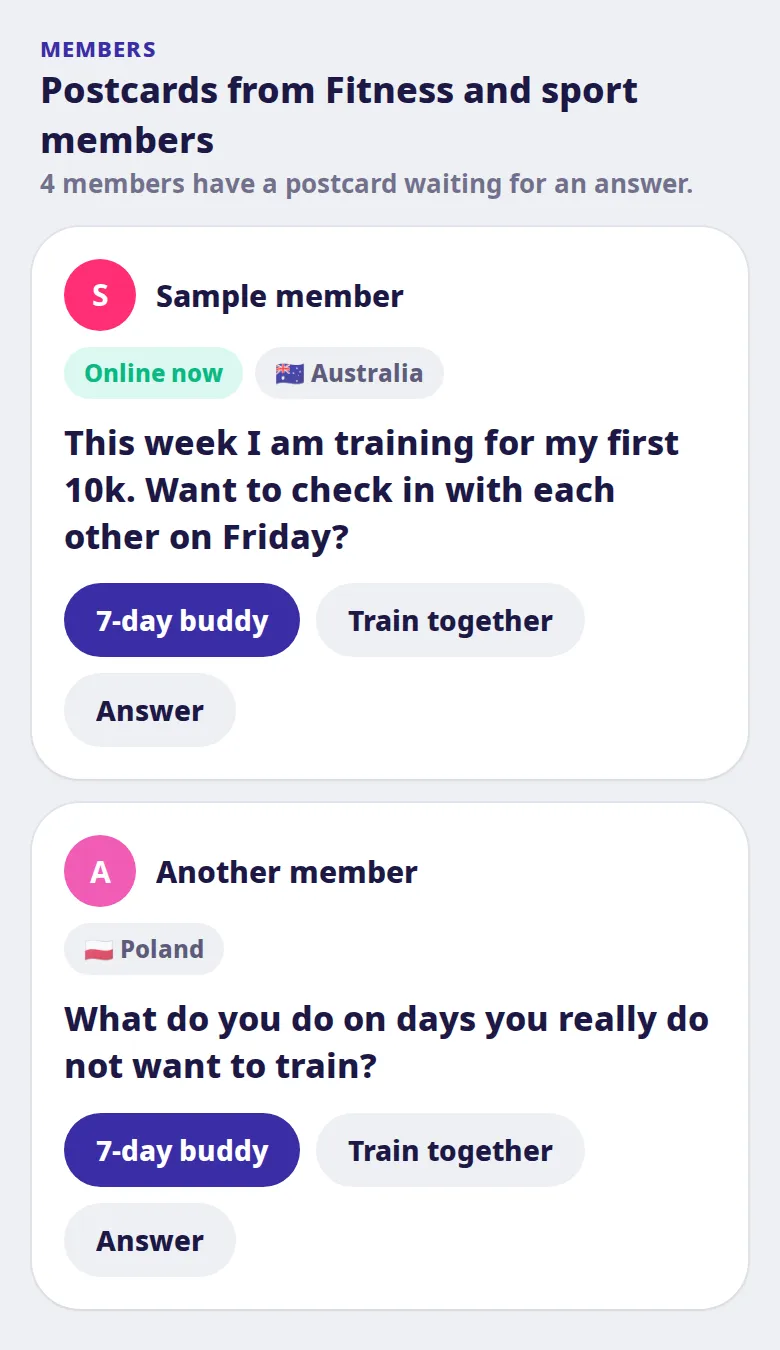 Example screen with sample members, not real people.
A few honest details:
- It's text only. No video, no voice. You can't train side by side; you check in by message.
- It's not for local meet-ups. Contact details are stopped before delivery, so it's built for a remote partner, not for swapping numbers to meet at the gym.
- Every message is translated both ways, with the original visible, so your partner doesn't need to share your language.
- The community is small. At quiet hours nobody may answer right away.
- Report and block are in every chat. No ads, no paid plan.
A Friday check-in can be one line: "Planned 3 runs, did 2. Next week: 3 runs and one strength session. How did yours go?" Knowing someone will ask is often enough to do the third run.
When a gym buddy isn't working
- They keep cancelling. Mention it once, kindly. If nothing changes, look for someone else.
- Very different levels. Switch to "same time, own plan", or to check-ins.
- It's turning into something you didn't want. Say so clearly. If they don't respect it, stop training together.
Many gym buddies become real friends, because you see each other every week. How to make friends in your 30s explains why that kind of routine works.
Questions people ask
+What is a gym buddy?
Someone you train with or check in with on a regular schedule, so you both keep showing up. You might lift together, run together, or just tell each other what you trained this week. You need similar commitment, not the same goal.
+How do I find a gym buddy?
Start with people you already see: gym regulars, people in your classes, friends who want to start. Then try running clubs, parkrun, Strava clubs, Meetup, local online groups and gym buddy apps. Gym staff know who trains at your time.
+Is there an app to find a gym buddy?
Yes, several, such as Actively and GymBuddy: Gym Partner Finder on iOS. Most are small and new, with few ratings in November 2026, so check that people near you actually use one before you rely on it. Strava clubs and Meetup groups are bigger places to find training partners.
+How do you ask someone to be your gym buddy?
Keep it light and specific. Mention what you share, then suggest one session: 'I see you here most Tuesday mornings. Want to do legs together next week?' One session is an easy yes. If it goes well, suggest a regular slot.
+Is it safe to meet a gym buddy from an app?
It can be, if you take basic steps: chat in text first, meet at a busy, staffed gym or public park, tell a friend where you'll be, travel there yourself, and keep your home address private. Never send money, and leave or report anyone who makes you uneasy.
+What if I can't find a gym buddy near me?
Use a remote check-in partner. Agree on a weekly goal and send each other a short update on a fixed day: what you planned, what you did, what's next. Research suggests encouragement matters more than training side by side.
Keep reading
Boarding pass · free
Tap, fly to a random country, and chat with someone who lives there.
Text first, translated both ways, no video, no coins to meet people. Works in your browser.
Take off on OluNew here? Read Ablo App: The Complete Story of the Chat App That Let You Fly Anywhere (2019–2022), the full history in one place.