 Olu
Instruments From Around the World: 35 Traditional Instruments by Country
35 instruments from around the world by country and region: strings, wind and percussion, with one line on how each is played, all checked in a source.
Updated 19 November 2026 · 11 min read
On this page
- Instruments from around the world, by region
- Strings, wind and percussion: how the types work
- Instruments on UNESCO's heritage lists
- National instruments: official and unofficial
- Instrument families that cross borders
- Learning a traditional instrument as an adult
- Ask a player where they live: the Musicians planet
- Questions to ask a musician from another country
Every country has a sound that people there would know with their eyes closed. It might be a drum at a celebration, a fiddle at a dance, a flute in a temple or a horn in the mountains. The materials tell a story too: bamboo for the bansuri, a gourd for the kora, apricot wood for the duduk, horsehair for the morin khuur and an old steel drum for the steelpan.
This guide lists instruments from around the world: 35 traditional instruments, grouped by region, with the country or region, the type, and one plain line on how each one is played. Every row is checked against a source we opened. Traditions vary within every country, so read "where" as "where it is best known", not "the only place it is played".
The short answer: well-known instruments from around the world include the sitar and tabla (India), the koto and taiko (Japan), the erhu and guzheng (China), gamelan (Indonesia), the oud (the Middle East), the duduk (Armenia), the kora and djembe (West Africa), the mbira (Zimbabwe), the bodhrán (Ireland), the bagpipe (Scotland), the steelpan (Trinidad and Tobago), the charango (the Andes) and the didgeridoo (northern Australia). Most are strings, wind or percussion.
Ask a musician abroad what they play
Instruments from around the world, by region
Africa
| Instrument | Where | Type | How it is played | Source |
|---|---|---|---|---|
| Djembe | West Africa | Percussion | A rope-tuned goblet drum with a goatskin head, played with bare hands. | Wikipedia |
| Kora | West Africa (Gambia, Senegal, Mali, Guinea, Guinea-Bissau) | String | A gourd covered in cow skin with a long neck; its 21 strings are plucked with the fingers. | Wikipedia |
| Mbira | Zimbabwe, also Malawi | Percussion (plucked) | Metal tines on a wooden board, plucked with the thumbs and fingers. | Wikipedia |
| Talking drum | West Africa | Percussion | An hourglass drum held under the arm; squeezing the cords changes the pitch so it can copy the tones of speech. | Wikipedia |
| Balafon | West Africa (Guinea, Mali, Burkina Faso) | Percussion | A wooden xylophone with gourds under the keys, struck with rubber-headed mallets. | Wikipedia, UNESCO |
Middle East, Caucasus and Central Asia
| Instrument | Where | Type | How it is played | Source |
|---|---|---|---|---|
| Oud | The Middle East (UNESCO entry: Iran and Syria) | String | A pear-shaped, fretless lute rested on the leg; one hand presses the strings, the other plucks them. | UNESCO, Wikipedia |
| Darbuka (goblet drum) | North Africa, the Middle East, the Balkans | Percussion | A single-headed goblet drum held under one arm or on the lap, played with fingertips and palm. | Wikipedia |
| Duduk | Armenia | Wind (double reed) | An apricot-wood pipe with a large reed. Usually two players: one holds a drone with circular breathing, the other plays the melody. | UNESCO, Wikipedia |
| Dombra | Kazakhstan | String | A pear-shaped, long-necked lute with two strings, plucked. | UNESCO, Wikipedia |
| Morin khuur | Mongolia | String (bowed) | A two-stringed fiddle with a carved horse head; strings and bow are horsehair. | UNESCO |
South Asia
| Instrument | Where | Type | How it is played | Source |
|---|---|---|---|---|
| Sitar | India and the Indian subcontinent | String | A plucked lute with curved, movable frets; extra sympathetic strings under the frets ring along. | Wikipedia |
| Tabla | South Asia | Percussion | A pair of hand drums, a small treble drum and a larger bass drum, played with fingers and palms. | Wikipedia |
| Bansuri | The Indian subcontinent | Wind | A side-blown bamboo flute with no keys; notes come from covering and uncovering finger holes. | Wikipedia |
East and Southeast Asia
| Instrument | Where | Type | How it is played | Source |
|---|---|---|---|---|
| Koto | Japan | String | A 13-string zither with movable bridges, plucked with three picks called tsume. | Nippon.com, Wikipedia |
| Shamisen | Japan | String | A three-stringed lute played with a plectrum called a bachi. | Wikipedia |
| Taiko | Japan | Percussion | Japanese drums struck with sticks, also called bachi. | Wikipedia |
| Erhu | China | String (bowed) | A two-stringed fiddle; the horsehair bow passes between the strings, not over them. | Wikipedia |
| Guzheng | China | String | A plucked zither, most often with 21 strings over movable bridges, played with fingerpicks. | Wikipedia |
| Pipa | China | String | A pear-shaped lute with frets, plucked with the fingers. | Wikipedia |
| Gamelan | Indonesia | Percussion ensemble | An orchestra of metal instruments, gongs and drums; the metallophones are struck with mallets. | UNESCO, Wikipedia |
Europe
| Instrument | Where | Type | How it is played | Source |
|---|---|---|---|---|
| Bodhrán | Ireland | Percussion | A goatskin frame drum struck with the hand or a small stick (tipper or cipín); the other hand presses the skin from inside to change the tone. | Wikipedia |
| Great Highland bagpipe | Scotland | Wind | A bag filled through a blowpipe feeds a chanter for the melody and three drones underneath. | Wikipedia |
| Hardanger fiddle (hardingfele) | Norway | String (bowed) | Four bowed strings, with extra understrings below that ring in sympathy. | SNL, Wikipedia |
| Kantele | Finland | String | A plucked zither, from 5 strings on the basic model to 39 on large concert ones. | thisisFINLAND, Wikipedia |
| Balalaika | Russia | String | A triangular, three-stringed lute with frets, played with the fingers or a pick, often by fast strumming. | Wikipedia |
| Bouzouki | Greece | String | A long-necked lute with steel strings, played with a plectrum. | Wikipedia |
| Alphorn | Switzerland | Wind | A wooden horn about 3.5 metres long with no finger holes or valves; the lips do all the work. | MySwitzerland, Wikipedia |
The Americas and Oceania
| Instrument | Where | Type | How it is played | Source |
|---|---|---|---|---|
| Steelpan | Trinidad and Tobago | Percussion | Made from a steel drum, its surface divided into tuned notes, played with rubber-tipped sticks. | Gov. of Trinidad and Tobago, Wikipedia |
| Marimba | Colombia's Pacific coast and Ecuador; also Guatemala | Percussion | Wooden bars with resonators below, struck with mallets. | UNESCO, Wikipedia |
| Charango | The Andes (Bolivia, Peru and neighbours) | String | A small lute, usually with ten strings in five pairs, mostly strummed. | Wikipedia, Wikipedia (Spanish) |
| Siku | The Andes, around Lake Titicaca | Wind | Panpipes split into two rows; traditionally two players each take a row and alternate notes. | Wikipedia |
| Cajón | Peru | Percussion | A wooden box drum, played by slapping its front panel with the hands. | Wikipedia |
| Bandoneon | Argentina and Uruguay | Wind (free reed) | A concertina held between the hands; bellows push air through reeds as buttons are pressed. | Wikipedia |
| Berimbau | Brazil (from Angola) | String / percussion | A one-string musical bow with a gourd, struck with a stick while a coin or stone changes the tone. | Wikipedia |
| Didgeridoo | Northern Australia | Wind | A long tube; vibrating lips make a drone, kept going with circular breathing. | Wikipedia |
Strings, wind and percussion: how the types work
String instruments make sound from a vibrating string. Some are plucked (oud, kora, koto, kantele), some bowed (erhu, morin khuur, Hardanger fiddle) and some mostly strummed (charango, balalaika). Movable bridges let a player retune each string (koto, guzheng). Sympathetic strings are never touched but ring along with the played ones (sitar, Hardanger fiddle).
Wind instruments vary too. The duduk uses a double reed, the bansuri is blown across a side hole, and on the alphorn and didgeridoo the player's own lips buzz. The bandoneon and bagpipe store air in bellows or a bag.
Percussion is struck, slapped or shaken. Museums split it further. A drum with a skin, like the darbuka, is a membranophone. An instrument whose own body makes the sound is an idiophone: the mbira (plucked metal tines), the balafon and marimba (struck wooden bars), and the steelpan, which the Trinidad and Tobago government describes as an idiophone tuned to definite pitches.
Instruments on UNESCO's heritage lists
UNESCO lists "intangible cultural heritage": living traditions, not museum objects. Several instruments here are listed, usually as a music tradition:
- Duduk and its music, Armenia (proclaimed 2005, inscribed 2008). The reed is a local plant that grows along the Arax River.
- Traditional music of the morin khuur, Mongolia (2008).
- Cultural space of Sosso-Bala, Guinea (2008). The Sosso-Bala is a balafon about 1.5 metres long with 20 wooden keys, played only by its guardian on important occasions.
- Kazakh dombra kuy (2014). A kuy is a short solo piece for the dombra.
- Marimba music and chants of Colombia's South Pacific and Ecuador's Esmeraldas Province (2015).
- Gamelan, Indonesia (2021): both the percussion orchestra and its set of instruments.
- Crafting and playing the oud, Iran and Syria (2022). Ouds usually have five pairs of strings, and a sixth can be added.
The mbira of Malawi and Zimbabwe was added in 2020, according to its Wikipedia entry.
National instruments: official and unofficial
Few countries have a national instrument by law.
- Trinidad and Tobago is the clearest case. The steelpan was declared the national instrument in 1992, and in 2024 Parliament made it official by law. The government's own page calls it indigenous to the country; encyclopedias date its development to the 1930s and 1940s.
- Finland's official country site calls the kantele the Finnish national instrument. The national epic, the Kalevala, has a hero who plays one.
- Kazakhstan's principal national instrument is the dombra, Norway's is considered to be the Hardanger fiddle, and the morin khuur is a symbol of Mongolia. These come from encyclopedia entries, not laws we could find.
- Switzerland's tourism board calls the alphorn a symbol of Switzerland. Herders once used it to call cows from the pastures.
Instrument families that cross borders
Instruments travel with people:
- East Asian zithers. The Chinese guzheng is described as ancestral to the Japanese koto, the Korean gayageum and the Vietnamese đàn tranh.
- The oud and the lute. The European lute and the Middle Eastern oud descend from a common ancestor (Wikipedia).
- The bandoneon. Named in Germany after the dealer Heinrich Band, it is believed to have reached Argentina around 1870 with German and Italian emigrants and sailors, and became the voice of tango.
- The mbira and the kalimba. Hugh Tracey began exporting a version called the kalimba in the late 1950s, which spread it outside Africa.
Learning a traditional instrument as an adult
You don't need to grow up with an instrument to learn it:
- Learn inside the tradition. Look for a teacher, a cultural association or a regular session where the music is played.
- Listen first. Spend a few weeks with recordings of the instrument in its own style before you buy one.
- Ask what beginners play. Players can name the tune every learner starts with, often the song everyone in the country knows.
- Borrow or rent first, and ask a player to look at a second-hand instrument before you buy.
Ask a player where they live: the Musicians planet
A table can't tell you what a session sounds like on a Thursday night. A player who lives there can. Olu is a free text chat site for adults 18+ to meet people in other countries, in your browser. Its Musicians planet is for players, singers and producers from everywhere: people share what music sounds like where they live, find people to learn from, and talk gear, practice and gigs.
Its ritual is Song swap: swap the song everyone in your country knows. You send yours and get theirs, and players and singers answer with the song and the story behind it. Postcards have three buttons: Swap a song, Collab and Answer.
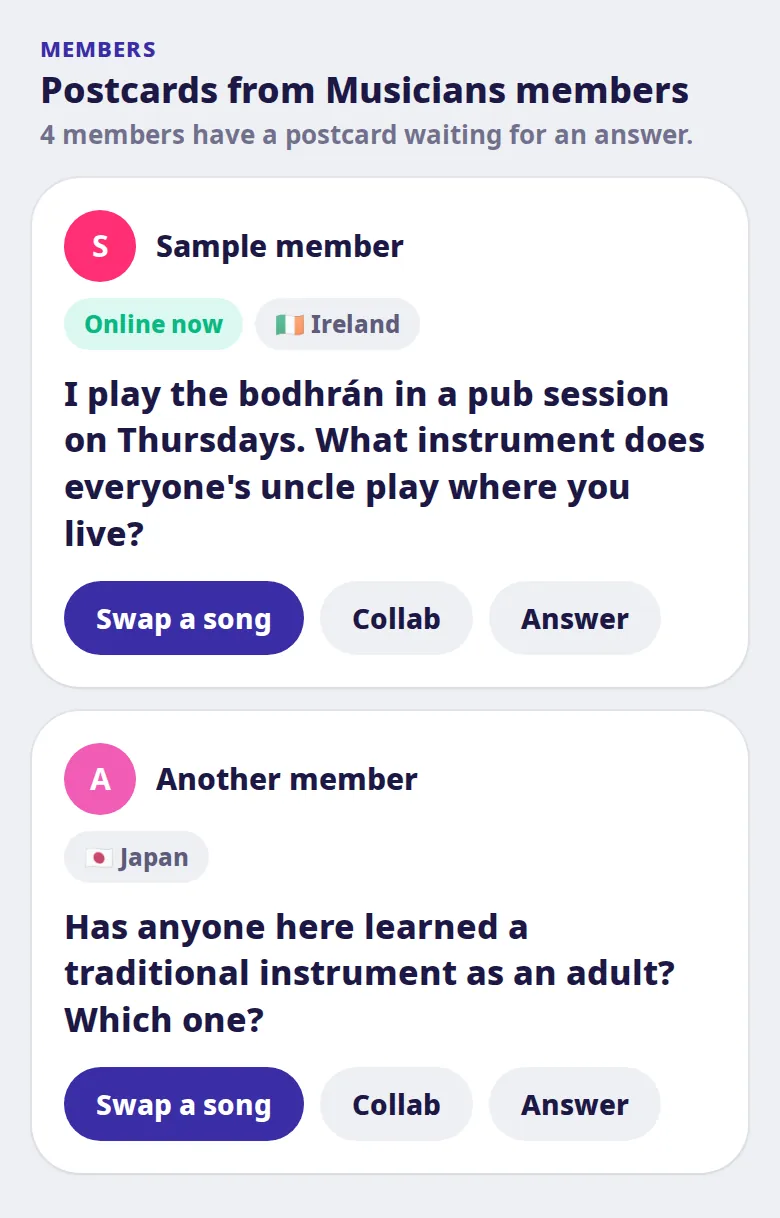 Example screen with sample members, not real people.
A few honest details:
- It is text chat only. No voice and no video, so you trade the names of songs and players, then listen on your own.
- Every message is translated both ways, with the original visible, so a kora player in Senegal and a koto player in Japan can each write in their own language.
- Adults 18+ only, with birth year asked at join and no ID check. Report and block are in every chat, and contact details are stopped before delivery.
- No ads and no paid plan.
To make music with someone, not just talk about it, see how to find musicians to collaborate with online. And if a song swap turns into a long chat, make friends from other countries online has ideas for keeping it going.
Questions to ask a musician from another country
- What instrument does everyone's uncle or grandmother play where you live?
- What is the one song every learner starts with?
- Where do people play: weddings, pubs, temples, festivals, at home?
- Which traditional instrument would you learn if you started today?
- What does your instrument sound like at a celebration, and at a funeral?
For more open questions, our list of pen pal questions works for musicians too.
Questions people ask
+What are some traditional instruments from different countries?
A few well-known ones: the koto and shamisen (Japan), the erhu and guzheng (China), the sitar and tabla (India), the duduk (Armenia), the kora (West Africa), the mbira (Zimbabwe), the bodhrán (Ireland), the bagpipe (Scotland), the kantele (Finland), the steelpan (Trinidad and Tobago), the charango (the Andes) and the didgeridoo (northern Australia).
+What are the main types of musical instruments?
In everyday terms: string instruments (plucked, bowed or strummed), wind instruments (blown, through a reed, across a hole or with buzzing lips) and percussion (struck, shaken or slapped). Museums use a finer system that separates drums with a skin (membranophones) from instruments whose own body sounds, like the steelpan or mbira (idiophones).
+Which instruments are on UNESCO's intangible heritage lists?
Several on this page are, usually as a music tradition rather than the object alone. Examples: the Armenian duduk and its music (2008), Mongolian morin khuur music (2008), the Sosso-Bala balafon in Guinea (2008), Kazakh dombra kuy (2014), marimba music of Colombia and Ecuador (2015), the mbira of Malawi and Zimbabwe (2020), Indonesian gamelan (2021) and crafting and playing the oud in Iran and Syria (2022).
+Which country has a national instrument by law?
Trinidad and Tobago. The steelpan was proclaimed the national instrument in 1992, and in 2024 Parliament passed a law recognising it as the country's national musical instrument. Many countries have an instrument that is widely called 'national' without any law behind it.
+Can adults learn a traditional instrument from another country?
Yes. Many people start as adults. Find a teacher or a group that plays the instrument in its own tradition, listen to a lot of recordings, and ask players from that country which pieces beginners learn first.
Keep reading
Boarding pass · free
Tap, fly to a random country, and chat with someone who lives there.
Text first, translated both ways, no video, no coins to meet people. Works in your browser.
Take off on OluNew here? Read Ablo App: The Complete Story of the Chat App That Let You Fly Anywhere (2019–2022), the full history in one place.