 Olu
How to Find Musicians to Collaborate With Online (and Make It Work)
Where to find musicians to collaborate with online, how to approach them, and how remote collaboration works: stems, tempo and key notes, file sharing, splits.
Updated 19 November 2026 · 9 min read
On this page
- What online music collaboration looks like
- Where to find musicians to collaborate with online
- How to approach a musician
- How remote collaboration works, step by step
- Credits and splits: agree before the song is finished
- A collaborator in another country
- Staying safe when you collaborate online
- When a collaboration stalls
You have a song with a hole in it. Maybe it needs a guitar part, a second voice, or someone who can actually mix. The people around you either don't play or don't like your kind of music. The good news is that you no longer need them in the room. Most musicians who collaborate online never meet. They swap files, notes and ideas across cities and countries.
This guide covers where to find musicians to collaborate with online, how to approach them so they answer, how remote collaboration actually works (stems, tempo and key notes, file sharing), and how to settle credits before they become a problem.
The short answer: to find musicians to collaborate with online, post a specific project on a collaboration platform (Kompoz, BandLab, Vampr), in forums and subreddits for your genre, or message artists you already admire on SoundCloud, TikTok or Instagram. To pay for a part, use a marketplace like SoundBetter. Once you find someone, chat first, agree roles, then trade stems that all start at bar 1, with the tempo, key and sample rate written down. Put credit splits in writing before the song is finished.
Swap a song or find a collaborator abroad
What online music collaboration looks like
"Collaboration" covers a few different ways of working:
- File swapping. The most common. You record in your own software, export your parts, and send them. Your collaborator adds theirs and sends them back.
- Shared cloud projects. Browser-based studios hold one project that several people edit. BandLab, for example, runs in a browser or on a phone.
- Real-time sessions. Low-latency tools let people play or produce together live. They need good internet and more setup.
- Hired parts. You pay a session player, singer or mix engineer to deliver a part. It's quicker and clearer, but it's a job, not a partnership.
Most songwriters start with file swapping, because it works with any software and any time zone.
Where to find musicians to collaborate with online
Collaboration platforms
These are built for finding collaborators:
- Kompoz calls itself a music collaboration platform. Musicians record in their own software, upload tracks to a project, and post "help wanted" requests for the parts they need. Its help pages say outside uploads aren't added to your song until you accept them, so you stay in control.
- BandLab is a free browser and mobile studio. Its shared projects let you invite collaborators into the same song, and its site says each project can take up to 50.
- Vampr describes itself as a social platform for creatives to find people to collaborate with. You describe your project and collaborators come to you. Its own blog suggests saying the role you need, the genre, the location and whether it's paid.
Marketplaces for hiring
SoundBetter is a marketplace for hiring mixing and mastering engineers, singers, songwriters, producers and studio musicians. Use it when you need a finished part by a date, not a creative partner.
Social media, forums and credits
- Forums and subreddits for your genre. Hypebot's guide (originally from the Lyric Studio blog) names Music Banter, the Make Pop Music Facebook group and Reddit's hip hop community as places its author met collaborators.
- SoundCloud. An older but practical guide suggests searching for your genre and filtering by city. If nobody close fits, collaborate online instead. If a message goes unanswered for a few days, try the person's more active social account.
- Song credits. The Hypebot guide also suggests checking the writing and production credits on a song you love, then contacting those writers or producers directly. Smaller names answer more often than you'd think.
- TikTok and Instagram. Duets, stitches and comment threads are a low-pressure way to show someone what you do before you ask anything.
Collaboration is normal at every level. The same Hypebot article, from 2022, says only 13 Billboard Hot 100 number ones in the 21st century were written by one person alone.
A comparison
| Option | Best for | How it works |
|---|---|---|
| Kompoz | Finding players for a song you started | Projects, uploaded tracks, help-wanted posts |
| BandLab | Working in one shared project | Free browser and mobile studio, shared projects |
| Vampr | Meeting musicians by role and genre | Profiles, project posts, messages |
| SoundBetter | Paying for a finished part or mix | Hire professionals by role |
| SoundCloud, TikTok, Instagram | Finding artists whose sound you like | Follow, comment, then message |
| Genre forums and subreddits | Peers who share your taste | Post your project, reply to others |
Features change, so check each site before you rely on it.
How to approach a musician
Most collaboration requests get ignored because they're vague. A good first message has four parts:
- What you heard. Name one of their songs and what you liked about it.
- What you have. One line on your song, plus a link to a rough demo.
- What you need. The exact part: "a fingerpicked acoustic guitar under the second verse."
- What's in it for them. Shared credit, a split, payment, or a part on their next track.
For example: "I loved the guitar on your track 'Low Tide'. I'm a pianist writing a slow indie song at 72 BPM in D minor, demo here. Would you add a guitar part to the verses? Shared writing credit if you add a melody, and I'll play keys on one of yours."
Soundtrap's blog adds two useful rules: connect before you write, ideally with a call about what the song should feel like, and don't say yes to every invite. Focus on one collaboration at a time.
How remote collaboration works, step by step
1. Agree the basics before anyone records
Write a short session note and share it with every file:
- Tempo (BPM), and any tempo changes with the bar they happen at.
- Key, and any key changes.
- Sample rate and bit depth of the project. Mismatched sample rates are a classic cause of parts that play back at the wrong speed or pitch.
- Song structure with bar numbers: "Intro bars 1 to 8, verse 9 to 24".
- Who does what: who writes, who plays, who mixes.
2. Export stems that line up
Stems are separate audio files for each part (drums, bass, piano, vocal). A recent Hypebot article on sending stems gives the key rule: every file starts at the same point and covers the same range, even if a part is silent for the first minute. Don't trim the silence off the front. Before sending, import the exact files into a new, empty project at the agreed tempo and check that later entrances land where they should. Include a rough mix, clearly labelled as a reference.
Uncompressed WAV files are the usual format. They open in any DAW, so your collaborator doesn't need the same software as you.
3. Share files and keep versions straight
Use a shared folder you both trust, and name files so nobody gets lost: songname_guitar_v2_72bpm_Dmin.wav. Keep a short changelog in the folder: what changed, who changed it, and what's needed next.
4. Give notes like a collaborator
Soundtrap's blog warns against being "sound greedy", piling on your own parts until the other person has no room. Leave space, ask before replacing someone's part, and keep feedback about the music: "the guitar fights the vocal in bar 20" beats "I don't like it".
Credits and splits: agree before the song is finished
The fastest way to lose a collaborator is to argue about ownership after the song does well. Use a split sheet: a short document that records who wrote what share of a song.
Hypebot's split sheet guide lists what to include: the song title (a working title is fine), each writer's legal name and contact details, their role (lyrics, melody, music), their percentage, their performing rights organisation and IPI/CAE number if they have one, and everyone's signature. It also warns never to assume a song will be split equally, and to settle splits by the end of the last writing session at the latest.
Two more points:
- The song and the recording are different things. Writing splits cover the composition. Who owns a particular recording (the master) is a separate agreement, so say which you mean.
- Playing on a track isn't the same as writing it. Agree up front whether a part is a paid or favour session, or a writing contribution.
For anything with real money behind it, talk to a music lawyer.
A collaborator in another country
Collaborating across borders has a real upside: different scales, rhythms and production habits get into your song. A guitarist in another country may hear your piano part in a way nobody local would.
Olu is a free text chat site for meeting people in other countries, in your browser, for adults 18+. Its Musicians planet brings together players, singers and producers from everywhere to share what music sounds like where they live, find people to learn from, and talk gear, practice and gigs. Its ritual is Song swap: you swap the song everyone in your country knows for the one everyone in theirs knows, and players and singers answer with the song and the story behind it. Member postcards have buttons to Swap a song, start a Collab, or Answer.
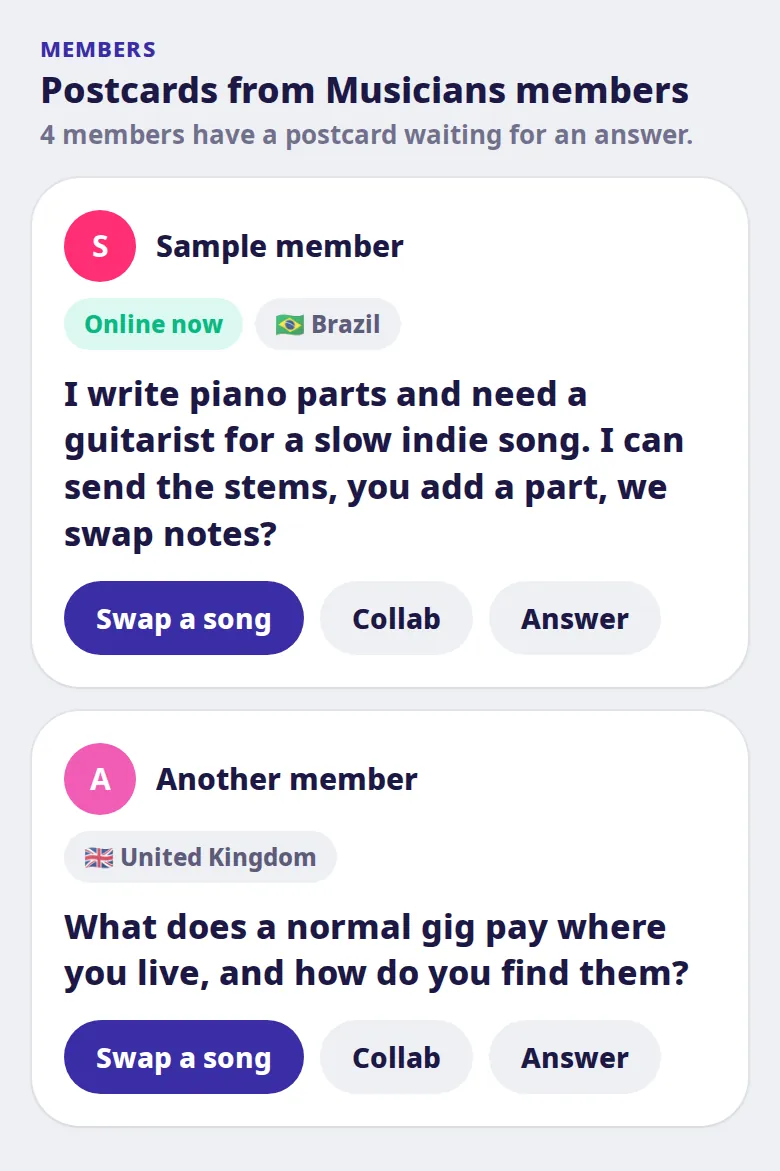 Example screen with sample members, not real people.
A few honest details:
- It's text chat only. No voice, no video and no file hosting. Use it to meet someone, agree the idea, tempo, key and roles, then swap files somewhere you both trust.
- Every message is translated both ways, with the original visible, so your collaborator doesn't need to speak your language.
- It's a small community. At quiet hours, nobody may answer straight away.
- Report and block are in every chat, and contact details are stopped before delivery.
A song swap is also a gentle way in if you're not ready to pitch a collab. If it turns into a long conversation, make friends from other countries online has ideas for keeping it going.
Staying safe when you collaborate online
- Never pay to be "featured" or promoted by an account you don't know. Real collaborators don't charge you to work with them.
- Be wary of overpayments. A "client" who pays too much and asks you to send the difference back is running a scam.
- Only open audio files you expect, and be careful with installers, plugins or "sample packs" a stranger sends you.
- Keep your address and phone number private until you've worked together and know who you're dealing with.
- Keep your own copies of every stem and version you make.
More tips for talking to people you meet online are in random text chat safety tips.
When a collaboration stalls
- Nobody sends the next file. Set a small deadline: "verse guitar by Sunday".
- Too many cooks. Name one person who makes the final call on the mix.
- You've drifted apart musically. Finish the song you started, credit everyone fairly, and part on good terms.
If you also make visual work, online art communities covers how artists swap works in progress. If lyrics are your part, a writing buddy can keep you writing between sessions.
Questions people ask
+Where can I find musicians to collaborate with online?
Try collaboration platforms such as Kompoz, BandLab and Vampr, forums and subreddits for your genre, SoundCloud and TikTok, and the credits of songs you like. To hire a session player or engineer instead, use a marketplace such as SoundBetter. Post a specific project, not a general 'anyone want to collab?'.
+How do musicians collaborate online?
Usually by trading files. One person records a part in their own software, exports stems that all start at the same point, and sends them with the tempo and key. The other adds a part and sends it back. Cloud studios like BandLab let several people work in one shared project instead.
+What are stems in music?
Stems are separate audio files for each part of a song, such as drums, bass, piano and vocals. Exported from the same start point and at the same length, they line up when a collaborator drops them into their own project.
+How do you split credit when you collaborate on a song?
Agree it in writing early, ideally before the last session ends, using a split sheet: song title, everyone's legal name and role, each person's percentage (adding up to 100%), and signatures. Don't assume an equal split. For big deals, talk to a music lawyer.
+Do I need the same DAW as my collaborator?
No. Exported audio files (WAV is the usual choice) open in any DAW. You only need the same software if you want to swap whole project files. Agree the sample rate, tempo and key before anyone records.
Keep reading
Boarding pass · free
Tap, fly to a random country, and chat with someone who lives there.
Text first, translated both ways, no video, no coins to meet people. Works in your browser.
Take off on OluNew here? Read Ablo App: The Complete Story of the Chat App That Let You Fly Anywhere (2019–2022), the full history in one place.