 Olu
Nursing in Different Countries: Training, Ratios, Shifts and Working Abroad
Nursing in different countries compared: how nurses train, who does what, nurse-to-patient ratios, shift lengths, migration and how registration abroad works.
Updated 19 November 2026 · 10 min read
On this page
- Nurses around the world in numbers
- How nurses train in different countries
- Who does what: titles and levels of nursing
- Nurse-to-patient ratios
- Shifts: 8 hours, 12 hours and nights
- Nurses who move abroad
- How to register as a nurse in another country
- Talking to nurses in other countries
- Questions worth asking a nurse abroad
Ask a nurse in Manila, Munich, Manchester and Melbourne what their week looks like and you'll get four different answers. They trained in different ways, carry different titles, look after different numbers of patients and work different shifts. Many of them will also know someone who has moved abroad to nurse, or be thinking about it.
This guide compares nursing in different countries using official sources: the size of the workforce, how training works, who does what, nurse-to-patient ratios, shift lengths, migration, and how registration works when you want to nurse abroad. Rules change, so check any detail with the regulator before you rely on it.
The short answer: nursing shares the same core work everywhere, but training routes, titles, staffing ratios and shift patterns differ a lot from country to country. The UK trains nurses on a 3-year degree in one of four fields, Germany on a 3-year generalist training, and the Philippines requires a nursing bachelor's degree. Some places, like California and Victoria in Australia, set ratios in law. About 1 in 7 nurses worldwide was born abroad, and moving countries usually means a new exam, a language test and registration with a new regulator.
Talk to a nurse in another country
Nurses around the world in numbers
The World Health Organization's State of the World's Nursing 2025 release (May 2025) gives the big picture:
- 29.8 million nurses worldwide in 2023, up from 27.9 million in 2018.
- A shortage of 5.8 million nurses in 2023, down from 6.2 million in 2020, and projected to fall to 4.1 million by 2030.
- Uneven spread. About 78% of the world's nurses work in countries that hold 49% of the world's population.
- Mostly women. 85% of nurses are women.
- A young workforce, overall. 33% of nurses are under 35, while 19% are expected to retire within 10 years.
- Born abroad. 1 in 7 nurses worldwide is foreign-born. In high-income countries it's 23%, compared with 8% in upper-middle-income, 1% in lower-middle-income and 3% in low-income countries.
How nurses train in different countries
Training routes are one of the biggest differences. Here are four countries where the rules are published clearly by an official source:
| Country | Main route to becoming a registered nurse | Source |
|---|---|---|
| United Kingdom | Approved degree in one of four fields (adult, children's, learning disability, mental health). 3 years full-time, 4 for a dual field. Degree apprenticeships also exist, mostly 4 years. Then registration with the NMC. | NHS Health Careers |
| Germany | Since 1 January 2020, training under the Nursing Professions Act (Pflegeberufegesetz). 3 years full-time or up to 5 part-time, with the first 2 years as joint generalist training, ending in a state exam. A nursing degree of at least 3 years is also possible. | Federal Ministry of Health |
| Philippines | A Bachelor's Degree in Nursing is required to sit the nurse licensure exam, then a written exam set by the Board of Nursing. | Philippine Nursing Act of 2002 (RA 9173) |
| United States | A first-level nurse (RN) program of at least 2 years, then the NCLEX-RN exam. Licences are issued by each state's board of nursing. | NCSBN manual |
Two points stand out. First, the UK makes you choose a field at the start, while Germany starts everyone with shared generalist training. Second, the US has no single national licence: each state's board of nursing makes its own licensing decisions.
Who does what: titles and levels of nursing
The word "nurse" covers different jobs in different places.
- Registered nurses and second-level nurses. The NCSBN separates first-level nurses (registered nurses) from second-level nurses, called licensed practical or vocational nurses (LPN/VN) in the US, who take a different exam, the NCLEX-PN.
- Nursing associates in England. NHS Health Careers is direct about it: a nursing associate is not a registered nurse.
- German job titles. Since the 2020 reform, people who pass the exam can use the title Pflegefachfrau, Pflegefachmann or Pflegefachperson.
- Advanced practice. WHO reports that 62% of countries now have advanced practice nursing roles, up from 53% in 2020. What those nurses are allowed to do varies a lot by country.
If you're talking to a nurse abroad, asking "what's your exact title and what can you do on your own?" often explains more than comparing job names.
Nurse-to-patient ratios
How many patients one nurse looks after is one of the most talked-about differences, and one of the hardest to compare, because most places don't set a single legal number.
Two places that do:
California, US. State regulations (Title 22, section 70217) set minimum ratios by unit, including:
| Unit | Nurse : patients |
|---|---|
| Critical care | 1 : 2 |
| Labor and delivery (active labor) | 1 : 2 |
| Step-down | 1 : 3 |
| Emergency | 1 : 4 |
| Pediatrics | 1 : 4 |
| Medical-surgical | 1 : 5 |
Victoria, Australia. Victoria put nurse- and midwife-to-patient ratios into law in 2015. In April 2025 the state government announced changes, including 1 nurse per occupied intensive care bed on all shifts in its Level 1 and 2 hospitals, and a night-shift midwife ratio of 1 to 4 on antenatal and postnatal wards, down from 1 to 6.
Elsewhere, staffing often depends on hospital policy, local agreements or guidance rather than a number in law. That's why nurses comparing notes across borders so often start with "how many patients did you have last night?"
Shifts: 8 hours, 12 hours and nights
Shift length is another big difference. A study by Griffiths and colleagues, published in Medical Care in 2014, surveyed 31,627 registered nurses in 488 hospitals across 12 European countries. It found:
- 15% of nurses worked shifts of 12 hours or more.
- Long shifts were far more common in England, Ireland and Poland than in the other countries studied.
- Shifts of 12 hours or more were linked with nurses reporting lower quality and safety of care and more care left undone. The data were self-reported by nurses.
So a nurse in one country may work three long days a week while a colleague elsewhere works five shorter ones. Night work is common almost everywhere hospitals run around the clock, and how nurses cope with it is one of the most shared topics between nurses in different countries.
Nurses who move abroad
Nursing is one of the most international jobs there is. The International Council of Nurses described the pattern in its 2024 report to WHO on international recruitment:
- Source countries. The Philippines and India have historically educated nurses for emigration. ICN reports that the Philippines itself now has a shortage of 190,000 healthcare workers and expects a shortage of 250,000 nurses by 2030.
- Step-by-step moves. ICN describes "stepping stone" or "carousel" migration. In the UK in 2022/23, nurses who first qualified outside the UK and the EU made 70% of applications for a certificate of professional status to work abroad. More than 4 in 5 of these applications from UK-registered nurses were for Australia, New Zealand or the US.
- Small countries feel it most. Tonga and Fiji were reported at the 2024 World Health Assembly as losing 20-30% of their nurses year on year, mainly to Australia and New Zealand.
- Africa. ICN cites reports of about 500 nurses leaving Ghana every month, and more than 1,700 registered nurses resigning in Zimbabwe in 2021.
ICN opposes targeted recruitment from countries with chronic nurse shortages, and WHO has called on high-income countries to review their reliance on foreign-trained nurses and strengthen bilateral agreements. Behind each of these numbers is a personal decision, and a gap left in the health system a nurse leaves behind.
How to register as a nurse in another country
Every country sets its own rules, and they change. Use these as examples of what to expect, then check the regulator itself.
United Kingdom
Overseas nurses must join the Nursing and Midwifery Council (NMC) register. The Royal College of Nursing says they need to show they can practise safely and that they speak English well enough, with OET accepted as an alternative to IELTS.
An NHS England international recruitment guide from June 2023 described the process at that time:
- A two-part Test of Competence: a computer-based test of 115 questions (15 numeracy, 100 clinical) taken in the home country, then a practical exam (OSCE) at a UK test centre.
- The OSCE taken within 12 weeks of the job start date, with up to 3 attempts.
- Registration completed within 2 years of passing the computer test.
- English scores at that time: IELTS 7.0 in speaking, listening and reading, 6.5 in writing and 7.0 overall, or OET with C+ in writing and B in the other parts.
Check the NMC's own site for current requirements before you apply.
United States
The NCSBN's manual on licensing internationally educated nurses sets out the usual steps:
- A credentials evaluation, usually by an evaluation agency, to decide whether your education is comparable to US nursing education.
- Passing the NCLEX-RN (or NCLEX-PN for practical nurses).
- An English proficiency exam, unless you come from a country where English is the native language and your program was taught in English with English textbooks.
- Criminal background and fingerprint checks.
Each state board of nursing makes the final decision, so requirements differ by state.
Philippines
Section 20 of the Philippine Nursing Act allows registration by reciprocity: a licence may be issued without the exam to nurses registered in another country, if that country's requirements are substantially the same and it grants the same privileges to Filipino nurses. Everyone else takes the licensure exam, which needs a Bachelor's Degree in Nursing.
A tip that applies everywhere
Start on the regulator's own website, not a recruiter's blog. Recruitment pages can be out of date or written to sell a placement. And talk to nurses who have already made the move. They'll tell you what the paperwork doesn't.
Talking to nurses in other countries
Reading rules only goes so far. The quickest way to learn what nursing in another country is really like is to ask someone who does it.
Olu is a free text chat site for adults 18+ to meet people in other countries, in your browser. Its Health workers planet is for nurses, doctors, carers and everyone who keeps people well, to compare night shifts, training and burnout across countries. Its ritual is called Quiet-hours company: on a quiet moment during a shift, send a postcard and talk to someone who understands the work. Somewhere, a nurse is awake at every hour. Buttons let you Talk a while, Swap a survival tip or Answer someone else's question.
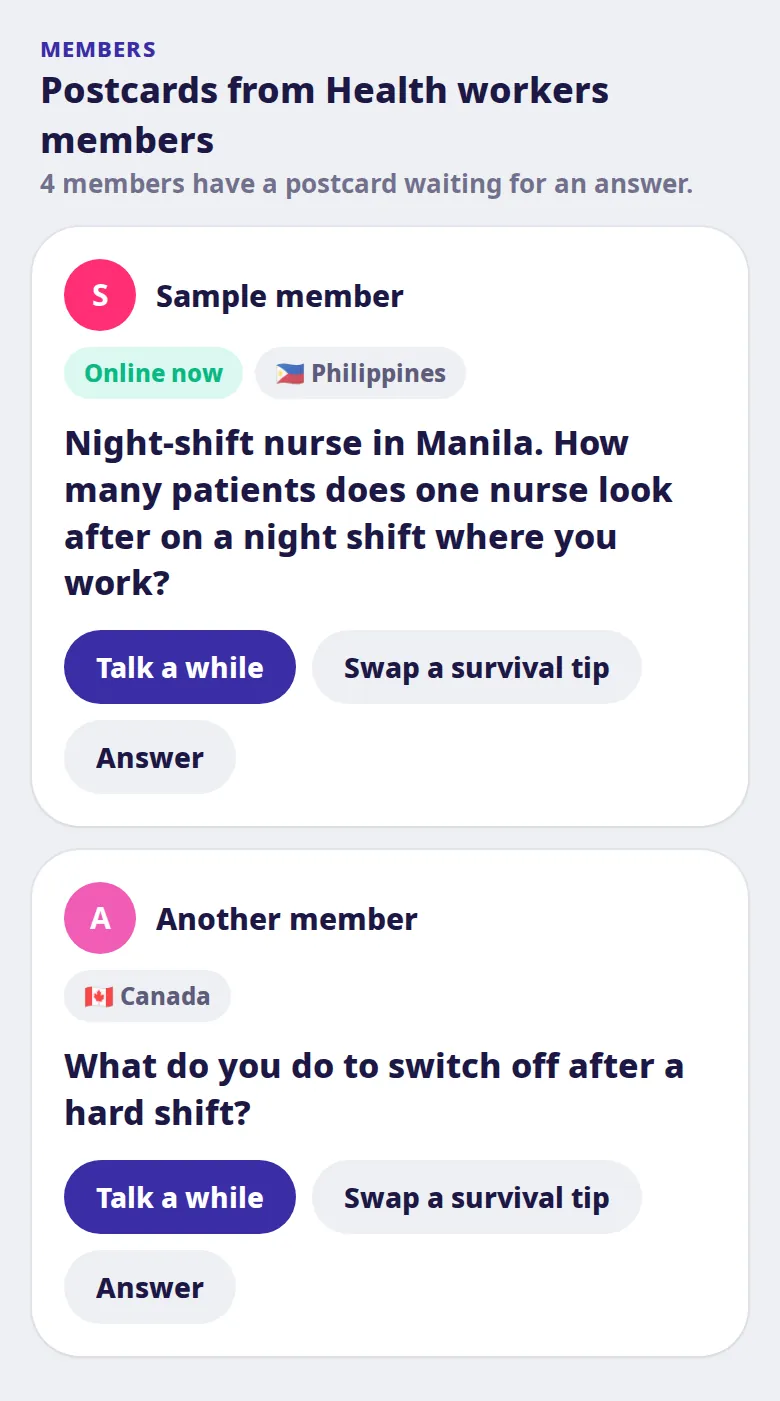 Example screen with sample members, not real people.
A few honest details:
- No patient details, ever. Talk about the work, not about the people you care for.
- No medical advice for individual cases. It's a place to compare jobs and swap tips, not to get or give clinical advice.
- Every message is translated both ways, with the original visible, so a nurse in Germany and a nurse in the Philippines can talk in their own languages.
- It's text only. No voice, no video, and contact details are stopped before delivery.
- Adults 18+ only. Birth year is asked at join; there's no ID check.
- The community is small. At quiet hours nobody may answer right away. Report and block are in every chat, and there are no ads and no paid plan.
Questions worth asking a nurse abroad
If you get talking to a nurse in another country, these questions open up the real differences:
- How long did your training take, and did you choose a field at the start?
- How many patients do you usually have on a day shift, and on nights?
- How long are your shifts, and how many do you work in a week?
- What can you do on your own, and what needs a doctor's sign-off?
- Have you thought about working abroad? What put you off, or what pulled you?
- What do you do to switch off after a hard shift?
The last one often starts the best conversations. If a colleague, at home or abroad, has had a rough shift and you want to support them by message, how to comfort someone over text has ideas. And for more on talking across languages, see chatting with people from other countries with translation and how to make friends from other countries online.
Questions people ask
+How many nurses are there in the world?
The World Health Organization counted 29.8 million nurses in 2023, up from 27.9 million in 2018. It estimated a global shortage of 5.8 million nurses in 2023, projected to fall to 4.1 million by 2030, with large gaps between regions.
+Is nurse training the same length in every country?
No. In the UK an approved full-time nursing degree lasts 3 years (4 for a dual field). In Germany the vocational training lasts 3 years full-time. In the Philippines you need a Bachelor's Degree in Nursing to sit the licensure exam. In the US, the NCSBN describes registered nurse programs as lasting at least 2 years.
+Can a nurse from one country work in another?
Usually yes, but not straight away. Most countries ask for a review of your education, a licensing exam or test of competence, proof of English or the local language, and background checks. Each country, and in the US each state, has its own regulator, so start on that regulator's own website.
+Do all countries have legal nurse-to-patient ratios?
No. Some places set ratios in law. California has done so for years, for example 1 nurse to 2 patients in critical care and 1 to 5 on medical-surgical units. Victoria in Australia put ratios into law in 2015. Many other places rely on staffing guidance instead.
+Are 12-hour nursing shifts normal everywhere?
No. A study of 31,627 nurses in 12 European countries found 15% worked shifts of 12 hours or more, and that long shifts were far more common in England, Ireland and Poland. Shift patterns vary by country, hospital and ward.
Keep reading
Boarding pass · free
Tap, fly to a random country, and chat with someone who lives there.
Text first, translated both ways, no video, no coins to meet people. Works in your browser.
Take off on OluNew here? Read Ablo App: The Complete Story of the Chat App That Let You Fly Anywhere (2019–2022), the full history in one place.