 Olu
Read Around the World: How the Challenge Works, Plus 30 Books From 30 Countries
How the read around the world challenge works, how to find a book from every country, and 30 books by authors from 30 countries to start your own list.
Updated 19 November 2026 · 10 min read
On this page
Look at your bookshelf and count the countries. When the writer Ann Morgan looked, the shelves showed far less world literature than expected, and many readers in English will find the same. The read around the world challenge fixes that one book at a time: you read a book from every country, or from as many as you can manage, and see the world through writers who grew up there.
This guide explains where the idea comes from, the rules people use, how to find a book for countries where almost nothing is translated, and a starter list of 30 books by authors from 30 countries, each checked.
The short answer: pick a country list, choose one rule (author from the country, or book set there), and read at your own pace. Start with countries you know nothing about. For hard countries, ask readers who live there, search translation prize longlists and world-writing magazines, and accept that one good book is enough.
Ask a reader abroad for their country's best book
Where the read around the world challenge comes from
The best-known version is Ann Morgan's project. In 2012, the UK-based writer and editor set out to read one book from every country in the world in a single year and wrote about each one on the blog A Year of Reading the World. The project FAQ says the list covered 195 UN-recognised sovereign states plus former UN member Taiwan, and blog visitors chose one extra territory.
Morgan asked the internet for help. The page describing the project invited readers to say what was hot in Russia, cool in Malawi and smoking in Iceland, and suggestions poured in. The FAQ gives the pace: about 150 pages a day, or four books a week. The project became a book, Reading the World (The World Between Two Covers in the US).
The idea has spread far beyond one blog, and many readers now run their own versions, some with printable trackers. Morgan's blog still keeps the list: a record of the book recommendations received for each country before, during and after the 2012 project, with a new Book of the Month added most months.
The rules: pick yours before you start
There is no official rulebook. The FAQ says it plainly: you can set your own rules. Most challenges differ on three points.
| Question | Common choices | Why it matters |
|---|---|---|
| Which country list? | UN members, a sports or travel list, or "every country I can find a book for" | Sets your total. Morgan's 2012 list was 196. |
| Author or setting? | Author from the country; book set in the country; either | Author rule gives you an inside view. Setting rule is easier for rare countries. |
| Fiction only? | Novels only; any book, including memoir, poetry, folk tales | Some countries have more memoir or poetry in translation than novels. |
| Deadline? | One year; one continent a year; no deadline | A year means about 4 books a week. You can go slower. |
Morgan mostly read writers from each country rather than books set there, though many of the books were set in the writers' homelands. The Literary Lifestyle's challenge counts any book set in a country. Directionally Challenged Traveler accepts a local author, non-fiction about the place, or a well-researched book set there.
Our suggestion: use the author rule wherever you can, and allow a book set in the country only when nothing by a local writer exists in a language you read. Write the rule at the top of your list, so you don't argue with yourself in month nine.
How to find a book from every country
Big countries are easy. The hard part is the 40 or 50 countries where your bookshop has nothing. Morgan's project page quotes a Literature Across Frontiers figure: at the time, just 4.5 per cent of poetry, fiction and drama published in the UK were translations. For some languages, next to nothing exists in English.
These methods work, roughly in order of effort:
- Ask someone who lives there. This was Morgan's main method, and it still works best. A reader in a country knows which book everyone there grew up with, and which one is only famous abroad.
- Use translation prize lists. The International Booker Prize is given each year to a single book translated into English and published in the UK or Ireland, and the prize is shared equally between author and translator. Its longlists from past years are a ready-made list of translated fiction.
- Read a world-writing magazine. Words Without Borders, founded in 2003, has published writing from 147 countries and 148 languages. A short story is a good way to sample a writer before you commit to a novel.
- Search your library catalogue by country. Search the country name with "fiction" or "translated", and ask a librarian about interlibrary loans for rare titles.
- Check the reading lists already out there. Morgan's list has several suggestions for most countries. Choose one and move on.
- Widen the form. If no novel exists, read a memoir, a poetry collection or a book of folk tales.
Morgan's FAQ also warns that some titles have gone out of print and others are sold only by specialist local shops. Libraries and second-hand sellers are your friends here.
30 books from 30 countries to start your list
Every book below appears under its country on Morgan's list, and we checked each author's country in their encyclopedia entry. This is a starter list, not a "best of": most countries have many great books, and readers there may point you to others.
Africa
| Country | Book | Author | Good to know |
|---|---|---|---|
| Nigeria | Things Fall Apart | Chinua Achebe | First novel, 1958 |
| Kenya | A Grain of Wheat | Ngũgĩ wa Thiong'o | |
| Senegal | So Long a Letter | Mariama Bâ | Written in French |
| Egypt | Midaq Alley | Naguib Mahfouz | Author won the 1988 Nobel Prize |
| Sudan | Season of Migration to the North | Tayeb Salih | |
| Zimbabwe | Nervous Conditions | Tsitsi Dangarembga | Debut novel, 1988 |
Asia and the Middle East
| Country | Book | Author | Good to know |
|---|---|---|---|
| Japan | Snow Country | Yasunari Kawabata | Cited by the Nobel committee in 1968 |
| South Korea | The Vegetarian | Han Kang | Won the International Booker in 2016 |
| China | The Garlic Ballads | Mo Yan | Novel from 1988 |
| India | Malgudi Days | R. K. Narayan | Stories set in a fictional South Indian town |
| Pakistan | The Wandering Falcon | Jamil Ahmad | Written in English |
| Vietnam | The Sorrow of War | Bao Ninh | Author's first novel |
| Indonesia | This Earth of Mankind | Pramoedya Ananta Toer | |
| Kyrgyzstan | Jamilia | Chinghiz Aitmatov | Short novel, first published in Russian in 1958 |
| Uzbekistan | The Railway | Hamid Ismailov | English translation by Robert Chandler, 2006 |
| Kazakhstan | The Silent Steppe | Mukhamet Shayakhmetov | Memoir |
| Turkey | Snow | Orhan Pamuk | Author won the 2006 Nobel Prize |
| Iran | Touba and the Meaning of Night | Shahrnush Parsipur |
Europe
| Country | Book | Author | Good to know |
|---|---|---|---|
| Norway | Hunger | Knut Hamsun | Author won the 1920 Nobel Prize |
| Poland | Stone upon Stone | Wiesław Myśliwski | Author won the Nike Award twice |
| Italy | My Brilliant Friend | Elena Ferrante | Written under a pen name |
| Portugal | Blindness | José Saramago | Author won the 1998 Nobel Prize |
| Russia | Anna Karenina | Leo Tolstoy |
The Americas and Oceania
| Country | Book | Author | Good to know |
|---|---|---|---|
| Mexico | Pedro Páramo | Juan Rulfo | Novel from 1955 |
| Brazil | Dom Casmurro | Machado de Assis | |
| Argentina | Fever Dream | Samanta Schweblin | |
| Chile | The House of the Spirits | Isabel Allende | Novel from 1982 |
| Peru | Aunt Julia and the Scriptwriter | Mario Vargas Llosa | |
| Australia | Cloudstreet | Tim Winton | Novel from 1991 |
| New Zealand | The Bone People | Keri Hulme | Won the Booker Prize in 1985 |
Central Asia is where many readers get stuck. The three books from Kyrgyzstan, Uzbekistan and Kazakhstan above are a good way through, and Morgan's list has more for Tajikistan and Turkmenistan.
How to keep going for a year (or five)
A list of 196 countries is long. A few habits help you keep going:
- Alternate easy and hard. Follow a long classic like Anna Karenina with something short, such as Jamilia.
- Go by region. Read one region a season, so you get a feel for how writers from neighbouring countries talk to each other.
- Keep a one-line log. Country, title, author, translator, one sentence on what stayed with you. In replies on the FAQ page, Morgan says blogging about each book made the books easier to remember.
- Name the translator. Translators make this challenge possible. Note who they are; you will start to recognise names you trust.
- Read with someone. A friend or a group keeps you honest. If you run a club, our book club questions work for any title on this list.
- Don't race. Morgan read four books a week because the project had a one-year deadline. You don't have one.
The best recommendations come from readers who live there
A list gets you started. A person gets you the book. When you ask a reader in Uzbekistan what to read, you get a reason, a story about the first time they read it, and often a second title you would never have found.
That is what the Book lovers planet on Olu is for. Olu is a free text chat site for meeting people in other countries, and the Book lovers planet is its group for "what the world is reading." The planet's ritual is the Book swap: you trade one book from your country for one from theirs. Tell a reader abroad what you just finished, and they send back the book from their country you should read next. You can also post a Read together request, which stays open for 72 hours, to find someone to read the same book with.
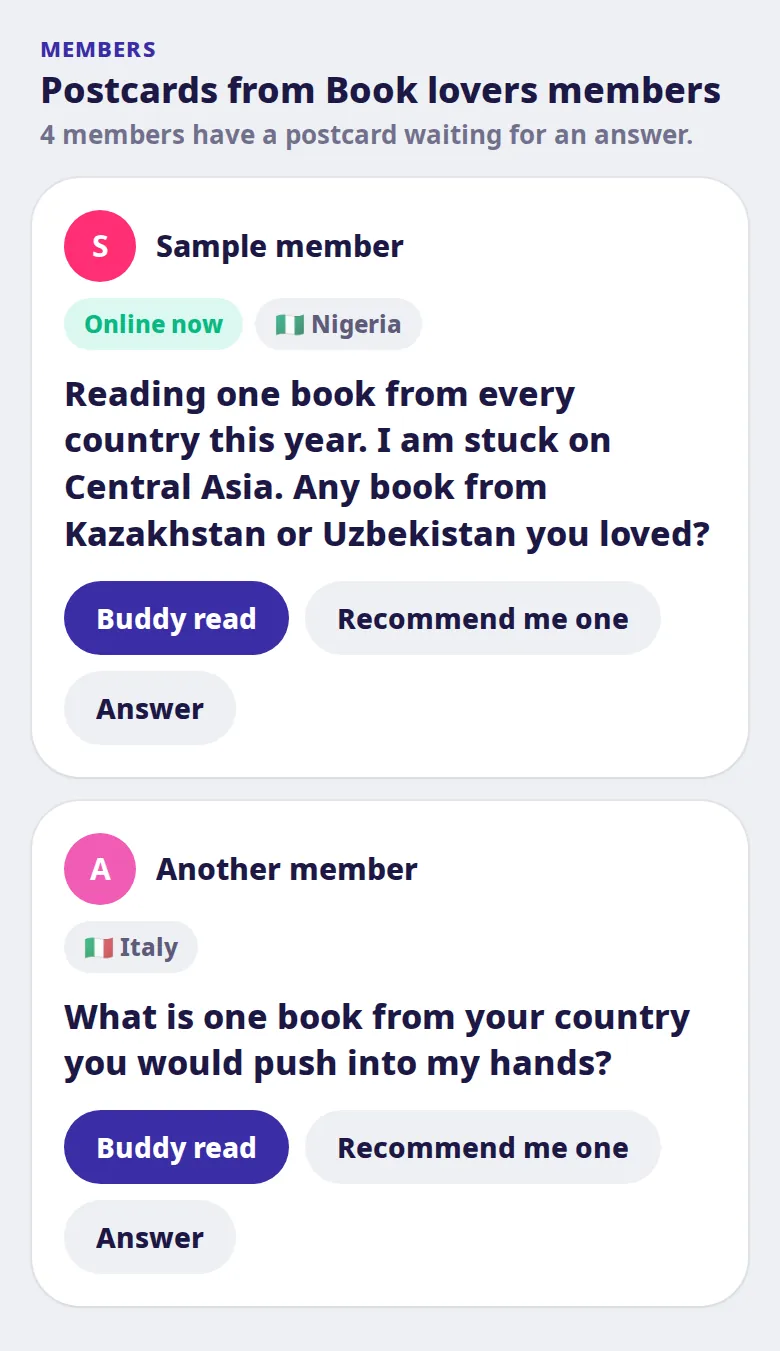 Example screen with sample members, not real people.
Each postcard has three buttons: Buddy read to read a book together, Recommend me one to ask for a pick, and Answer to reply to the question. The planet has three laws: say the book and the author, warn before spoilers, and every taste counts.
Honest limits: it's text only, with no voice or video, and the community is small, so at quiet hours you may wait for an answer. It's for adults 18+, free, with no ads and no paid plan, and it runs in your browser. Every message is translated both ways with the original visible, so a reader in Almaty can recommend a book in Kazakh or Russian and you can read the reply in English. You can report and block anyone, and contact details are stopped before delivery.
If a book swap turns into a long friendship, see how to make friends from other countries online and our guide to international pen pals for adults.
The short version
Choose a country list and one rule, then read at your own pace. Start with the 30 books above or Morgan's list, use prize longlists and world-writing magazines for hard countries, and ask readers who live there. The challenge isn't about finishing 196 books. It's about meeting writers, and readers, you would never have met.
Questions people ask
+What is the read around the world challenge?
A reading goal where you read at least one book from every country, or from as many countries as you choose. Most versions count a book by an author from that country. Some also accept books set there. You set the pace: a year, several years, or no deadline.
+How many countries are there to read?
It depends on the list you use. Ann Morgan's 2012 project used 195 UN-recognised sovereign states plus Taiwan, 196 in all. Many readers start with a smaller goal, such as one book from each continent or 50 countries.
+Does the book have to be by an author from that country?
There is no single rule. Ann Morgan mainly read writers from each country rather than books set there. Other challenges count books set in a country, or well-researched non-fiction about it. Pick one rule before you start and keep it.
+How do you find books from small countries?
Ask readers who live there, search your library catalogue by country, read through translation prize longlists, and look at magazines of world writing such as Words Without Borders. For some countries very little is translated into English, so one book may be all you can find.
+Where can I talk about the books with someone from that country?
Join a book club with members abroad, or find a reader in that country online. On Olu's Book lovers planet you can trade one book from your country for one from theirs, in a free text chat that translates every message.
Keep reading
Boarding pass · free
Tap, fly to a random country, and chat with someone who lives there.
Text first, translated both ways, no video, no coins to meet people. Works in your browser.
Take off on OluNew here? Read Ablo App: The Complete Story of the Chat App That Let You Fly Anywhere (2019–2022), the full history in one place.