 Olu
School Around the World: How School Differs from Country to Country
School around the world, compared: when children start, when the school year begins, how long the day is, lunch, homework, uniforms and exams, with sources.
Updated 19 November 2026 · 10 min read
On this page
Ask a teacher in Santiago when the school year starts and they'll say March. Ask a teacher in Helsinki and they'll say August, and a teacher in Tokyo will say April. School looks familiar everywhere: a timetable, a bell, homework, a test at the end. But the details change a lot once you cross a border.
This guide compares start age, school year dates, day length, lunch, homework, uniforms and exams. Every fact is linked to its source, and anything we couldn't confirm says "not checked".
The short answer: most children start compulsory school at around 6, but the range runs from 3 in France and Hungary to 7 in Croatia and Finland's basic school. Northern Europe often starts the school year in August, most of Europe in September, Japan in April, South Korea and Chile in March, and Kenya and South Africa in January. Lunch, homework, uniforms and exams vary even more. The quickest way to learn how school really works somewhere is to ask a teacher who works there.
Swap one lesson idea with a teacher abroad
School in different countries at a glance
The start age is when compulsory education begins, not optional pre-school. Start ages for Europe come from Eurydice's Compulsory education in Europe 2023/2024; European year start dates come from Eurydice's Organisation of school time in Europe 2023/2024.
| Country | Compulsory school starts | School year begins | Source |
|---|---|---|---|
| Finland | 6 (one compulsory pre-primary year), basic school at 7 | August | Eurydice |
| Sweden | 6 | August | Eurydice |
| Denmark | 6 | August | Eurydice |
| Germany | 6 | 1 August officially; real start depends on each Land's summer holiday | Eurypedia Germany |
| France | 3 | not checked | Eurydice |
| Hungary | 3 | 1 September | Eurydice |
| Ireland | 6 | 1 September | Eurydice |
| Italy | 6 | not checked | Eurydice |
| Netherlands | 5 | not checked | Eurydice |
| Croatia | 7 (part-time pre-primary the year before) | not checked | Eurydice |
| England | The term after the 5th birthday; most start reception the September after turning 4 | September | gov.uk |
| Japan | 6 (the April after the 6th birthday) | April | MEXT, Tokyo Metropolitan Government |
| South Korea | March of the year after the child turns 6 | Early March | Invest Korea |
| Chile | not checked | March (4 March in 2026) | La Tercera |
| Kenya | not checked | January (5 January in 2026) | The Star |
| South Africa | not checked | January (14 January in 2026) | gov.za |
| United States | 5 to 8, set by each state (2017) | not checked; varies by state | NCES |
When children start school
Six is the most common age. Eurydice found that across Europe, compulsory education most often starts at 6, and usually lasts 10 or 11 years, ending at 15 or 16. France has the longest span in Europe: 15 years, from 3 to 18.
The edges are where it gets interesting:
- Finland makes one year of pre-primary education compulsory at 6. According to Eurypedia's Finland overview, comprehensive school then begins at 7 and lasts nine years.
- England separates the age children usually start from the age school is compulsory. The gov.uk page says most children start reception full-time in the September after their fourth birthday, while compulsory school age begins on 31 December, 31 March or 31 August after the fifth birthday, whichever comes first.
- Japan follows a 6-3-3-4 system. MEXT describes six years of elementary school from age 6, then three years of lower secondary until the end of the school year in which a pupil turns 15.
- The United States has no single age. In the NCES 2017 table, 11 of the 51 jurisdictions (the states plus DC) set the compulsory start at 5, 25 at 6, 13 at 7 and 2 at 8.
When the school year starts and ends
In Europe the year generally begins in September. Eurydice lists 11 systems that start on 1 September, including Ireland, Hungary, Estonia, Latvia, Lithuania, Slovenia and Slovakia. A group starts in August instead: Denmark, Finland, Sweden, Norway, Iceland, Switzerland, Liechtenstein and the French Community of Belgium. Finnish schools could start as early as 9 August in 2023/24, while Malta was the last to go back, at the end of September.
Germany is a special case. Its school year officially runs from 1 August to 31 July, but the real first day depends on when each Land's summer holiday ends, so it moves from state to state.
Summer holidays vary just as much. Eurydice says most European systems have 8 to 12 weeks off. Denmark, France, the Netherlands, Norway and some German Länder have 8 weeks or less. Greece, Latvia, Malta, Albania, Iceland, most regions of Italy, and some secondary levels in Ireland and Portugal have more than 12.
South of the equator, the school year often follows the calendar year:
- Chile: La Tercera reported the education ministry's 2026 calendar: teachers back on 2 March, students on 4 March. The winter break for the regions from Antofagasta to Los Ríos, including Santiago's Metropolitana region, runs from 22 June to 3 July.
- Kenya: the 2026 calendar reported by The Star has three terms, with Term 1 running from 5 January to 2 April.
- South Africa: on gov.za, public school Term 1 in 2026 runs from 14 January to 27 March and Term 4 ends on 11 December.
In the northern hemisphere, Japan starts in April, as the Tokyo Metropolitan Government explains, and South Korea in early March. The Invest Korea guide describes two semesters, the second starting in late August or early September, with about a month of summer holiday, about a month in winter and one to two weeks in spring.
How long the school day and year are
Eurydice's report on recommended annual instruction time for 2024/25 puts the European average at 725 hours a year in primary school. It ranges from under 500 hours in Croatia to 1,000 in Denmark. In lower secondary the average is 857 hours, from 465 in Ireland to 1,000 or more in Denmark, Spain and the Netherlands.
Two examples show how the day itself is built:
- France: Eurypedia gives primary pupils 24 hours of lessons a week, 864 hours a year, with breaks of about 15 minutes.
- Germany: Eurypedia describes grades 1 to 4 as 20 to 29 lessons a week of 45 minutes each. A traditional half-day school runs from 7.30 or 8.30 until 11.30 or 13.30. All-day schools (Ganztagsschulen) offer at least three days a week of at least seven hours, and 73.8% of primary schools were all-day schools in 2024/25.
The United States counts days rather than hours. In the NCES 2018 table, 28 of the 51 jurisdictions set a minimum of 180 school days. The range ran from 160 days in Colorado to 186 in Kansas.
Lunch at school
Finland's Food Authority says Finland was the first country in the world to serve free school meals, with 1948 seen as the start. Section 31 of its Basic Education Act gives pupils a balanced meal, free of charge, every school day.
In Germany, the length of the day shapes lunch. A half-day timetable finishes by 11.30 or 13.30, while all-day schools provide a midday meal, according to Eurypedia.
Worldwide, the World Food Programme's State of School Feeding Worldwide 2024 counts at least 466 million children who get meals at school, nearly 80 million more than four years earlier. Who pays and what is served still differ between countries.
Homework
The OECD's PISA in Focus no. 46 (2014, using PISA 2012 data from 15-year-olds) found:
- The OECD average was almost 5 hours of homework a week.
- Students in Ireland, Italy, Kazakhstan, Romania, Russia and Singapore reported 7 hours or more. In Shanghai-China it was about 14 hours.
- Students in Finland and Korea reported under 3 hours a week.
- Homework time fell between 2003 and 2012 in 31 of the 38 systems with data. The average in 2003 was 5.9 hours.
The same brief notes that, based on PISA 2009 data, extra homework beyond about 4 hours a week made a negligible difference to performance. These are teenage averages and over a decade old, so ask teachers what holds today.
School uniforms
Uniform rules are often set by schools, so a national answer is rare. England has one. The government's statutory guidance on the cost of school uniforms, updated on 6 July 2026, says that from September 2026 schools can require no more than three compulsory branded items, or four in secondary schools if one is a tie. Schools must also make second-hand uniform easy to get.
For other countries we found no national rule to cite, so we don't list them here.
The big exams
Some countries have one exam that the whole country notices.
- South Korea: at the November 2025 college entrance exam, the Suneung, more than 550,000 people were registered, VnExpress reported. Flights were halted for 35 minutes during the English listening test, 140 flights were rescheduled, and banks, public offices and the stock market opened an hour late.
- China: the 2025 gaokao, which started on 7 June, had 13.35 million candidates, down from a record 13.42 million the year before, according to Ministry of Education figures reported by CGTN.
Comparing notes with teachers in other countries
Tables won't tell you how a Monday feels in a Chilean primary school. Teachers can.
If you're a teacher, online communities for teachers covers the main forums and groups. Olu is a free text chat site for meeting people in other countries, in your browser, with no ads and no paid plan. Its Teachers planet is for "teachers from every country, comparing notes." The ritual there is Lesson swap: you share one lesson idea that works in your class, and a teacher in another country answers with one that works in theirs. Postcards have three buttons: Swap a lesson idea, Answer and Class exchange. Class exchange is for two teachers to talk through an idea between themselves.
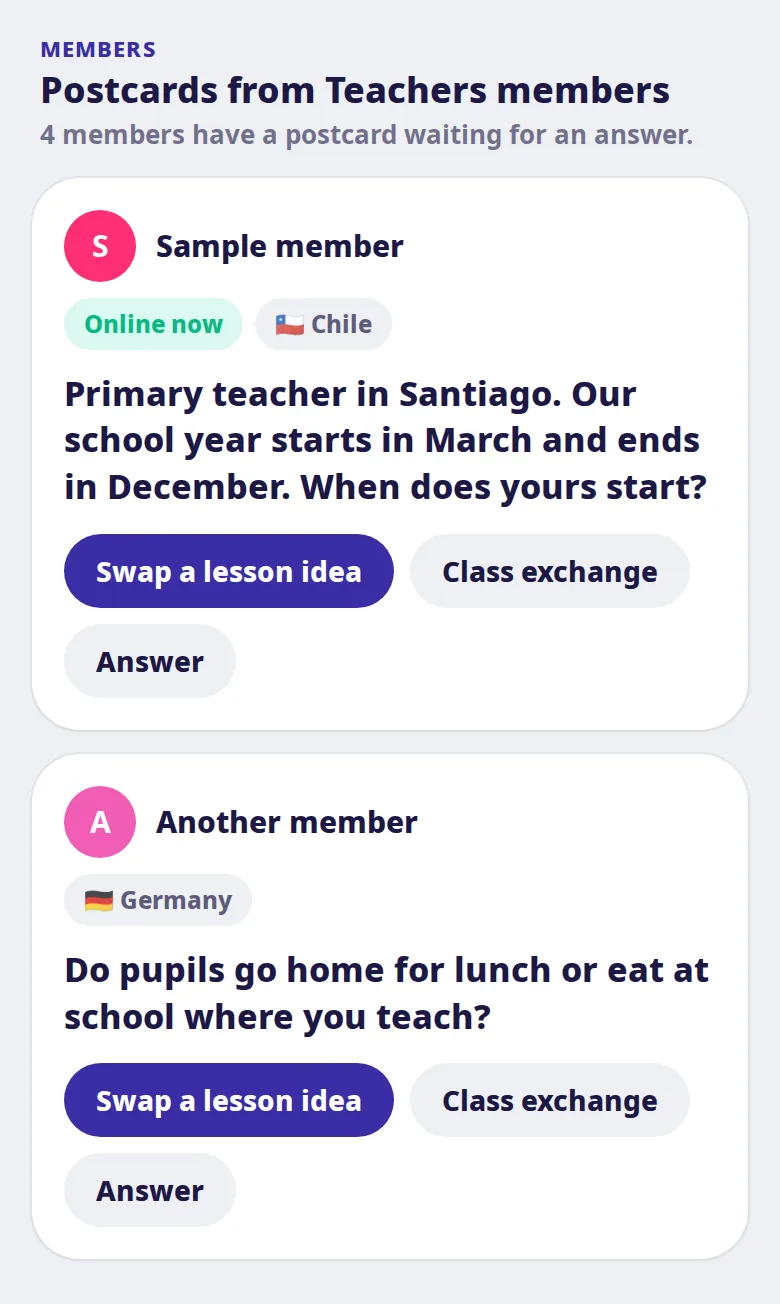 Example screen with sample members, not real people.
The planet has three laws: say which country and which age you teach; no names of pupils or schools; share what works, not just what hurts.
Honest details before you try it:
- Teachers only, adults only. Olu is for adults 18+. It asks for a birth year when you join and refuses anyone younger, though there is no ID check. Pupils never join or chat there. If two teachers want to link their classes, that belongs on a school-approved platform, under your school's rules.
- Nothing that identifies a pupil or a school. No names, photos or pupils' work.
- Text only. There is no voice and no video.
- Translation both ways. Every message is translated, with the original visible, so a teacher in Seoul and a teacher in Lyon can swap ideas without a shared language. More on how that works in chatting with people from other countries with translation.
- A small community. At quiet hours, an answer may take a while.
- Report and block are in every chat, and contact details are stopped before delivery.
Questions to ask a teacher abroad
These questions open a real conversation:
- When does your school year start and end, and how long is the summer break?
- What time does your day start and finish, and how long are lessons?
- Where do pupils eat lunch, and who pays for it?
- How much homework do you set for the age you teach?
- Do your pupils wear a uniform? Who decides the rules?
- Is there one big exam at the end of school, and how does it shape your teaching?
- What is one lesson that always works in your class?
Ask one at a time and share your own answer first. For more openers, see conversation starters for online chat.
Questions people ask
+At what age do children start school around the world?
Most often at 6. In Europe, 6 is the most common start of compulsory education, but it is 3 in France and Hungary and 7 in Croatia and Estonia (Eurydice, 2023/24). In England most children start reception the September after they turn 4, though school is only compulsory from the term after the fifth birthday. In the United States the compulsory start age ranged from 5 to 8 by state in 2017 (NCES).
+Which countries start the school year in March or January?
Many countries in the southern hemisphere run the school year close to the calendar year. Chile's 2026 school year started on 4 March, Kenya's Term 1 on 5 January 2026 and South Africa's public school Term 1 on 14 January 2026. South Korea starts its first semester in early March and Japan starts its school year in April.
+Which country has the longest school summer holiday?
In Europe, Eurydice's 2023/24 report lists summer holidays of more than 12 weeks in Greece, Latvia, Malta, Albania, Iceland, most regions of Italy, and some secondary levels in Ireland and Portugal. Denmark, France, the Netherlands, Norway and some German Länder have 8 weeks or less.
+Do children get free school lunch in every country?
No. Finland's food authority says Finland was the first country to serve free school meals, and its Basic Education Act gives every pupil a free meal each school day. The World Food Programme counts at least 466 million children worldwide who get school meals, but rules on who pays differ from country to country.
+Is Olu a place for pupils to talk to students abroad?
No. Olu is a free text chat site for adults 18+ only, and its Teachers planet is teacher to teacher. Pupils never join or chat there. Teachers compare notes and swap lesson ideas with colleagues in other countries, and any link between classes should run through a school-approved platform and your school's rules.
Keep reading
Boarding pass · free
Tap, fly to a random country, and chat with someone who lives there.
Text first, translated both ways, no video, no coins to meet people. Works in your browser.
Take off on OluNew here? Read Ablo App: The Complete Story of the Chat App That Let You Fly Anywhere (2019–2022), the full history in one place.