 Olu
Comfort Food Around the World: 30 Dishes People Grow Up With
Comfort food around the world: 30 dishes from 30 countries, from congee and rosół to poutine and pozole, each sourced, plus what makes a food comforting.
Updated 19 November 2026 · 11 min read
On this page
Ask people in almost any country what they eat after a bad week, and the answer is rarely fancy. It is a bowl of something soft, warm and familiar, often a dish a parent or grandparent made, and often the same dish they were given when they were ill as a child.
This list covers comfort food around the world: 30 dishes from 30 countries, plus one from Ashkenazi Jewish kitchens, what each one is and when people eat it, with a source for every entry. Then: what makes a food comforting, and the patterns that repeat across kitchens.
The short answer: comfort food is simple, filling food tied to home and childhood. Around the world it is most often a soup, a rice porridge, a bean stew or a dish of dumplings or noodles. Examples include rosół (Poland), arroz caldo (Philippines), okayu (Japan), khichdi (India), pozole (Mexico), poutine (Canada), stamppot (Netherlands) and pot-au-feu (France). No list is final: every family has its own.
Ask a home cook abroad what they cook on a bad day
30 comfort foods from around the world
Each dish name links to the page it was checked against. "Comfort food" is a personal label, so where a source does not use the words, the table says what the dish is and when people eat it, and leaves the rest to you.
| Country or community | Dish | What it is | When people eat it |
|---|---|---|---|
| Poland | Rosół | Clear chicken broth, usually with thin noodles | Family dinners and weddings; a traditional cold remedy |
| Philippines | Arroz caldo | Rice and chicken porridge with lots of ginger, a kind of lugaw | Called a comfort food in Philippine culture; eaten in colder months, in rainy weather and by people who are sick |
| Japan | Okayu | Soft rice porridge, sometimes just rice, water and salt, with toppings like umeboshi | Often a baby's first solid food; served to the sick and elderly |
| South Korea | Juk | Rice porridge; pumpkin (hobak-juk), abalone (jeonbok-juk) and red bean (patjuk) are common | A "get well" dish for babies, people who are ill and older people |
| China | Congee | Rice boiled in plenty of water until soft, with salt or a mild broth | Seen as easy to digest when ill; century egg congee is a common breakfast order |
| Vietnam | Cháo | Rice porridge | Commonly eaten when someone is ill |
| Indonesia | Bubur ayam | Chicken congee with shredded chicken | Considered a comfort food; given to young children and people recovering from illness |
| India | Khichdi | Rice and lentils cooked together, with many regional versions | One of the first solid foods babies eat, especially in the north |
| Iran | Ash reshteh | Thick soup of noodles, beans, herbs and kashk, topped with fried onion, garlic or mint | Cooked in autumn and winter; served at Nowruz, when the noodles stand for good fortune |
| Turkey | Kuru fasulye | White beans stewed with onion and tomato paste, with rice or bulgur and cacık | Often called the national dish |
| Egypt | Koshary | Rice, lentils, macaroni and vermicelli with tomato sauce, garlic vinegar, chickpeas and crispy onions | Street-cart food that became the national dish; recognised by UNESCO in 2025 |
| Nigeria | Pepper soup | Light, spicy broth of meat or fish with chili, scent leaves and calabash nutmeg | Chicken pepper soup is served to people who are ill; some give it to new mothers |
| Ghana | Light soup | Thin tomato and chili soup with fish or meat, first made by the Akan people | Eaten with fufu, banku, kokonte or rice |
| South Africa | Bobotie | Spiced minced meat with dried fruit, baked under an egg and milk topping | Served with yellow rice and chutney; adopted by the Cape Malay community |
| Ukraine | Borscht | Beetroot soup cooked with broth, served with bread or garlic buns | UNESCO notes it is passed on within families, with children helping to cook |
| Hungary | Gulyás | A paprika soup of beef and vegetables, cooked in one pot | Began as the food of cattle herders; now a symbol of the country |
| Greece | Avgolemono | Chicken broth thickened with egg and lemon, with rice or orzo | One version, magiritsa, breaks the Lent fast; Sephardic Jewish cooks make it as agristada |
| Italy | Pastina | The smallest pasta, cooked in soup | Used as infant food; nicknamed "Italian penicillin" |
| France | Pot-au-feu | Beef and vegetables simmered slowly; the broth first, then the meat with mustard and coarse salt | Chef Raymond Blanc calls it the essence of French family cooking |
| Spain | Cocido madrileño | Chickpea, vegetable and meat stew from Madrid, served as three courses from one pot | Most popular in winter |
| Germany | Käsespätzle | Egg noodles layered with melted cheese and topped with fried onions | A traditional dish of Swabia, Baden and the Allgäu |
| Netherlands | Stamppot | Potatoes mashed with kale, sauerkraut, or carrot and onion, with smoked sausage | A cold-weather dish |
| Sweden | Ärtsoppa | Pea soup, followed by thin pancakes with jam | Traditionally on Thursdays, a habit dating back to at least the 13th century |
| Ireland | Colcannon | Mashed potato with cabbage or kale, butter and milk | A cheap year-round food; popular on Saint Patrick's Day |
| United Kingdom | Cottage or shepherd's pie | Minced meat under mashed potato, baked | Long made from the leftovers of a roast |
| Canada | Poutine | Fries and cheese curds under hot gravy, from Quebec in the late 1950s | Described as a comfort food for the local community after the 2013 Lac-Mégantic rail disaster |
| United States | Macaroni and cheese | Pasta in a cheese sauce | Described as a comfort food; the boxed version took off during the Great Depression |
| Mexico | Pozole | Hominy stew with pork or chicken, white, green or red, topped with cabbage, radish, onion and lime | An everyday meal and a festive one, for New Year's Eve and Independence Day |
| Brazil | Feijoada | Black bean and pork stew | Created in colonial Brazil, now often called the national dish; popular at weddings and birthdays |
| Peru | Aguadito de pollo | Green chicken and rice soup, coloured by a large amount of cilantro | Eaten partly as a hangover remedy |
A 31st belongs here too: matzo ball soup, chicken soup with dumplings of matzah meal, egg and fat, a staple of Ashkenazi Jewish cooking at Passover. Chicken soup's nickname, "Jewish penicillin", comes from its place in European Jewish kitchens.
What makes a food a comfort food
The usual definition is food that gives the eater a sense of nostalgia or sentiment. Wikipedia's summary of the research describes it as often hearty, simple and tied to childhood or home cooking, with the nostalgia either personal or shared across a culture. The same article traces the phrase to at least 1966, when a Florida newspaper wrote that adults under severe stress turn to "comfort food", with a poached egg or chicken soup as the example.
One study cited there, of college students, sorted comfort foods into four rough kinds: nostalgic foods (what you ate as a child), indulgent foods (sweet or rich treats), convenient foods (quick and easy) and physically comforting foods (warm and soft). Most of the dishes in the table are the first and last kind at once.
Why it works is less clear. In a 2011 study in Psychological Science, Jordan Troisi and Shira Gabriel at the University at Buffalo found that eating chicken soup in the lab made people think more about relationships, but only if they already counted chicken soup as a comfort food. Writing about a comfort food also eased loneliness after recalling a fight with someone close. MedicalXpress covered the findings, and one of the authors put it simply: a comfort food is something "consistently associated with their close others."
That idea needs a caveat. A 2015 replication in Frontiers in Psychology tested it in the United States, Singapore and the Netherlands and did not confirm the overall effect, though the pattern looked similar in the American samples. In Singapore, only 25% of students named chicken noodle soup as a comfort food at all. The bowl that comforts depends on where, and with whom, you grew up.
Five patterns that show up in kitchens everywhere
Rice porridge for sick days
Across East and Southeast Asia, the food for a sick day is rice cooked in far more water than usual until it is soft. China has congee, Japan okayu, Korea juk, Vietnam cháo, Indonesia bubur ayam and the Philippines arroz caldo and other lugaw. The reasons repeat too: it is easy to digest, so it goes to babies, older people and anyone recovering. India's khichdi plays a similar role as an early food for babies.
Chicken soup in almost every country
Wikipedia's chicken soup article lists versions from Colombia (ajiaco) and Ghana (chicken light soup) to Korea (samgyetang), Portugal and Brazil (canja) and Scotland (cock-a-leekie). Many are linked to colds and flu. Science has not settled that: a 2000 lab study found some soup components acted on immune cells in a dish, but its authors called any benefit to symptoms hypothetical.
Beans and one-pot stews
Feijoada, kuru fasulye, cocido madrileño, pozole, ärtsoppa and pot-au-feu are all one big pot that feeds a lot of people for a long time. Several were built around cheap ingredients, and several are now called national dishes.
Dumplings and small pasta
Pierogi are a good example: Poles traditionally serve two kinds of pierogi on Christmas Eve, and small mushroom dumplings called uszka go into clear beet soup. Italy's pastina, Ashkenazi matzo balls and Germany's spätzle sit in the same family of small, soft, filling things made from flour and egg.
Dishes made from leftovers
Cottage pie used up the cooked meat from a roast before fridges were common. Feijoada began with black beans and leftover pork. Colcannon was a cheap food eaten all year. Several comfort foods started as thrifty food, and the thrift is part of the memory.
How to ask someone about their comfort food
Learn a comfort food from the person who grew up with it. A cookbook gives you ingredients; a person tells you what it is eaten with, when, and the one thing they would never change. Good questions:
- What did your family cook when you were ill as a child?
- What do you make when you're homesick?
- Is there a dish everyone in your country seems to agree on, or does every family do it differently?
- What would you cook for a friend who had a bad week?
- Which ingredient would be hard to find where I live, and what would you use instead?
- What do you serve with it, and when do you eat it?
If a friend is the one having a bad week, the food is only half of it. Our guide on how to comfort someone over text covers what to say alongside the soup.
Trade comfort food recipes with a home cook abroad
On Olu, a free text chat site for meeting people in other countries, cooks join the Home cooks planet: real home cooking from real kitchens. Its ritual is Same dish, two kitchens. You name tonight's dish, and a cook in another country tells you how their kitchen does it and what they would never change. You can also post a Swap a recipe request, which stays open for 48 hours.
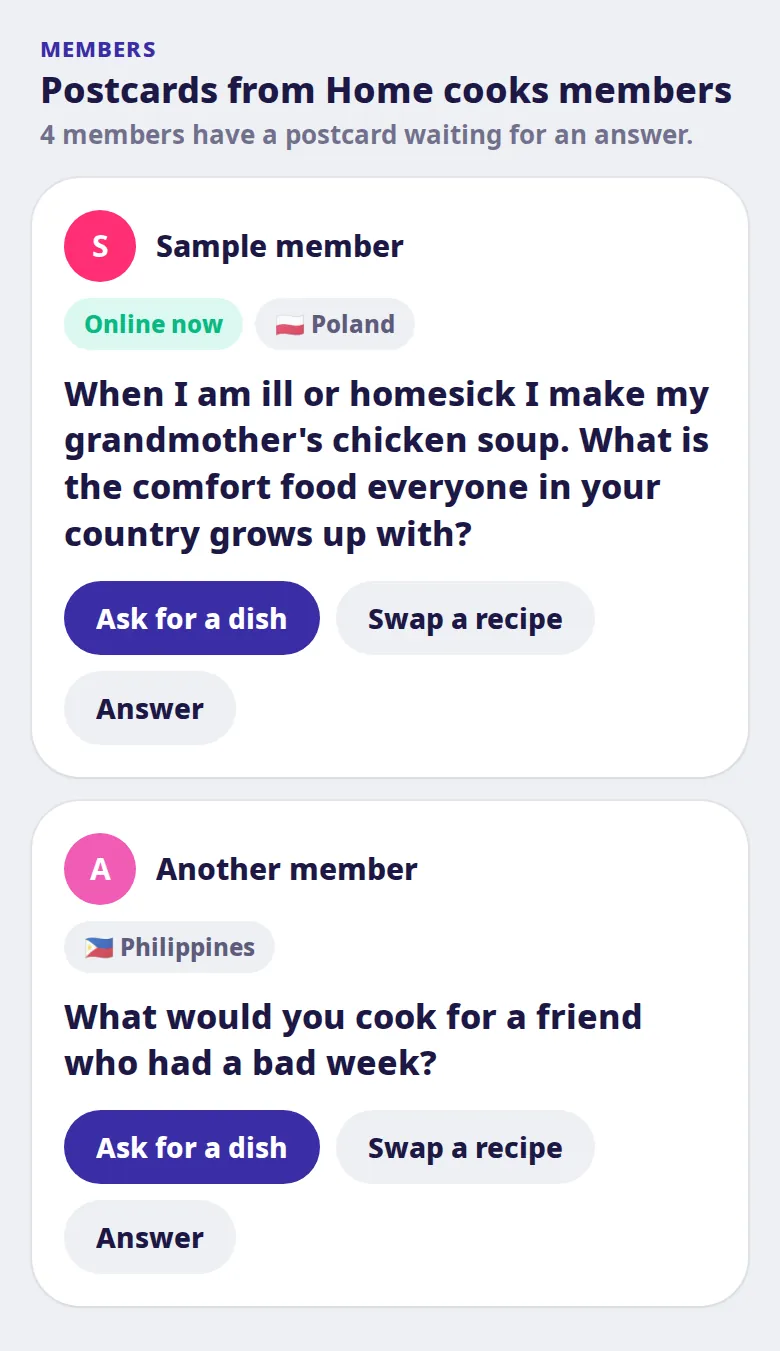 Example screen with sample members, not real people.
Each postcard has three buttons: Ask for a dish, Swap a recipe and Answer. The planet has three laws: say where the dish is from, real home cooking only, and never mock a recipe from someone's home.
Honest limits: it is text only, with no voice or video, so a cook-along means typing steps rather than watching. Every message is translated both ways with the original visible, which helps with dish names, though check amounts and units (cups, grams, spoons) with the other cook. It is for adults 18+, free, with no ads and no paid plan. Contact details are stopped before delivery, and you can report and block anyone. For more ideas on swapping, see our guide to a recipe exchange, or how to make friends from other countries online.
The short version
Comfort food around the world tends to be simple, warm and tied to home: rice porridge for sick days in East and Southeast Asia, chicken soup from Poland to Peru, bean stews in Turkey, Spain, Mexico and Brazil, and dumplings and mash across Europe. The research on why it comforts is still unsettled, but the pattern is clear: the dish matters because of who made it. The easiest way to try one properly is to ask someone who grew up with it, and swap one of yours.
Questions people ask
+What is comfort food?
Food that gives the person eating it a sense of nostalgia or home. It is usually simple, warm and filling, and often tied to childhood, a family cook or being looked after when ill. What counts as comfort food changes from country to country and from family to family.
+What is the most popular comfort food in the world?
There is no single answer, and no reliable worldwide ranking. Two kinds of dish do appear in a lot of countries: chicken soup (rosół in Poland, avgolemono in Greece, aguadito in Peru, matzo ball soup in Ashkenazi Jewish homes) and soft rice porridge for sick days (congee in China, okayu in Japan, juk in Korea, arroz caldo in the Philippines).
+What do people eat when they are sick in different countries?
Often a soft rice porridge or a chicken soup. Juk in Korea is known as a get-well dish, okayu in Japan is served to the sick and elderly, people in Vietnam often eat cháo when ill, rosół is a traditional cold remedy in Poland, and chicken pepper soup is served to people who are ill in Nigeria.
+Why does comfort food make us feel better?
One idea from psychology research is that comfort foods remind us of the people we ate them with. In a 2011 study, eating chicken soup made people think more about relationships, but only if chicken soup was already a comfort food for them. A later replication across countries only partly confirmed the effect, so treat it as an interesting idea, not settled science.
+How can I try comfort food from another country?
Ask someone who grew up with it. A recipe from a person who ate the dish as a child usually comes with the details a cookbook leaves out: which pot, which brand, what to eat it with and when. Swapping one of your own comfort foods in return makes it a fair trade.
Keep reading
Boarding pass · free
Tap, fly to a random country, and chat with someone who lives there.
Text first, translated both ways, no video, no coins to meet people. Works in your browser.
Take off on OluNew here? Read Ablo App: The Complete Story of the Chat App That Let You Fly Anywhere (2019–2022), the full history in one place.