 Olu
How to Make Friends at University: Where Students Actually Meet
How to make friends at university or college: halls, your course, societies, jobs and volunteering, plus tips for mature, commuter and international students.
Updated 19 November 2026 · 10 min read
On this page
- Is it normal to struggle to make friends at university?
- Where students actually make friends
- How to turn a classmate into a friend
- Making friends at uni as a mature student
- If you commute or live at home
- Making friends as an international student
- Friends in other countries while you study
- Staying safe when you meet new people
- If you still feel lonely after the first term
The first weeks of university are loud with people saying it's the best time of their lives. Then there are the quieter facts: eating lunch alone between lectures, a flat that never gels, a group chat everyone else seems to be in. If you're searching how to make friends at university (or "how to make friends in college", as it's called in the US), you're in large company, and almost nobody feels as settled as they look.
This guide covers where students meet friends, what to say, and tips for mature, commuter and international students. It's for university students and adult learners of any age.
The short answer: go where you'll see the same people every week, and keep going back. That means your hall or flat's shared spaces, one or two societies or sports clubs, a study group with coursemates, a part-time campus job or a volunteering role. Make the first move with small, specific invites ("Lunch after this seminar?"). Expect it to take a term or more, because friendships need many hours of time together. If your days don't fit campus life, there are mature students' groups, commuter tricks and international buddy schemes, and students in other countries to talk to while you study.
Ask a student abroad how they made their first friends at uni
Is it normal to struggle to make friends at university?
Yes. Several large surveys put the number of lonely students well above what most freshers expect:
- In an ONS survey of higher education students in England in February 2021, 26% said they felt lonely often or always, against 8% of all adults in Great Britain over a similar period. Students under 30 reported it more (33%) than students aged 30 and over (20%). This was during the pandemic, and the ONS calls these experimental statistics from a small sample, so read them as a signal, not a precise rate.
- The 2026 Unite Students Applicant Index, a survey of 2,200 university applicants summarised on the HEPI blog, found around 26% feel lonely all or most of the time before they even arrive.
- In the US, an Active Minds survey with TimelyCare of about 1,100 college students found 64.7% reported feeling lonely.
The numbers vary because each survey asks a different question. The pattern doesn't: a lot of the people around you in that lecture hall are also hoping someone will say hello first.
There's also a time problem. Communication researcher Jeffrey Hall estimated it takes roughly 50 hours together to go from acquaintance to casual friend, about 90 hours to become a friend, and more than 200 hours to become close friends. One of the studies followed 112 first-year students at the University of Kansas. So a quiet first month isn't failure. It's just early.
Where students actually make friends
| Place | Why it works | First step |
|---|---|---|
| Halls or shared flat | You see the same people daily | Cook in the kitchen, not your room |
| Your course | Same people, same deadlines, all year | Start or join a study group |
| Societies and sports | Shared interest, weekly sessions | Go to two taster sessions in week one |
| Campus or part-time job | Regular shifts with the same team | Apply for student ambassador or union roles |
| Volunteering | People from outside your course | Sign up through your students' union |
Halls and shared flats
For many students, flatmates are the first friends. The simplest advice from university guides is also the most repeated: be visible. The University of Central Lancashire suggests leaving your door open, or sitting in the kitchen while you cook and eat, and bringing a pack of cards or a board game. Unite Students adds small favours, like offering to make tea or help carry bags, and inviting the quieter housemates along when plans form.
If your flat doesn't click, that's common too. Hall events, the building's common room and your floor or block group chat give you a second chance with people a few doors away.
Your course: seminars, group chats and study groups
Coursemates are the people you'll see most over the next three or four years. A few habits help:
- Arrive a few minutes early and sit near people. The University of Wisconsin-La Crosse also suggests looking up from your phone and taking your headphones off between classes.
- Join or start the course group chat. One commuter student at the University of Worcester says an early WhatsApp group for their cohort helped with study questions and planning meetups.
- Start a study group before the first deadline or exam, as Unite Students recommends. Studying together gives you a reason to meet that isn't "be my friend". If you want a structured version, see our guide to finding a study buddy.
- Turn the study group into something social. Hall's research found that hours spent working together counted for less than hanging out and joking around. So after the library, suggest food.
Societies, clubs and sports
Societies are where you meet people from other courses and years who like what you like. The University of Birmingham, for example, lists over 300 societies covering hobbies, cultures, faiths and charities, and notes that many offer free or cheap taster sessions at the start of the year.
How to make a society work for friendship:
- Pick one or two and go every week, rather than ten you visit once.
- Choose something with a built-in activity, like a sport or a choir. Doing something together beats small talk.
- Help run it. Committee roles, which Birmingham also mentions, mean meetings, planning and more time with the same people.
- Try sports at your level. Recreational and intramural leagues exist for people who just want to play. At UW-La Crosse, intramurals are the most popular extracurricular activity on campus.
Part-time jobs and campus roles
A part-time job gives you regular shifts with the same people. Campus jobs, such as student ambassador or union roles, also introduce you to students from other courses and years. UW-La Crosse lists on-campus jobs as a way to meet students and staff, and the Worcester commuter student made friends across the university after becoming a student ambassador.
Volunteering
Loughborough University's student blog puts it plainly: volunteering "is highly sociable", and it lets you know people away from your course. A weekly role works better for friendship than a one-off event, for the same reason a weekly society does.
How to turn a classmate into a friend
Meeting people isn't usually the hard part. Moving from "we sit together in stats" to "we hang out" is. As Hall put it: "You can't make people spend time with you, but you can invite them."
- Ask about them. "What made you pick this course?" or "Where are you living this year?" Most students are just as nervous, so a question takes the pressure off both of you.
- Make small, specific invites. "Want to grab lunch after this?" works better than "we should hang out sometime".
- Repeat. The same coffee after the same seminar each week adds up to those 50 hours faster than one big night out.
- Say yes when you can. You don't have to go to everything, but say yes to invitations that sound fun.
Two openers you can adapt:
"Did you understand the last ten minutes of that lecture? I'm going to the library to go over it if you want to join."
"I'm trying the climbing society on Wednesday and don't know anyone. Want to come?"
If you're quiet or find big groups tiring, start with one-to-one plans and activity-based societies. Apps to make friends for introverts has more low-pressure options.
Making friends at uni as a mature student
Starting university later can feel like walking into someone else's party. A few things help:
- Name the real barrier. A University of Alberta counsellor writes that work, family and caregiving often limit campus time, so the problem may be your schedule, not your age. The same column advises finding common ground and assuming people will like you.
- Look for your own group. Many universities have a mature students' society. At Sussex, a student describes a restarted Mature Students Society and drop-ins with coffee, games and academic support.
- Use your course. Study groups and group projects fit around a job or children far better than late nights out, and your experience is useful in them.
- Keep it short and regular. One weekly society, one coffee after class. You don't need a nightlife to belong.
If you commute or live at home
Commuters miss the easy contact of halls, so they have to create it. The Worcester student's steps are a good template: attend lectures and seminars in person, set up a cohort group chat, go to welcome events (they met another commuter who lived nearby), carpool with a coursemate, and take a campus role. Ask your students' union whether there's a commuter or off-campus students' group.
Making friends as an international student
Moving countries alone adds distance, a new culture and sometimes a new language. University of Plymouth Students' Union notes that the harder part is often not English itself but regional accents and slang, and that socialising in the UK often centres on alcohol. What helps:
- Join a buddy scheme early. De Montfort University's i-Buddies, for example, puts new international students into groups of about two volunteers and four new students for their first term, meeting or messaging at least weekly. Places are first come, first served.
- Go to international meet-ups, and to one interest-based society too. That way you meet other internationals and home students.
- Missed Welcome Week? Ask the union. Plymouth runs weekly meet-ups for international students who missed it.
Friends in other countries while you study
Some of your best support may come from students who aren't on your campus at all. Someone in another country going through the same deadlines can be easier to talk to than a flatmate, and they can tell you what student life is like where they are.
Olu is a free text chat site for meeting people in other countries, in your browser, for adults 18+. Its University students planet is for students 18+ from universities around the world. The house rules are simple: say what and where you study, adults only, and no selling essays or answers. Its ritual is Study together: you study beside another student for 25 minutes, say what you're studying, a student in another country answers, and you check in with each other when the time is up. Member postcards have buttons to Study together, ask someone to Quiz me, or simply Answer.
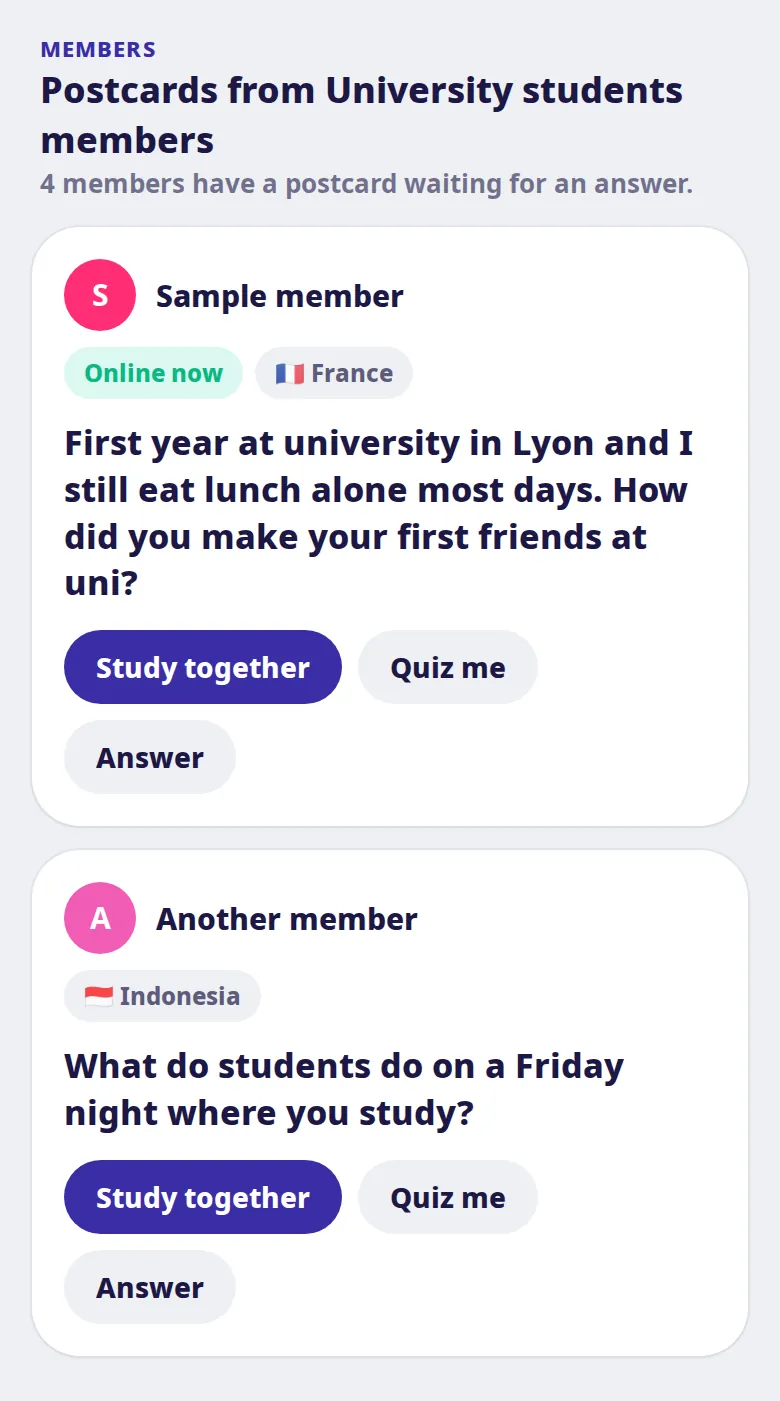 Example screen with sample members, not real people.
A few honest details:
- It's text only. No voice, no video.
- Every message is translated both ways, with the original visible, so you can talk to a student who doesn't share your first language.
- It's a small community. At quiet hours, nobody may answer right away.
- Report and block are in every chat, and contact details are stopped before delivery.
It won't replace friends on your course, but it can make a lonely week easier.
Staying safe when you meet new people
Most people you meet at university are what they seem. Still, if you meet someone from an app, an online group or a chat, meet in a busy public place on or near campus first, tell a friend or flatmate where you're going, and keep your address private until you know the person. Never send money or share passwords. Random text chat safety tips covers more.
If you still feel lonely after the first term
Give it time, and keep one or two regular commitments going even when you don't feel like it. If loneliness is affecting your sleep, studies or mood, talk to someone: your university's counselling or wellbeing service, a personal tutor, or your GP or doctor. It's what those services are there for, and you don't need to be in crisis to use them.
Questions people ask
+Is it normal to have no friends at university?
Yes, and more common than it looks. In an ONS survey of students in England in early 2021, 26% said they felt lonely often or always. A 2026 Unite Students survey of 2,200 applicants found around 26% felt lonely all or most of the time. Friendships take time to build, so a slow first term doesn't mean you've missed your chance.
+What is the easiest way to make friends at university?
Go somewhere you will see the same people every week and keep going back: one society or sports club, a weekly study group with coursemates, a part-time campus job or a volunteering role. Repeated contact does the work. Then invite one person to one small plan, like lunch after a seminar.
+Is it too late to make friends after first year?
No. Research by Jeffrey Hall at the University of Kansas suggests a casual friendship takes about 50 hours together and a close one more than 200, so friendships keep forming through every year of a course. Join a society or start a study group whenever you are ready, and ask your students' union how to join mid-year.
+How do mature students make friends at university?
Look for a mature students' society or drop-in, which many unions run, and use your course: study groups and group projects suit people with jobs or families. A University of Alberta counsellor suggests the real barrier is often time, not age, so pick a few regular, short commitments rather than late nights out.
+How can international students make friends at university?
Sign up early for your university's international buddy scheme, go to the international society's meet-ups, and also join one interest-based society so you meet home students too. If you arrived late or missed Welcome Week, ask the students' union about later events. Many unions run them for exactly that reason.
Keep reading
Boarding pass · free
Tap, fly to a random country, and chat with someone who lives there.
Text first, translated both ways, no video, no coins to meet people. Works in your browser.
Take off on OluNew here? Read Ablo App: The Complete Story of the Chat App That Let You Fly Anywhere (2019–2022), the full history in one place.