 Olu
National Dishes of Different Countries: 36 Dishes and Which Are Official
National dishes of different countries: 36 dishes by country, which ones a government actually named, which are only widely called national, and who has none.
Updated 19 November 2026 · 10 min read
On this page
- National dish by country: 36 dishes and their status
- Which national dishes are actually official?
- Why many countries have no single national dish
- Traditional dishes from different countries on UNESCO's list
- How to ask someone about their national dish
- Swap a national dish with a home cook abroad
- The short version
Ask people from almost any country to name their national dish and you rarely get one tidy answer. Some name a stew, some a street snack, some a dish their grandparents made for holidays, and a few point to a dish their government actually chose.
This guide lists national dishes of different countries: 36 countries, what each dish is, and whether the title is official or just widely used. Every row links to its source.
The short answer: only a handful of countries have a national dish named by a government or law, such as Denmark (stegt flæsk), Norway (fårikål), Peru (ceviche) and Georgia (khachapuri). Most other "national dishes", from ackee and saltfish in Jamaica to goulash in Hungary, are national by custom, not by decision. Many countries, including Mexico, China and India, have no single national dish, and every country cooks its famous dish in more than one way.
Ask a home cook abroad which dish their country argues about
National dish by country: 36 dishes and their status
Official means a government page or legal act names the dish. Widely called means encyclopedias describe it as a national dish, but no government decision was found.
| Country | Dish | What it is | Status |
|---|---|---|---|
| Denmark | Stegt flæsk med persillesovs | Fried pork belly with potatoes and parsley sauce | Official. Won the Ministry of Food's 2014 public vote |
| Norway | Fårikål | Mutton on the bone and cabbage with whole black pepper, slow cooked, served with potatoes | Official. Presented by the agriculture and food minister in June 2014 |
| Peru | Ceviche (cebiche) | Raw fish with lime juice, chilli and salt | Official heritage. Cultural Patrimony of the Nation since 2004 |
| Georgia | Khachapuri | Leavened bread filled with cheese, sometimes with egg | Official heritage. Intangible heritage status by a 2019 order |
| Indonesia | Soto, rendang, nasi goreng, satay, gado-gado | Aromatic soup; meat stewed in coconut milk and spices; fried rice; satay; vegetables with peanut sauce | Named by the Tourism Ministry in 2018 (news report) |
| Argentina | Locro | Thick squash or potato stew from the Andes | Widely called a national dish; eaten on 25 May and 9 July |
| Australia | Meat pie | Handheld pie of minced or diced meat and gravy | Called the national dish by NSW Premier Bob Carr in 2003 |
| Barbados | Cou-cou and flying fish | Cornmeal and okra, served with flying fish | Widely called the national dish |
| Brazil | Feijoada | Black bean stew with pork and beef, with rice, farofa, greens and orange | Widely called a national dish, mainly in Pernambuco and Bahia |
| Canada | Poutine | Fries and cheese curds under hot gravy, from Quebec | Called the national dish by some; critics say it is a Québécois symbol |
| Colombia | Bandeja paisa | Large platter from the Paisa region | Unofficial. A 2005 government plan to name it was opposed |
| Costa Rica | Gallo pinto | Rice and beans cooked with garlic, oregano and onion | Widely called a national dish, in Nicaragua too |
| Cuba | Ropa vieja | Stewed beef and tomato on a sofrito base; came from Spain | Widely called one of the national dishes |
| Egypt | Koshary | Pasta, rice, vermicelli and lentils with chickpeas, tomato sauce and fried onions | Widely called the national dish; ful medames too |
| El Salvador | Pupusa | Thick cornmeal or rice-flour griddle cake stuffed with cheese, beans or squash | Widely called the national dish |
| Ethiopia | Wat | Spiced stew of chicken, beef, lamb or vegetables, eaten with injera | Widely called the national dish |
| Germany | Sauerbraten | Roast, most often beef, marinated for 5 to 15 days | Widely called a national dish |
| Hungary | Goulash | Meat and vegetables seasoned with paprika | Widely called a national dish and a symbol of the country |
| Iran | Chelow kabab, ghormeh sabzi | Steamed rice with kebab; herb stew | Each is widely called the national dish |
| Ireland | Irish stew | Lamb or mutton with root vegetables; beef is common now | Widely called a national dish |
| Jamaica | Ackee and saltfish | Sautéed ackee with salted cod, onion, pepper and tomato | Widely called the national dish |
| Japan | Ramen | Noodles in hot broth, with regional styles | Widely called a national dish |
| Jordan | Mansaf | Lamb cooked in fermented dried yogurt sauce, with rice or bulgur | Widely called the national dish |
| Lebanon | Kibbeh | Spiced lean ground meat pounded with bulgur | Widely called a national dish, in Syria too |
| Malaysia | Nasi lemak | Rice cooked in coconut milk and pandan leaf | Widely called the national dish |
| Mexico | Mole, chiles en nogada | Chilli, fruit, nut and spice sauces (some 50 kinds); stuffed poblano chiles under walnut sauce | Both called a national dish; no single dish |
| Philippines | Adobo | Meat, seafood or vegetables simmered in vinegar, soy sauce or salt, and garlic | Unofficial. A 2014 House bill proposed it |
| Poland | Bigos | Hunter's stew of meats with sauerkraut and cabbage | Widely called a national dish |
| Senegal | Thieboudienne (ceebu jën) | Fish, broken rice and tomato sauce cooked in one pot | Widely called the national dish |
| Singapore | Hainanese chicken rice | Poached or roasted chicken with seasoned rice and chilli sauce | Widely called one of the national dishes |
| Switzerland | Rösti, fondue | Pan-fried potatoes; melted cheese with wine | Rösti widely called one; fondue promoted by the Swiss Cheese Union in the 1930s |
| Thailand | Pad thai | Stir-fried rice noodles with shrimp, peanuts, egg and bean sprouts | Widely called one of the national dishes |
| Turkey | Kuru fasulye | White beans stewed with olive oil, onion and tomato | Widely called the national dish |
| United Kingdom | Fish and chips | Battered fried fish with chips, from 19th-century England | Widely called the national dish |
| Uzbekistan | Plov | Rice cooked in broth with meat, vegetables and spices | Widely called the national dish, in Tajikistan too |
| Venezuela | Pabellón criollo | Rice, shredded beef stew and black beans | Widely called the national dish |
A table shows only the famous version. In every country the dish changes by region, family and budget, and plenty of people would pick another dish.
Which national dishes are actually official?
Very few. Only four countries here have a government page or legal act behind the title, and two of those grant heritage status rather than the words "national dish".
- Denmark. In 2014 the Ministry of Food ran a public vote with 24 dishes from 8 regions. According to the ministry's own results page, stegt flæsk med persillesovs won with 27,893 of 63,263 votes. Smørrebrød came second.
- Norway. Fårikål first won a vote on the NRK radio programme Nitimen in 1972. In June 2014 the Ministry of Agriculture and Food presented it again as the national dish after an Ipsos survey: 45 percent chose fårikål and 36 percent chose kjøttkaker (meatballs).
- Peru. The state brand site PromPerú calls ceviche Peru's flagship dish and says it was recognised as Cultural Patrimony of the Nation in March 2004. The state news agency Andina reports that the Ministry of Production set 28 June as National Ceviche Day.
- Georgia. A 2019 order of the National Agency of Cultural Heritage Protection gave the khachapuri tradition the status of a monument of intangible cultural heritage.
Three cases sit in between. Indonesia's Tourism Ministry named five national dishes in 2018; the Jakarta Post reported the minister saying the country had lacked an official national food. No government page was checked, so it is not marked official here. In the Philippines, a 2014 House bill sought to make adobo the national food, but no record that it became law was found. In Colombia, a 2005 government plan to name bandeja paisa was opposed, partly because the dish comes from one region.
Why many countries have no single national dish
The encyclopedia entry on the national dish says some countries, such as Mexico, China and India, have no single national dish, even unofficially, because their regions and cuisines are so varied. That is true in smaller ways almost everywhere. Feijoada is linked mainly to Pernambuco and Bahia, while other parts of Brazil have their own dishes. Poutine started in Quebec, and some critics object to calling it Canadian.
The same source gives four common routes to the title:
- A staple made from local food.
- A local ingredient the country is known for.
- A festival or religious tradition, such as locro in Argentina on national holidays.
- Promotion. Fondue was pushed as a Swiss national dish by the Swiss Cheese Union in the 1930s to sell more cheese.
So a national dish says more about history and pride than about Tuesday dinner. For what people eat on a hard day, see comfort food around the world.
Traditional dishes from different countries on UNESCO's list
UNESCO does not name national dishes. It lists living traditions, and several are about one dish. These UNESCO pages were checked:
- Gastronomic meal of the French (2010) and traditional Mexican cuisine (2010)
- Washoku, Japan (2013), and kimjang, making and sharing kimchi, South Korea (2013)
- Palov culture, Uzbekistan (2016)
- Couscous, shared by Algeria, Mauritania, Morocco and Tunisia (2020)
- Ceebu jën, Senegal (2021), and joumou soup, Haiti (2021)
- Al-Mansaf, Jordan (2022), and Ukrainian borscht cooking, on the urgent safeguarding list (2022)
- Ceviche, Peru (2023)
- Tomyum kung, a traditional prawn soup from Thailand (2024)
- Koshary, Egypt (2025)
A listing protects the custom around the food, such as who cooks it and when, not one fixed recipe.
How to ask someone about their national dish
The best answers come from people, not lists. These questions tend to open a real conversation:
- "Is there one dish everyone in your country agrees on, or do people argue about it?"
- "Does your region make it differently from the rest of the country?"
- "When do people at home actually cook it: weeknights, holidays or only for guests?"
- "What is the one thing a restaurant abroad always gets wrong?"
- "If you could cook only one dish to show someone your country, which would it be?"
Then offer one from your side. A swap feels fairer than an interview.
Swap a national dish with a home cook abroad
On Olu, a free text chat site for meeting people in other countries, people who cook join the Home cooks planet: real home cooking from real kitchens. Its ritual is Same dish, two kitchens. Cook the same dish as someone in another country: name tonight's dish, and a cook abroad tells you how their kitchen does it and what they would never change. You can also post a Swap a recipe request, which stays live for 48 hours.
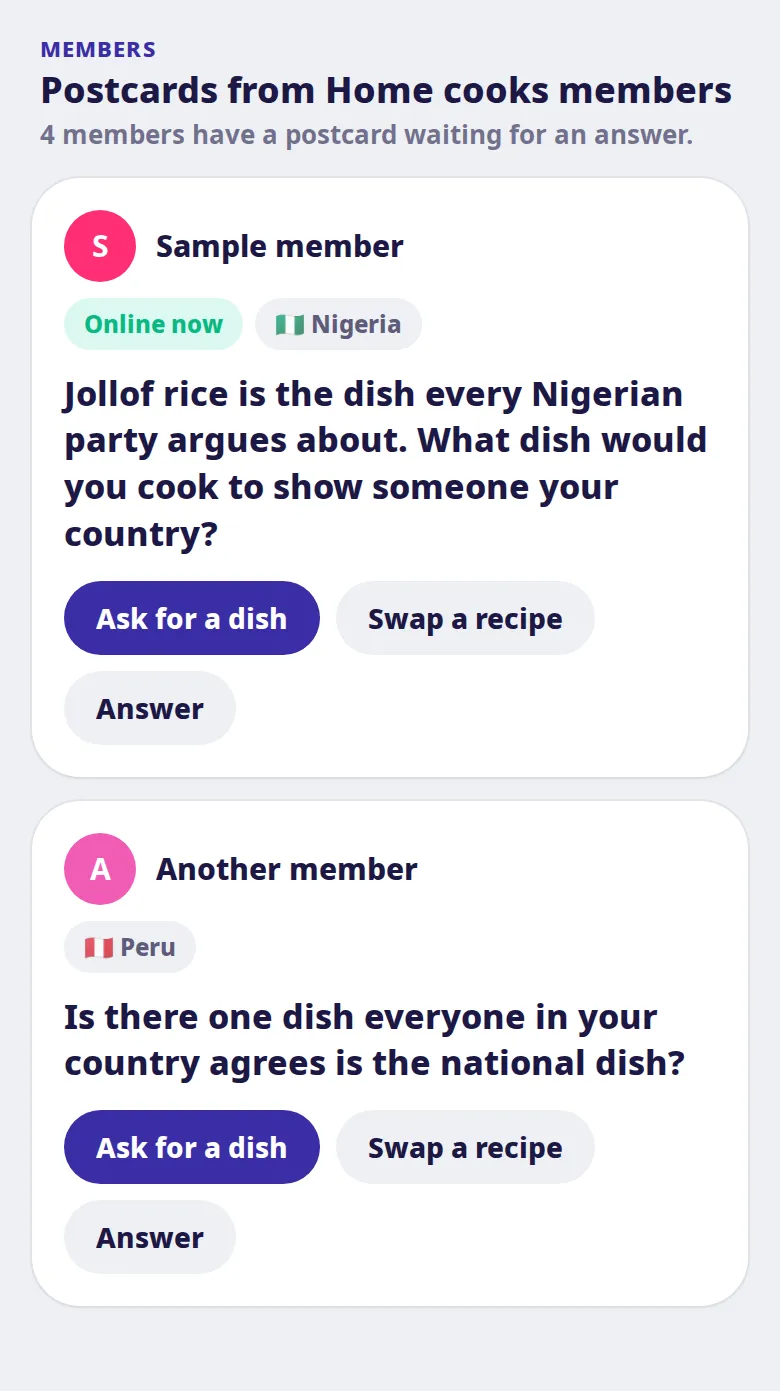 Example screen with sample members, not real people.
Every postcard has three buttons: Ask for a dish, Swap a recipe and Answer. The planet keeps three laws: say where the dish is from, real home cooking only, and never mock a recipe from someone's home.
Honest limits: Olu runs in the browser and is text only, with no voice or video. Every message is translated both ways with the original visible, which helps with dish names, but check units and amounts with the other cook. It is for adults 18+ (birth year is asked at join, with no ID check), it is free, and it has no ads and no paid plan. Contact details are stopped before delivery, and you can report and block in every chat. For more on trading recipes, see our recipe exchange guide, or read how to make friends from other countries online.
The short version
National dishes of different countries are mostly a matter of custom. Only a few have a government decision behind them: Denmark and Norway after public votes in 2014, and Peru and Georgia through heritage status. Dishes like ackee and saltfish, goulash, mansaf and pupusa are widely called national without any formal act, and Mexico, China and India have no single dish. Every dish also changes from kitchen to kitchen, so ask someone who grew up cooking it.
Questions people ask
+What is a national dish?
A dish that is strongly associated with one country. It usually gets that status because it is a staple, because it uses a local ingredient, because it belongs to a festival or religious tradition, or because someone promoted it as national. Most national dishes were never chosen by a government: people simply came to see them that way.
+Do all countries have an official national dish?
No. Very few governments have formally named one. Denmark and Norway each named a dish after a public vote in 2014, and Peru and Georgia gave official heritage status to ceviche and khachapuri. Most other dishes on lists like this one are only widely called the national dish, and some countries, such as Mexico, China and India, have no single national dish at all.
+Can a country have more than one national dish?
Yes. Indonesia's Tourism Ministry named five dishes in 2018 (soto, rendang, nasi goreng, satay and gado-gado). Iran is linked to both chelow kabab and ghormeh sabzi, and Thailand to pad thai, with tom yum kung on UNESCO's heritage list. Large countries with many regional cuisines often have several candidates and no agreement.
+What is the difference between a national dish and a traditional dish?
A traditional dish is any dish with a long history in a place, and every country has hundreds. A national dish is one that has come to stand for the whole country, either by public agreement or by an official decision. Many national dishes started as regional dishes, such as poutine in Quebec or feijoada in Pernambuco and Bahia.
+How can I find out what people really cook at home in another country?
Ask someone who lives there. A national dish on a list is not always what people eat on a normal weeknight, and the recipe changes from region to region and family to family. A home cook can tell you what the dish means where they live, when they make it, and what they would never change.
Keep reading
Boarding pass · free
Tap, fly to a random country, and chat with someone who lives there.
Text first, translated both ways, no video, no coins to meet people. Works in your browser.
Take off on OluNew here? Read Ablo App: The Complete Story of the Chat App That Let You Fly Anywhere (2019–2022), the full history in one place.