 Olu
New Year Traditions Around the World: How 26 Countries See In the Year
New Year traditions around the world: 12 grapes in Spain, 108 bells in Japan, first-footing in Scotland, white in Brazil, plus Lunar New Year, Nowruz and more.
Updated 19 November 2026 · 10 min read
On this page
At midnight on 31 December, someone in Madrid is racing to swallow twelve grapes, someone in Copenhagen is jumping off a chair, and someone in Tokyo is listening to a temple bell that will ring 108 times. Same moment, very different rituals.
This guide covers New Year traditions around the world: what people eat, wear, hear and do at midnight in 26 countries, and the new years that follow other calendars. Every row comes from a page we opened. Traditions vary by region, family and faith within every country, and plenty of people skip them altogether, so read each line as "something you may see", not a rule.
The short answer: most of the world counts down to midnight on 31 December with fireworks, but the details change everywhere. Spain and much of Latin America eat twelve grapes on the twelve chimes. Japan eats toshikoshi soba and rings temple bells 108 times. Scotland sends a "first foot" through the door with whisky, coal or shortbread. Brazilians wear white, Italians wear red, and Danes jump into the new year. Many people also keep a second new year: Lunar New Year, Nowruz, Songkran, Rosh Hashanah or Enkutatash.
Ask someone abroad how they see in the new year
New Year's Eve traditions in 26 countries
The custom people are best known for, from food and colours to sounds and midnight rituals. For the words people shout at midnight, see Happy New Year in different languages.
| Country | What many people do | Source |
|---|---|---|
| Spain | Eat twelve grapes, one on each midnight chime, one for each month; the main crowd is at Puerta del Sol in Madrid | Wikipedia |
| Mexico | Twelve grapes; clothes and decorations in wish colours (red for love, yellow for work, green for money, white for health); a list of the year's bad events burned before midnight | Wikipedia |
| Colombia | Run around the block with a suitcase for travel; carry or eat lentils for abundance; burn an Año Viejo (Old Year) effigy | Western Union |
| Ecuador | Burn a monigote, an old-year figure of old clothes stuffed with paper, before midnight; men dressed as its "widows" collect coins; twelve grapes | Primicias (Spanish), Wikipedia |
| Venezuela | Yellow underwear, pan de jamón and twelve grapes; Caracas Cathedral's bells ring twelve times | Wikipedia |
| Chile | Yellow underwear, suitcases carried for luck, coins by the door, lentils and grapes | Wikipedia |
| Brazil | White clothes; flowers offered to the sea for Iemanjá; some jump waves at midnight; about two million people on Copacabana Beach | Wikipedia, AFAR |
| Argentina | A summer family meal (asado, vitel toné, pan dulce); in La Plata, giant paper dolls burned after midnight | Wikipedia |
| Uruguay | White clothes; in Montevideo's Old City, office workers throw torn calendars from windows on the last working day | Wikipedia |
| United States | The Times Square ball starts down at 11:59 pm; in the South, black-eyed peas for prosperity | Times Square Alliance, EBSCO |
| Scotland | Hogmanay: Auld Lang Syne at midnight, then first-footing with whisky, coal or shortbread; fire festivals | VisitScotland, Wikipedia |
| Ireland | Traditionally, bread banged against doors and walls to drive away bad spirits; a big feast for a plentiful year | Wikipedia, EBSCO |
| Denmark | The King's speech at 18:00; kransekage and bubbly at midnight; some jump off a chair "into" the new year | denmark.dk, VisitDenmark |
| Germany | Pour molten metal into water to read the year's fortune; a marzipan pig for luck; the sketch Dinner for One on TV | Wikipedia, Wikipedia |
| Finland | Tin casting for fortunes; a late supper of sausages and potato salad | Wikipedia, Wikipedia |
| Netherlands | Oliebollen (fried dough balls); carbide shooting in rural areas; the Top 2000 song countdown on radio | Wikipedia |
| Austria | The Pummerin bell of St. Stephen's Cathedral on radio and TV at midnight, then the Blue Danube waltz, and people dance | Wikipedia |
| Italy | Red underwear for luck; lentils with cotechino or zampone; spumante at midnight | Wikipedia |
| Greece | Cut the vasilopita, a cake with a hidden coin, often at midnight; slices go from eldest to youngest | Wikipedia |
| Estonia | Eat seven, nine or twelve times for strength; leave some food for ancestors | Wikipedia |
| Russia | The Kremlin clock chimes; the president's address shown in each time zone; Ded Moroz and Snegurochka bring gifts | Wikipedia |
| Turkey | Big family dinners, small gifts and, more and more, a New Year tree | Wikipedia |
| Philippines | Medianoche feast; polka dots and round fruits for prosperity; jumping and twelve grapes at midnight; horns and pots to scare off bad luck | Wikipedia |
| Japan | Toshikoshi soba on 31 December; temple bells rung 108 times from midnight; a first shrine or temple visit on 1 to 3 January | JNTO |
| South Korea | The Bosingak bell in Seoul rings 33 times at midnight; 1 January is a public holiday, and Seollal comes later | Wikipedia, Wikipedia |
| Australia | Summer beach parties; Sydney Harbour fireworks at 9 pm and at midnight | Wikipedia |
EBSCO Research Starters is a reference database. The Times Square Alliance runs the Times Square event. JNTO is Japan's national tourism organization.
What the traditions have in common
Look down the table and the same four ideas keep coming back: eat something lucky, wear the right colour, make noise, and do one small thing at the exact moment the year turns.
Lucky food
Food is the most common way to welcome luck. Spain's twelve grapes go back at least to 1895, and they took off in 1909 when grape growers in Alicante promoted them after a big harvest, according to Wikipedia. The custom then spread to Latin America and the Philippines.
Lentils are on the New Year's Eve table in Italy and Chile, and in Colombia people carry or eat them for abundance. In Japan, JNTO says long toshikoshi soba noodles stand for a long life and seeing off the old year. Greece hides a coin in the vasilopita, and in Mexico a coin goes inside a sweet bread. In the Philippines, round fruits on the table stand for prosperity.
Lucky colours
Underwear does a lot of work at midnight. Yellow means money or work in Mexico, Ecuador, Chile and Venezuela. Red means love in Mexico and Ecuador, and luck in Italy. Brazilians wear white: the Wikipedia page on Copacabana says the custom grew from Candomblé practitioners who wore white to honour Iemanjá on the beach in the 1970s.
Noise, bells and fire
Fireworks are almost everywhere, but other sounds matter too. Japanese temples ring their bells 108 times. Seoul's Bosingak bell rings 33 times. Austria plays the Pummerin bell, then a waltz. In the Philippines, people blow horns and bang pots to scare off bad luck. In Denmark, VisitDenmark says people light fireworks "just about everywhere", so watch where you stand.
Fire also burns the old year away. Ecuador and Colombia burn figures of the old year, and La Plata in Argentina burns giant paper dolls after midnight. In Scotland, VisitScotland lists fireballs in Edinburgh, a bonfire in Biggar and a flaming barrel in Burghead, and Wikipedia describes Stonehaven's swinging fireballs.
Midnight rituals
The last seconds of the year get the strangest jobs. Danes jump off a chair. People in Colombia and Ecuador grab a suitcase and run around the block, hoping for travel, and in Chile people carry suitcases too. Finns and Germans drop molten metal into cold water and read the shape. Since 2018, EU rules limit the sale of lead kits, so many people now use tin or wax (Wikipedia).
In Scotland the ritual comes just after midnight. The first person to cross a friend's or neighbour's door is the "first foot", and they should not arrive empty-handed. VisitScotland lists whisky, coal and shortbread as lucky gifts.
New Year on other calendars
Many people celebrate 1 January and another new year as well. These are the best-known, with dates only as our sources give them.
| New year | Where | When | What people do | Source |
|---|---|---|---|---|
| Lunar New Year | China, Vietnam (Tết) and communities worldwide | A new moon between 21 January and 20 February; 6 February in 2027 | Clean the house first, reunion dinner, red envelopes of money, red decorations, firecrackers | Wikipedia, Wikipedia |
| Seollal | South and North Korea | Late January or February | Sebae, a deep bow to elders, who give children money; tteokguk rice cake soup | Wikipedia |
| Nowruz | Iran, Afghanistan, Azerbaijan, Central Asia and more | The March equinox, usually 19 to 22 March | A haft-sin table of seven items; jumping over bonfires before it; a day outdoors on the 13th day | Wikipedia |
| Nyepi | Bali, Indonesia | 9 March in 2027 | A day of silence: no lights, travel or work, and the airport closes; ogoh-ogoh figures paraded the night before | Wikipedia |
| Songkran | Thailand | 13 to 15 April | Water poured on elders' hands, temple visits, house cleaning, street water fights | Wikipedia |
| Pohela Boishakh | Bangladesh and West Bengal | 14 April in Bangladesh | A dawn procession in Dhaka listed by UNESCO; Vaisakhi, Puthandu and Vishu fall at the same time in India | Wikipedia |
| Islamic New Year | Muslims worldwide | 1 Muharram, about 11 days earlier each year; about 6 June in 2027 | Marks the Hijrah; a public holiday in 24 countries | Wikipedia |
| Rosh Hashanah | Jewish communities worldwide | Between 5 September and 5 October; from sunset on 1 October in 2027 | The shofar (ram's horn) blown; apples dipped in honey for a sweet year; round challah | Wikipedia |
| Enkutatash | Ethiopia | 11 September (12 September in Ethiopian leap years) | Church, then injera and wat; girls in new clothes give daisies and sing door to door | Wikipedia |
| Yennayer | Algeria, Morocco and Amazigh communities in North Africa | 12 to 14 January | Family meals such as couscous; a public holiday in Algeria since 2018 and declared one in Morocco in 2023 | Wikipedia |
Lunar dates move every year, and some, like the Islamic New Year, can shift by a day with local moon sightings. Check a local calendar before you plan a trip around one.
Where the new year arrives first
New Year's Eve is not one moment. According to timeanddate.com, Kiritimati (Christmas Island) in Kiribati reaches midnight first and uninhabited Baker Island, a US territory, last. It takes 26 hours for the new year to reach every time zone.
How to join in New Year traditions as a guest
- Ask your host what they do. Customs change from family to family, even within one city.
- Bring something. In Scotland, a first foot should not arrive empty-handed. Elsewhere, a small food gift is rarely wrong.
- Learn the midnight words. One phrase in the local language goes a long way. Our list of greetings around the world covers how to say hello once the hugging starts.
- Respect quiet new years. On Nyepi in Bali, visitors must follow the same rules as everyone else. Rosh Hashanah and the Islamic New Year are religious days for many people, not parties.
- Stay safe in crowds. Big public events can draw millions. Agree a meeting point before midnight, keep valuables close, and take care around fireworks.
- Meeting someone you met online? Choose a busy public place, tell a friend where you are going, and never send money to someone you have not met.
If a custom still takes you by surprise, that is normal. Our guide to culture shock examples explains why.
Ask a local how they see in the new year
A list can tell you that Spain eats grapes. It can't tell you what your friend's family in Valencia does. Someone who lives there can.
Olu is a free text chat site for adults 18+ to meet people in other countries, in the browser. Its Travellers planet is about where to go and what it is really like, from people who live there. The ritual is Ask a local: skip the list, name the place, and ask a person who lives there what to skip and what not to miss. Tap Ask a local, Swap trip tips, or Answer someone who wants to know about your country. The laws are short: say which country, be curious and never insulting, and remember that locals know best.
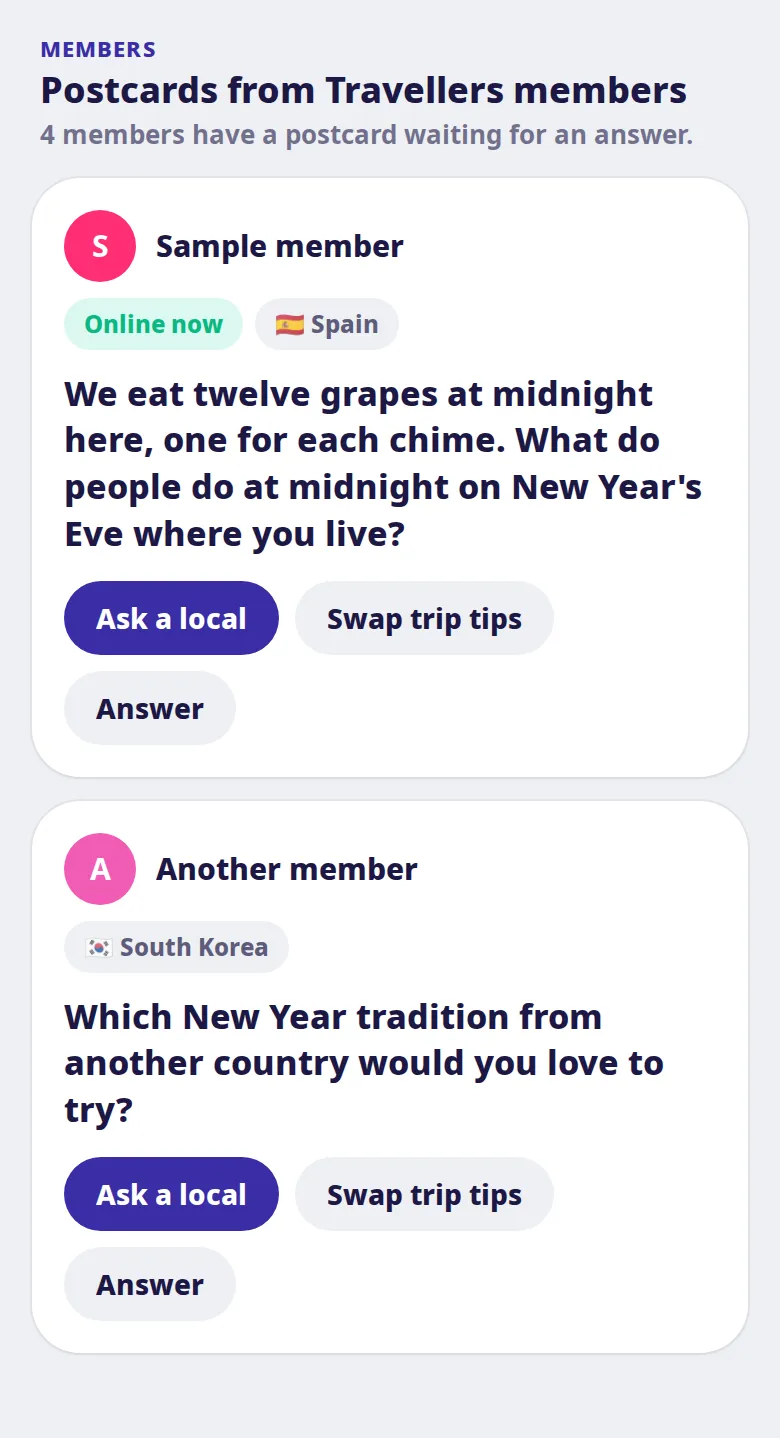 Example screen with sample members, not real people.
- Every message is translated both ways, with the original visible, so you can ask someone in Manila or Quito in your own language.
- Text only. No voice, no video, and contact details are stopped before delivery.
- Small community. Replies can take time, so ask a few days before 31 December.
- Report and block in every chat. No ads, no paid plan.
Questions people ask
+What are the most common New Year traditions around the world?
Fireworks and a countdown to midnight are the most widespread. Many countries add a lucky food (twelve grapes in Spain and much of Latin America, lentils in Italy and Chile, toshikoshi soba in Japan), a lucky colour (white in Brazil, yellow or red underwear in Latin America and Italy) and a sound at midnight, such as church or temple bells, clock chimes or a song like Auld Lang Syne.
+Why do people eat 12 grapes at midnight?
In Spain, people eat one grape on each of the twelve chimes at midnight, one for each month of the coming year, for luck. The custom goes back at least to 1895 and spread widely after 1909. The best-known place to do it is Puerta del Sol in Madrid, shown live on Spanish TV. It is also common across Latin America and in the Philippines.
+Which country celebrates New Year first?
Kiritimati (Christmas Island) in Kiribati is the first inhabited place to reach midnight. Baker Island, an uninhabited US territory, is last. According to timeanddate.com it takes 26 hours for the new year to reach every time zone.
+Do all countries celebrate New Year on 1 January?
Most countries mark 1 January, but many people also keep a new year from another calendar. Lunar New Year falls in late January or February, Nowruz on the March equinox, Songkran on 13 to 15 April, Rosh Hashanah in September or October and Enkutatash in Ethiopia on 11 September. Many people celebrate both.
+What colour should you wear on New Year's Eve for luck?
It depends on the country. Many Brazilians wear white for luck and peace. In Mexico, clothes in red are for love and yellow for work, and in Ecuador yellow underwear is for money and red for love. Yellow underwear is common in Chile and Venezuela too. In Italy, red underwear is worn for luck. Customs vary by family, so ask a local.
+When is Lunar New Year in 2027?
Lunar New Year falls on Saturday 6 February 2027. It is the Spring Festival in China and Tết in Vietnam. Seollal in Korea also follows the lunar calendar. The Chinese zodiac year that starts then is the Year of the Goat.
Keep reading
Boarding pass · free
Tap, fly to a random country, and chat with someone who lives there.
Text first, translated both ways, no video, no coins to meet people. Works in your browser.
Take off on OluNew here? Read Ablo App: The Complete Story of the Chat App That Let You Fly Anywhere (2019–2022), the full history in one place.