 Olu
Night Shift Tips: How to Sleep, Eat and Stay Alert on Nights
Night shift tips from NIOSH, the HSE, the RCN and the NHS: how to sleep in the day, what to eat at 3am, using light, getting home safely and recovering after.
Updated 19 November 2026 · 10 min read
On this page
- Why night shifts are so hard on the body
- Night shift sleep tips
- How to stay alert during the shift
- What to eat on a night shift
- Getting home safely after a night shift
- Days off and recovery
- Night shift tips for nurses and other health workers
- When to talk to a doctor or occupational health
- Company on a quiet night shift
At 3am the ward is quiet, the coffee is cold and your body is asking why you are awake. Night shifts keep hospitals, care homes, factories and emergency services running, but people are built to sleep at night and be awake in the day. Working against that takes some planning.
These night shift tips come from official occupational health guidance, mainly the US National Institute for Occupational Safety and Health (NIOSH), the UK Health and Safety Executive (HSE), the Royal College of Nursing (RCN) and the NHS. This is general information, not medical advice. If sleep is a real problem, talk to your doctor or occupational health.
The short answer: nap before your first night, go straight to bed when you get home and protect the morning for sleep, make your bedroom dark, quiet and cool, seek bright light early in the shift and less towards the end, eat light regular meals instead of a big one in the small hours, keep caffeine light and away from bedtime, and never drive home if you are very sleepy. On days off, avoid staying awake for very long stretches, and tell the people you live with when you need to sleep.
Talk to a nurse or carer on the night shift somewhere else
Why night shifts are so hard on the body
NIOSH's training for nurses on shift work names three problems with nights. You are working against your body clock, which is set by daylight. You will probably get less sleep, and poorer sleep, than people on days. And your relationships can suffer because family and friends live on a daytime schedule.
Over the long term, NIOSH says current evidence suggests shift workers may be at somewhat higher risk of conditions including cardiovascular disease, gastrointestinal disorders, psychological disorders, diabetes and some cancers. It says the research has limits, since diseases take years to appear and other factors are hard to separate out. Either way, sleep is the thing to protect.
Some people develop shift work disorder. The Sleep Foundation describes its main signs as insomnia, too much sleepiness while awake and repeated sleep loss, lasting at least a month, and cites research suggesting about one in five shift workers has experienced it. Only a clinician can diagnose it.
Night shift sleep tips
Before your first night
The worst plan is to stay up all day and then work all night. NIOSH warns that long stretches awake before a first night or after a last night raise the risk of accidents and add to sleep debt.
Sleep before you go in instead. The HSE's hints and tips for shift workers suggest a short sleep before your first night. NIOSH describes studies of long naps where nurses who napped 1.5 hours in the late afternoon felt more alert late in their first night, and naps of 2.5 to 3 hours also helped.
After the shift
NIOSH's sleep advice for night-shift nurses is direct:
- Go straight to bed when you get home. If you are hungry, have something small first.
- Get as much sleep as you can before about 2pm. The body's alerting signal returns in the afternoon, so later sleep is harder.
- Keep the early morning for sleep, not for errands, appointments or chores.
- Spend as much time in bed as you can. Night workers usually sleep less than day workers, so every extra hour counts.
Make the bedroom work for daytime sleep
Daylight tells your body to wake up, so darkness matters most. NIOSH suggests blackout blinds or curtains, blocking light under the door, an eye mask if needed, and a dim red nightlight for trips to the bathroom. The HSE adds a few more:
- Turn the phone off or right down, and ask the people you live with to keep noise down.
- Tell close neighbours your work pattern so they can avoid noisy jobs in your sleep time.
- Try earplugs or white noise to cover outside noise.
- Keep the room comfortably cool, which the HSE says improves sleep.
The RCN's shift work wellbeing guide adds: sleep in your bed, not on the sofa, and mute work message groups at home.
Wind down, even at 9am
Before bed, the HSE suggests a short walk, a book, music or a hot bath, and no vigorous exercise. Skip caffeine and energy drinks for a few hours before you sleep. Alcohol may help you drop off, but the HSE says it lowers sleep quality and is linked to waking early, so it is a poor sleep aid.
How to stay alert during the shift
Use light on purpose
Your body clock is strongly influenced by light and dark. NIOSH's light advice for night workers is to get as much light as you can early in the shift (a brightly lit area is enough) and to cut back on light later in the shift so sleep comes more easily at home. The exception: if you are very sleepy late in the shift, bright light may help you stay awake.
On the way home, NIOSH mentions dark or blue-light-blocking sunglasses to help you sleep afterwards. But it warns that sunglasses can block the alerting effect of light and make drowsy driving more likely, so wear them only if someone else is driving.
Breaks, movement and short naps
The HSE suggests taking regular short breaks if you can, getting up and walking around during them, keeping in touch with co-workers to help each other stay alert, and saving more stimulating tasks for the times you feel most drowsy.
If your workplace allows it, NIOSH says a brief nap of about 30 minutes during a scheduled break can increase alertness on nights. Leave time to wake up properly before going back to work. NIOSH explains that grogginess after sleep, called sleep inertia, typically lasts 30 to 60 minutes, and can last longer if you are sleep deprived. Bright light and washing your face helped people recover faster in studies.
Caffeine, lightly
NIOSH suggests only light caffeine during the shift. The HSE calls caffeine a mild stimulant to use occasionally, not something to rely on to stay awake. Both point the same way on timing: stop caffeine in the hours before you plan to sleep. The HSE also says regular sleeping pills or other sedatives are not recommended, and that any medicine to change alertness should only be used under medical supervision.
What to eat on a night shift
NIOSH's diet suggestions for night-shift nurses say to:
- Eat less between midnight and 6am, and keep to three meals in 24 hours where you can.
- Choose foods like vegetables, salads, vegetable soups and fruit during the shift.
- Avoid sugar-rich foods and low-fibre carbohydrates when you need to stay alert, because they can make you sleepier.
- Eat with colleagues away from the work area if you can.
Its next page adds: eat a small breakfast before your daytime sleep so hunger does not wake you, avoid large meals in the 1 to 2 hours before your main sleep, and avoid heavy, fatty or spicy food.
The HSE agrees: regular light meals and snacks affect alertness less than one heavy meal, easy-to-digest foods such as pasta, rice, bread, salad and fruit are good choices, and sugary snacks like chocolate give a short boost followed by a dip. Drink plenty of fluids, since dehydration reduces performance, but not too much right before bed.
| When | What the guidance suggests | Source |
|---|---|---|
| Before the shift | Moderate exercise, which may help alertness during the shift | HSE |
| Midnight to 6am | Eat less; if you eat, light foods like fruit or vegetable soup | NIOSH |
| Through the night | Fluids, light caffeine only, nothing very sugary | NIOSH, HSE |
| Before sleep | A small snack, no large meal 1 to 2 hours before | NIOSH |
Getting home safely after a night shift
Tiredness does not end with the shift. NIOSH's advice is simple: if you are very sleepy, do not drive. Get a lift, take a taxi or public transport, carpool, or sleep near work. Some hospitals pay for nurses' taxis home, so ask.
The HSE adds: share the driving if you can, don't hurry, and stop for a short nap if you feel sleepy and it is safe to do so.
Days off and recovery
Coming off nights
The HSE suggests that after a run of nights you have a short sleep, then go to bed earlier that night. NIOSH also describes a compromise schedule for regular night workers: on work nights, sleep from soon after you get home; on days off, stay up until about 3 or 4am and sleep until around noon or 1pm, so part of your sleep window (for example 8am to noon) stays the same every day.
Your family and friends
The HSE suggests talking to friends and family about shift work so they can be supportive, sharing your rota so they can include you in plans, and inviting people on similar shifts to join you socially. NIOSH suggests at least one meal together most days, notes for each other, and planning something special after a run of shifts with little time together.
Night shift tips for nurses and other health workers
Health workers have a few extra tools:
- NIOSH's free course. NIOSH Training for Nurses on Shift Work and Long Work Hours covers the risks and strategies above in more depth.
- Plan breaks at the start of the shift. The RCN advises managers to do this.
- Know the rules where you work. The RCN notes, for example, that NHS Employers sets a minimum of 11 hours' rest between shifts in the UK, and that the HSE recommends allowing two full nights of sleep when switching between days and nights. Rules differ by country and employer.
If you want to compare how shifts, ratios and training work in other countries, see nursing in different countries.
When to talk to a doctor or occupational health
Some signs deserve a conversation with a professional. The NHS page on insomnia lists shift work among the most common causes and says to see a GP if:
- changing your sleep habits has not helped,
- you have had trouble sleeping for months, or
- it is affecting your daily life in a way that makes it hard to cope.
The RCN also mentions regularly taking more than 30 minutes to fall asleep as a possible sign of a sleep problem. If your employer has occupational health, talk to them too. Don't start sleeping tablets or alertness medicines on your own.
Company on a quiet night shift
Nights can be lonely. Your friends and family are asleep, and the people who would understand are on the same shift, too busy to talk. Somewhere else in the world, though, a nurse or carer is on a break right now.
Olu is a free text chat site for adults 18+ to meet people in other countries, in your browser. Its Health workers planet is for nurses, doctors, carers and everyone who keeps people well. Its ritual is Quiet-hours company: on a shift and awake? Someone else is too. Send a postcard on a quiet moment and talk to someone who understands the work. Buttons let you Talk a while, Swap a survival tip or Answer someone else's question.
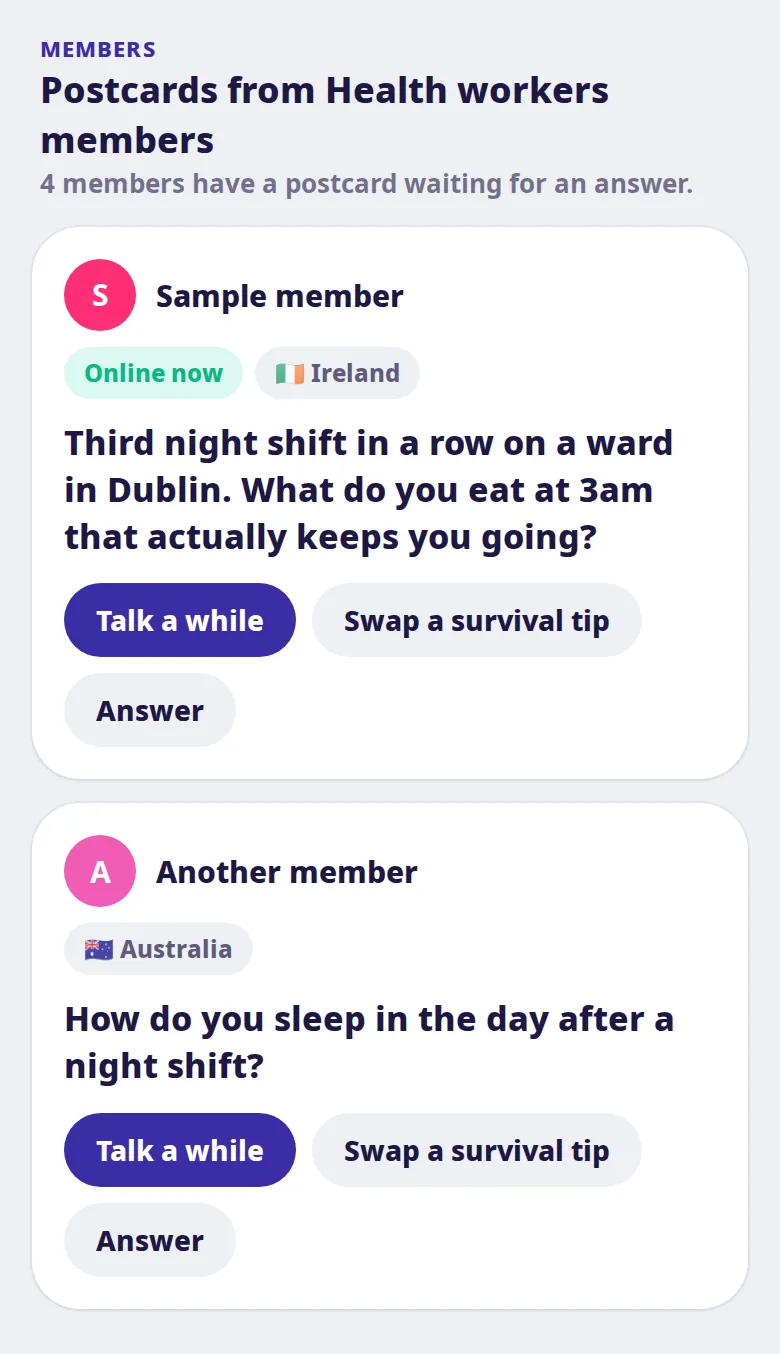 Example screen with sample members, not real people.
The planet has three laws, and they matter:
- Say where you work and what you do, so others know who they are talking to.
- No patient details, ever. Talk about the work, not the people you care for.
- This is not medical advice for strangers. Swap what helps you on nights, but anything about your own health goes to your doctor.
Every message is translated both ways with the original visible, so a nurse in Dublin and a carer in Seoul can each write in their own language. It is text only, contact details are stopped before delivery, and report and block are in every chat. Adults 18+ only (birth year asked at join, no ID check), no ads, no paid plan. The community is small, so at some hours nobody may answer straight away.
If a colleague has had a hard night and you want to support them by message, how to comfort someone over text has ideas. And if the loneliness of nights is getting heavy, what to do when you have no one to talk to lists people you can reach at any hour.
Questions people ask
+How do you survive your first night shift?
Do not stay up all day before it. The UK Health and Safety Executive suggests a short sleep before your first night shift, and NIOSH describes studies where a long nap of 1.5 to 3 hours in the afternoon or evening improved alertness on the night. Take a light meal with you, plan your breaks, and arrange a safe way home in case you are too sleepy to drive.
+When should I sleep after a night shift?
NIOSH's training for nurses says to go straight to bed when you get home and to get as much of your sleep as you can before about 2pm, because the body's alerting signal comes back in the afternoon. Keep the early morning free of errands and chores, since that is your best window for sleep.
+What should I eat on a night shift?
Guidance from NIOSH and the HSE points the same way: regular light meals and snacks rather than one heavy meal, foods that are easy to digest, fruit and vegetables over sugary snacks, plenty of fluids, and eating less between midnight and 6am. Have a small snack before bed so hunger does not wake you, but avoid a large meal in the 1 to 2 hours before you sleep.
+Is it OK to drink coffee on a night shift?
NIOSH suggests only light caffeine during the shift, and the HSE says to use it occasionally and not rely on it to stay awake. Both say to avoid caffeine in the hours before you plan to sleep. If you have a health condition or take medicine, ask your doctor what is right for you.
+When should I see a doctor about night shift sleep problems?
The NHS says to see a GP if changing your sleep habits has not helped, if you have had trouble sleeping for months, or if it is making daily life hard to cope with. If you work for a hospital or large employer, occupational health is also a good place to start.
Keep reading
Boarding pass · free
Tap, fly to a random country, and chat with someone who lives there.
Text first, translated both ways, no video, no coins to meet people. Works in your browser.
Take off on OluNew here? Read Ablo App: The Complete Story of the Chat App That Let You Fly Anywhere (2019–2022), the full history in one place.