 Olu
Online Communities for Developers: Where Programmers Ask, Learn and Hang Out
The online communities for developers worth joining: Q&A sites, forums, Discord servers, open source and meetups, plus how to ask a good question and give back.
Updated 19 November 2026 · 10 min read
On this page
- What developer communities are for
- Developer communities at a glance
- Q&A sites: Stack Overflow and Stack Exchange
- Forums and discussion boards
- Chat servers: Discord, Slack and Zulip
- Language-specific communities
- Developer communities in other languages
- Open source projects as communities
- Local meetups and in-person groups
- How to ask a good question
- How to give back
- Talking to a developer in another country
- Staying safe in developer communities
- How to choose your developer community
Every developer gets stuck. The difference between losing an afternoon and losing ten minutes is usually whether you know where to ask. The right community answers your question, shows you the bug you couldn't see, and later becomes the place where you hear about jobs, tools and side projects.
The trouble is that "developer community" covers very different things: a Q&A site with strict rules, a Discord server where answers scroll away in minutes, a forum run by a language team, a meetup in your city. This guide sorts the well-known ones by what they're good for, then covers how to ask a question people want to answer and how to give back once you can.
The short answer: for answers to specific errors, search and ask on Stack Overflow (or the Stack Exchange site that fits, such as Code Review). For live help, join your language's chat: Python Discord, Reactiflux for React, the Gophers Discord for Go, the Rust Zulip. For reading and discussion, DEV Community, Hacker News and Reddit (r/learnprogramming if you're learning). Learners do well in The Odin Project's Discord and the freeCodeCamp forum. For code review and real teamwork, contribute to open source. To meet people in person, try Meetup groups or a Google Developer Group. Ask with a minimal example, and never paste secrets.
Name the bug you're stuck on and ask a developer abroad
What developer communities are for
Before picking one, decide what you need this month. Each type of place does one or two jobs well:
- Answers. A searchable record of solved problems: Q&A sites.
- Live help. Someone to look at your error now: chat servers.
- Discussion and news. What people are building and reading: forums and link boards.
- Review and teamwork. Feedback from people who maintain the code: open source.
- People. Regulars, mentors and job leads: meetups and smaller servers.
Developer communities at a glance
| Community | Type | Good for |
|---|---|---|
| Stack Overflow | Q&A site | Specific errors, searchable answers |
| Code Review Stack Exchange | Q&A site | Feedback on working code |
| DEV Community | Blog and forum | Posts, tutorials, project write-ups |
| Hacker News | Link board | Tech news and long discussions |
| Lobsters | Link board (invite only) | Narrow, computing-only discussion |
| r/learnprogramming, r/cscareerquestions | Learning help, career questions | |
| freeCodeCamp forum | Forum | Learners, project feedback, career talk |
| The Odin Project | Discord | Web development learners |
| Python Discord | Discord | Python help, code jams |
| Reactiflux | Discord | React and JavaScript |
| Meetup, Google Developer Groups | Local groups | Meeting developers in person |
We checked each community's own pages in November 2026. Where a site blocked us, we used its most recent archived copy.
Q&A sites: Stack Overflow and Stack Exchange
Stack Overflow answers show up for most error messages, and a good answer there helps everyone who hits the same bug later. Its help centre says questions must be on-topic programming questions written in English, and asks you to search first because many common questions are already answered.
Stack Overflow is one of 184 communities in the Stack Exchange network, according to the network's own tour pages. A few others matter to developers:
- Code Review is for feedback on code that already works. Stack Overflow is for code that doesn't.
- Software Engineering covers design, architecture and process questions that have no single correct line of code.
- Stack Overflow in other languages. There is Stack Overflow em Português, Stack Overflow en español, a Japanese Stack Overflow and Stack Overflow на русском. If English slows you down, ask in your own language there.
Forums and discussion boards
DEV Community
DEV describes itself as a community of software developers helping one another. People publish posts, tutorials and project write-ups, and others comment. It runs on Forem, which is open source, and it has joined forces with Major League Hacking. It suits developers who learn by writing things down.
Hacker News and Lobsters
Hacker News is run by Y Combinator. Its guidelines say anything that gratifies intellectual curiosity is on topic, and ask commenters to be kind, skip snark, and not post AI-generated text. It is a place to read and discuss, not to get your bug fixed.
Lobsters is a smaller link board focused only on computing. You join through an invitation from an existing member, and careers and self-help are off topic.
- r/learnprogramming is for learners. Its rules say debugging posts must include a clear title, a description, a small runnable program, the output you expected and what you got, and the full error. It also bans offering or asking for payment for help.
- r/cscareerquestions is for careers. It runs regular resume advice threads and salary sharing threads for new graduates.
- r/programming is for discussion, not help requests, as MakeUseOf's roundup points out.
The freeCodeCamp forum
The freeCodeCamp forum has categories for curriculum help, general programming questions in any language, career talk, and an "I Built This" board where you show a project and give feedback on other people's.
Chat servers: Discord, Slack and Zulip
Chat gets you help in minutes, but answers scroll away, so search the server's history and read its rules before asking.
- Python Discord says it is dedicated to helping beginners, has help channels staffed by volunteer helpers across time zones, and runs code jams and hackathons.
- Reactiflux is a Discord for React, React Native and JavaScript developers, and hosts Q&As with developers from the community.
- The Odin Project runs its community on Discord, where learners working through its free web development curriculum help each other.
- Go's help page lists the Go Forum, the Gophers Discord, the Gopher Slack, the golang-nuts mailing list and #go-nuts on Libera IRC.
- Rust's community page points to the Users Forum for questions, the Internals Forum for work on the language itself, and a Zulip server for chat.
Language-specific communities
The best place for a language question is often that language's own home. Python has Discussions on Python.org, with a "Python Help" category open to all. The Rust Users Forum runs a weekly "What's everyone working on" thread. Most languages have an official community page that lists the places the core team reads. Start there.
Developer communities in other languages
English isn't the only working language of software. Besides the Stack Overflow sites above:
- Qiita (Japan) calls itself a technical knowledge-sharing platform for engineers, built around articles that others can reuse.
- Zenn (Japan) is an information-sharing community for engineers where people write articles and can publish or sell books on topics they know well.
- Habr started in 2006 as a Russian newsfeed and grew into a large blog platform for tech professionals, with Q&A, discussion and jobs. It has an English version.
Reading them shows how developers elsewhere solve the same problems.
Open source projects as communities
An open source project is a community with a shared goal and real code review. GitHub's docs explain that maintainers apply the good first issue label so newcomers can find tasks, which makes it the easiest search to start with.
You don't have to write code to join in. GitHub's Open Source Guides list documentation, translations, examples, tutorials, design and organising meetups as contributions that projects often neglect. Before your first pull request, read the project's contributing guide and code of conduct. Many projects use the Contributor Covenant, which sets out how people are expected to treat each other.
Local meetups and in-person groups
Online communities are wide; local ones are deep. A few ways in:
- Meetup lists software development groups worldwide, from .NET São Paulo to The New York Python Meetup Group.
- Google Developer Groups are local chapters that meet online and in person, and say beginners are welcome.
- PyLadies is a worldwide group of women developers who love Python, with local Meetup groups and a Slack.
- Django Girls is a volunteer-run non-profit that helps people organise free one-day Python and Django workshops for women. Its site says these have run in more than 100 countries.
If you meet someone from an online community in person, pick a public venue, tell a friend where you're going, and leave if anything feels off.
How to ask a good question
The way you ask decides whether anyone answers. These habits come from Stack Overflow's guide to asking and Eric Raymond's long-running essay How To Ask Questions The Smart Way:
- Search first, and say what you found. Link the answers that didn't help and why.
- Write a title that names the problem. "Why does 5 / 2 return 2 in Python 2?" beats "Python help".
- Describe the goal, not just the step. The XY problem is asking about your attempted fix instead of the real problem. Give the bigger picture.
- Describe symptoms, not guesses. Say what happened, in order. If you have a theory, label it as one.
- Include a minimal, reproducible example. As little code as still shows the bug, complete enough for someone else to run, and tested.
- Paste text, not screenshots. Code, data and error messages should be copyable.
- Stay around and follow up. Answer comments, try the suggestions, and post what fixed it.
How to give back
Communities run on people who answer. Once you can, return the favour:
- Answer one question a week in the place that helped you. Explaining is the fastest way to find gaps in what you know.
- Edit and improve. Fix a broken link, clarify an old answer, or improve a project's docs.
- Review code. Code Review Stack Exchange, the freeCodeCamp "I Built This" board and Exercism's volunteer mentoring all need reviewers.
- Show your work. A post on DEV or Qiita about a bug you fixed saves the next person an afternoon.
- Run something. Host a study night or a local meetup.
Talking to a developer in another country
Big communities are great for answers. What they rarely give you is a conversation with one developer in another country: how junior roles work there, which stack local companies use, what remote work really looks like.
Olu is a free text chat site for meeting people in other countries, in your browser, for adults 18+. Its Developers planet is for people who build software anywhere in the world, comparing stacks, salaries, remote work, first jobs and side projects across countries. The ritual is Stuck? Ask a human: you name the thing you're stuck on, a developer who has hit it before answers, and you talk it through, with the aim of getting you unstuck in about ten minutes. Member postcards have Pair 10 minutes, Review my code and Answer buttons.
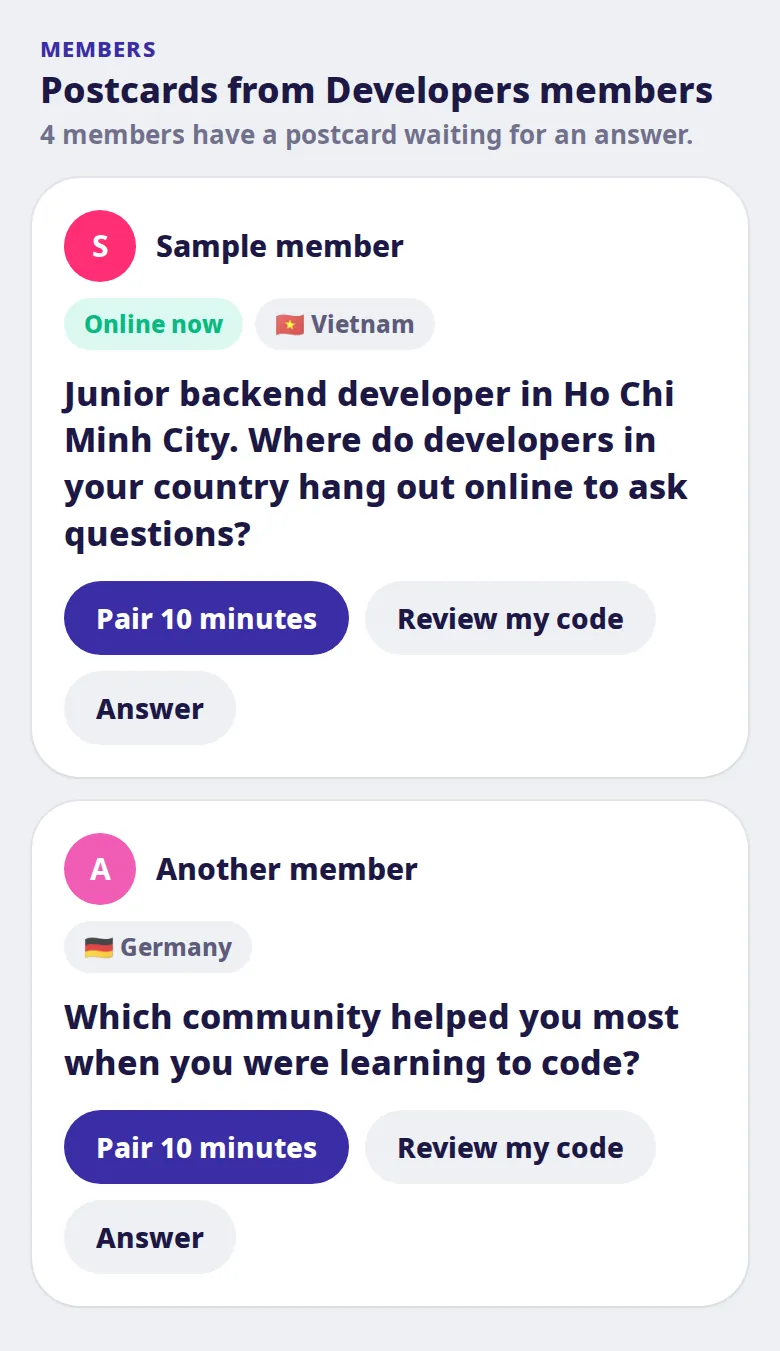 Example screen with sample members, not real people.
A few honest details:
- It's text only. No screen share and no voice. You describe the problem and paste a short snippet or error message.
- Every message is translated both ways, with the original visible. Code and errors usually read best in the original anyway.
- It's a small community, so at quiet hours nobody may answer straight away.
- Report and block are in every chat, and contact details are stopped before delivery.
If you want a regular partner rather than a one-off answer, our guide to finding a coding buddy covers that. Friendships that start over a bug can last; make friends from other countries online has ideas for keeping them going.
Staying safe in developer communities
- Never share credentials. No passwords, API keys, tokens, SSH keys or
.envfiles, in public or in private messages. Check every snippet before you paste it, and rotate any secret that leaks. - Never give a stranger access to a private repository, a work repository or your machine.
- Read before you run. Don't run scripts or install packages a stranger sends you without checking what they do.
- Never pay for help or "guaranteed jobs" offered in a chat. r/learnprogramming bans payment for help for good reason.
- Keep your employer's code private. Rewrite the problem as a tiny example instead.
More general habits are in our random text chat safety tips.
How to choose your developer community
- Stuck on a specific error? Search Stack Overflow, then ask in your language's chat.
- Learning from scratch? The Odin Project's Discord, the freeCodeCamp forum or r/learnprogramming.
- Want feedback on working code? Code Review Stack Exchange or an open source project.
- Want news and debate? Hacker News, Lobsters or DEV.
- Want people? A local Meetup group or Google Developer Group.
Join two, one to ask and one to read, and check the newest posts are recent first.
Questions people ask
+What is the best online community for developers?
There isn't one best place, because each type does a different job. Stack Overflow for searchable answers to specific errors, a language's own forum or Discord for live help, DEV Community or Hacker News for reading and discussion, r/learnprogramming or the freeCodeCamp forum if you're learning, and open source projects for real code review. Most developers use two or three.
+Where do programmers hang out online?
Mostly in four kinds of place: Q&A sites (Stack Overflow and the Stack Exchange network), forums and link boards (DEV Community, Hacker News, Lobsters, Reddit), chat servers on Discord, Slack or Zulip (Python Discord, Reactiflux, the Gophers Discord, the Rust Zulip), and open source projects on GitHub. Developers in Japan and Russia also use local sites such as Qiita, Zenn and Habr.
+Is there a Stack Overflow in other languages?
Yes. Stack Overflow itself asks for questions in English, but the Stack Exchange network also runs Stack Overflow em Português, Stack Overflow en español, a Japanese Stack Overflow and Stack Overflow на русском. Each works the same way as the English site.
+How do I ask a programming question so people answer it?
Search first. Then write a title that names the specific problem, explain what you were trying to do, include a minimal, reproducible example as text (not a screenshot), paste the full error message, and say what you expected versus what happened. Reply to comments and post the fix when you find it.
+Is it safe to share code in developer communities?
Share only code you're allowed to make public, and cut it down to the smallest piece that shows the problem. Never paste passwords, API keys, tokens or .env files, and never give a stranger access to a private or work repository. If a secret slips into a post, rotate it straight away.
Keep reading
Boarding pass · free
Tap, fly to a random country, and chat with someone who lives there.
Text first, translated both ways, no video, no coins to meet people. Works in your browser.
Take off on OluNew here? Read Ablo App: The Complete Story of the Chat App That Let You Fly Anywhere (2019–2022), the full history in one place.