 Olu
Running Buddy: How to Find a Running Partner and Run Safely Together
How to find a running buddy: clubs, parkrun, apps and virtual check-ins, how to match pace and goals, and how to stay safe when you run with someone new.
Updated 19 November 2026 · 10 min read
On this page
Running alone is easy to skip. It's dark, it's cold, and nobody will know. A running buddy changes that. Someone is standing at the park gate at 6:30, or waiting for your Friday message, and that is often what gets your shoes on.
This guide covers where runners actually find partners, how to match pace and goals, how to stay safe with a new partner, and how a virtual running buddy works when nobody near you fits.
The short answer: look first at people you already see (on your route, at work, at your gym), then running clubs, running shop group runs, parkrun and beginner groups. Agree on days, times and a pace where you can both talk in full sentences. Meet someone new at the start of a busy route in daylight and tell a friend where you'll be. If no one local fits, a remote check-in partner who expects a weekly update still keeps you honest.
Find someone to check in with every Friday
What is a running buddy?
A running buddy is a partner you run with, or report to, on a regular schedule. Most partnerships take one of four shapes:
- Every-run partner. Same days, route and pace. Suits two people training for the same race.
- Long-run partner. You run your weekday sessions alone and meet once a week for the long, slow one. This is the easiest kind to keep going.
- Group regular. You don't have one partner, you have a club night or a Saturday 5k where the same faces turn up.
- Check-in partner. You live in different places, maybe different countries. You each run alone and send an update on a fixed day.
"Virtual running buddy" adds a fifth meaning: an app that paces you with a voice or a "ghost runner". Useful on a treadmill, but it won't notice when you skip a week.
If you also lift or train indoors, the gym buddy guide covers that side, including the research on training with a partner.
Why run with someone
- You keep each other accountable. The running-partner guides we read all put this near the top: when one of you wants to skip, the other one is already lacing up.
- Easy runs stay easy. Talking slows you down in a good way. Coach Greg McMillan's talk test says that in the easy endurance zone you should be able to carry on a full conversation. A partner makes that check automatic.
- It's safer. The Road Runners Club of America's runner safety tips start with running with a club or crew, because running in a group increases your safety.
- Friendships form. Seeing the same person every week, side by side, is how many adult friendships start.
How to match pace and goals
Most running partnerships end over pace or scheduling, not personality. Sort both before your first run.
Know your own pace first
Run a few times alone and note your average pace on an easy run, not your best day. Melinda Rangel's guide on Active.com suggests exactly this, because pace changes from run to run. Then say it plainly when you look for a partner: "easy runs around 6:30 per km" or "slow, run-walk, happy to go slower".
Use the talk test together
McMillan's talk test gives you a shared language: full conversation on easy runs, a sentence or two on steady runs, a word or two on hard ones. Easy runs are the natural buddy runs. The rule that keeps partnerships alive: on easy days, the slower runner sets the pace. If one of you can't answer a question, you're going too fast.
Decide what to do about a pace gap
| Situation | What works |
|---|---|
| Same pace | Run everything together if your plans allow it |
| Small gap | Easy and long runs together, hard sessions apart |
| Big gap | Warm up together, split for the main run, cool down together |
| Very different goals | Meet for one long run a week, or switch to check-ins |
The Rockay guide to finding a running buddy makes the same point: interval, fartlek and tempo sessions often work better alone, and a personal training plan may not line up with a partner's. You don't need to share every run.
Agree on the boring things
- Days and times. "Tuesday 6:30 am and Saturday 8 am" beats "a few times a week". Active.com's guide prefers mornings, because later plans tend to get in the way.
- The goal. One sentence each: "First half marathon in April." "Run 5k without stopping."
- Cancelling. "Message by 9 pm the night before." The other person runs anyway.
- A review. After a month, ask: is this still working for both of us?
If you're new to running or have a health condition, check with a doctor before you start. If something hurts and doesn't settle, see a doctor or physio rather than running through it.
Where to find a running partner
People you already see
The best running partner is often someone whose routine already overlaps with yours. Look at:
- Your route. If the same runner passes you on the river path every morning, you already share a time and a place. A wave becomes a "same time tomorrow?"
- Work and friends. Tell people you're training for something. Someone always says "I've been meaning to start".
Running clubs and shop runs
- Running clubs. Most towns have one, often with groups for different paces. In the US, the Road Runners Club of America has a "Find Run Clubs, Coaches, & Events" search on its home page.
- Running shops. Some host a weekly group run, and staff usually know the local clubs. Ask at the till.
- Beginner groups in England. England Athletics runs RunTogether, a national programme for people starting out, coming back or wanting to improve, with runs led by trained Run Leaders. Its page listed 3,686 groups when we checked in November 2026.
parkrun
parkrun is a free, timed 5 km event held in parks on Saturday mornings in many countries. You register once and get a barcode that works at any parkrun; without one you can still take part, but your time isn't recorded. Walkers are welcome, and volunteers run every event. Because the same people come every week, it's one of the easiest places to find someone at your pace: look at who finishes near you in the results.
Beginner plans
Starting from zero? The NHS Couch to 5K plan takes about 9 weeks, with 3 runs a week and rest days between, and its app is free. Two beginners on the same week of the plan make good partners, because neither one is waiting for the other.
Apps and online groups
- Strava clubs. Many local clubs and run crews have a Strava club; search your town's name.
- Meetup and local groups. Search your city for running groups, or post in your city's subreddit or Facebook group with your area, days and pace.
- Running partner apps. Some apps try to match runners directly. Running Mate, for example, says on its App Store page that it matches runners by pace, location and availability with "verified, background-checked" partners. In November 2026 it had just 4 ratings on the US App Store. Check that people near you use one before you count on it.
New to the city as well as new to running? How to make friends in a new city has a wider plan.
How to ask, and how to run the first run
Make the ask small. One run, not a training partnership.
- Start with what you share. "You run this path most mornings too, right?"
- Suggest one easy run. "Fancy an easy 5k on Saturday? I run around 6:30 per km."
- Keep the first run short. The Bunchups guide to finding a running buddy suggests 20 to 30 minutes, enough to see whether the pace and the chat fit.
For an online post, give the details people need to say yes: "Looking for someone to do a slow long run on Sunday mornings near the canal, around 10 km at 7 min per km. Training for my first half. Happy to start with one run."
Safety when you meet a running partner you don't know
Most people looking for a running partner just want a running partner. Still, a run puts you somewhere quieter than a café, so take care:
- Chat first. A few days of messages tells you a lot. Keep your phone number and social profiles private for now.
- Meet at the start of a busy, public route, in daylight. A popular park loop or parkrun, not a quiet trail. Bunchups suggests meeting somewhere public first, even for a quick coffee or a warm-up lap.
- Tell someone. Who you're meeting, where, and when you expect to be back. The RRCA tips also say to carry your phone and some ID.
- Share your location. Strava's Beacon shares your live location with up to three safety contacts through a link they open in a browser; they don't need a Strava account. Strava made it free for everyone recording on a phone in 2021.
- Don't start from your front door. Meet at the route, travel there yourself, and keep your home address private until you trust someone.
- Never send money. No "club fees" to a person, no gift cards, no loans. That's a scam.
- Trust your instincts. If a person or place feels wrong, leave and get somewhere safe. You owe nobody a full run. Block and report anyone who pushes for dates, photos or personal details.
More on spotting bad actors before you meet is in random text chat safety tips.
No one local? Try a virtual running buddy
Maybe you live somewhere small or run at 5 am. Don't wait. A real person in another city, or another country, can still give you what keeps you running: someone who expects to hear how the week went.
How it works:
- Agree on one goal each. Different goals are fine. A first 10k and a marathon base can share a Friday message.
- Pick a fixed day. Friday works well: you can still save the week.
- Keep the update short. "Planned 3 runs, did 2. Long run 12 km, felt good. Next week: 3 runs and one hill session. How was yours?"
- Ask one real question back. What time do they run? What's their route like? That's half the fun.
Olu is a free text chat site for meeting people in other countries, in your browser, for adults 18+. Its Fitness and sport planet is for runners, lifters, climbers and weekend footballers. The planet rules are simple: say your sport, no selling pills or plans, and every level is welcome. Its ritual is called Check-in partner: find someone to check in with every Friday, say what you're training for, and someone with a goal of their own answers. You keep each other honest.
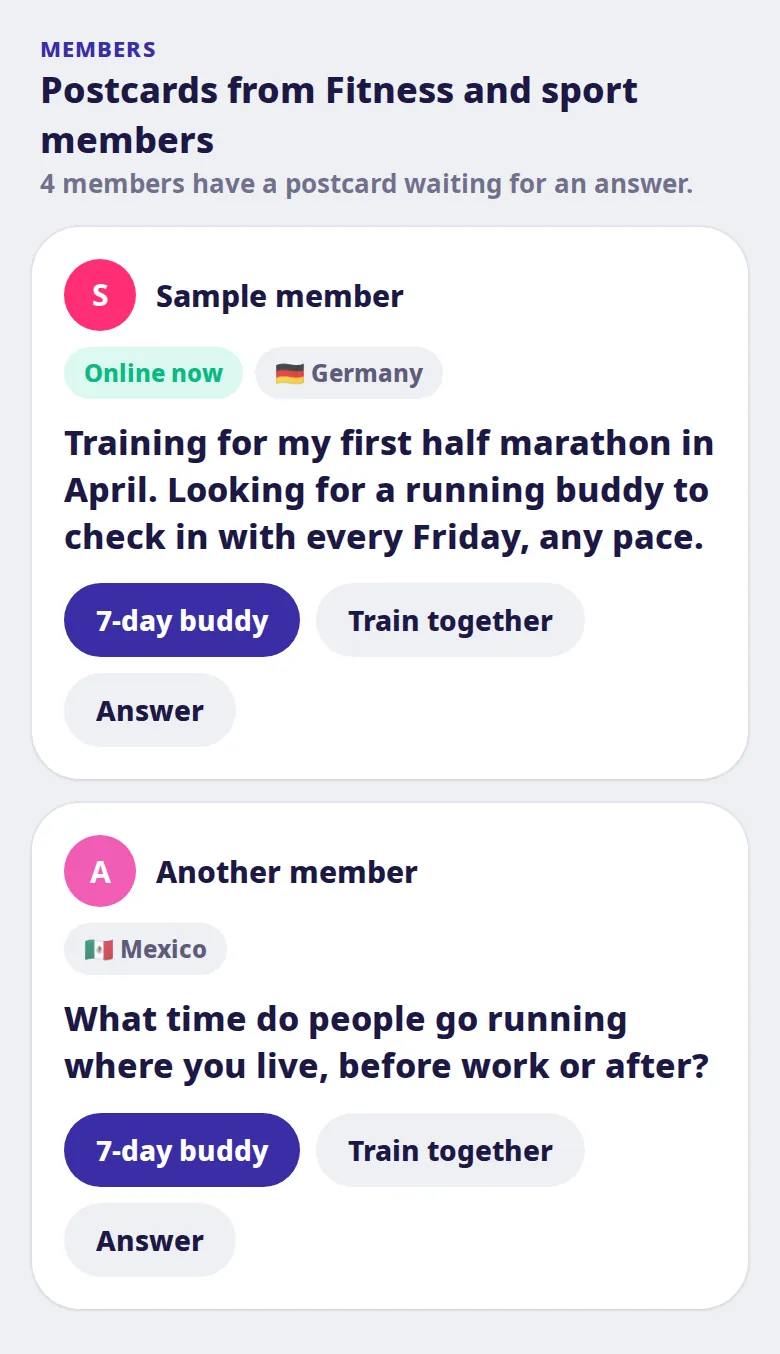 Example screen with sample members, not real people.
A few honest details:
- It's text only. No voice, no video. You check in by message; you don't run "together" live.
- It's not for arranging local meet-ups. Contact details are stopped before delivery, so it suits a remote partner, not swapping numbers to meet at the park.
- Every message is translated both ways, with the original visible, so your partner in Mexico or Germany doesn't need to share your language.
- The community is small. At quiet hours, nobody may answer straight away.
- Report and block are in every chat. There are no ads and no paid plan.
The same idea works anywhere you can message someone reliably; an accountability partner guide goes into how to set one up for any goal.
When a running partnership isn't working
- They keep cancelling. Mention it once, kindly. If nothing changes, keep your slot and find someone else.
- One of you is always waiting. Switch to "easy runs together, hard runs apart", or to check-ins.
- Your goals have split. One of you is chasing a time, the other wants a chat. Keep the weekly long run and drop the rest.
- It's turning into something you didn't want. Say so clearly. If they don't respect it, stop running together.
Ending it doesn't need drama. "My plan's changing, so I'm going to run solo for a while" is enough.
Questions people ask
+What is a running buddy?
A running buddy is someone you run with, or check in with, on a regular schedule. Some run every session side by side, some meet for one long run a week, and some live in different cities and swap updates. What matters is that you both expect each other to show up.
+How do I find a running partner near me?
Start with people you already see on your route or at work, then try a local running club, a running shop's group run, parkrun on Saturday mornings, or a beginner group such as England Athletics' RunTogether in England. In the US, the Road Runners Club of America website has a search for clubs, coaches and events.
+Does my running buddy need to run at my pace?
Not exactly, but close. For easy runs, the slower runner sets the pace and both of you should be able to talk in full sentences. If the gap is big, run your warm-up and easy runs together and do hard sessions apart.
+Is there a running partner app?
There are several small ones. Running Mate, for example, says it matches runners by pace, location and availability with background-checked partners, but it had only 4 ratings on the US App Store in November 2026. Check that people near you actually use an app before you rely on it. Strava clubs and Meetup groups are bigger places to look.
+What is a virtual running buddy?
It can mean two things: an app voice or ghost runner that paces you, or a real person who lives somewhere else. With a real person, you agree on a weekly goal, each run on your own, and send each other a short update on a fixed day.
+How do I stay safe running with someone I met online?
Chat first, meet at the start of a busy, well-known route in daylight, tell a friend who you are meeting and where, and keep your home address private. On Strava, Beacon lets up to three contacts follow your run live. Trust your instincts and leave if anything feels wrong.
Keep reading
Boarding pass · free
Tap, fly to a random country, and chat with someone who lives there.
Text first, translated both ways, no video, no coins to meet people. Works in your browser.
Take off on OluNew here? Read Ablo App: The Complete Story of the Chat App That Let You Fly Anywhere (2019–2022), the full history in one place.