 Olu
Table Manners Around the World: Dining Etiquette in 26 Countries
Table manners around the world: dining etiquette in 26 countries, from chopsticks and the right hand to who starts eating, clean plates, toasts and saying no.
Updated 19 November 2026 · 11 min read
On this page
You are a guest at a family dinner abroad. The food arrives. Should you start? If you clear your plate, will they think you are still hungry?
This guide covers table manners around the world: how people eat, who starts, whether to finish your plate, how toasts work, and how to say no to seconds. Every country row comes from a source we opened. Table manners vary by region, religion, age, family and setting within every country, so read each line as "what a guest will often see", not a rule everyone follows.
The short answer: in most countries, guests wait for the host or the oldest person to start, try a little of everything, and stay for the talk after the meal. Beyond that, the details change. In Japan, China and Vietnam, never stand chopsticks upright in rice. In India, Pakistan, Saudi Arabia, Ethiopia and Egypt, eat and pass food with your right hand. Germany, Spain and Brazil expect a clean plate, while in Egypt, Thailand and Russia leaving a little shows the host was generous. When unsure, watch the family and copy what they do.
Ask someone who lives there what a guest should know
Table manners in 26 countries
What a guest will often see at a meal, before, during and after. The Cultural Atlas, the source for most rows, is a cultural reference site published by Mosaica.
| Country | Before you eat | At the table | Finishing and drinks | Source |
|---|---|---|---|---|
| Japan | Say "Itadakimasu"; the most honoured person starts | Never stand chopsticks in rice or pass food chopstick to chopstick; slurping noodles is fine | An empty plate means you are satisfied; say "Gochisosama-deshita"; pour for others, not yourself | JNTO, Cultural Atlas |
| China | Elders get deference | Shared dishes in the middle; hold the rice bowl near your mouth; don't take the last piece | Decline seconds once before accepting; finishing is now encouraged by anti-waste campaigns | Cultural Atlas |
| South Korea | The oldest person is served first and starts first | Spoon for soup, chopsticks for the rest; give and take food with two hands | Fill others' glasses first; in formal settings wait for someone to fill yours | Cultural Atlas |
| Vietnam | Hosts may call it a simple meal; praise the food | Serve yourself from dishes in the middle; never stand chopsticks in rice | Drinks often come after the meal | Cultural Atlas |
| Thailand | Take rice first, then one or two dishes | Fork and spoon; use the serving spoon for shared dishes | Leave a little to show you are satisfied; put utensils together when done | Cultural Atlas |
| India | Wash your hands; accept the offered chai | Eat and serve with your right hand | Compliment the host; ask before leaving an elder's home | Cultural Atlas |
| Pakistan | Wait for elders to sit and begin | Right hand to eat and pass; the left can hold the plate | To decline a dish, hand on heart and a slight bow of the head | Cultural Atlas |
| Indonesia | Wait to be seated and invited to eat | Hands above the table; pass food with the right hand | An empty plate or glass invites more; stay until all have finished | Cultural Atlas |
| Philippines | Hosts may wait until every dish is out | Spoon and fork, or hands; don't lean on your arms | Refusing refreshments is impolite; people avoid the last serving when a visitor is there | Cultural Atlas |
| Saudi Arabia | Wait for the host's signal and the eldest; "Bismallah" often starts it | Eat with the right hand, often without utensils | Cover the coffee cup or shake it gently to say "enough"; thank the host before getting up | Cultural Atlas |
| Egypt | Wait for the host to seat and serve you | Right hand only; don't add salt to your food | Leave a little to show abundance; accepting seconds is a compliment | Cultural Atlas |
| Turkey | Tea is offered as soon as you sit | Handle food with your right hand; feet under the table | Say "Elinize sağlık" (health to your hands); hosts refill empty glasses | Cultural Atlas |
| Iran | Taarof: refuse politely at first, even when hungry | No left hand for eating or offering | A clean plate shows you enjoyed it; you may need to insist you are full | Cultural Atlas |
| Ethiopia | Wash hands; wait for the blessing | Shared platter; scoop with injera, right hand; accept gursha, a bite fed to you as respect | In the north, leave a little; don't leave right after eating | Cultural Atlas |
| Kenya | Hands washed before and after | Right hand in many rural families; never pass with the left alone | Sharing matters and waste is rare; accepting tea accepts hospitality | Cultural Atlas |
| Georgia | A tamada (toastmaster) leads the supra feast | Eating during toasts is fine; talking over the speaker is not | Toasts go round the table; each speaker raises a glass and drains it | Wikipedia |
| Russia | Accept food and drink if you can | Don't eat or drink during a toast | Leave a little to show you are full; "Vashe zdoroviye" (your health) | Cultural Atlas |
| Germany | Wait for the host; "Guten Appetit" | Hands above the table, elbows off | Eat everything; wait for the host's toast and look people in the eye at "Prost" | Cultural Atlas |
| France | Wait until all are seated and served; "bon appétit" | Pass dishes, holding them for your neighbour | Finish your food; knife and fork side by side; leave the glass mostly full to decline wine | Cultural Atlas |
| Italy | Wait for the host's "Buon appetito"; some say grace | Hands not in your lap, elbows off; bread for the sauce at the end | Leave the wine glass nearly full to decline more; stay until all have finished | Cultural Atlas |
| Spain | The host signals the start | Wrists on the table edge; bread to clean up sauce | Finish your plate; host toasts first, guest replies later; stay for the sobremesa | Cultural Atlas |
| United States | Wait until all are served; some homes say grace | Many switch the fork to the right hand after cutting; napkin on the lap | Seconds show you enjoyed it; a "no thanks" is taken as meant | Cultural Atlas |
| Mexico | Tell the host if you can't eat spicy food | Hands visible above the table; tortillas can scoop food | "Salud!"; ask to be excused; stay and talk after the meal | Cultural Atlas |
| Brazil | Some finger foods are eaten with a napkin or toothpick | Eat quietly | Finish your plate; stay for dessert and cafezinho | Cultural Atlas |
| Argentina | Bring a dish to share at an asado | Knife in the right hand, fork in the left | "Salud" while looking at the person toasted; sharing mate signals friendship | Cultural Atlas |
| Chile | The host invites everyone to start | Both hands above the table | Finish your plate; accept drinks; "Salud" | Cultural Atlas |
Hands, chopsticks and cutlery
Chopsticks
The rule that comes up most often: never stand chopsticks upright in a bowl of rice. The Cultural Atlas links it to funerals in Japan, China and Vietnam. Rest them on the table or in front of you instead. Japan adds more: don't pass food from your chopsticks to another person's, don't point with them, and don't rub disposable ones together, which can suggest the restaurant is cheap. In Thailand, chopsticks are mostly for noodles; the usual pair is a fork and spoon.
Eating with the right hand
In India, Pakistan, Saudi Arabia, Egypt, Ethiopia and many rural Kenyan families, much food is eaten with the fingers, and guides say to eat, serve and pass it with the right hand. Turkey and Indonesia say the same for passing food. In Pakistan, the left hand can hold the plate, but should not bring food to your mouth.
In Ethiopia, injera, a spongy flatbread, is the scoop for nearly every dish. If the host feeds you a bite by hand, it is gursha, a sign of respect. Smile and accept it.
Knife and fork
In much of Europe and in Argentina, the fork stays in the left hand and the knife in the right. In the US, many people cut, put the knife down, then switch the fork to the right hand. Wikipedia's table manners article gives the European signal for "finished": knife and fork together on the plate at 6 o'clock.
Hands go above the table, not in your lap, in Germany, Italy, Spain, Mexico, Chile and Indonesia.
Who starts eating
This one is close to universal: guests wait. In South Korea, nobody starts until the oldest person does, and Pakistan and Saudi Arabia also wait for elders. In Japan the most honoured person begins. In Germany, Italy, Spain, Chile, Indonesia and the US, the host signals the start. In Ethiopia, wait for the blessing over the food. In France, wait until everyone is served, unless the person still waiting tells you to go ahead.
Clean plate or a little left?
This is where guests get it wrong most often, because the same act means opposite things.
| What to do | Where (guides we opened) | Why |
|---|---|---|
| Finish your plate | Germany, France, Spain, Brazil, Chile | Leftovers suggest you didn't enjoy it |
| An empty plate means "enough" | Japan | It signals you are satisfied |
| A clean plate is a compliment | Iran | It shows you enjoyed the meal |
| Leave a little | Egypt, Thailand, Russia, northern Ethiopia | It shows the host served plenty |
| It is changing | China | A little left once showed generosity; anti-waste campaigns now encourage finishing |
In Indonesia, an empty plate or glass tells the host you want more. Spain's advice is practical: if you can't finish, decline a big portion up front rather than leave food.
Toasts and pouring drinks
- Georgia: the supra feast has a tamada, a toastmaster chosen by the guests or the host. The toast travels round the table, each speaker raising a glass and draining it.
- Russia: toasts can be long. Don't eat or drink during one, and clink with everyone at the end. Refusing a toast is impolite.
- Germany and Spain: wait for the host's toast. In Germany, look people in the eye at "Prost". In Spain, the guest returns the toast later.
- Japan and South Korea: pour for others, not yourself. To decline more, leave some in your glass.
- France and Italy: leave the wine glass mostly full if you don't want more.
- Saudi Arabia: Arabic coffee keeps coming until you cover the cup or gently shake it.
Not everyone drinks alcohol. Guides for India, Egypt, Saudi Arabia and Turkey note that some or many people avoid it, so never push a drink. The words for raising a glass are in cheers in different languages.
Saying no to more food
In some countries the first "no" is not a real no.
- Iran: under taarof, you refuse politely at first, even if you want the food, and hosts offer again. If you really are full, you may need to insist.
- China: decline seconds once before accepting.
- Turkey and Pakistan: hosts often ignore a first refusal. If you can't eat something, give a real reason, such as being vegetarian.
- Mexico: instead of a flat no, "ahorita" means "not right now, maybe later".
- United States: the opposite. A "no thanks" is taken as meant.
How to be a good guest at any table
- Wait to be seated, to be served, and for the host or eldest to start.
- Use your right hand for food.
- Try a little of everything. Guides for China, Saudi Arabia and Iran say this pleases the host.
- Praise the food. In Egypt, make it a statement, not a question about how it was cooked.
- Don't rush off. Leaving right after eating is impolite in Ethiopia, Spain, Chile and Mexico.
- Watch and ask. Copy the family, and ask when unsure. A question about a custom is a compliment.
Being surprised at the table is normal. Food comes up in our list of culture shock examples for good reason.
Ask a local what a guest should know
A guide shows what is common. It can't tell you what one family in Osaka, Tehran or Seville expects at their table. Someone who lives there can.
Olu is a free text chat site for adults 18+ to meet people in other countries, in the browser. Its Travellers planet is about where to go and what it is really like, from people who live there. The ritual is Ask a local: skip the list, name the place, and ask a person who lives there what to skip and what not to miss. Tap Ask a local, Swap trip tips, or Answer a question about your own country. The laws are short: say which country, be curious and never insulting, and remember that locals know best.
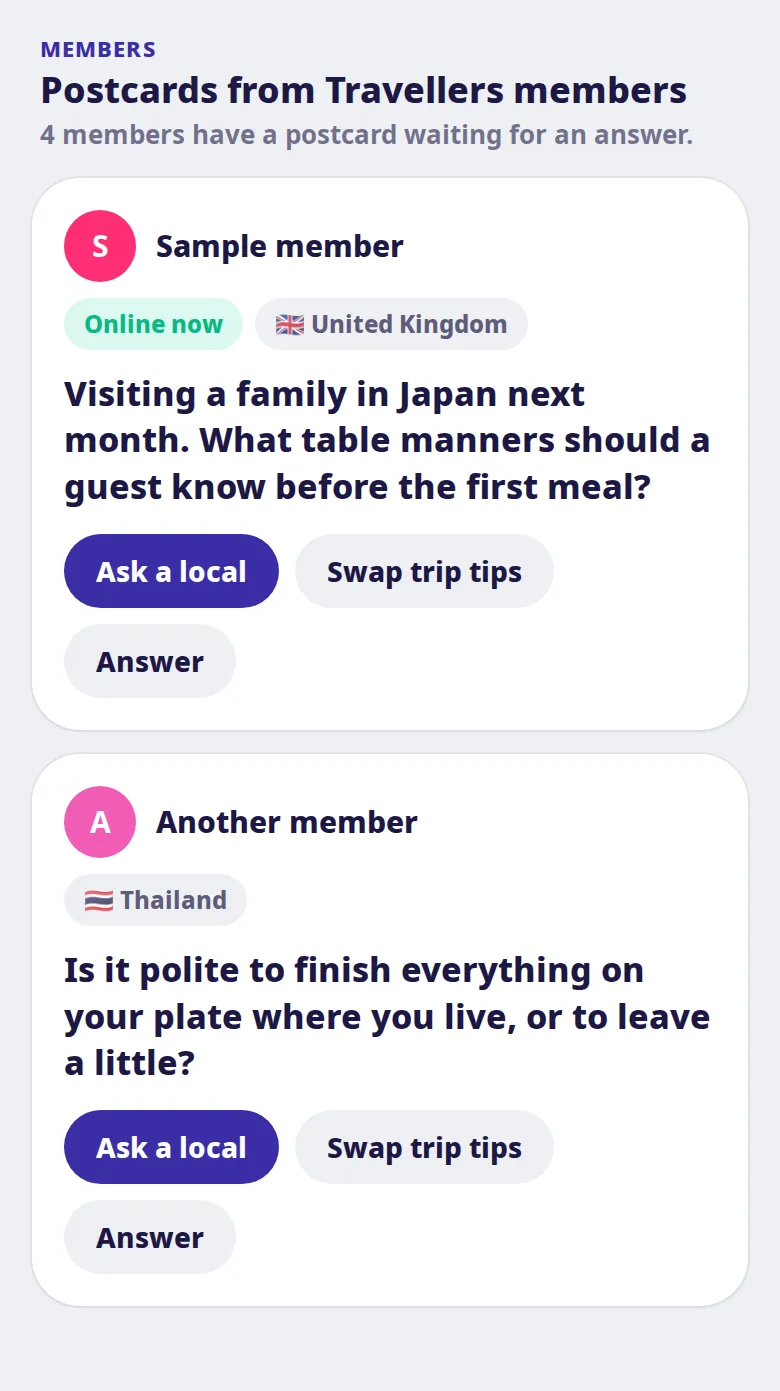 Example screen with sample members, not real people.
- Every message is translated both ways, with the original visible, so you can ask someone in Seoul or Cairo in your own language.
- Text only. No voice, no video, and contact details are stopped before delivery.
- Small community. Replies can take time.
- Report and block in every chat. No ads, no paid plan.
Going out to eat rather than to a home? Check tipping in different countries before the bill arrives.
Questions people ask
+Is it polite to finish everything on your plate?
It depends on the country. In Germany, France, Spain, Brazil and Chile, guides say to finish your plate, because leaving food can suggest you did not enjoy it. In Egypt, Thailand, Russia and parts of northern Ethiopia, leaving a little shows the host served enough. In China, a little left over once signalled generosity, but anti-waste campaigns now encourage finishing. In Japan, an empty plate says you are satisfied.
+What are the main chopstick rules in Japan, China and Korea?
Never stand chopsticks upright in a bowl of rice: in Japan, China and Vietnam it is linked to funerals and incense. In Japan, do not pass food from your chopsticks to someone else's, do not point with them, and rest them in front of you when not in use. In South Korea, soup is eaten with a spoon and most other food with chopsticks.
+Which countries eat with the right hand only?
Guides for India, Pakistan, Saudi Arabia, Egypt, Ethiopia, Turkey and Indonesia say to eat, serve and pass food with your right hand, and not with the left alone. In many of these places food is often eaten with the fingers, or scooped with bread such as injera in Ethiopia.
+Who starts eating first at a meal?
In most countries, guests wait. In South Korea the oldest person is served first and starts first. In Japan the most honoured person begins. In Saudi Arabia, Pakistan and Ethiopia, people wait for the eldest, the host's signal or a blessing. In Germany, Italy, Spain, Chile and the US, the host signals when to begin, often with a phrase like Guten Appetit or Buon appetito.
+What is the safest table manner when visiting a family abroad?
Wait to be seated, wait for the host to start, try a little of everything, use your right hand, and stay for the talk after the meal. Watch what the family does and copy it. If you are unsure whether to finish your plate or say no to seconds, ask the host. Customs vary a lot within every country, and people forgive a guest who is clearly trying.
Keep reading
Boarding pass · free
Tap, fly to a random country, and chat with someone who lives there.
Text first, translated both ways, no video, no coins to meet people. Works in your browser.
Take off on OluNew here? Read Ablo App: The Complete Story of the Chat App That Let You Fly Anywhere (2019–2022), the full history in one place.