 Olu
Traditional Games From Around the World: 29 Board, Card and Outdoor Games
29 traditional games from around the world: board, tile, card and outdoor games, with country, players, how each is played and where to play some online.
Updated 19 November 2026 · 11 min read
On this page
- Traditional strategy board games
- Mancala: the seed-sowing games
- Race games with dice, sticks and shells
- Traditional tile and card games from different cultures
- Traditional outdoor games and sports
- Which traditional games you can play online today
- How to learn a traditional game from someone abroad
- Find a player on the Gamers planet
- Keep the old games alive
Every country has a game that grandparents taught at the kitchen table or that came out every New Year. Many are hundreds or thousands of years old, and some travelled so far that the same idea has ten names on three continents.
This list covers traditional games from around the world: board, tile, card and outdoor games. For each one you get where it comes from, how many play, and one plain line on how it works, plus which ones you can play online today.
The short answer: well-known traditional games include Go and xiangqi (China), shogi (Japan), yut nori (Korea), oware (Ghana), bao (East Africa), pachisi (India), backgammon, mahjong, hanafuda, scopa (Italy), and outdoor games like pétanque, kubb, kabaddi and sepak takraw. Rules vary by region and even by family, so agree on them first. Many board games are free to play on Online-Go.com, Lishogi, PlayStrategy and PlayOK.
Find someone to play a traditional game with
Each game links to the page where its facts were checked. Every country has many regional versions, so treat these as the common form, not the only one.
Traditional strategy board games
These are two-player games of pure skill. No dice, no luck. Many of the chess-like games share an ancestor: chaturanga, first known from India around the seventh century, is seen by most chess historians as the common ancestor of chess, xiangqi, janggi, shogi and makruk.
| Game | Where it's from | Players | How it's played | Source |
|---|---|---|---|---|
| Go (weiqi, baduk) | China, more than 2,500 years ago; also big in Korea and Japan | 2 | Take turns placing black and white stones on the points of a 19×19 grid (beginners use 9×9 or 13×13). Surround territory and capture stones. More territory wins. | Wikipedia |
| Xiangqi (Chinese chess) | China; widely played in Vietnam too | 2 | Pieces sit on line crossings, not squares. Checkmate the enemy general. The cannon must jump over a piece to capture. | Wikipedia |
| Shogi (Japanese chess) | Japan | 2 | Chess on a 9×9 board with 40 pieces. Pieces you capture become yours, and you can drop them back onto the board later. | Wikipedia |
| Janggi (Korean chess) | Korean Peninsula | 2 | Derived from xiangqi, on the same 9×10 board but with no river. Checkmate the general, which can never leave its palace. | Wikipedia |
| Makruk (Thai chess) | Thailand; a similar game, ouk, in Cambodia | 2 | Chess on an 8×8 board, but pawns start on the third row and the "queen" moves only one square diagonally. | Wikipedia |
| Hnefatafl and other tafl games | Norway, Sweden, Denmark, Iceland, Britain, Ireland and Sápmi | 2 | Uneven armies: a king and a small group of defenders try to get the king to the edge or a corner, while about twice as many attackers try to trap it. Capture by sandwiching a piece between two of yours. | Wikipedia |
| Fanorona | Madagascar | 2 | 22 pieces each on a 9×5 grid of lines. Move along the lines and capture until your opponent has no pieces left. | Wikipedia |
| Nine men's morris | Europe; at least as old as the Roman Empire | 2 | Nine pieces each on a 24-point board. Line up three in a row (a "mill") to remove one of your opponent's pieces. | Wikipedia |
| Morabaraba | South Africa and Botswana, with a variant in Lesotho | 2 | Close to twelve men's morris. Make mills of three to take your opponent's pieces, which are called "cows". | Wikipedia |
Morris games show how one idea spreads: there are versions in India (char bhar), Ghana (achi), Kenya (shisimia), Somalia (shax) and Iran (dooz).
Mancala: the seed-sowing games
Mancala is not one game but a family of two-player games played with seeds, stones or beans and rows of pits, cut into a board or dug into the ground. It is among the oldest families of games still widely played. The basic move is the same everywhere: scoop up the seeds from one pit and drop them one at a time into the next pits.
| Game | Where it's from | Players | How it's played | Source |
|---|---|---|---|---|
| Oware (awalé, ayò, wari) | Widely believed to be of Ashanti origin, Ghana; played across West Africa and the Caribbean | 2 | Two rows of six pits, four seeds in each. Sow counter-clockwise. If your last seed leaves an opponent's pit with two or three seeds, you take them. First to 25 seeds wins. | Wikipedia |
| Bao | East Africa: Tanzania, Kenya, Malawi, Burundi, Rwanda and more | 2 | A complex mancala, most popular among the Swahili people of Tanzania and Kenya. There are official tournaments, and a beginners' version called bao la kujifunza. | Wikipedia |
| Congkak, congklak, sungka | Malaysia, Indonesia, Brunei, the Philippines; makkhum in Thailand | 2 | Unlike most mancala games, your own store counts as a pit when you sow. Rules and the number of pits vary a lot. | Wikipedia |
Race games with dice, sticks and shells
These mix luck and choice: throw dice, sticks or shells, then pick which piece to move.
| Game | Where it's from | Players | How it's played | Source |
|---|---|---|---|---|
| Royal Game of Ur | Ancient Mesopotamia, early third millennium BC | 2 | A race to run your pieces along the board and bear them off before your opponent. Modern rules come from a British Museum curator's reading of a Babylonian clay tablet. | Wikipedia |
| Senet | Ancient Egypt, from at least about 2620 BCE | 2 | Pawns on a board of 30 squares in three rows of ten. The original rules are unknown; modern reconstructions race the pawns off the board, moved by throwing four flat sticks. | Wikipedia |
| Backgammon and tavla | Tables games go back at least 1,600 years; backgammon itself is first recorded in 17th-century England; tavla is the Turkish name, takhteh the Persian one | 2 | Roll two dice and move 15 pieces around 24 points. Be first to bring all your pieces home and bear them off. | Wikipedia, tavla |
| Pachisi | Ancient India | 2 to 4 (four usually play in two teams) | Throw cowrie shells to move four pieces around a cross-shaped board, counter-clockwise, and get them all home first. | Wikipedia |
| Yut nori | Korea, especially at Korean New Year | 2 players or 2 teams | Throw four sticks and count the flat sides to move four tokens round a board of 29 stations. Land on an opponent to send them back. | Wikipedia |
Pachisi has many relatives: Ludo for 2 to 4 players, parchís in Spain, parqués in Colombia, jeu des petits chevaux in France and Mensch ärgere Dich nicht in Germany.
Traditional tile and card games from different cultures
| Game | Where it's from | Players | How it's played | Source |
|---|---|---|---|---|
| Mahjong | China, 19th century; now played across East and Southeast Asia and beyond | 2 to 4 | Draw and discard tiles to complete a hand of four sets and a pair. Regional rules and scoring differ a lot. | Wikipedia |
| Okey | Turkey | Usually 4 (2 or 3 possible) | A rummy-style tile game: collect groups of tiles to score against the other players. | Wikipedia |
| Dominoes | Earliest mention in Song dynasty China; modern European dominoes from 18th-century France | 2 or more, alone or in teams | Add tiles to either end of a line so the touching ends match. In Britain, Fives and Threes is a common pub game. | Wikipedia |
| Hanafuda (Koi-Koi) | Japan | 2 | Small, stiff "flower cards" grouped by month. Match cards to collect sets called yaku, then stop and score or call "koi-koi" to keep going and risk it. | Hanafuda, Koi-Koi |
| Scopa | Italy; also popular in Argentina and Brazil | Mostly 2, or 4 in pairs | A fishing game with a 40-card Italian deck. Capture cards from the table; clearing it in one go is a "scopa", the Italian word for broom. | Wikipedia |
| Truco | Originally from Valencia and the Balearic Islands; popular in South America | 2, or two teams of 2 or 3 | A trick-taking game, usually played with a Spanish deck. | Wikipedia |
| Carrom | India; clubs and cafés across South Asia hold tournaments | 2 to 4 | Flick a heavy striker to knock nine white and nine black discs, plus a red queen, into the corner pockets. | Wikipedia |
Traditional outdoor games and sports
| Game | Where it's from | Players | How it's played | Source |
|---|---|---|---|---|
| Pétanque | Provence, France; current form set down in La Ciotat in 1907 or 1910 | Two teams of 1, 2 or 3 | Stand in a circle with both feet on the ground and throw boules as close as you can to a small target ball, the jack. | Wikipedia |
| Kubb | Gotland, Sweden | Two teams, from one person each | Throw wooden batons to knock over the other team's wooden blocks, then topple the "king" in the middle. | Wikipedia |
| Kabaddi | India; national sport of Bangladesh | Two teams of 7 | A "raider" crosses into the other half, tags defenders and tries to get back without being tackled. | Wikipedia |
| Kho kho | India; played across South Asia | Two teams; 9 chasers on court against 3 runners at a time | Eight chasers crouch in a line. The active chaser tags runners and swaps roles by touching a teammate's back and saying "kho". | Wikipedia |
| Sepak takraw | Southeast Asia; Malaysia's national sport | Two teams of 2 to 4 | "Kick volleyball": get a rattan or plastic ball over a net using feet, knees, chest and head, never hands. | Wikipedia |
Which traditional games you can play online today
You don't need a board for most strategy games. These sites were checked in November 2026; features change, so check each site's own pages.
| Site | Traditional games on it | What the site says about itself |
|---|---|---|
| Online-Go.com (OGS) | Go | A community-supported Go server that describes itself as free |
| Lishogi | Shogi and smaller shogi variants | Free, no ads, open source; play the computer, friends or random opponents |
| PlayStrategy | Go (9×9, 13×13, 19×19), xiangqi, shogi, oware, backgammon, togyzqumalaq | Free and open source; the official online platform of the Mind Sports Olympiad |
| PlayOK | Go, xiangqi, shogi, makruk, oware, mangala (Turkish mancala), mill, backgammon, ludo, mahjong, dominoes | Free online games, with a guest option |
| RoyalUr.net | Royal Game of Ur | A site for the game, with rules and a Discord where players find opponents |
Physical games like yut nori, kubb and pétanque are harder to find online. People who grew up with them can still teach you the rules over chat.
For quick games that need nothing at all, see our list of games to play with two people online.
How to learn a traditional game from someone abroad
The best teacher is someone who grew up with the game. A few habits help:
- Agree on the rules first. Names, board sizes and house rules differ. Ask "how did your family play it?"
- Start small. Play Go on a 9×9 board, try the beginners' version of bao, or start with a two-player hand of mahjong before a full table.
- Ask about the story. Who taught them, and what it is called at home.
- Keep it a game. No money, no betting, no gift cards.
If you want a group to play with regularly, our guide on how to find gaming friends covers Discord servers, LFG tools and picking a good group.
Find a player on the Gamers planet
Olu is a free text chat site for meeting people in other countries, in your browser, for adults 18+ only. Its Gamers planet is for "players from every server and every time zone".
The planet's ritual is Squad up: find one or two people to play with tonight. You say the game, your platform and when you are free, and players in other time zones answer when they are on. Member postcards have three buttons: Squad up, Duo request and Answer. If you want to play right now, an LFG now request stays open for two hours. The planet's rules are short: say which game, no cheats or account selling, and trash talk the game, not the player.
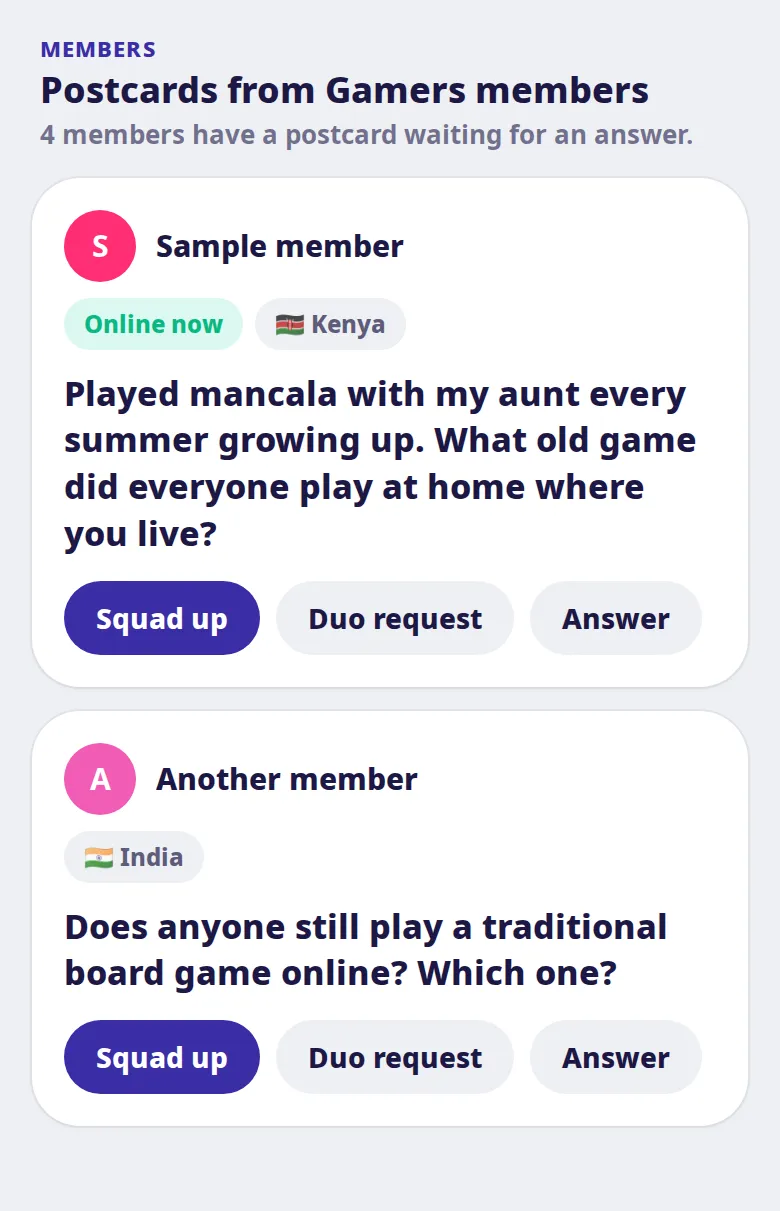 Example screen with sample members, not real people.
What to expect:
- It's text chat only. No voice, no video. You agree on the game, the rules and the time there, then play on a game site or board of your choice.
- Every message is translated both ways, with the original visible. So someone in Korea can explain yut nori to you in Korean, and you can still follow.
- Contact details are stopped before delivery, and report and block are in every chat.
- It's a small community. At quiet hours a request may wait a while for an answer.
Never share account logins or send money, and see our random text chat safety tips for the rest.
Keep the old games alive
Traditional games survive because someone teaches them to someone else. Learn one game from another country this month, and teach someone the one you grew up with. It may turn out to be a cousin of your family's game, with a rule you've never heard of.
Questions people ask
+What is the oldest board game still played today?
Go is widely described as the oldest board game continuously played to the present day. It was invented in China more than 2,500 years ago. Older boards exist, such as senet from ancient Egypt and the Royal Game of Ur from Mesopotamia, but their original rules were lost and modern versions are reconstructions.
+What are some traditional board games from different countries?
Go and xiangqi (China), shogi (Japan), janggi and yut nori (Korea), makruk (Thailand), oware (Ghana), bao (East Africa), fanorona (Madagascar), morabaraba (South Africa), pachisi (India), hnefatafl (Nordic countries) and nine men's morris (Europe) are a good start.
+Can you play traditional games online?
Yes, many of them. Online-Go.com is a free site for Go. Lishogi is a free, ad-free shogi site. PlayStrategy has Go, xiangqi, shogi, oware and backgammon. PlayOK has xiangqi, makruk, oware, mangala, mill, ludo, mahjong, dominoes and more. RoyalUr.net is built around the Royal Game of Ur.
+What is mancala?
Mancala is a family of two-player games played with seeds or stones and rows of pits. You pick up the seeds from one pit and sow them one by one into the next pits, trying to capture your opponent's seeds. Oware from Ghana, bao from East Africa and congkak from Malaysia are all mancala games.
+Do traditional games have one set of rules?
Rarely. Most traditional games changed as they travelled, so the same game can have different names, board sizes and house rules in different regions, and even between families. Before you play with someone from another country, agree on the rules first.
Keep reading
Boarding pass · free
Tap, fly to a random country, and chat with someone who lives there.
Text first, translated both ways, no video, no coins to meet people. Works in your browser.
Take off on OluNew here? Read Ablo App: The Complete Story of the Chat App That Let You Fly Anywhere (2019–2022), the full history in one place.