 Olu
Virtual Book Club: How to Join One or Start Your Own Online
How a virtual book club works, where to find an online book club to join, and how to start and run your own: size, schedule, tools, spoilers and buddy reads.
Updated 19 November 2026 · 10 min read
On this page
You want to talk about the book you just finished, but nobody near you has read it. Or your friends love books but live in three different cities. A virtual book club solves both: a group that reads the same book and talks about it online, on a call, in a forum or in a chat.
This guide covers how online book clubs work, where to find one worth joining, how to start and run your own, and the smallest version of all, the buddy read.
The short answer: a virtual book club is a group that reads one book on a schedule and discusses it online. To join one, try Goodreads groups, The StoryGraph's book clubs and buddy reads, Bookclubs.com or your library's online reads. To start one, pick a focus, invite 6 to 10 readers, choose a video or chat tool, meet monthly for 60 to 90 minutes, and agree a spoiler rule before the first meeting.
Find a reader abroad to buddy read with
How a virtual book club works
Every book club has the same core: one book, a deadline and a conversation. Online clubs differ mainly in when people talk.
| Format | How it works | Best for | Typical tools |
|---|---|---|---|
| Live video meeting | Everyone joins a call at a set time, usually once a month | Friends, coworkers, groups in one or two time zones | Zoom, Google Meet, Microsoft Teams |
| Forum or group chat | People post thoughts at their own pace, often one thread per section | Big groups and members spread across the world | Goodreads groups, Discord, WhatsApp, Facebook groups |
| Mixed | A monthly call plus a chat between meetings | Most clubs that last | A video tool plus a group chat |
| Buddy read | Two to a few people read together and check in at agreed points | Readers who want depth without a schedule | Reading apps, any chat |
| Readalong | A large public group reads one book with a reading plan | Classics and long books you'd never finish alone | Reading apps, forums |
The mixed format is common for a reason. Penguin's guide to setting up an online book club describes groups that pair a monthly video call with a WhatsApp thread, so members who miss a call can still join in.
Where to find an online book club to join
Reading apps and book sites
- Goodreads groups. Groups are organised into folders and discussion threads, and many pick their group read through nomination and voting threads. Book Riot's guide to Goodreads groups suggests starting in the Introductions thread and marking spoilers with the spoiler tag. Groups can be adults-only (18+), and Goodreads' moderator guidelines say moderators can delete posts and remove members.
- The StoryGraph. It has buddy reads, larger readalongs and book clubs. Its public roadmap lists book clubs as shipped in 2024, with polls to choose the book and the date, meeting agendas and a question bank. The same post says only the host needs a Plus membership.
- Bookclubs.com. A site for finding and running book clubs. Its own guide says you can search by location, keyword, theme or genre, filter for online or in-person clubs, and that virtually all clubs are free to join.
Libraries
Your local library may run its own online club, so ask at the desk or check its events page. There is also a library-wide option: OverDrive introduced Libby Reads in 2025 as the new name for Big Library Read. Each featured ebook and audiobook is free in the Libby app for two weeks, with no waitlist, so a whole group can read at once.
Clubs with no homework
Silent Book Club has no assigned reading. You bring your own book, read together and swap stories, and its groups meet in person and online. It suits people who like reading company more than literary debate.
How to tell if a club is still alive
Many groups look busy but stopped years ago. Before you join, check three things:
- Last activity. Book Riot's guide says to check the "last active" date, because an old one usually means the group is dead.
- Size. The same guide found very large groups overwhelming and very small ones prone to stall. A moderate size is often the sweet spot.
- The current read. If the books on its shelf bore you, the conversation will too.
How to start a virtual book club
Starting your own is easier than finding the perfect one. These steps follow what most guides agree on.
- Pick a focus. Literary fiction, crime, translated books, non-fiction, one author, books set in a different country each month. Penguin's guide suggests deciding what you want from each session first. A clear focus also tells people whether to join.
- Keep it small. Penguin suggests 6 to 10 people; TCK Publishing's guide to virtual book clubs says 6 to 12. On a video call, more than that and the quiet members never speak.
- Choose your tools. One live tool and one chat tool is enough. Pick tools everyone already has, so nobody spends the first meeting installing software.
- Set the rhythm. Most online clubs meet for 60 to 90 minutes. Monthly is the usual pace. Reviewed's step-by-step guide suggests giving a longer book about six weeks.
- Decide how books are chosen. Vote, take turns, or follow a theme. TCK Publishing lists all three. Whatever you pick, announce the next book at the end of each meeting.
- Write three ground rules. How spoilers work, how long each person talks, and what happens if someone hasn't finished.
- Run a setup meeting. Penguin suggests using a poll to find a time, then using the first session for logistics: how books are picked and what to read first. Send a short summary afterwards.
Time zones
A club with members on three continents can't all meet at 8 pm. Two fixes work:
- Rotate the slot. Alternate between a time that suits the east and one that suits the west, so nobody always joins at midnight.
- Go asynchronous. Open one thread per section of the book and give everyone a week to post. TCK Publishing suggests using scheduling tools for time zones and keeping a group chat going between meetings.
How to run meetings people come back to
A virtual meeting needs a little more structure than a living room, because people can't read the room through a screen.
- Name a facilitator, and rotate the role. Penguin and TCK Publishing both suggest it. The facilitator keeps time, invites quieter members in, and moves the talk on when it stalls.
- Send questions ahead. Penguin suggests sharing prompts in advance so members have time to think. For ready-made prompts that work on any title, use our book club questions.
- Open with a quick round. One line each on the book gets every voice in the room early.
- Ask before you record. TCK Publishing suggests recording for members who miss a meeting, but only if you tell people first.
- Keep the chat alive between meetings. A reading-progress message, a favourite line, a poll for the next book. Small posts keep people reading.
- End on time, with the next book and date confirmed.
Pace: how much to read between meetings
| Book | Meeting rhythm | Tip |
|---|---|---|
| Short novel, under 250 pages | Monthly, whole book | Good for first meetings |
| Average novel | Monthly | Set the date before people start |
| Long book or classic | Six weeks, or split into two meetings | Name the stopping chapter for each meeting |
| Doorstopper or series | Weekly check-ins on a few chapters | Treat it as a readalong |
Buddy reads: the smallest book club
A buddy read is a book club with no host, no calendar and as few as two members. You pick a book, agree checkpoints, and talk about each section before reading on.
Book Riot's piece on buddy reads on The StoryGraph describes how this works in an app. You both add the same book to your currently reading shelf and send an invitation. You set break points, such as page 100 or a chapter, and each person's notes stay hidden from the other until they reach the same point. The writer listened to an audiobook while their buddy read a paperback, and it still worked.
A few habits make a buddy read last:
- Use chapters, not page numbers, if you're reading different editions, an ebook, or a translation. Page 100 is a different place in every copy.
- Agree the pace out loud. "A chapter a day, talk on Sundays" is a plan. "Let's read it together" isn't.
- Say when you fall behind. A short message keeps the other person from waiting in silence.
- Write the thought down when it happens. A one-line note at the end of a chapter beats trying to remember it three days later.
A buddy read with a reader in another country
Reading the same novel as someone in another country changes the conversation. They notice what you skimmed, explain a joke that didn't translate, and tell you how the book is taught or talked about where they live.
Olu is a free text chat site for meeting people in other countries. It runs in your browser, has no ads and no paid plan, and is for adults 18+. People join interest groups called planets. The Book lovers planet is about what the world is reading. Its ritual is the Book swap: tell a reader abroad what you just finished, and they send back the book from their country you should read next. Members post short postcards with buttons to start a Buddy read, ask someone to Recommend me one, or simply Answer.
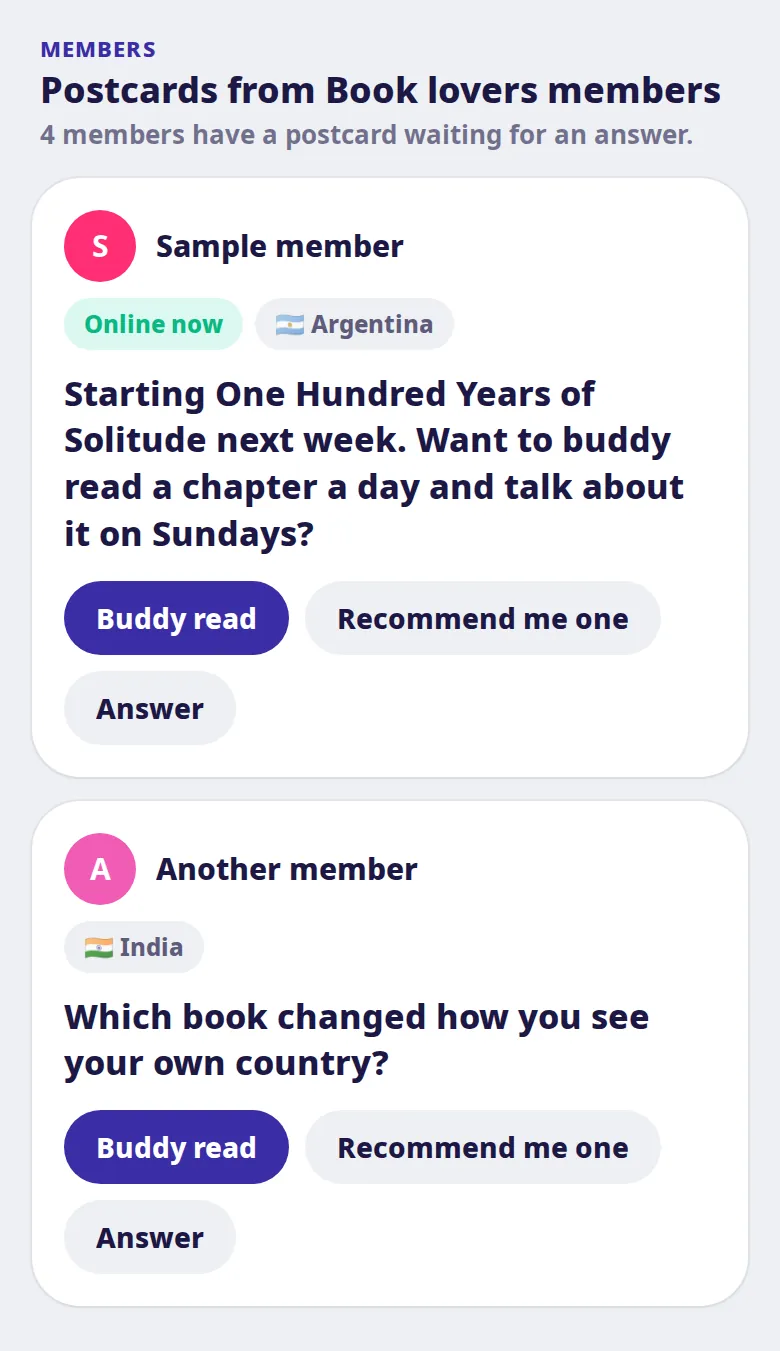 Example screen with sample members, not real people.
The planet has three simple laws: say the book and the author, warn before spoilers, and every taste counts.
Some honest limits:
- It's text only. No voice and no video, so it won't host your club's monthly call. It works well for buddy reads and for the chat between meetings.
- Every message is translated both ways, with the original visible. A reader in Buenos Aires can write in Spanish while you reply in English, and you can both quote the original line.
- It's a small community, so at quiet hours a reply may take a while.
- Report and block are in every chat, and contact details are stopped before delivery.
If a buddy read turns into a long friendship, how to make friends from other countries online has more on keeping it going.
Spoilers and other ground rules
Spoilers cause more friction in online clubs than in person, because a single chat message can ruin the ending for someone two chapters behind. Agree one of these on day one:
- Checkpoint rule. Only discuss up to the current checkpoint. Anything later goes in a separate thread or waits.
- Tag rule. Spoilers are allowed only behind a warning or spoiler tag, as many Goodreads groups do.
- Meeting rule. The whole book is open for discussion in the meeting. People who haven't finished come anyway, knowing that.
Two more rules worth writing down: respond to the idea, not the person, and every taste counts. Someone loving the book you hated is the best part of a book club, not a problem to fix.
If your online club ever plans to meet in person, choose a public place such as a café or library, tell a friend where you're going, travel there yourself, and never send money to anyone you met online.
When a virtual book club starts to fade
Most clubs don't end with a decision. Attendance just thins out. The usual causes and fixes:
- The books are too long. Alternate a long pick with a short one.
- The same two people choose. Switch to voting or a rotation.
- People feel bad for not finishing. Say clearly that they are still welcome, and keep the meeting rule on spoilers.
- The meeting time never suits some members. Rotate it, or move part of the talk to a chat thread.
- Nobody talks between meetings. Post one line from what you're reading this week. Someone usually answers.
If a club still dies, keep the two or three people who always showed up. That's a buddy read waiting to happen, and it's often the best book talk you'll have all year.
Questions people ask
+How does a virtual book club work?
Members read the same book on an agreed schedule, then talk about it online. Some clubs meet on a video call once a month for about an hour. Others talk in a forum, group chat or reading app at their own pace, which suits members in different time zones.
+Where can I join an online book club?
Look at Goodreads groups, The StoryGraph's book clubs, buddy reads and readalongs, and Bookclubs.com, which lets you search clubs by genre, theme and location. Libraries run shared reads too, such as Libby Reads, and Silent Book Club has groups that meet online.
+How many people should be in a virtual book club?
Guides suggest about 6 to 10 members (Penguin) or 6 to 12 (TCK Publishing) for a club that meets on video, so everyone gets a turn to speak. Forum and chat clubs can be much bigger because people post at different times.
+How long should a virtual book club meeting be?
Most online book clubs meet for 60 to 90 minutes. That leaves time for a catch-up, the discussion and choosing the next book without tiring people out on a screen.
+What is a buddy read?
A buddy read is a book club of two or a few people. You read the same book at the same time, agree checkpoints such as a chapter or page number, and talk about each part before moving on. It needs no host and no meeting slot.
Keep reading
Boarding pass · free
Tap, fly to a random country, and chat with someone who lives there.
Text first, translated both ways, no video, no coins to meet people. Works in your browser.
Take off on OluNew here? Read Ablo App: The Complete Story of the Chat App That Let You Fly Anywhere (2019–2022), the full history in one place.