 Olu
Birthday Traditions Around the World: How 25 Countries Celebrate
Birthday traditions around the world: seaweed soup in Korea, long noodles in China, Las Mañanitas in Mexico, ear tugs in Italy, name days and milestone ages.
Updated 19 November 2026 · 10 min read
On this page
On the same day, someone in Seoul is eating seaweed soup, someone in Mexico City is being woken up by a song, and someone in Budapest is having their ears pulled by friends, once for every year. A birthday is personal, but the way people mark it says a lot about where they live.
This guide covers birthday traditions around the world: the food, songs, rules and milestone ages in 25 countries, plus name days, which in some places matter as much as birthdays. Every row comes from a page we opened. Customs vary by region, family and generation within every country, and many people simply have cake and a song, so read each line as "something you may see", not a rule.
The short answer: cake, candles and a song are common almost everywhere, but the details change from country to country. Koreans eat miyeok-guk (seaweed soup) to honour their mothers. Chinese families serve long noodles for a long life. In Mexico, Las Mañanitas is sung in the morning. In Italy, Hungary, Argentina and Spain, friends tug the birthday person's ears. In Germany the birthday person often bakes the cake, and wishing someone well early is bad luck. Some birthdays, such as the 60th in Korea and Japan or the 50th in the Netherlands, get a much bigger celebration.
Ask someone abroad how they celebrate birthdays
Birthday traditions in 25 countries
One or two customs per country, from family tables to the office. For the words people say and write, see our list of happy birthday in different languages.
| Country | What many people do | Source |
|---|---|---|
| South Korea | Eat miyeok-guk, a seaweed soup, often for breakfast; mothers traditionally eat it after giving birth, so it honours them | Wikipedia, EF |
| China | Long "longevity noodles" on the day; rice wine is a traditional gift because the word for wine sounds like the word for long; Western cakes are now common in cities | Wikipedia, Wikipedia |
| Japan | Adults often celebrate with a partner; the 60th birthday (kanreki) is a big one | Wikipedia, Wikipedia |
| Vietnam | Traditionally, everyone grew a year older together at Tết (Lunar New Year) rather than on their own birthday | Babbel, Wikipedia |
| Philippines | A coming-of-age party called a debut, held at 18 for women and at 21 for men | Wikipedia |
| Mexico | Las Mañanitas, sung early in the morning to wake the birthday person; a piñata at many parties | Wikipedia, Babbel |
| Brazil | The first slice of cake goes to the person the birthday person loves most, such as a parent, sibling or grandparent | EF |
| Argentina | Friends tug the birthday person's ears, one tug for each year | Babbel |
| Spain | Los tirones de oreja: a gentle tug on the earlobe for each year, with cake and singing | EF |
| Italy | Ear tugs; the birthday person often pays for drinks; gifts are opened straight away in front of the giver | Babbel |
| Hungary | Ear tugs; at work, name days are often marked more than birthdays, with flowers or a bottle as a gift | Babbel, Wikipedia |
| Poland | Everyone sings Sto lat ("a hundred years"); in parts of Poland, name days have long mattered more than birthdays | Wikipedia, Wikipedia |
| Germany | No wishes before the day; people may party the evening before ("reinfeiern") and wish at midnight; the birthday person bakes the cake and often pays | EF, Babbel |
| Denmark | Small paper Danish flags on the cake; the birthday person brings treats to work; speeches and specially written songs at big parties | Studieskolen |
| Netherlands | Fruit tarts with whipped cream; at 50, people "see Abraham" or "see Sarah", often with posters at work | Babbel, DutchNews |
| Russia | A pie with the birthday person's name on it; before 1917 name days were as important as birthdays, or more | Babbel, Wikipedia |
| Greece | No early wishes; name days are celebrated much like birthdays, with gifts but no cake | Babbel, Wikipedia |
| Slovakia | At work, name days are marked more often than birthdays, since the dates are printed in calendars and newspapers | Wikipedia |
| Latvia | Name days are celebrated very much like birthdays; some families prefer the one that falls in a nicer season | Wikipedia |
| France | Name days have long been part of daily life, with small gifts; people born in January may get a galette des rois with a hidden figurine | Wikipedia, EF |
| Canada | "Greasing": friends ambush the birthday person and smear butter on their nose to keep bad luck away | Babbel |
| Jamaica | The birthday person gets covered in flour, a custom often called "antiquing" | Babbel |
| United States | Happy Birthday to You, with cake and candles; Guinness once listed it as the most recognised song in English | Wikipedia |
| United Kingdom | People turning 100 and 105, and every year after, can receive a card from the King | Wikipedia |
| South Africa | The 21st is a big birthday, and a symbolic key can mark coming of age | Sowetan |
Babbel and EF are language-learning companies; Studieskolen is a Danish language school; DutchNews is an English-language Dutch news site.
What birthday traditions have in common
Look down the table and a few ideas keep coming back: eat something that stands for a long life, make a little noise, and do the birthday the way your family always has.
Food for a long life
Long noodles are the clearest example. In China, Wikipedia says noodles eaten on a birthday are called longevity noodles, and at Lunar New Year, tradition says the cook should not cut the strands. Rice wine is a traditional gift because its name sounds like "long".
Korea's birthday dish has a different story. Miyeok-guk is the soup women traditionally eat for months after giving birth, so eating it on your own birthday is a quiet thank-you to your mother. Some families serve it for breakfast, and guests may get it with rice cakes.
Ears, butter and flour
Some customs are a little rough, all in good fun: ear tugs in Italy, Hungary, Argentina and Spain, butter on the nose in Canada, flour in Jamaica. As a guest, follow your host's lead. Some families love these customs, others skip them.
Who pays and who bakes
In many places, guests bring the cake. In Germany and Denmark, it often works the other way round: the birthday person brings the cake or treats for colleagues, and in Germany and Italy may pay for the drinks too.
Birthday rules worth knowing
Some customs are about what not to do. A few worth knowing before you visit:
- Don't wish early in Germany or Greece. Wishing someone a happy birthday before the day, or celebrating early, is widely seen as bad luck. In Germany people may "reinfeiern" (party into the birthday) the night before, then wish at midnight.
- Open gifts straight away in Italy. Setting a present aside to open later can seem rude.
- Check the date, not just the birthday. In Greece, Hungary and Poland, someone's name day may be the day people expect a call or a gift.
- Ask before a prank. Ear tugs, butter and flour are family fun, not something to try on a colleague you just met.
If a custom still surprises you, that is normal: see our guide to culture shock examples.
Milestone birthdays
Not every birthday is equal. These ages get a bigger celebration in some countries, according to the sources we opened.
| Age | Where | What happens | Source |
|---|---|---|---|
| 15 | Spanish-speaking countries and Brazil | A family celebration called a quinceañera (festa de quinze anos in Brazil), often a church service and then a party | Wikipedia, Babbel |
| 18 or 20 | Japan | Coming of Age Day, the second Monday of January: a morning ceremony at the city office, often in kimono; the legal age of adulthood fell from 20 to 18 in 2022, and towns now invite either age | Wikipedia |
| 18 and 21 | Philippines | The debut: 18 for women, 21 for men | Wikipedia |
| 21 | South Africa | A big party and, for some, a symbolic key | Sowetan |
| Round numbers | Denmark | A bigger family party and a small reception at work; 18, 25 and 75 are also popular | Studieskolen |
| Each decade | China | A bigger occasion, often a large dinner | Wikipedia |
| 50 | Netherlands | You have "seen Abraham" or "seen Sarah"; posters at work and teasing songs about getting old | DutchNews |
| 60 | South Korea (hwangap), Japan (kanreki) | A full 60-year cycle of the traditional calendar; in Korea, children bow and offer drinks, and guests bring gifts | Wikipedia |
| 100 | United Kingdom and other Commonwealth countries | A card from the King, then again at 105 and every year after | Wikipedia |
At a Korean hwangap, Wikipedia says, the person turning 60 and their spouse sit before a folding screen and a large table of food, always with a bowl of miyeok-guk. The eldest son and their spouse bow first, then the rest of the family. Today many families keep it smaller, in a restaurant.
Name days: the second birthday
In much of Europe, people also celebrate the feast day of the saint who shares their name. Wikipedia's page on name days shows how much this varies:
- Bigger than birthdays in places: parts of Poland, Hungary and Slovakia (especially at work) and southern Italy.
- Much like a birthday: Greece and Cyprus, where guests bring gifts but there is no cake, and Latvia.
- Smaller than birthdays: Russia, the Czech Republic, Romania and Croatia.
- Mostly faded: Spain, Austria and Germany; in Denmark the custom is practically unknown.
Sweden and Finland use official name-day calendars, so almost every day is someone's name day: a nice excuse to message a friend there.
Birthday songs in different countries
Happy Birthday to You is the best-known birthday song. Its tune comes from "Good Morning to All", published in 1893 and credited to the sisters Patty and Mildred Hill. The birthday words were printed with it in 1912. It is now in the public domain in the United States and the European Union (Wikipedia).
Many countries have their own song too. In Mexico, Las Mañanitas is usually sung early in the morning to wake the birthday person. In Poland, Sto lat wishes the person a hundred years of life, and it is sung at name days and weddings as well. In Denmark, guests at big birthdays traditionally write new song lyrics about the person, although that is less common than it was.
How to be a good birthday guest abroad
- Ask your host what the family does. Customs change from home to home, even within one city.
- Bring something small. Flowers or a bottle are common gifts for name days in Hungary. If you are not sure, a small food gift is rarely wrong.
- Learn one line. A birthday wish in the local language goes a long way.
- Mind the date. Don't wish early in Germany or Greece, and ask whether a name day matters more.
- Meeting someone you met online? Choose a busy public place, tell a friend where you are going, and never send money to someone you have not met.
Ask a local how birthdays work where they live
A list can tell you Koreans eat seaweed soup. It can't tell you what your friend's family in Busan actually puts on the table. Someone who lives there can.
Olu is a free text chat site for adults 18+ to meet people in other countries, in the browser. Its Travellers planet is about where to go and what it is really like, from people who live there. The ritual is Ask a local: skip the list, name the place, and ask a person who lives there what to skip and what not to miss. Tap Ask a local, Swap trip tips, or Answer someone who wants to know about your country. The laws are short: say which country, be curious and never insulting, and remember that locals know best.
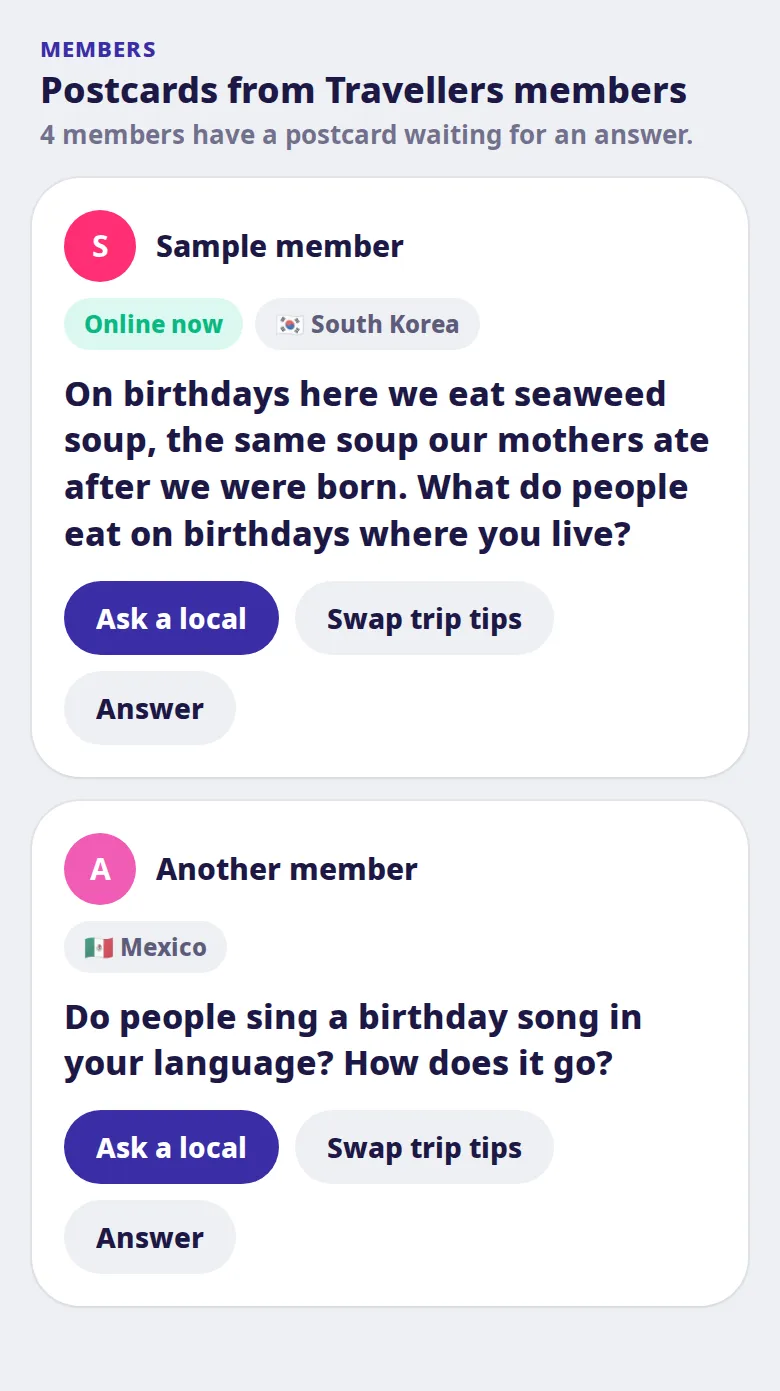 Example screen with sample members, not real people.
- Every message is translated both ways, with the original visible, so you can ask someone in Seoul or Guadalajara in your own language.
- Text only. No voice, no video, and contact details are stopped before delivery.
- Small community. Replies can take time, so ask a few days before a friend's birthday.
- Report and block in every chat. No ads, no paid plan.
Questions people ask
+What are some unique birthday traditions around the world?
In South Korea people eat miyeok-guk, a seaweed soup, to honour their mother. In China, long noodles stand for a long life. In Mexico, Las Mañanitas is sung early in the morning to wake the birthday person. In Italy, Hungary, Argentina and Spain, friends tug the birthday person's ears once for each year. In parts of Canada, friends put butter on the birthday person's nose for luck.
+Why do Koreans eat seaweed soup on their birthday?
Miyeok-guk is the soup women traditionally eat for weeks or months after giving birth. Eating it on your birthday is a way to honour your mother. Some people have it for breakfast on the day.
+Is it bad luck to say happy birthday early?
In Germany and Greece, wishing someone a happy birthday before the day, or celebrating early, is widely seen as bad luck. In Germany, people may party on the evening before, but the wishes wait until midnight.
+Which countries celebrate name days instead of birthdays?
Few skip birthdays entirely, but in Hungary, Slovakia, parts of Poland and southern Italy, name days can matter as much as birthdays, or more, especially at work. In Greece and Cyprus a name day is celebrated much like a birthday, though without a cake.
+Which birthdays are milestones in different countries?
The 60th is a big birthday in Korea (hwangap) and Japan (kanreki), because traditional calendars run in 60-year cycles. Dutch people who turn 50 are said to have seen Abraham or Sarah. In China, decade birthdays get a bigger dinner, and in Denmark round birthdays get a bigger party.
Keep reading
Boarding pass · free
Tap, fly to a random country, and chat with someone who lives there.
Text first, translated both ways, no video, no coins to meet people. Works in your browser.
Take off on OluNew here? Read Ablo App: The Complete Story of the Chat App That Let You Fly Anywhere (2019–2022), the full history in one place.