 Olu
Coffee Around the World: How People Drink It in 30 Countries
Coffee around the world in 30 countries: how people make and drink it at home and in cafes, from Ethiopia's three rounds to a Vietnamese phin, each sourced.
Updated 19 November 2026 · 10 min read
On this page
- Coffee around the world, country by country
- What changes from one country to the next
- Coffee for guests: what a visitor is offered
- Coffee at home vs coffee in a cafe
- How to make a coffee from another country at home
- Ask a home cook abroad: the Home cooks planet
- Questions to ask someone about coffee in their country
Coffee is one drink made a hundred ways. In one kitchen the beans are roasted in a pan in front of the guests. In another, instant coffee is shaken into foam over ice, or strong coffee drips slowly onto condensed milk. The cup can be a quick stop at a bar counter, a two-hour ceremony or the first thing offered to a visitor.
This guide shows coffee around the world in 30 countries, grouped by region. Each row says how people commonly make or drink coffee there and links its sources: UNESCO, encyclopedias, and food and coffee publications. Habits differ by city, family and generation, so read each row as "a common way there", not "how everyone does it".
The short answer: coffee around the world falls into a few families. Unfiltered coffee, often with cardamom, rules from Turkey to the Arabian Peninsula. Ethiopia, where coffee is traced to, brews at home in a clay jebena and serves three rounds. Southern Europe drinks small espressos, often standing. The Nordic countries drink filter coffee with buns or cake. Southeast Asia pours strong robusta onto condensed milk, and Latin America often boils coffee with sugar or spices, from Colombia's tinto to Mexico's café de olla.
Ask a home cook abroad how they make their coffee
Coffee around the world, country by country
Africa and the Middle East
| Country | How coffee is made and drunk | Source |
|---|---|---|
| Ethiopia | Buna is a home ceremony. Green beans are pan-roasted and carried to guests to smell, crushed with a mortar and pestle, and brewed in a clay jebena while frankincense burns. Three rounds follow, abol, tona and baraka, each lighter than the last. It can take two hours. | Barista Magazine, Discover |
| Yemen | Coffee was shipped from the port of Mokha. Yemeni "white coffee" is roasted pale, for about half the usual time, often with the spice blend hawaij. | Wikipedia, Tasting Table |
| Saudi Arabia | Qahwa: light, golden roast boiled with cardamom (sometimes saffron), poured from a dallah a little at a time into small handleless cups, with dates. Elders and guests come first; shake the cup when you have had enough. | UNESCO, Wikipedia |
| Turkey | Fine coffee, cold water and sugar to taste brew slowly in a cezve until foam forms, then go unfiltered into a small cup, with a glass of water. The grounds are sometimes read to tell a fortune. | UNESCO, Tasting Table |
| Senegal | Café Touba is roasted and ground with djar (grains of Selim), sometimes cloves, then filtered. Linked to the Mouride brotherhood, it is now drunk widely, often from street stands in small cups. | Wikipedia, Tasting Table |
Europe
| Country | How coffee is made and drunk | Source |
|---|---|---|
| Italy | Espresso is the default, often drunk standing at the counter (sitting can cost more). Cappuccino and other milky drinks are for the morning, traditionally not after 11 am. | Wikipedia, Tasting Table |
| Austria | The Viennese coffee house, on Austria's heritage inventory since 2011: coffee with a glass of water, newspapers, and hours at one table. The melange (coffee, milk and foam) is the classic order. | Wikipedia, Tasting Table |
| Germany | Strong black coffee with meals and at work, plus the afternoon Kaffeeklatsch: coffee and cake with friends. | Wikipedia, Wikipedia |
| Sweden | Fika, a coffee break with cinnamon buns or other pastries, at home, at work or in a cafe, traditionally mid-morning and mid-afternoon. Some job contracts include it. | Wikipedia |
| Finland | Mostly light-roast filter coffee (suodatinkahvi). In the north of Finland, Sweden and Norway, kaffeost puts cheese in the cup before the hot coffee goes in. | Chowhound, Tasting Table |
| Greece | The frappé: instant coffee, sugar and a little water frothed into foam over ice, ordered glykós (sweet), métrios (medium) or skétos (no sugar). The freddo espresso, first made in Athens in 1991, is the newer iced favourite. | Wikipedia |
| France | Coffee is a social, cafe-table habit. Café au lait (coffee with hot milk) and caffè crema are the most popular orders. | Wikipedia, Tasting Table |
| Netherlands | Koffie verkeerd, "wrong coffee": equal parts coffee and milk, served with a biscuit. | Tasting Table, Wikipedia |
| Spain | The cortado, espresso "cut" with warm milk, is served all over Spain (tallat in Catalan). In Valencia, café bombón layers espresso over condensed milk in a glass. | Wikipedia, Tasting Table |
| Portugal | Ask for "um café" and you get an espresso: a bica in Lisbon, a cimbalino in Porto. The galão, a tall glass of milky coffee, is popular in the morning and late afternoon. | Portugalist, Wikipedia |
South, Southeast and East Asia
| Country | How coffee is made and drunk | Source |
|---|---|---|
| India | In the south, filter coffee: dark roast with 10 to 20% chicory drips through a two-part steel filter, is mixed with hot milk and sugar, and is poured between a tumbler and a second cup to froth it. | Wikipedia, Chowhound |
| Vietnam | Cà phê sữa đá: dark robusta drips through a small metal phin into a cup of sweetened condensed milk, then is stirred and poured over ice. Hanoi's egg coffee, topped with whipped egg yolk and condensed milk, dates from 1946. | Wikipedia, Chowhound |
| Malaysia and Singapore | Kopi in a kopitiam (coffee shop): robusta roasted with sugar and margarine, brewed in a cloth "sock". Kopi has condensed milk, kopi-O is black with sugar, kopi-C has evaporated milk, and peng means iced. | Wikipedia, Discover |
| Indonesia | Kopi tubruk: grounds and cane sugar go straight in the cup, hot water on top, and you wait for the grounds to settle. Yogyakarta's kopi joss adds a piece of hot charcoal to the glass. | Chowhound, Tasting Table |
| Thailand | Oliang: black iced coffee of Teochew Chinese origin, from beans roasted with grains and seeds such as sesame, soybeans, corn and rice, often brewed in a cloth filter. | Tasting Table |
| Japan | Canned coffee from vending machines, hot in winter and cold in summer, a Japanese idea from the late 1960s. Quiet kissaten coffee shops serve a "morning service" of thick toast and eggs with coffee. | Wikipedia, Wikipedia |
| South Korea | Coffee shops boomed: Seoul's number rose about 900% from 2006 to 2011. At home, dalgona coffee (instant coffee, sugar and hot water whipped and spooned over iced milk) took off during COVID-19. | Wikipedia, Tasting Table |
The Americas and Oceania
| Country | How coffee is made and drunk | Source |
|---|---|---|
| Mexico | Café de olla, often made at home in a clay pot with cinnamon, sometimes cloves, orange peel or chocolate, sweetened with piloncillo (unrefined cane sugar). | Wikipedia, Discover |
| Cuba | Café cubano: moka-pot espresso with the first drops whipped into sugar for a sweet foam (espumita). A colada is several shots with small cups to share. Café con leche with buttered toast is breakfast. | Wikipedia |
| Colombia | Tinto, a small cup of black coffee, often boiled in a pot and sweetened with panela; cinnamon and cloves are sometimes added. The Smithsonian's Colombia programme calls it a "habitual companion during the day". | Chowhound, Smithsonian |
| Venezuela | Guayoyo, a long, mild pour-over made with a coarse grind and more water. | Chowhound |
| Brazil | The cafezinho, "a little coffee": strong, sweet and black, brewed with sugar and filtered through paper or cloth, served in small cups. Café com leite adds milk. | Discover, Tasting Table |
| Argentina | Café lágrima ("teardrop"), a breakfast glass of warm milk with a small splash of espresso, about nine parts milk to one part coffee. | Tasting Table |
| United States | Often taken to go, in bigger cups than elsewhere (up to 24 ounces). A 1952 campaign popularised the coffee break. | Wikipedia, Tasting Table |
| Australia and New Zealand | The flat white: espresso with steamed milk and a thin layer of microfoam. Both countries claim to have invented it and the argument is open. | Wikipedia, Tasting Table |
What changes from one country to the next
Four choices explain most of these cups.
Filtered or not. Turkish coffee, Arabic qahwa and Indonesian kopi tubruk let the grounds settle in the pot or cup. Finland, India, Vietnam and Malaysia filter them out through paper, steel, a phin or a cloth sock.
Boiled, dripped or pressed. Tinto, café de olla and cezve coffee are heated in a pot. A phin or a steel filter drips slowly. Espresso, from a machine or a moka pot, rules in Italy, Portugal, Spain and Cuba.
What goes in. Spices go into the pot or the roast in Saudi Arabia (cardamom), Senegal (djar) and Mexico (cinnamon). Sweetness comes from condensed milk in Vietnam and Malaysia, panela or piloncillo in Latin America, and sugar whipped with the first drops in Cuba.
Hot or iced. Greece (frappé, freddo espresso), Vietnam (cà phê sữa đá) and Thailand (oliang) drink much of their coffee over ice.
Coffee for guests: what a visitor is offered
In many countries, coffee is how a host says welcome. UNESCO calls Turkish coffee a symbol of hospitality and friendship, part of engagements and holidays as well as long talks. Arabic coffee is listed as a symbol of generosity, with clear manners: elders and guests first, the right hand, and a small shake of the cup when you have had enough.
In Ethiopia, an invitation to the coffee ceremony signals respect and friendship, and the visit runs over three rounds.
As a guest somewhere new, ask "how do you make it here?" People are usually glad to show you.
Coffee at home vs coffee in a cafe
Lists show the cafe version, but much of the world's coffee is made at home. Café de olla is a family drink, the Ethiopian ceremony happens in living rooms, and fika fills kitchen tables and offices as much as cafes. Other habits belong to the counter or the street: an espresso standing at an Italian bar, café Touba from a street stand in Senegal, a hot can from a vending machine in Japan. To see what many of these cups are drunk with in the morning, read breakfast around the world.
How to make a coffee from another country at home
You do not need a machine for most of these:
- Café de olla (Mexico). Simmer water with a cinnamon stick and piloncillo or brown sugar, add ground coffee, take it off the heat and let it settle before you pour. A clay pot is traditional.
- Frappé (Greece). Shake two spoons of instant coffee with sugar to taste and a little water until thick and foamy. Pour over ice, top up with cold water, and add milk if you like.
- Cà phê sữa đá (Vietnam). Put sweetened condensed milk in a cup, drip strong dark coffee onto it (a phin is ideal), stir, and pour over ice.
- Dalgona (South Korea). Whisk equal parts instant coffee, sugar and hot water until it holds its shape, then spoon it over cold milk.
If you collect recipes, hosting a recipe exchange has simple ways to swap them, and national dishes of different countries has food to go with the coffee.
Ask a home cook abroad: the Home cooks planet
Olu is a free text chat site for adults 18+ to meet people in other countries, in your browser. Its Home cooks planet is for "real home cooking from real kitchens". The planet has three laws: say where the dish is from, real home cooking only, and never mock a recipe from someone's home.
Its ritual is Same dish, two kitchens. Name what you are making, even this morning's coffee, and a cook in another country tells you how their kitchen does it, and what they would never change. Buttons let you Ask for a dish, Swap a recipe or Answer someone else's question. A Swap a recipe request stays open for 48 hours, so cooks in other time zones can see it.
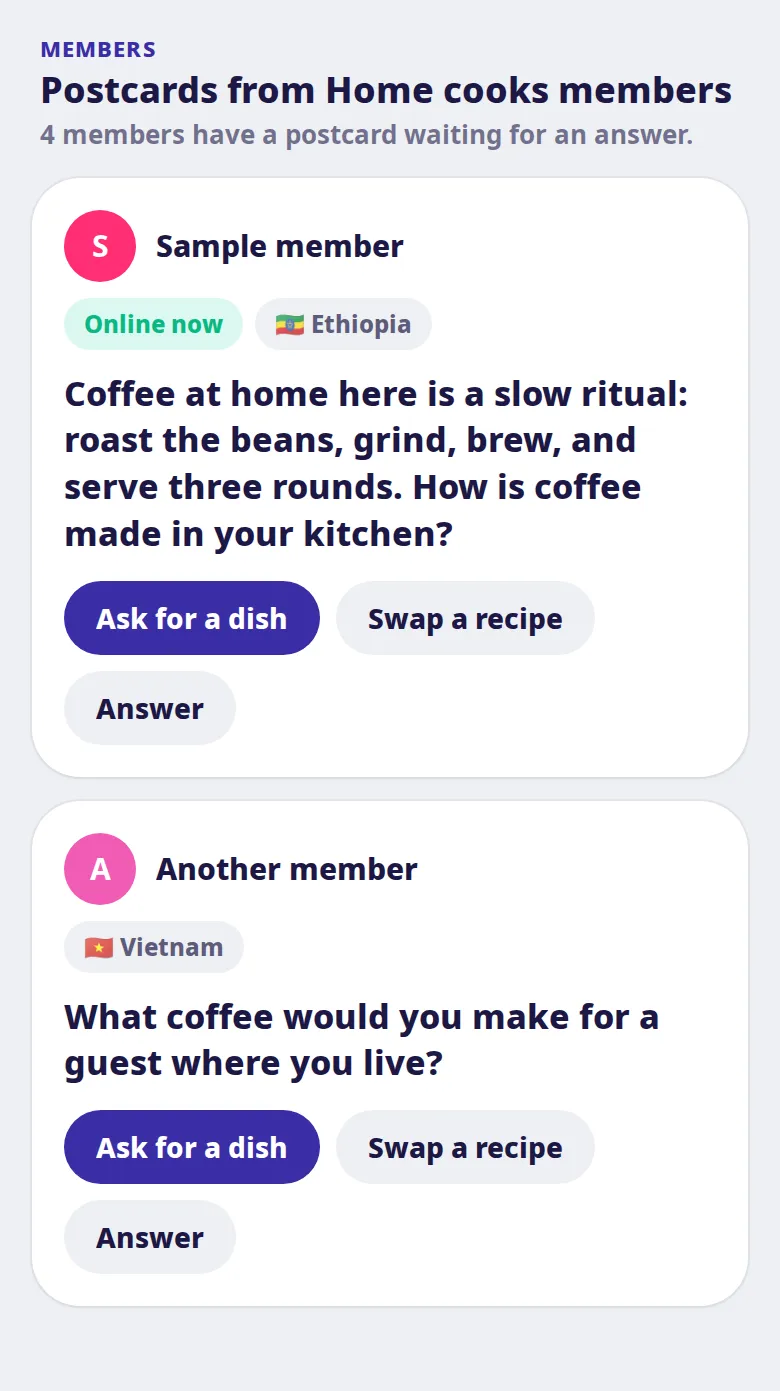 Example screen with sample members, not real people.
A few honest details:
- Every message is translated both ways, with the original visible, so each cook writes in their own language.
- It is text only. No voice and no video. Contact details are stopped before delivery, and report and block are in every chat.
- Adults 18+ only. Birth year is asked at join; there is no ID check.
- No ads and no paid plan. The community is still small, so at quiet hours an answer can take a while.
Questions to ask someone about coffee in their country
- How did you make your coffee this morning?
- What would you make for a guest who just walked in?
- What do you add to it: milk, sugar, spices, nothing?
- What is the one thing about your family's coffee you would never change?
Questions people ask
+Where does coffee come from?
Coffee is traced to Ethiopia. It then spread through Yemen, where it was shipped from the port of Mokha, and on to Mecca, Istanbul, Venice, Vienna and London between the 15th and 17th centuries.
+Which country drinks the most coffee per person?
Finland is usually named first, at about 12 kg of coffee per person per year. Other Nordic countries and the Netherlands are also near the top. Most Finns drink a light-roast filter coffee rather than espresso.
+Is any coffee tradition protected as world heritage?
Yes. UNESCO added Turkish coffee culture and tradition to its list of the intangible cultural heritage of humanity in 2013. Arabic coffee, described as a symbol of generosity, is also on the list, under the United Arab Emirates, Oman, Qatar, Saudi Arabia and Jordan. Austria lists Viennese coffee house culture on its national inventory, since 2011.
+Why do some Italians not order cappuccino in the afternoon?
In Italy, milky coffees such as cappuccino are mostly a morning drink and are traditionally not drunk after about 11 am. Later in the day and after meals, the usual order is a plain espresso, often drunk standing at the bar.
+What is the easiest coffee from another country to make at home?
Greek frappé and Korean dalgona coffee only need instant coffee, sugar, water, ice and milk. Mexican café de olla needs ground coffee, a cinnamon stick and piloncillo or brown sugar. Vietnamese iced coffee needs strong coffee and sweetened condensed milk, ideally dripped through a phin filter.
Keep reading
Boarding pass · free
Tap, fly to a random country, and chat with someone who lives there.
Text first, translated both ways, no video, no coins to meet people. Works in your browser.
Take off on OluNew here? Read Ablo App: The Complete Story of the Chat App That Let You Fly Anywhere (2019–2022), the full history in one place.