 Olu
Hand Gestures in Different Countries: What They Mean and Which Can Be Rude
Hand gestures in different countries: thumbs up, the OK sign, beckoning, pointing, nodding, the left hand and the soles of the feet, and where each can be rude.
Updated 19 November 2026 · 11 min read
On this page
A wave, a nod, a quick thumbs up. Abroad, the same small movement can mean something else: money instead of "OK", "no" instead of "yes", or an insult instead of a friendly hello.
This guide goes through the hand gestures in different countries that travellers most often get wrong, from the thumbs up to pointing, beckoning, nodding, the left hand and the soles of your feet. Each meaning comes from a page we opened and cite. One rule runs through all of it: meanings vary within every country, by region, age and setting, and many people know the foreign meaning too. Think of each entry as "what you may meet", not "what everyone does".
The short answer: the gestures that most often cause trouble are the thumbs up (an insult in Iran), the OK sign (money in Japan, "zero" in parts of France, and rude or offensive in Turkey, Greece, Brazil and much of Latin America), the palm-inward V sign (offensive in the UK, Ireland, Australia, New Zealand and South Africa), the open palm pushed at someone (an insult in Greece and Mexico), calling people with a curled finger, pointing with one finger, and showing the soles of your feet. Nodding can mean "no" in Greece, Bulgaria and Turkey. When in doubt, use words and watch what locals do.
Ask someone who lives where you're going
Hand gestures in different countries at a glance
28 gestures and places, with what each can mean there. The sections below give the source for each.
| Gesture | Where | What it can mean |
|---|---|---|
| Thumbs up | English-speaking countries | Approval, "good" |
| Thumbs up | Iran | An insult |
| Thumbs up | Germany, France, Hungary | The number one |
| Thumbs up | Tibet | A traditional way of begging for mercy |
| OK sign (thumb and index finger in a ring) | English-speaking countries | "OK", "all is well" |
| OK sign | Japan | Money |
| OK sign | France (especially the south), Tunisia | Zero, worthless |
| OK sign | Turkey, Greece, Brazil, parts of Germany, much of Latin America | Can be read as rude or offensive |
| OK sign | Some Middle Eastern countries, such as Kuwait | The evil eye |
| V sign, palm turned inward | UK, Ireland, Australia, New Zealand, South Africa | Offensive |
| V sign, palm outward | Japan | "Peace sign", common in casual photos |
| Open palm pushed toward someone (moutza) | Greece, Mexico | An insult |
| Open palm waved | Mexico, Brazil | Hello |
| Curled finger, palm up, to call someone | United States | Used for children, rude for adults |
| Curled finger to call someone | Japan | An insult; people beckon with the palm down |
| Beckoning with the palm down | Malaysia | The polite way to call someone |
| Pointing with the fingers together, palm up | Japan | The usual way to point |
| Pointing with the thumb | Malaysia | The polite way to point |
| Pointing with the chin, whole hand or thumb | People of Indian heritage | Polite alternatives to the index finger |
| Pointing with the lips | Nicaragua | A common way to point at things |
| Single upward nod | Greece, Cyprus, Iran, Turkey, Bulgaria | No |
| Shaking the head | Parts of southern Albania | Yes |
| Head bobble (tilting side to side) | India and South Asia | Yes, OK, I understand, thanks, or a soft no |
| Using the right hand only | Indonesia | Polite for handshakes, giving, eating, pointing |
| Left hand on the forearm while pouring | Korea | Respect when pouring a drink |
| Handing things over with both hands | Japan | Respect, for example with business cards |
| Showing the soles of your feet | Thailand, much of the Middle East | Often rude |
| Touching someone's head | Thailand | Disrespectful; the head is seen as sacred |
Thumbs up
In English-speaking countries the thumbs up generally means approval, and Wikipedia's thumb signal article traces one British use back to 1917, meaning "everything is fine with me". It travels well in many places, but not everywhere:
- Iran. The same article, and Wikipedia's page on etiquette in the Middle East, say the thumbs up is considered an offensive insult in Iran.
- Tibet. The thumb signal article says that in Tibet it is a traditional way of begging for mercy, not a sign of approval.
- Germany, France and Hungary. In the right context, a raised thumb is simply how people show the number one.
The OK sign
The ring made with the thumb and index finger is one of the gestures whose meaning changes most. Wikipedia's OK gesture article lists:
- English-speaking countries: approval or "all is well". Scuba divers also use it to say everything is OK.
- Japan: money. The ring stands for a coin.
- France and Tunisia: zero, or "worthless", especially in the south of France. In the north of France it more often means "OK".
- Turkey, Greece, other Mediterranean countries, parts of Germany and much of Latin America: it can be read as rude or offensive. The article says it was received badly when a visiting US politician used it in São Paulo in the 1950s.
- Some Middle Eastern countries, such as Kuwait: it can stand for the evil eye.
The V sign
Two raised fingers look harmless, but the direction of the palm matters. Wikipedia's V sign article says the version with the palm turned inward, toward you, is offensive in the UK, Ireland, Australia, New Zealand and South Africa.
With the palm turned outward it is the well-known victory or peace sign. In Japan it is very common in casual photos, especially among younger people, and is called pīsu sain, "peace sign". If you want to make the gesture in a photo, keep your palm toward the camera.
The open palm
An open palm can be a greeting or an insult depending on how it moves. Wikipedia's moutza article describes the moutza, pushing an open palm with spread fingers toward someone, as a traditional insult in Greece and Mexico. The closer it gets to the other person, the stronger it is. The article notes that Greeks showing the number five often keep their fingers together or turn the palm away so it is not mistaken for one.
The same article says that in Mexico and Brazil, waving an open palm is a common hello. The difference is the movement: a friendly wave moves side to side, while a palm held still or pushed at someone can be read as a warning.
Beckoning: calling someone over
How you call someone over is one of the easiest things to get wrong.
- United States. Wikipedia's beckoning sign article describes the American way: palm up, one or more fingers curling in. It notes this is mostly used with children and is seen as very rude toward adults.
- Japan. The same article says the curled-finger beckon is an insult in Japan, because it is how you would call a dog or another animal. People beckon with the hand at head height, palm down, waving the fingers toward themselves.
- Malaysia. Wikipedia's etiquette in Asia article also lists beckoning with the palm down as the polite way in Malaysia.
Pointing
Wikipedia's pointing article says pointing with the index finger is considered rude in much of the world, especially when you point at a person. Many places have a polite alternative:
- Japan: fingers held together, palm up, as if presenting the thing.
- Malaysia: the thumb, according to the etiquette in Asia article.
- People of Indian heritage: the chin, the whole hand or the thumb. The pointing article adds that index-finger pointing may be seen as rude.
- Nicaragua: the lips, pushed out toward the thing you mean.
- Some cultures: pointing with the left hand is taboo.
The pointing article notes that an open hand is seen as more polite in some contexts, which makes it a sensible default when you need to show a waiter which dish you mean.
Nodding and shaking the head
Head movements feel universal, but they are not.
- Greece, Cyprus, Iran, Turkey and Bulgaria. Wikipedia's article on nodding says that in these countries a single nod of the head up, not down, means "no".
- Southern Albania. Wikipedia's head shake article says that in some areas, such as southern Albania, shaking the head means "yes" and nodding means "no".
- India and South Asia. The head bobble, a side-to-side tilt, is common in South Asia, especially in southern India. It usually means agreement or "I understand", but it can also mean thank you, a friendly hello, or a polite way to decline without saying no.
Many people in these places know that visitors nod the other way and adjust. If a yes or no really matters, for a price or a direction, ask for the word.
The left hand and passing things
In some cultures the left hand is kept for cleaning, so it is avoided for giving, receiving and eating. The etiquette in Asia article advises using the right hand in Indonesia when you shake hands, offer a gift, hand over or receive something, eat, point, or touch another person.
Using both hands, or adding the left hand as support, can show respect:
- Japan: give and receive business cards with both hands.
- Korea: when pouring a drink, hold the bottle in the right hand and rest the left hand lightly on the right forearm.
If you are left-handed, nobody expects you to change who you are. Handing money or a gift over with the right hand, or both, is an easy habit to learn before a trip.
Feet, soles and the head
Some of the strongest rules are not about hands at all.
- Thailand. The etiquette in Asia article says the head is considered sacred and should not be touched, and that feet are considered unclean. Do not point at people or things with your feet, and do not show the soles of your feet when sitting on the floor.
- The Middle East. Wikipedia's etiquette in the Middle East page says showing the sole of your foot, or touching someone with your shoe, is often considered rude. In some homes you may also be asked to take your shoes off before going into the living room.
In practice that means sitting with your feet tucked to the side or flat on the floor, not crossed with a sole pointing at someone, and never touching anyone's head.
How to avoid a gesture mistake abroad
You do not need to memorise every meaning. A few habits cover most situations:
- Watch first. Spend your first day noticing how people call a waiter, point, count on their fingers and say yes.
- Use words for the important things. Prices, directions, yes and no: say them, or write them down.
- Keep your hands calm. Fewer gestures means fewer surprises. An open palm and a smile work almost everywhere.
- Learn the local greeting. Our guide to greetings around the world covers bows, handshakes and cheek kisses.
- Apologise simply. If you get it wrong, a quick "sorry, I didn't know" is the simplest fix.
- Ask someone who lives there. No list, including this one, knows your city's habits as well as a local does.
Gestures are one part of a bigger picture. If small differences keep piling up, our page of culture shock examples explains why that happens and how to cope.
Ask a local about gestures before you go
The quickest way to learn what a gesture means in a place is to ask someone who uses it every day. They can tell you what visitors get wrong, what is truly rude and what is just unfamiliar.
Olu is a free text chat site for adults 18+ to meet people in other countries, in the browser. Its Travellers planet is about where to go and what it is really like, from people who live there. The ritual is Ask a local: skip the list, name the place, and ask a person who lives there what to skip and what not to miss. You can also Swap trip tips, or Answer a question about your own country. The planet's rules are short: say which country, be curious and never insulting, and remember that locals know best.
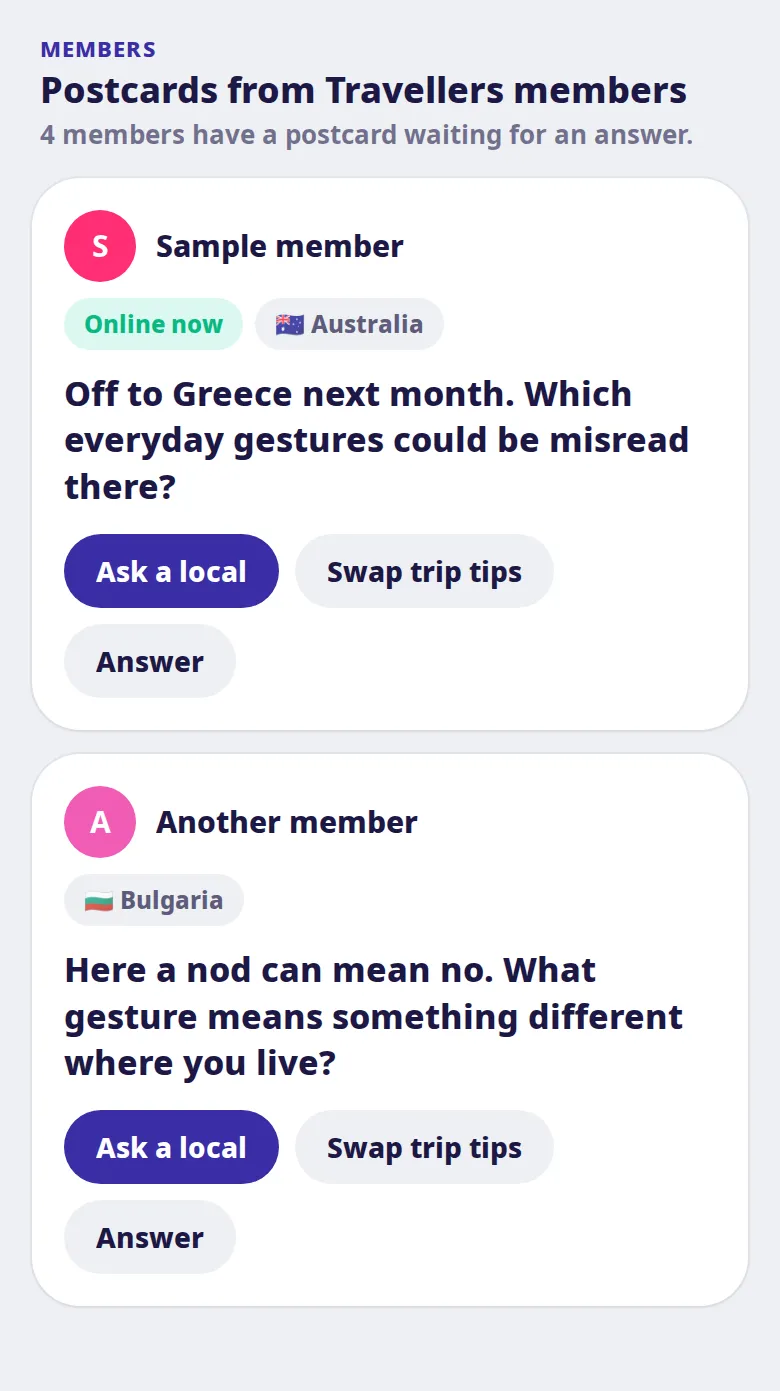 Example screen with sample members, not real people.
A few honest details:
- Every message is translated both ways, with the original visible, so you can ask someone in Athens or Sofia in your own language.
- It's text only. No voice and no video, so you describe a gesture in words rather than show it. Contact details are stopped before delivery.
- It's small. Not every country has someone online at every hour, so an answer can take time.
- Report and block are in every chat. No ads, no paid plan. Birth year is asked at join, with no ID check.
If you want to get to know a place before you book, virtual travel chat explains how.
Questions people ask
+Which hand gestures are rude in other countries?
Some of the best-known examples: the thumbs up is an insult in Iran, the OK sign can be read as rude or offensive in Turkey, Greece, Brazil and much of Latin America, the V sign with the palm turned inward is offensive in the UK, Ireland, Australia, New Zealand and South Africa, and an open palm pushed toward someone (the moutza) is an insult in Greece and Mexico. Meanings vary within every country.
+Is the thumbs up rude anywhere?
Yes. Wikipedia's article on the thumb signal says it is an insult in Iran, and that in Tibet it is a traditional way of begging for mercy. In English-speaking countries it is generally positive, and in Germany, France and Hungary it can simply mean the number one.
+In which countries does a nod mean no?
Wikipedia's article on nodding says that in Greece, Cyprus, Iran, Turkey and Bulgaria a single nod of the head up, not down, means no. In parts of southern Albania, shaking the head can mean yes. Many people in these places also know the more common meanings, so watch for words too.
+Why should you not use your left hand in some countries?
In some cultures the left hand is kept for cleaning, so using it to give, receive, eat or point is avoided. For Indonesia, for example, Wikipedia's etiquette in Asia article advises using the right hand to shake hands, hand things over, eat and point.
+Is it rude to show the soles of your feet?
In many places, yes. Wikipedia's etiquette pages say showing the sole of your foot is often considered rude in the Middle East, and that in Thailand feet are seen as unclean, so you should not point with them or show your soles when sitting on the floor.
Keep reading
Boarding pass · free
Tap, fly to a random country, and chat with someone who lives there.
Text first, translated both ways, no video, no coins to meet people. Works in your browser.
Take off on OluNew here? Read Ablo App: The Complete Story of the Chat App That Let You Fly Anywhere (2019–2022), the full history in one place.