 Olu
Street Food Around the World: 30 Countries and Their Street Food
Street food around the world in 30 countries, from tacos al pastor in Mexico to suya in Nigeria and takoyaki in Japan: what each dish is, with a source each.
Updated 19 November 2026 · 10 min read
On this page
Every city has a food that is eaten standing up: a sesame bread ring from a cart in Istanbul, spiced beef skewers in the evening in Nigeria, a paper cone of fries in Belgium, a taco shaved from a spinning spit in Mexico. Street food is often the first thing a visitor tastes, and the last thing someone who moves away stops missing.
This list covers street food around the world: 30 countries and more than 30 dishes, grouped by region, each linked to the page it was checked against. Recipes change from city to city and family to family, so read each row as "a well-known version", not the only one.
The short answer: famous street foods around the world include tacos al pastor and elote in Mexico, bánh mì in Vietnam, mango sticky rice in Thailand, chicken rice in Singapore's hawker centres, pani puri in India, simit in Turkey, koshary in Egypt, suya in Nigeria, the rolex in Uganda, currywurst in Germany, fish and chips in the UK, arepas in Colombia and Venezuela, and poutine in Canada. Most are cheap, quick and eaten by hand, and many started as food for workers or arrived with migrants.
Ask a home cook abroad about their street food
Street food around the world, country by country
East Asia
| Country | Street food | What it is | Source |
|---|---|---|---|
| Japan | Takoyaki | Batter balls filled with octopus, tempura scraps, pickled ginger and green onion, topped with sauce, mayonnaise and bonito flakes. Osaka street vendor Tomekichi Endo is credited with it in 1935; linked with yatai stalls. | Wikipedia |
| South Korea | Tteokbokki, hotteok | Tteokbokki: rice cakes and fish cakes in spicy gochujang sauce, sold at pojangmacha street stalls. Hotteok: a pancake filled with brown sugar, nuts and cinnamon, usually eaten in winter. | Wikipedia, Wikipedia |
| China | Jianbing | A thin egg crepe folded around a crispy cracker or fried dough stick, scallions and sauces. From northern China; generally eaten for breakfast and sold by street vendors. | Wikipedia |
| Taiwan | Stinky tofu | Fermented tofu with a strong smell and a mild taste, most often deep-fried, with chili or soy sauce. Common at night market stalls. | Wikipedia |
Southeast Asia
| Country | Street food | What it is | Source |
|---|---|---|---|
| Thailand | Mango sticky rice | Sticky rice cooked with coconut milk, served with ripe yellow mango. A common street food, usually eaten in the peak mango season of April and May. | Wikipedia |
| Vietnam | Bánh mì | A crisp rice-and-wheat baguette filled with pork, pâté, pickled carrot and daikon, coriander and chili. Became a popular street food in Saigon in the 1950s. | Wikipedia |
| Singapore | Hainanese chicken rice | Poached or roasted chicken with seasoned rice and chili sauce, created by immigrants from Hainan. Widely seen as a national dish; found in hawker centres across the country. | Wikipedia |
| Malaysia | Char kway teow | Flat rice noodles stir-fried over very high heat with soy sauce, chili, prawns, cockles and bean sprouts. Began as cheap evening hawker food; in Penang often served on a banana leaf. | Wikipedia |
| Indonesia | Satay | Seasoned meat on skewers, grilled over charcoal, usually with peanut sauce. Sold by hawkers and at night markets; listed among Indonesia's national foods in 2011. | Wikipedia |
| Philippines | Isaw | Grilled pork or chicken intestine skewers, part of Filipino barbecue, with a vinegar dip. Sold on streets and at night markets. | Wikipedia |
South Asia
| Country | Street food | What it is | Source |
|---|---|---|---|
| India | Pani puri, vada pav | Pani puri: a hollow fried shell filled with potato or chickpeas, dipped in mint or tamarind water and eaten in one bite; golgappa in Delhi, puchka in the east. Vada pav: a fried potato dumpling in a bun, born as cheap food for Mumbai's mill workers. | Wikipedia, Wikipedia |
Pani puri crosses borders: as fuchka it is sold by street vendors in Bangladesh, and golgappe were traditionally sold from street carts in Pakistan.
Middle East and North Africa
| Country | Street food | What it is | Source |
|---|---|---|---|
| Turkey | Simit | A sesame-crusted bread ring, sold by vendors with trolleys or trays carried on their heads. Often eaten for breakfast; tea with simit is traditional. | Wikipedia |
| Egypt | Koshary, ta'ameya | Koshary: rice, pasta, black lentils and fried onions, with vinegar, garlic and hot sauce, served from street carts and restaurants. Ta'ameya: fava bean and herb fritters in pita, a popular breakfast. | UNESCO, Wikipedia |
Sub-Saharan Africa
| Country | Street food | What it is | Source |
|---|---|---|---|
| Nigeria | Suya | Thin-sliced beef rubbed with yaji (dried chili, ginger, ground peanut cake, salt) and grilled on skewers. A Hausa dish, most popular as evening street food. | Wikipedia |
| Uganda | Rolex | Eggs cooked with onion, cabbage, tomato and chili, rolled in a chapati ("rolled eggs"). Sold at stalls for under a dollar, eaten at any time of day. | CS Monitor |
| South Africa | Bunny chow | A hollowed-out loaf of white bread filled with curry, from Durban's Indian South Africans in the 1940s. Sold by the quarter, half or full loaf at takeaways. | Wikipedia |
Europe
| Country | Street food | What it is | Source |
|---|---|---|---|
| Germany | Currywurst | Sliced pork sausage under curry ketchup, with chips or a roll. Credited to Herta Heuwer, who sold it from a West Berlin stand in 1949. | Wikipedia |
| United Kingdom | Fish and chips | Battered cod or haddock with thick chips, salt and vinegar. Usually takeaway, traditionally wrapped in paper; shops date to the 1860s. | Wikipedia |
| Belgium | Frites | Fries from a frietkot or friterie, traditionally in a white cardboard cone with a spoonful of sauce, often mayonnaise. | Wikipedia |
| Italy | Arancini | Breaded, fried rice balls from Sicily, filled with ragù, cheese and peas. Sold at fry stands and cafés; western Sicily tends to say arancina, the east arancino. | Wikipedia |
| Poland | Zapiekanka | Half a baguette with sautéed mushrooms and cheese, toasted, finished with ketchup. Sold from stands and trailers since the 1970s. | Wikipedia |
The Americas
| Country | Street food | What it is | Source |
|---|---|---|---|
| Mexico | Tacos al pastor, elote | Al pastor: pork marinated with chilies and pineapple, cooked on a vertical spit (trompo), shaved onto corn tortillas. Elote: corn on the cob, sold from carts by eloteros with mayonnaise, cheese or chili powder. | Wikipedia, Wikipedia |
| Colombia | Arepa | A flat, round maize patty filled with cheese, beans, meat, avocado or eggs, eaten in Colombia and Venezuela. In Colombia sold by street vendors, cafeterias and neighbourhood stores. | Wikipedia |
| Peru | Anticuchos | Beef heart marinated in vinegar, cumin, ají pepper and garlic, grilled on skewers. Sold from carts by anticucheras; most eaten in July, around the Fiestas Patrias. | Wikipedia |
| Argentina | Choripán | Grilled chorizo in crusty bread, often with chimichurri. Sold at football games and roadside stands. | Wikipedia |
| Brazil | Acarajé | A black-eyed pea fritter fried in dendê palm oil, filled with vatapá and caruru. Sold in Salvador, Bahia, mostly by women called baianas who dress in white. | Wikipedia |
| Trinidad and Tobago | Doubles | Curried chickpeas between two small fried flatbreads (bara), with pepper sauce and chutneys. Of Indo-Trinidadian roots; usually eaten for breakfast. | Wikipedia |
| Jamaica | Jerk chicken | Chicken in a rub of allspice (pimento) and Scotch bonnet peppers, cooked over charcoal in halved oil barrels. Sold at roadside jerk stands. | Wikipedia |
| United States | Hot dog from a cart | Carts are very common in New York City. A US hot dog council estimated that 15% of hot dogs eaten in the US in 2014 were bought from a cart. | Wikipedia |
| Canada | Poutine | Fries and cheese curds under hot gravy, from rural Quebec around 1959. Sold at roadside chip wagons (cabanes à patates) and food trucks. | Wikipedia |
Street food that became heritage
Some street foods, and the people who sell them, are officially protected:
- Hawker culture in Singapore, added to UNESCO's list in 2020. UNESCO describes hawker centres as "community dining rooms" that grew out of street food culture, where many hawkers refine one dish for years and pass it on to family or apprentices.
- Koshary in Egypt, inscribed in 2025 as a daily life dish. The decision also names the craftspeople who build and decorate koshary carts.
- Jemaa el-Fna square in Marrakesh, proclaimed in 2001. UNESCO's page describes storytellers and musicians in a square lined with food stands.
- Acarajé in Brazil, listed as national heritage in 2004, together with the baianas who make and sell it.
What street foods have in common
Grilled on a stick. Satay, suya, anticuchos and isaw are all meat on skewers over charcoal: fast to cook, cheap to sell one at a time, no plate needed.
Wrapped in bread. Bánh mì, choripán, bunny chow, zapiekanka, doubles and the rolex put a hot filling inside bread, so the food is its own container.
Brought by migrants. Tacos al pastor descend from shawarma brought by Lebanese immigrants. Bánh mì puts Vietnamese fillings in a French bread. Bunny chow came from Indian South Africans, doubles from Indo-Trinidadians, and chicken rice from Hainanese immigrants.
Cheap food for working people. Char kway teow gave labourers cheap energy, and vada pav fed Mumbai's mill workers.
When people eat street food
- Morning: jianbing in China, simit with tea in Turkey, doubles in Trinidad and Tobago, ta'ameya in Egypt. More ideas in our guide to breakfast around the world.
- After dark: suya is mostly an evening food, stinky tofu a night market one. In Fukuoka, Japan's tourism site says yatai stalls are set up every evening, and diners give up their seats once they finish eating.
- In season: mango sticky rice in April and May, hotteok in winter, anticuchos in July.
Street foods you can make at home
- Zapiekanka (Poland). Halve a baguette, top with sautéed mushrooms and grated cheese, toast, finish with ketchup.
- Elote (Mexico). Cook corn on the cob and add mayonnaise, grated cheese, chili powder and a little lemon juice.
- Choripán (Argentina). Grill a chorizo, split it into crusty bread, spoon on chimichurri.
A recipe misses the street: which stall, which sauce, how spicy. That part comes from a person. Our guide to hosting a recipe exchange has ideas for swapping recipes with friends.
Swap street food recipes with a home cook abroad
Olu is a free text chat site, in your browser, where adults 18+ meet people in other countries. Its Home cooks planet is for "real home cooking from real kitchens", including the street dish you cook at home because you miss it. Three laws: say where the dish is from, real home cooking only, and never mock a recipe from someone's home.
Its ritual is Same dish, two kitchens. Name tonight's dish, and a cook in another country tells you how their kitchen does it, and what they would never change. Each postcard has three buttons: Ask for a dish, Swap a recipe and Answer. A Swap a recipe request stays open for 48 hours, so cooks in other time zones can see it.
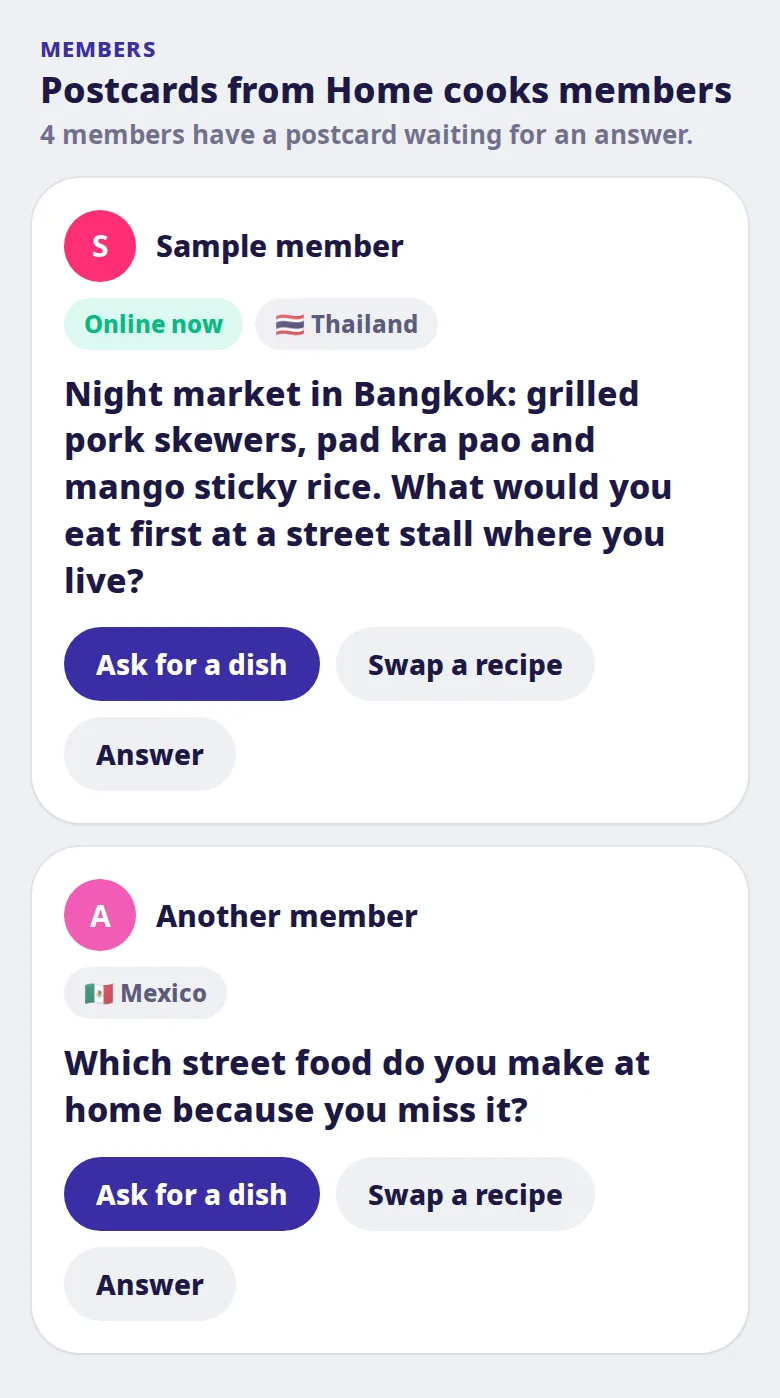 Example screen with sample members, not real people.
Honest details: every message is translated both ways with the original visible, so dish names survive, but check amounts and units with the other cook. It is text only, with no voice or video. Contact details are stopped before delivery, and report and block are in every chat. There are no ads and no paid plan, and the community is small, so at quiet hours an answer may take a while.
Questions to ask someone about street food where they live
- What would you eat first at a street stall in your city?
- Which street food do you make at home because you miss it?
- What do people eat late at night, and on the way to work?
- What would you never change about the way it is made?
If you share the meal you cooked, bon appétit in different languages is a friendly way to sign off.
Questions people ask
+Which country has the best street food?
There is no fair ranking, and published lists disagree. Singapore is the only one whose hawker culture as a whole is on UNESCO's intangible heritage list, inscribed in 2020. The honest answer is the one a local gives you about their own street.
+What is the most popular street food in the world?
No reliable worldwide count exists. A few kinds of food do repeat across continents: meat grilled on skewers (satay, suya, anticuchos, isaw), something hot in bread (bánh mì, choripán, bunny chow, zapiekanka) and small fried snacks (takoyaki, arancini, pani puri, ta'ameya).
+Is any street food protected as heritage?
Yes. UNESCO inscribed hawker culture in Singapore in 2020 and Egypt's koshary in 2025, and proclaimed the Jemaa el-Fna square in Marrakesh, where traditional food is sold among storytellers and musicians, in 2001. Brazil listed acarajé and the baianas who sell it as national heritage in 2004.
+What street foods are eaten for breakfast?
Several. Jianbing is one of China's most popular street breakfasts, simit with tea is a traditional breakfast in Turkey, doubles are usually eaten in the morning in Trinidad and Tobago, ta'ameya is a breakfast item in Egypt, and char kway teow is often eaten at breakfast at stalls in Malaysia and Singapore.
+How can I make street food from another country at home?
Start with dishes built from everyday ingredients, like zapiekanka (a baguette with mushrooms and cheese), elote (corn with a creamy, cheesy, chili topping) or choripán (a grilled sausage in bread). For the details a recipe leaves out, ask someone who grew up buying it on their street.
Keep reading
Boarding pass · free
Tap, fly to a random country, and chat with someone who lives there.
Text first, translated both ways, no video, no coins to meet people. Works in your browser.
Take off on OluNew here? Read Ablo App: The Complete Story of the Chat App That Let You Fly Anywhere (2019–2022), the full history in one place.