 Olu
Study Abroad Tips: What to Sort Before You Go and in Your First Weeks
Study abroad tips for international students: visas from official pages, money, housing, insurance, first-week admin, study culture and homesickness help.
Updated 19 November 2026 · 10 min read
On this page
Studying abroad starts long before the flight: a visa, a room in a city you may never have seen, a bank that wants a local address. Then, a few weeks in, the paperwork calms down and the homesickness starts.
This guide covers what to sort before you go, your first weeks, how teaching may differ, and coping when it gets lonely. It's for university students and adult learners going abroad for a semester or a full degree.
The short answer: start 12 to 18 months ahead if you can. Get visa information only from the official government page of your destination and your university's international office. Budget for the hidden costs, find housing early and never pay for a room you haven't seen or checked. Sort health and travel insurance. In your first weeks, complete your university check-in, register your address where required, register with a doctor, get a local number and open a bank account. Expect homesickness, and know where your university's wellbeing service is before you need it.
Ask a student abroad what they wish they had known
Before you go: the study abroad checklist
Start earlier than feels necessary
Prospects, a UK careers site run by Jisc, suggests starting to plan 12 to 18 months in advance. CIEE, a study abroad organisation, recommends having your passport and visa in hand six to nine months before departure, and tracking every application deadline with calendar reminders. Prospects also advises checking that credits will transfer, or that your qualification will be recognised where you plan to work.
Visas: go to the official page, every time
Visa rules depend on your nationality, course and length of stay, and they change. So this guide won't tell you what they are, only where to look:
| Destination | Official starting point |
|---|---|
| United Kingdom | GOV.UK: Student visa |
| Canada | IRCC: Study permit |
| Australia | Department of Home Affairs: Student visa (subclass 500) |
| Netherlands | Study in NL: Do you need a visa? (run by Nuffic) |
| Germany | DAAD: Residence permit and address registration |
| Anywhere else | The destination government's immigration site, and your university's international office |
Prospects adds two useful checks: prepare your proof of funds early, and find out whether you must register with any authority after you arrive. Trust the international office over any summary, including an agent's or a friend's.
Money: budget for more than tuition and rent
Prospects lists travel, visa costs, insurance and accommodation, and says to build an emergency fund. Studyabroad.com adds medical emergencies to the list of costs people forget. Times Higher Education's student guide warns that a student loan may not cover everything, so decide in advance where your money goes.
Two practical points:
- Check your home card's fees. NCUK's student services team notes that your home bank may charge high fees for card payments or cash withdrawals abroad. Compare options before you go.
- Find out how people pay where you're going. Study in NL says many Dutch grocery stores don't accept credit cards and some no longer take cash.
Housing: early, careful, and never unseen
Housing advice differs by country, so read your destination's own guidance:
- In the UK, UKCISA (the UK Council for International Student Affairs) says you must apply for university housing before you arrive and watch the deadlines. For private renting, it does not usually advise arranging it from abroad. A hotel or hostel can cover your first weeks while you search in person.
- In the Netherlands, Study in NL warns of "a severe housing shortage" and says to start looking as soon as possible and arrange housing before you arrive.
What both agree on is scams. UKCISA says fake landlords advertise rooms that don't exist and ask for a deposit. Study in NL's advice is to never sign a tenancy contract without having seen the room, and not to pay brokerage fees. If you can't view a place yourself, ask your university's housing office for help, and never pay a deposit without proof of payment.
Insurance and health
Prospects notes that insurance is often a visa requirement. Think about health, travel and belongings cover; NCUK points out the last is separate. Rules on health insurance vary widely. Study in NL, for example, says health insurance is compulsory for Dutch residents, and that a part-time job or internship can change whether a student must take out Dutch cover. Before you leave, Prospects suggests checking vaccination requirements, arranging any prescriptions and seeing your doctor.
The final fortnight
Prospects' last checks: a passport valid for your whole stay, digital and printed copies of key documents, your new address and emergency contacts saved, a SIM or phone plan, some local currency and a planned airport transfer. NCUK suggests labelling key contacts "ICE" (in case of emergency), with one at home and one in your new country.
Your first weeks abroad
The first weeks are mostly admin, and one step often depends on another. The usual tasks, with examples from official and university pages:
| Task | What the sources say |
|---|---|
| University check-in | Many universities require an immigration check-in after arrival. The University of Washington's post-arrival checklist says wrong contact details are the most common reason check-ins fail. |
| Address registration | In the Netherlands, Study in NL says students staying more than four months register with their municipality and get a BSN, which they need for a bank account, health insurance or a job. Many universities run special registration days. In Germany, DAAD says to register at the residents' registration office within two weeks of moving in. |
| Bank account | UKCISA says banks must check your immigration status and may ask your university to confirm you're a student, often with a letter. Tell your bank if you'll be away for a long break so the account isn't closed as dormant. |
| Doctor | UKCISA advises registering with a GP as soon as you arrive in the UK, not when you're ill. Learn the local emergency and non-emergency numbers. In the UK they are 999 and 111. |
| Phone | Prospects suggests arranging a SIM or plan before you leave. The University of Washington check-in asks for a US phone number. |
When any of this stalls, ask your international office. Deadlines and documents differ by city.
Watch for scams aimed at new students
UKCISA's page on frauds and scams describes callers who pretend to be from the Home Office, sometimes knowing your passport number, and demand a "fine" for an invented visa problem. The Home Office does not issue penalties by phone. UKCISA also warns about letting unknown money pass through your bank account, which is money laundering even if you didn't know. If a call asks for money or personal details, hang up and tell your international student adviser.
How studying may feel different
Teaching styles vary between countries and between universities. Know what's expected before the first deadline.
UKCISA's study skills page describes the UK version: a lot of independent study, reading expected before or after lectures, and seminars where you're expected to take an active role in discussion. It also stresses referencing. Each institution has its own rules, and mistakes can be treated as plagiarism even when they're unintentional. The consequences can include failing the assignment or being asked to leave the course.
In the US, office hours can surprise students. The University of North Carolina's Writing Center says instructors "genuinely welcome student visits", and that pretending to understand is a mistake. Ask for clarification, and be specific.
Some habits that help anywhere:
- Learn your university's referencing style in week one, and use its study skills or writing centre early.
- Never buy essays or share answers. UKCISA defines plagiarism as presenting someone else's work as your own.
- Keep study hours realistic. The University of Liverpool suggests around 30 to 35 hours a week.
- Study with someone. A regular session keeps you on track and helps you get to know people. See our study buddy guide.
Homesickness and culture shock
You will probably feel homesick at some point, and it doesn't mean you made the wrong choice. The University of Liverpool says "nearly two out of three students feel homesick to some extent" in their first six weeks, and that a new language and culture can make it stronger.
UKCISA's culture shock page describes a common pattern: excitement first, then confusion and isolation, then a gradual return to confidence. Family dates and festivals can bring the loneliness back, even once you feel settled. For real-world examples of what catches people out, from greetings to queues, see culture shock examples.
What university wellbeing services suggest:
- Keep in touch with home, in balance. UKCISA says very frequent contact, especially at first, can make settling in harder.
- Build a routine. Liverpool and the Australian National University both suggest it, with time for sleep, food and things you enjoy. ANU adds that you may need extra sleep while you get over jet lag.
- Mark milestones on a calendar, such as holidays and due dates, so the year feels like smaller pieces. That's another ANU tip.
- Go easy on alcohol. ANU notes it can make low mood worse.
- Don't make big decisions in a low week. Liverpool advises talking things through before deciding to leave.
When to get help
If homesickness is affecting your sleep, your studies or your mood, or it isn't improving, talk to someone. UKCISA says most universities have a wellbeing or counselling service, that it is confidential, and that a doctor can help with mental as well as physical health. Its message is simple: don't suffer in silence. If you ever feel unable to keep yourself safe, contact local emergency services or your university's crisis support straight away.
Making friends as an international student
Studyabroad.com says international student groups and clubs can ease homesickness, and you can start before you land. Prospects suggests connecting with other international students through university forums, social media groups and virtual events, then joining welcome activities, societies and buddy schemes on arrival. UKCISA recommends making friends with both international and local students, and finding shared interests like sport, music or volunteering.
Our guide on how to make friends at university covers this in depth: halls, societies, study groups, buddy schemes and what to say.
Talk to students in other countries
Some questions are best answered by someone who has just done it. How long did the bank take? Is it normal that nobody talks in seminars?
Olu is a free text chat site for meeting people in other countries. It runs in your browser and is for adults 18+. Its University students planet is for students 18+ from universities around the world. The house rules: say what and where you study, adults only, and no selling essays or answers. The planet's ritual is Study together: study beside another student for 25 minutes, say what you're studying, a student in another country answers, and you check in with each other when the time is up. Postcards from members have three buttons: Study together, Quiz me and Answer.
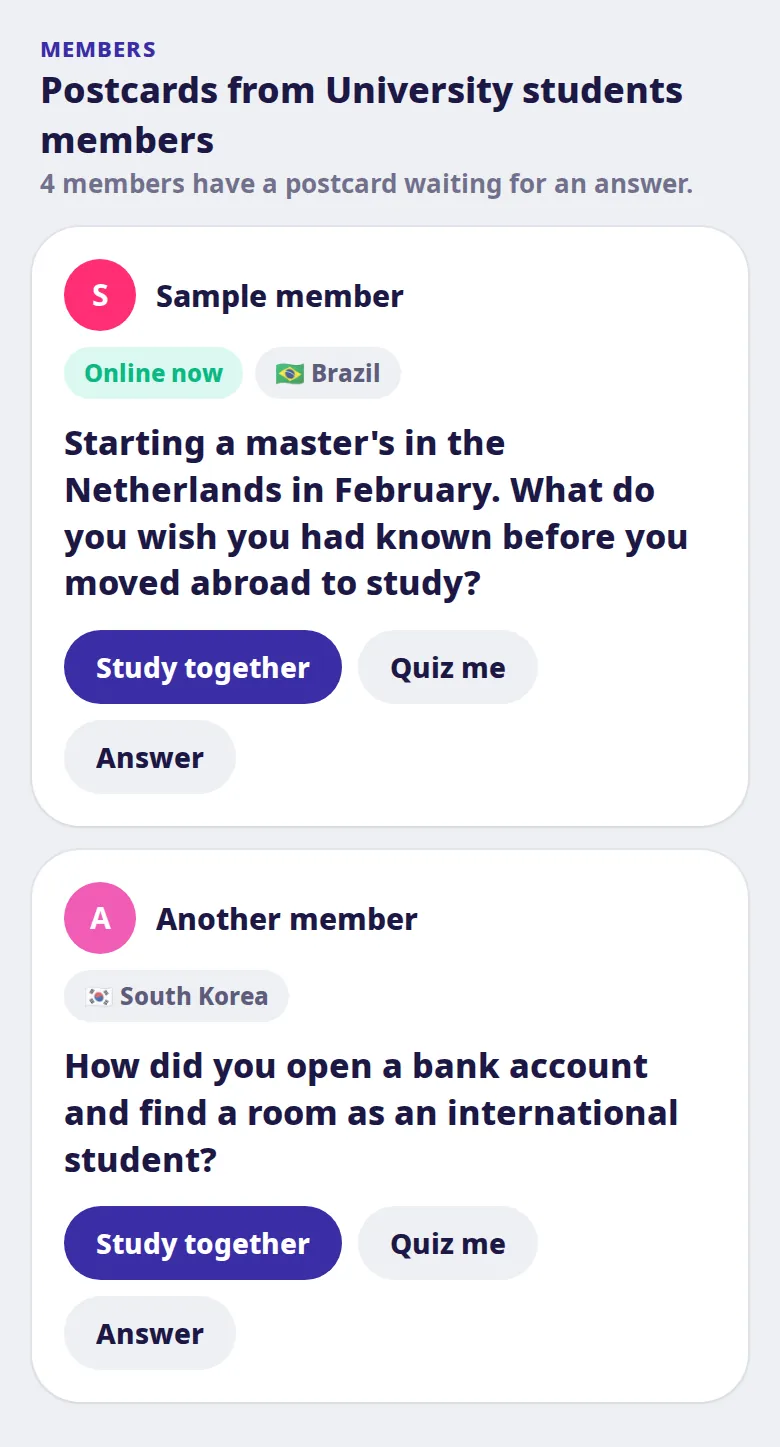 Example screen with sample members, not real people.
Honest details:
- Text only. No voice, no video.
- Every message is translated both ways, with the original visible, so you can talk with a student whose first language isn't yours.
- It's for advice and company. It won't replace your international office or official visa advice.
- Report and block are in every chat, and contact details are stopped before delivery. No ads, no paid plan.
- It's a small community, so at quiet hours a reply can take a while.
Study abroad tips: the short checklist
- Start 12 to 18 months ahead.
- Visa information only from official pages and your international office.
- Budget for the hidden costs and an emergency fund.
- Never pay for a room you haven't seen or verified.
- Sort insurance and copy your documents.
- Week one: check in, register, find a doctor, get a number, open an account.
- Learn the referencing rules and use office hours.
- Expect homesickness, keep a routine, and talk to people.
Questions people ask
+How early should I start planning to study abroad?
Earlier than you think. Prospects, a UK careers site run by Jisc, suggests starting 12 to 18 months ahead for a full degree, and CIEE advises having your passport and visa sorted six to nine months before you leave. Visa, housing and funding deadlines are usually the ones that catch people out.
+Where do I find the right visa information for studying abroad?
On the official government page of the country you will study in, and from your university's international office. Examples are GOV.UK's Student visa guide, Canada's IRCC study permit page and Australia's Department of Home Affairs Student visa page. Rules change, so don't rely on forums, agents' summaries or old blog posts.
+What should I do in my first week as an international student?
Complete any check-in or enrolment your university asks for, register your address if the country requires it, register with a doctor, get a local phone number and start opening a bank account. The exact list depends on the country, so follow your university's arrival checklist.
+Is it normal to feel homesick when studying abroad?
Yes. The University of Liverpool says nearly two out of three students feel homesick to some extent in their first six weeks. Keep a routine, join one or two activities, stay in touch with home without living on your phone, and talk to your university's wellbeing or counselling service if it doesn't ease.
+How can I talk to students in other countries before I move?
Join your university's offer-holder groups and virtual events, and ask current students questions. On Olu's University students planet, adults 18+ can ask students in other countries what they wish they had known, in free text chat that is translated both ways.
Keep reading
Boarding pass · free
Tap, fly to a random country, and chat with someone who lives there.
Text first, translated both ways, no video, no coins to meet people. Works in your browser.
Take off on OluNew here? Read Ablo App: The Complete Story of the Chat App That Let You Fly Anywhere (2019–2022), the full history in one place.