 Olu
Superstitions Around the World: 30 Folk Beliefs in 27 Countries
Superstitions around the world: Friday the 17th in Italy, the number 4 in East Asia, the evil eye, knock on wood, first-footing and more, each sourced.
Updated 19 November 2026 · 11 min read
On this page
- 30 superstitions from 27 countries
- Lucky and unlucky numbers by country
- The evil eye: one belief, many countries
- Knock on wood, and its cousins
- New Year, journeys and thresholds
- Superstitions travellers notice, and how to handle them
- Beliefs change, and many people don't hold them
- Ask a local which superstitions are real where they live
In Florence, a hotel might have a room 13 but skip 17. In Seoul, the lift may show F where you expect 4. In Istanbul, a blue glass eye hangs by the door, and in Edinburgh people still talk about who should step into the house first after midnight on New Year's Eve.
This guide covers superstitions around the world: 30 folk beliefs from 27 countries, each checked against an encyclopedia, a museum or national page, or a news report we opened. These are beliefs some people hold, not facts, and nothing here claims they work. Every belief varies by region, family and generation within a country, and many people in each place do not hold it at all.
The short answer: the most common superstitions around the world fall into a few families. Numbers: 4 is avoided in China, Japan and South Korea, 13 in the US, and 17 in Italy, while 8 is lucky in China. The evil eye: blue eye-shaped charms in Turkey and Greece, the hamsa hand in Egypt and Morocco, lemons and chillies by the door in India. Tempting fate: knocking on or touching wood, from the UK to Brazil, Turkey and Russia. And thresholds: who enters a home first at New Year in Scotland, Greece and Vietnam, or sitting down for a moment before a long trip in Russia.
Ask someone who lives there what people avoid
30 superstitions from 27 countries
One or two beliefs per country, with the source we checked. Read each row as "some people here believe or do this", not "everyone does".
| Country | Superstition | Source |
|---|---|---|
| Italy | Friday the 17th, not the 13th, is the unlucky day. XVII can be rearranged into the Latin "vixi", "I have lived". The number 13 is generally seen as lucky | Wikipedia |
| Italy | In southern Italy, small horn-shaped charms (cornicello) and gestures are used for protection against the evil eye | Wikipedia |
| Spain | Tuesday the 13th, "martes trece", is the unlucky day. People say "tocar madera" (touch wood) when they want good luck to continue | Wikipedia, Wikipedia |
| Mexico and other Spanish-speaking countries | Tuesday the 13th, rather than Friday, is the day to be careful | Wikipedia |
| Greece | Tuesday the 13th is unlucky. Many people guard against "mati", the evil eye, with blue eye charms | Wikipedia, Wikipedia |
| Turkey | The blue nazar boncuğu bead hangs in homes and cars. People knock on wood three times, often with an earlobe pull, after praise or bad news | Wikipedia, Wikipedia |
| China | 8 is lucky because it sounds like "prosper". The Beijing Olympics opened on 8/8/08 at 8 pm. 4 sounds close to "death" and is avoided in phone numbers and addresses | Wikipedia, Wikipedia |
| Japan | Chopsticks are never left standing upright in rice, as that is done at funeral altars. 4 and 9 can sound like "death" and "agony". A black cat crossing your path is lucky | Wikipedia |
| Japan | Weddings are planned for taian, the luckiest day of a six-day cycle, and funerals avoid tomobiki. Most people ignore these days in daily life | Wikipedia |
| South Korea | Hospitals and funeral halls almost always skip the 4th floor, and lifts may label it F. Writing a living person's name in red ink is avoided | Wikipedia, Gwangju News |
| South Korea | "Fan death", the belief that a fan in a closed room can kill a sleeper, was widely held until the mid-2000s and has faded since | Wikipedia |
| Vietnam | The first visitor at Tết (xông đất) sets the family's luck for the year, so hosts invite someone with a good temper and success. Sweeping during Tết sweeps luck away | Wikipedia |
| United Kingdom | A lone magpie is greeted, for example "Good morning, Mr Magpie", to turn away bad luck. "Touch wood" is more common than "knock on wood" | Wikipedia, Wikipedia |
| United Kingdom | At least six ravens are kept at the Tower of London, after a legend that the Crown will fall if they leave. The Tower's historian thinks the legend is Victorian | Wikipedia |
| Scotland | The first-foot, the first person through the door after midnight at New Year, ideally a tall dark-haired man, brings coal, shortbread or whisky for luck | Wikipedia |
| Ireland | Fairy forts, old circular earthworks, are traditionally left untouched. There were 30,000 to 40,000 identifiable ones in 1991 | Wikipedia |
| United States | Many tall buildings have no floor numbered 13 | Wikipedia |
| Canada | Vancouver banned skipping 4 and 13 in floor numbers, because it could confuse emergency crews | Wikipedia |
| Finland | Friday the 13th is National Accident Day, a safety campaign held since 1995 | Wikipedia |
| Russia | Travellers and the people seeing them off sit in silence for a moment before leaving. Going back for something forgotten is a bad omen. Whistling indoors is said to lose you money | Wikipedia |
| Germany | Wishing someone happy birthday early, even by a few minutes, is thought to bring bad luck. People make eye contact when clinking glasses, and a chimney sweep is a sign of luck | The Local |
| Hungary | Many people do not clink beer glasses, after a legend tied to the 13 Martyrs of Arad in 1849. Younger people often ignore it | Wikipedia |
| Iran | On Sizdah Bedar, the 13th day after Nowruz, many families picnic outdoors to turn away the bad luck of 13, and throw sprouted greens into moving water | Wikipedia |
| India | Some families hang green chillies, neem leaves and lemons at the door, or leave rock salt outside, against the evil eye (nazar or drishti) | Wikipedia |
| Pakistan | "Masha'Allah" is said with a compliment to keep the evil eye away. Trucks and buses often carry a small black cloth on the bumper | Wikipedia |
| Egypt | The hamsa, an open hand, is the most popular charm against the evil eye | Wikipedia |
| Morocco | The hamsa, or khamsa, is a common protective symbol in jewellery, home decor and art | Wikipedia |
| Brazil and Portugal | "Bater na madeira": three knocks on wood after mentioning something bad. It is seen as a polite habit, and people don't necessarily believe it works | Wikipedia |
| Sweden | "Peppar, peppar, ta i trä" (pepper, pepper, touch wood), said to keep good luck going | Wikipedia |
| Denmark | People say "7, 9, 13" while knocking under the table | Wikipedia |
Lucky and unlucky numbers by country
4 in East Asia. In Chinese, "four" and "death" differ mainly in tone, so 4 is avoided in phone numbers and addresses. Yet 4 can also stand for luck in Chinese culture, so it is not a simple rule. In Japan, 4 can be read "shi" and 9 "ku", close to the words for death and agony, which is why some hospitals and hotels skip rooms or floors with 4. In South Korea the belief is described as less extreme, but the 4th floor is almost always skipped in hospitals and funeral halls. Vietnam is the exception in the region: the article on tetraphobia says it is not common there.
8 in China. Eight sounds like the word for "prosper", and several eights are very lucky.
13 in the US and the UK. In 2002, an Otis Elevators review of its own records estimated that about 85% of buildings with 13 or more floors and Otis lifts had no floor named 13. The floor is still there, just called 14, 12A or the "mezzanine".
17 and Tuesday the 13th. Italy worries about Friday the 17th instead, Spanish-speaking countries and Greece about Tuesday the 13th, and in Iran Sizdah Bedar sends families outdoors on the 13th day of the new year.
The evil eye: one belief, many countries
The evil eye is the belief that an envious look can bring bad luck. Wikipedia finds it from the Mediterranean and the Balkans to South Asia, Africa and Latin America.
The charms differ:
- The nazar. A blue and white glass eye, called nazar boncuğu in Turkey and máti in Greece. It hangs in homes, offices and cars, and on jewellery.
- The hamsa. An open hand, popular across North Africa and the Middle East. In Egypt it is the most popular evil eye charm.
- Words. In Arab cultures and in Pakistan, people add "Masha'Allah" ("God has willed it") to a compliment.
How many people believe it? A 2015 Pew survey of Central and Eastern Europe, cited by Wikipedia, found a median of 48% of adults said they believe in the evil eye, with 66% in Greece and Latvia, 56% in Russia and 55% in Bulgaria. Many others wear a nazar simply as decoration.
Knock on wood, and its cousins
Saying something good out loud, then knocking on wood so it does not get "jinxed", is one of the most widely shared habits. The words change by country:
- Germany: "Dreimal Holz", three times wood.
- Italy and Catalonia: iron instead of wood.
- Russia, Ukraine and Estonia: knocking on wood, plus "tfu tfu tfu", the sound of spitting over the shoulder.
The UK, Brazil, Portugal, Turkey, Sweden and Denmark versions are in the table above.
Germany also has a cousin of crossed fingers: people "press thumbs" (die Daumen drücken) to wish someone luck. For more on hands, see hand gestures in different countries.
New Year, journeys and thresholds
Many beliefs gather around a doorway: who comes in, and how you leave.
The first visitor of the year. In Scotland, the first-foot after midnight should ideally be a tall, dark-haired man who was outside when the clock struck, bringing coal, coins, whisky, shortbread or black bun. Arriving empty-handed is unlucky. Greece has a similar custom called podariko. In Vietnam, nobody enters a house on the first day of Tết without an invitation, and some hosts step out just before midnight so they can be the first to come back in.
Leaving for a trip. In Russia, travellers and the people seeing them off sit quietly for a moment before setting out. Going back for a forgotten item is seen as a bad sign.
Superstitions travellers notice, and how to handle them
A few beliefs come up at the table, in hotels or when giving gifts:
- Chopsticks in Japan. Rest them on the holder or across the bowl, not upright in the rice.
- Red ink in Korea. Write names in black or blue. Gwangju News advises against writing a living person's name in red, for example on a card.
- Gifts in Germany. The Local says a knife as a gift is thought to "cut" the friendship, and shoes for a partner may make them walk away.
- Birthday wishes in Germany. Wait until the day, or join a party the evening before and wish happy birthday at midnight ("reinfeiern").
- Beer in Hungary. If your hosts don't clink beer glasses, follow their lead.
- Lift buttons. Floor 4 or 13 may be missing, renamed or shown as a letter, so check the room number twice.
When in doubt, ask your host: "Is there anything I should avoid?" For bigger surprises, from tipping to personal space, see our culture shock examples.
Beliefs change, and many people don't hold them
The sources show the same pattern again and again: beliefs fade, or turn into habits people keep without believing them.
- Fan death in South Korea was widely believed until the mid-2000s. Wikipedia says the claimed mechanism is impossible given how fans work, and quotes a writer who saw internet scepticism shifting younger Koreans' views.
- The Hungarian beer custom is still followed by many, but younger people often say the vow was only meant to last 150 years.
So when you meet someone from Italy, don't assume they fear 17, and don't assume someone from Seoul avoids fans. Ask. The answer is usually more interesting than the list.
Ask a local which superstitions are real where they live
A table can tell you that some people in Italy avoid 17. It can't tell you whether your host's family does, what their grandmother always said, or which habits people follow "just in case" without believing them. Someone who lives there can.
Olu is a free text chat site for adults 18+ to meet people in other countries, in the browser. Its Travellers planet is about where to go and what it is really like, from people who live there. The ritual is Ask a local: skip the list, name the place, and ask a person who lives there what to skip and what not to miss. You can tap Ask a local, Swap trip tips, or Answer a question about the beliefs you grew up with. The laws are short: say which country, be curious and never insulting, and remember that locals know best.
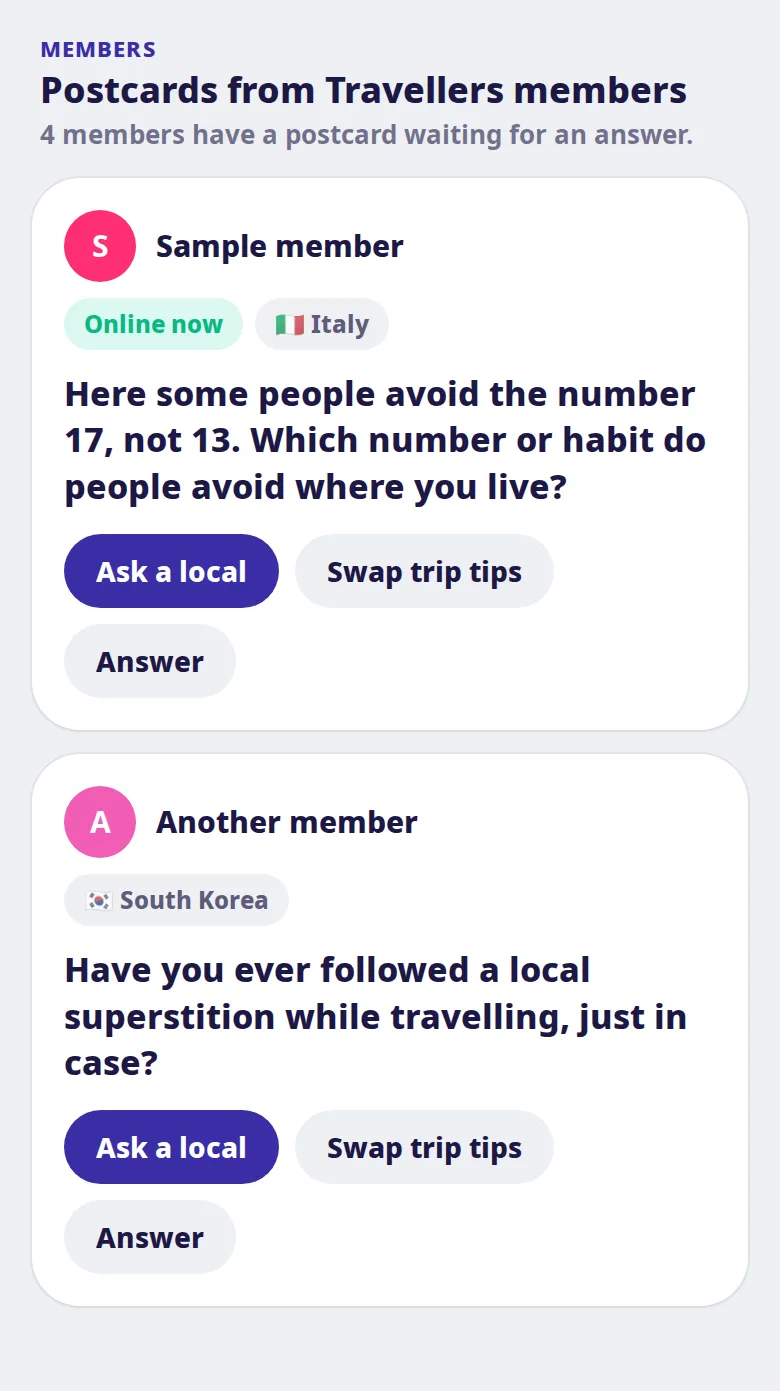 Example screen with sample members, not real people.
- Every message is translated both ways, with the original visible.
- Text only. No voice, no video, and contact details are stopped before delivery.
- Small community. Replies can take time, depending on who is online.
- Report and block in every chat. No ads, no paid plan.
Want to wish someone luck in their own language? See good luck in different languages.
Questions people ask
+What are some common superstitions around the world?
Some of the most widespread are lucky and unlucky numbers (4 in China, Japan and Korea, 13 in the US, 17 in Italy), the evil eye and the blue nazar charm from Turkey and Greece to India and Pakistan, knocking on or touching wood to avoid tempting fate, and New Year beliefs about who should be the first visitor to a home. Each is a folk belief that some people hold and many do not.
+Why is Friday the 17th unlucky in Italy?
In Italian popular culture Friday the 17th, not the 13th, is the bad luck day. One explanation is that the Roman numeral XVII can be rearranged into the Latin word vixi, 'I have lived', read as an omen of death. The number 13 is generally considered lucky in Italy.
+Which countries think Tuesday the 13th is unlucky?
Spanish-speaking countries and Greece. In Spanish the day is called martes trece. In Greece, Tuesday is linked to Ares, the god of war, and its Greek name, Triti, means the third day, which adds to the idea that bad luck comes in threes.
+Why do some buildings have no 13th or 4th floor?
Because of number superstitions. In 2002 an Otis Elevators review estimated that about 85% of buildings with 13 or more floors and Otis lifts had no floor named 13. In South Korea the 4th floor is almost always skipped in hospitals and funeral halls, and is sometimes shown as F in lifts. Vancouver has banned skipping 4s and 13s because it can confuse emergency crews.
+Do people really still believe in superstitions?
Some do, many don't, and plenty follow a custom without believing it. In a 2015 Pew survey, a median of 48% of adults in Central and Eastern Europe said they believe in the evil eye. In Brazil and Portugal, knocking on wood three times is described as a polite social habit rather than a belief, and in Japan most people ignore the lucky and unlucky calendar days in daily life.
Keep reading
Boarding pass · free
Tap, fly to a random country, and chat with someone who lives there.
Text first, translated both ways, no video, no coins to meet people. Works in your browser.
Take off on OluNew here? Read Ablo App: The Complete Story of the Chat App That Let You Fly Anywhere (2019–2022), the full history in one place.