 Olu
Dumplings Around the World: 33 Countries and Their Favourite Dumpling
Dumplings around the world in 33 countries, from jiaozi and momo to pierogi, khinkali and kenkey: what each is made of, how it is cooked, with sources.
Updated 19 November 2026 · 10 min read
On this page
Almost every kitchen in the world has a dumpling. Sometimes it is a pleated parcel of pork and cabbage, sometimes a ball of potato with bacon inside, sometimes fermented corn dough steamed in a banana leaf. Many are folded by a whole family around one table, which is part of why people love them.
This guide shows dumplings around the world in 33 countries. Each row names one well-known dumpling, says what it is and how it is cooked, and links its sources. Every country on the list has many more than one, and recipes change from region to region and family to family, so read each row as "a well-known one there", not "the only one".
The short answer: dumplings around the world fall into a few families. Thin wrappers around a filling run from China's jiaozi and Nepal's momo to Turkey's mantı, Georgia's khinkali and Poland's pierogi. Potato dumplings fill Central and Northern Europe, from Lithuania's cepelinai to Sweden's kroppkaka. Plain dough balls are dropped into stew in Britain and the United States. Rice, corn and barley make dumplings in India, Ghana and Ethiopia.
Ask a home cook abroad which dumpling their family folds
Dumplings around the world, country by country
East and Southeast Asia
| Country | A well-known dumpling | Source |
|---|---|---|
| China | Jiaozi: minced meat and chopped vegetables in a dough skin, shaped a little like an ear. In northern China families gather to make them, and they are served at midnight on Chinese New Year's Eve. Wontons and xiaolongbao are other favourites. | Wikipedia, Olive |
| Japan | Gyoza: the Japanese version of jiaozi, often filled with ground pork and cabbage and usually pan-fried until the base is crisp and brown. | Wikipedia, The Daily Meal |
| South Korea | Mandu: filled with pork, kimchi, vegetables or glass noodles, then steamed, fried or boiled. They also go into a soup called mandu-guk. | Wikipedia, The Daily Meal |
| Mongolia | Buuz: steamed dumplings of minced mutton, lamb or beef with onion or garlic. They are made at home in large numbers for Tsagaan Sar, the Lunar New Year. | Wikipedia, Wikipedia |
| Indonesia | Siomay: a fish dumpling served with peanut sauce. In Surabaya the word can mean steamed pangsit (wonton) served with meatball soup. | Wikipedia |
South Asia
| Country | A well-known dumpling | Source |
|---|---|---|
| Nepal | Momo: pleated rounds of meat, vegetables or cheese, steamed, fried or grilled, and dipped in achar, a tomato and chilli sauce. Jhol momo come in a soup. Common on menus across the Kathmandu Valley. | Wikipedia, Olive |
| India | Modak: a steamed rice-flour shell around fresh coconut and jaggery, eaten hot with ghee. It is offered to Ganesha during Ganesh Chaturthi. India has many others, from kozhukattai to samosas. | Wikipedia, Wikipedia |
Central Asia, Turkey and the Caucasus
| Country | A well-known dumpling | Source |
|---|---|---|
| Kazakhstan | Manti: ground lamb or beef with black pepper, cooked in a tall multi-level steamer and topped with butter, yogurt, sour cream or onion sauce. Popular across Central Asia. | Wikipedia, Fine Dining Lovers |
| Uzbekistan | Chuchvara: very small boiled dumplings of meat without pork, served in clear soup or topped with suzma (strained yogurt) or sour cream. | Wikipedia |
| Turkey | Mantı: parcels of minced lamb or beef, boiled and served under garlic yogurt, melted butter and chilli flakes or Aleppo pepper, with dried mint or sumac. | Olive, The Daily Meal |
| Georgia | Khinkali: from the mountain regions of Pshavi, Mtiuleti and Khevsureti. Spiced meat with onion and cumin is sealed in a twisted knot of dough. You sip the juices with the first bite so the dumpling does not burst. | Wikipedia, The Daily Meal |
| Armenia | Boraki: small open-topped cylinders of spiced meat and onion, boiled in broth and then baked or fried, served with matzoon (a yogurt) and garlic. | Wikipedia |
| Azerbaijan | Dushbara: a soup full of tiny lamb-filled dumplings. | Wikipedia |
Europe
| Country | A well-known dumpling | Source |
|---|---|---|
| Poland | Pierogi: unleavened dough around a filling, boiled, then often fried in butter. Pierogi ruskie hold potato and farmer's cheese. Sauerkraut and mushroom pierogi and tiny uszka in beet soup are part of the Christmas Eve supper. | Wikipedia, Olive |
| Ukraine | Varenyky: crescent-shaped dumplings with a savoury or sweet filling, usually boiled or steamed. | Wikipedia, Wikipedia |
| Russia | Pelmeni: small, with the thinnest dough possible and a raw filling of minced meat and onion, boiled and served with plenty of sour cream. In Siberia they were frozen outdoors over winter. | Wikipedia, Fine Dining Lovers |
| Lithuania | Cepelinai: grated potato dumplings filled with meat, curd cheese or mushrooms, named after zeppelin airships for their shape, and topped with a sour cream sauce and bacon. Called a national dish. | Wikipedia, Wikipedia |
| Czech Republic | Knedlíky: bread or potato dough boiled as a loaf, sliced, and served to soak up sauce, as in svíčková. Sweet fruit knedlíky hold plums or apricots. | Wikipedia, Fine Dining Lovers |
| Slovakia | Bryndzové halušky: small potato dumplings with no filling, under bryndza sheep's cheese and often bacon. One of the national dishes. | Wikipedia, Wikipedia |
| Slovenia | Idrijski žlikrofi: small hat-shaped dumplings with a potato filling, from the town of Idrija. The first Slovenian food registered as a Traditional Speciality Guaranteed. | Wikipedia, Fine Dining Lovers |
| Hungary | Szilvás gombóc: potato dough wrapped around a whole plum, boiled, then rolled in hot buttered breadcrumbs. | Wikipedia |
| Germany | Maultaschen: a Swabian speciality, pasta dough around sausage meat, spinach, breadcrumbs and onion, bigger than ravioli at 8 to 12 cm across. Thuringia's potato Klöße have their own museum. | Wikipedia |
| Italy | Ravioli: pockets of pasta filled with cheese, meat, spinach or mushrooms, probably first from the Genoa area. Gnocchi, "lumps" of potato, semolina or ricotta dough, are another Italian dumpling. | Wikipedia, The Daily Meal |
| United Kingdom and Ireland | Suet dumplings: self-raising flour and suet bound with cold water, dropped into a stew to half-boil, half-steam for about ten minutes. Scotland's clootie dumpling is a sweet, fruity one boiled in a cloth. | Wikipedia, Olive |
| Sweden | Kroppkaka: potato and wheat flour around smoked bacon and onion, spiced with allspice, boiled and served with melted butter and lingonberry jam. In the north the barley version is called palt. | Wikipedia, Fine Dining Lovers |
| Cyprus | Ravioli (ravioles): pasta filled with halloumi cheese. | Wikipedia |
Africa
| Country | A well-known dumpling | Source |
|---|---|---|
| Ghana | Kenkey: ground maize soaked, milled and fermented for days, then wrapped in banana leaves or corn husks and steamed. Usually eaten with pepper sauce and fried fish, or with soup. | Wikipedia, Wikipedia |
| South Africa | Dombolo (ujeqe, or steam bread): steamed dough eaten with chicken, beef, oxtail or lamb stew. Souskluitjies are a sweet version served with cinnamon syrup or custard. | Wikipedia |
| Ethiopia | Tihlo: made from roasted barley flour, from the Tigray Region and now popular in Amhara too. | Wikipedia |
The Americas
| Country | A well-known dumpling | Source |
|---|---|---|
| United States | Chicken and dumplings: flour, fat and baking powder dough dropped into chicken broth, where the starch thickens it into gravy. Baked apple dumplings are a dessert. | Wikipedia |
| Jamaica | Dumplings come fried, boiled or roasted, and are eaten with dishes like ackee and saltfish. The festival is a slightly sweet fried dumpling served with escovitch fish. | Wikipedia |
| Chile | Milcao: from the island of Chiloé, a potato dumpling, flat and round, either boiled or filled with pork greaves and fried. | Wikipedia |
| Brazil | Coxinha: thick dough around a chicken filling, one of several party dumplings along with pastéis and bolinhas de carne. | Wikipedia, The Daily Meal |
Types of dumplings: the four big families
Look across the table and four kinds of dumpling keep coming back.
A thin wrapper around a filling. Dough is rolled flat, cut, filled and sealed. Jiaozi, gyoza, mandu, momo, manti, khinkali, pierogi, varenyky, pelmeni and ravioli all work this way. The fillings change with the country: pork and cabbage in East Asia, lamb and onion in Central Asia, potato and cheese in Poland.
A plain ball of dough. No filling at all. British suet dumplings, American drop dumplings, Jamaican fried dumplings and Italian gnocchi are cooked as lumps of dough, often in or beside a stew.
Potato dumplings. Central and Northern Europe made potato the base: Lithuanian cepelinai, Slovak halušky, Swedish kroppkaka, German Klöße and Chile's milcao. Some hide bacon, meat or a plum inside.
Rice, corn and barley. Not every dumpling is wheat. India's modak use rice flour, Ghana's kenkey use fermented maize, and Ethiopia's tihlo use roasted barley. In China, sweet tangyuan are made from glutinous rice flour.
How dumplings are cooked
- Boiled: pierogi, pelmeni, varenyky, chuchvara and mantı. Boiled dumplings are done when they float.
- Steamed: momo, buuz, manti in a tall steamer, xiaolongbao in bamboo, kenkey in leaves.
- Pan-fried after steaming or boiling: gyoza with a crisp base, pierogi fried in butter, leftover kroppkaka fried in halves.
- Cooked in a soup or stew: mandu-guk, jhol momo, dushbara, British stew and dumplings, chicken and dumplings.
- Baked: American apple dumplings and Armenian boraki, which are boiled first and then baked.
If you love the soup side of this list, soups around the world has the broths many of these dumplings swim in.
Dumplings for holidays and family days
Folding dumplings is often a group job, and many belong to a special day.
- Chinese New Year: in northern China, jiaozi are served at the stroke of midnight on New Year's Eve, and extended families gather to make them together. Sweet tangyuan are eaten on the Lantern Festival, the 15th day of the new year.
- Tsagaan Sar: Mongolian families make buuz at home for the Lunar New Year.
- Dragon Boat Festival: zongzi, triangular glutinous rice parcels filled with red bean paste, dates or cured meat, are the traditional food.
- Christmas Eve in Poland: sauerkraut and mushroom pierogi, and small mushroom uszka in clear beet soup.
- Ganesh Chaturthi: modak are offered to Ganesha, often 21 or 101 of them.
Some, like cepelinai in Lithuania, are also called a national dish; see national dishes of different countries.
How to fold dumplings at home with friends
Most need no special tools. A few habits help with all of them:
- Keep the wrappers covered. Dough dries fast. Keep a damp towel over the ones you are not using.
- Do not overfill. A small spoon of filling is enough. Too much and the edges will not seal.
- Seal with water. Wet the edge with a fingertip and press out the air as you close it.
- Freeze extras flat. Freeze them on a tray so they do not stick, then bag them. Cook straight from frozen.
If you want to trade recipes with friends afterwards, hosting a recipe exchange has simple ways to do it.
Ask a home cook abroad: the Home cooks planet
Olu is a free text chat site for adults 18+ to meet people in other countries, in your browser. Its Home cooks planet is for "real home cooking from real kitchens". It has three laws: say where the dish is from, real home cooking only, and never mock a recipe from someone's home.
Its ritual is Same dish, two kitchens. Name tonight's dish, say pierogi or momo, and a cook in another country tells you how their kitchen makes it, and what they would never change. Buttons let you Ask for a dish, Swap a recipe or Answer someone else's question. A Swap a recipe request stays open for 48 hours, so cooks in other time zones can see it.
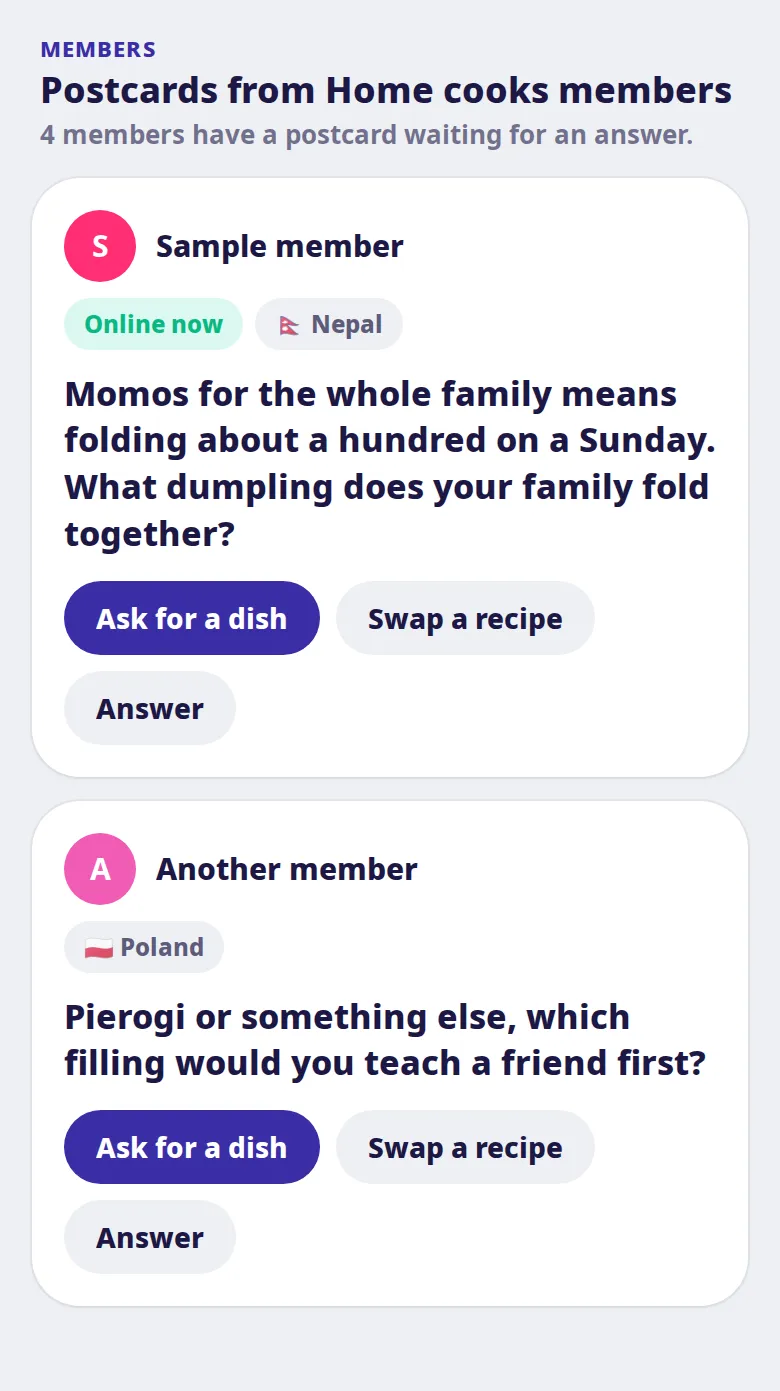 Example screen with sample members, not real people.
A few honest details:
- Every message is translated both ways, with the original visible, so each cook writes in their own language.
- It is text only. No voice and no video. Contact details are stopped before delivery, and report and block are in every chat.
- Adults 18+ only. Birth year is asked at join; there is no ID check.
- No ads and no paid plan. The community is still small, so at quiet hours an answer can take a while.
Questions to ask someone about dumplings in their country
- Which dumpling does your family make together, and for which day?
- What filling would you teach a friend first?
- Do you boil, steam or fry them, and what goes on top?
- How many do you make at once?
- Is there a sweet dumpling where you live?
- What is the one thing about your family's recipe you would never change?
Questions people ask
+What counts as a dumpling?
There is no single agreed definition. Broadly, a dumpling is a piece of cooked dough, made from wheat, rice, corn, potato or another starch, often wrapped around a filling. Most are boiled, simmered or steamed; some definitions leave out baked and fried pastries, others include them.
+Which country invented dumplings?
No one country can claim them. One of the earliest written mentions is in a Chinese poem by the scholar Shu Xi from around 300 CE, and dumplings over 1,000 years old have been found in Turfan, Xinjiang. Many other cuisines developed their own dumplings, from British suet dumplings to West African kenkey.
+What is the difference between pierogi, varenyky and pelmeni?
Pierogi (Poland) and varenyky (Ukraine) are crescent-shaped and can be savoury or sweet, usually with a cooked filling. Pelmeni (Russia) are smaller, with the thinnest possible dough, a raw minced meat filling, and are never sweet.
+Which dumplings are eaten on holidays?
Many. In northern China jiaozi are served at midnight on Chinese New Year's Eve. In Mongolia buuz are made at home for Tsagaan Sar, the Lunar New Year. In Poland pierogi and small uszka are part of the Christmas Eve supper. In India modak are offered to Ganesha during Ganesh Chaturthi.
+Which dumplings are easiest to make at home?
Dropped dumplings are the simplest: a dough of flour, fat and baking powder spooned into a simmering stew, as in British stew and dumplings or American chicken and dumplings. Of the filled kinds, potato and cheese pierogi and pan-fried gyoza need no special tools.
Keep reading
Boarding pass · free
Tap, fly to a random country, and chat with someone who lives there.
Text first, translated both ways, no video, no coins to meet people. Works in your browser.
Take off on OluNew here? Read Ablo App: The Complete Story of the Chat App That Let You Fly Anywhere (2019–2022), the full history in one place.