 Olu
Easter Traditions Around the World: How 30+ Countries Celebrate
Easter traditions around the world: how 30+ countries celebrate, from Greek midnight candles and Spanish processions to Easter witches, kites and Fasika.
Updated 19 November 2026 · 11 min read
On this page
At midnight in a Greek village, a single flame passes from candle to candle until the whole churchyard glows. In Seville, a float carried by people hidden underneath turns a corner while someone sings to it from a balcony. In Kraków, families carry small baskets of eggs and bread to church. In Oslo, people pack a crime novel for the cabin. All of it is Easter.
This guide covers Easter traditions around the world: how more than 30 countries celebrate, when, and one or two customs you will really see, checked against tourism boards and encyclopedias. Easter is a Christian feast, and how people mark it varies by church, region and family. Many people in every country do not celebrate it. Read each row as "what you will often find", not a rule.
The short answer: most countries mark Easter across Holy Week, from Palm Sunday to Easter Sunday, and many add Easter Monday as a holiday. Western churches celebrate on a Sunday between 22 March and 25 April. Orthodox churches, as in Greece, Russia, Serbia, Ukraine and Ethiopia, often celebrate later, between 4 April and 8 May. The customs differ more than the dates: processions in Spain and Guatemala, a midnight candle service in Greece, basket blessings in Poland and Ukraine, water on Easter Monday in Central Europe, Easter witches in Sweden and Finland, crime novels in Norway, kites in Bermuda and the Easter Bilby in Australia.
Ask someone who lives there how Easter looks
How 30+ countries celebrate Easter
Main days, one or two customs, and the source we checked. "Orthodox date" means the Eastern churches' Easter, often later than the Western one.
| Country | Main days | Customs | Source |
|---|---|---|---|
| Greece | Orthodox date; Holy Thursday to Easter Monday | Red eggs dyed on Holy Thursday; the Epitaphios procession on Good Friday; candles at the Saturday midnight service; lamb on the spit on Sunday | Visit Greece |
| Cyprus | Orthodox date | Large bonfires in churchyards and school grounds, where an effigy of Judas is burned | Wikipedia |
| Russia | Orthodox date | Kulich, a tall Easter bread, blessed after the service; the greeting with a triple kiss | Wikipedia, Wikipedia |
| Ukraine | Easter Sunday and Monday | Pysanky and other decorated eggs; baskets of food blessed at the Easter Vigil break the fast | Wikipedia |
| Serbia | Orthodox date | The Easter greeting with a triple kiss; in some areas, jumping over flames (krljaveštice) | Wikipedia, Wikipedia |
| Bulgaria | Orthodox date; eggs from Thursday | Egg fights, where the last unbroken egg is the "borak"; roast lamb and kozunak bread | Wikipedia |
| Ethiopia | Fasika, Orthodox date | A 55-day Lent without animal products; a night vigil; the fast broken around 3 am | Wikipedia |
| Egypt | Coptic Easter Monday | Sham Ennessim: painted eggs, eating outdoors, fesikh (salted mullet) | Wikipedia |
| Ghana | Good Friday to Easter Monday | Four days of holiday; a solemn Good Friday, some fasting until evening | Wikipedia |
| Spain | Holy Week (Semana Santa) | Brotherhood processions with pasos, carved floats; saetas sung to them; the mona pastry in Catalonia and Valencia | Wikipedia, Wikipedia |
| Italy | Easter Sunday and Pasquetta | Florence's Scoppio del carro fireworks cart; colomba bread, roast lamb; Monday picnics | Wikipedia |
| France | Maundy Thursday to Easter Sunday | Silent church bells "fly to Rome" and return with eggs and chocolate | Wikipedia |
| Netherlands | Easter Sunday and Monday | "Silent Saturday"; Easter fires in Twente and the Achterhoek | Wikipedia |
| Germany | Holy Saturday to Easter Monday | Bonfires in the north; Osterbrot; the Emmausgang walk in the south | Wikipedia, Wikipedia |
| Poland | Holy Saturday to Easter Monday | The święconka basket; Easter breakfast with white sausage and mazurek cake; śmigus-dyngus water fights | Wikipedia, Wikipedia |
| Czech Republic and Slovakia | Easter Monday | The pomlázka (Czech) or korbáč (Slovak), a willow switch used in an old Monday custom, answered with decorated eggs; water may be poured too | Wikipedia |
| Hungary | Easter Monday | Watering Monday: water or perfume, returned with eggs; ham and horseradish | Wikipedia |
| Croatia and Slovenia | Holy Saturday | Food baskets blessed at church, with potica nut cake | Wikipedia |
| Sweden | Holy Saturday | Easter witches swap handmade cards for sweets; a Holy Saturday smörgåsbord | Wikipedia |
| Finland | Easter weekend | Virvonta willow branches; mämmi or pasha | Wikipedia |
| Norway | Påske, about five days | Cabins, skiing, påskekrim crime novels, oranges and Kvikk Lunsj chocolate | Visit Norway |
| Denmark | Before Easter | Gækkebrev: an unsigned paper-cut letter; guess the sender, win a chocolate egg | Wikipedia |
| United Kingdom | Easter; Monday is a bank holiday in England, Wales and Northern Ireland | Egg rolling and pace egging in Scotland, northern England and Northern Ireland | Wikipedia |
| Ireland | Easter Sunday and Monday | A big family meal to end Lent; Easter Monday also remembers the 1916 Easter Rising | Wikipedia, Wikipedia |
| Mexico | Holy Week, often two weeks of school holiday | The Iztapalapa passion play; Judas effigies burned on Holy Saturday | Wikipedia |
| Guatemala | Holy Week | Alfombras in Antigua: sawdust and flower carpets on procession routes | Wikipedia |
| Philippines | Maundy Thursday to Easter Sunday | Pabasa chanting; Visita Iglesia; the pre-dawn Salubong; a quiet Good Friday | Wikipedia |
| Bermuda | Good Friday | Homemade kites flown on Good Friday; hot cross buns and fish cakes | Wikipedia |
| Jamaica | Easter weekend | Spiced bun eaten with cheese, often given by employers to staff | Wikipedia |
| United States | Easter Sunday (not a federal holiday on Monday) | Egg knocking in Marksville, Louisiana; Dyngus Day in Polish communities | Wikipedia, Wikipedia |
| Australia | Easter Sunday and Easter Monday (public holiday) | Hot cross buns and the Easter Bilby; the Sydney Royal Easter Show | Wikipedia, Wikipedia, Wikipedia |
When is Easter? Western and Orthodox dates
Western churches follow a lunar rule: Easter is a Sunday after the spring full moon. In the Gregorian calendar it always falls between 22 March and 25 April (Wikipedia). Orthodox churches use the same idea but count from the Julian calendar, so their Easter usually comes later, between 4 April and 8 May in our calendar. The two match in 31 years of this century, Wikipedia says. Otherwise, Orthodox Easter comes one, four or five weeks after Western Easter.
That is why a traveller can see two Easters in one spring. In countries where most people who belong to a church are Orthodox, such as Greece, Cyprus, Russia, Serbia, Bulgaria and Ukraine (Wikipedia), the big Easter is usually the Orthodox one. Ethiopia's Fasika follows the Eastern way of counting too. Egypt's Sham Ennessim falls on the Monday after Coptic Easter. On the Greek island of Syros, the two churches are among the few that share one date.
The days around Easter matter too. In the Philippines, the days from Maundy Thursday to Black Saturday are national holidays, and many businesses close. In Mexico, school students up to high school generally get two weeks off. In Norway, most shops close for five days. Easter Monday is a public holiday in more than 50 countries, Wikipedia says, but not in the United States.
Processions, candles and fire
Processions. In Spain, Catholic brotherhoods carry pasos, lifelike carved scenes of the Passion, through the streets. Wikipedia notes that Seville has some of the most elaborate processions, Málaga's are lively rather than silent, and Castile and León's are more sombre. In Antigua, Guatemala, residents lay carpets of coloured sawdust and flowers, and the procession walks over them. Each takes hours to make and is gone in minutes.
Passion plays. Mexico City's Iztapalapa play runs from Palm Sunday to Good Friday, with over 4,000 residents in the cast and over 2 million spectators. In the Philippines, many towns stage their own Senakulo, some with scripts decades or centuries old.
Midnight candles. Greece's Holy Saturday service ends in darkness. Then a flame passes from candle to candle, and at midnight bells, drums and fireworks mark the Resurrection. On Corfu, people drop clay pots from balconies on Holy Saturday. On Chios, two parishes in Vrontados hold the Rouketopolemos, a "rocket war" of homemade fireworks aimed at each other's bell towers (Wikipedia).
Bonfires. Easter fires burn on Holy Saturday in northern Germany and western Sweden, and on Easter Day in parts of the Netherlands. In Cyprus and in central and southern Mexico, effigies of Judas are burned.
Eggs, bread and the Easter table
Eggs. In Greece, eggs are dyed red on Holy Thursday and tapped together after the midnight service; the winner is the one whose egg stays whole. Bulgaria plays a similar game, and in Marksville, Louisiana, an egg-knocking contest dates back to the 1950s.
Blessed baskets. In Ukraine, baskets of eggs, paska bread, butter, cheese and sausage are blessed at the Easter Vigil, and people break their fast with them. Poland, Croatia and Slovenia have their own basket blessings. In Russia, the tall kulich bread is blessed after the service and is only eaten between Easter and Pentecost.
Breaking a long fast. Ethiopian Orthodox Christians keep a 55-day Lent without meat, milk or butter, and families break the fast around 3 am after the vigil. In Greece, the first meal after midnight is often mageiritsa soup, and Sunday brings lamb or kid on a spit or in the oven.
Breads and cakes. Italy's dove-shaped colomba, Bulgaria's kozunak, Germany's Osterbrot, Poland's mazurek, Jamaica's spiced bun with cheese and Finland's mämmi, a rye pudding.
Easter Monday and figures other than the bunny
In many countries the day after Easter has its own customs. In Poland, śmigus-dyngus has grown into an all-day water fight, and Hungary has Watering Monday. In Italy, Pasquetta means a countryside picnic, and Egyptians spend Sham Ennessim eating outdoors. In Ireland, the day also remembers those who died in the 1916 Easter Rising. For other big days on the calendar, see festivals around the world.
The Easter Bunny is not the only Easter figure either:
- Flying bells. In France and Belgium, church bells go silent and, the story goes, fly to Rome and come back with eggs and chocolate.
- The Easter Bilby. Rabbits were brought to Australia by people and damage the land, so in 1991 a conservation group promoted the bilby, a threatened native marsupial, instead.
- Crime novels. Visit Norway calls påskekrim, Easter mysteries read at the cabin, a tradition that seems unique to Norway.
- Kites. In Bermuda, homemade kites go up on Good Friday.
The Easter greeting
In Orthodox countries, Easter has its own greeting. One person says "Christ is risen!" and the other answers "Truly risen!" In Greek that is "Christos Anesti!" and "Alithos Anesti!" In Church Slavonic, used in Russia and Serbia, it is "Khristos voskrese!" and "Voistinu voskrese!" In Russia and Serbia, people often add a triple kiss on alternating cheeks (Wikipedia).
As a guest, a simple "Happy Easter" in the local language is enough. For more on how people greet each other, see greetings around the world.
Spending Easter in another country as a guest
- Check which Easter. In Greece, Serbia or Ukraine, the Orthodox date may be weeks after the Western one.
- Expect closures. Good Friday, Easter Sunday and Easter Monday are family days in many countries, and in the Philippines and Norway many shops close for several days.
- Ask your host about services. If you want to join a procession or a midnight service, ask what to wear and when to arrive.
- Ask about the fast. In Orthodox homes, the meal before Easter may have no meat or dairy. Check before you bring food.
- Plan around holidays. In Mexico, schools and many companies close for Holy Week, so travel gets busy.
For the winter holiday, see Christmas traditions around the world.
Ask a local how Easter looks where you are going
A guide can tell you that Greeks light candles at midnight. It can't tell you what time your host's family eats, or what a guest should bring. Someone who lives there can.
Olu is a free text chat site for adults 18+ to meet people in other countries, in the browser. Its Travellers planet is about where to go and what it is really like, from people who live there. The ritual is Ask a local: skip the list, name the place, and ask a person who lives there what to skip and what not to miss. You can tap Ask a local, Swap trip tips, or Answer a question about how Easter works in your own country. The laws are short: say which country, be curious and never insulting, and remember that locals know best.
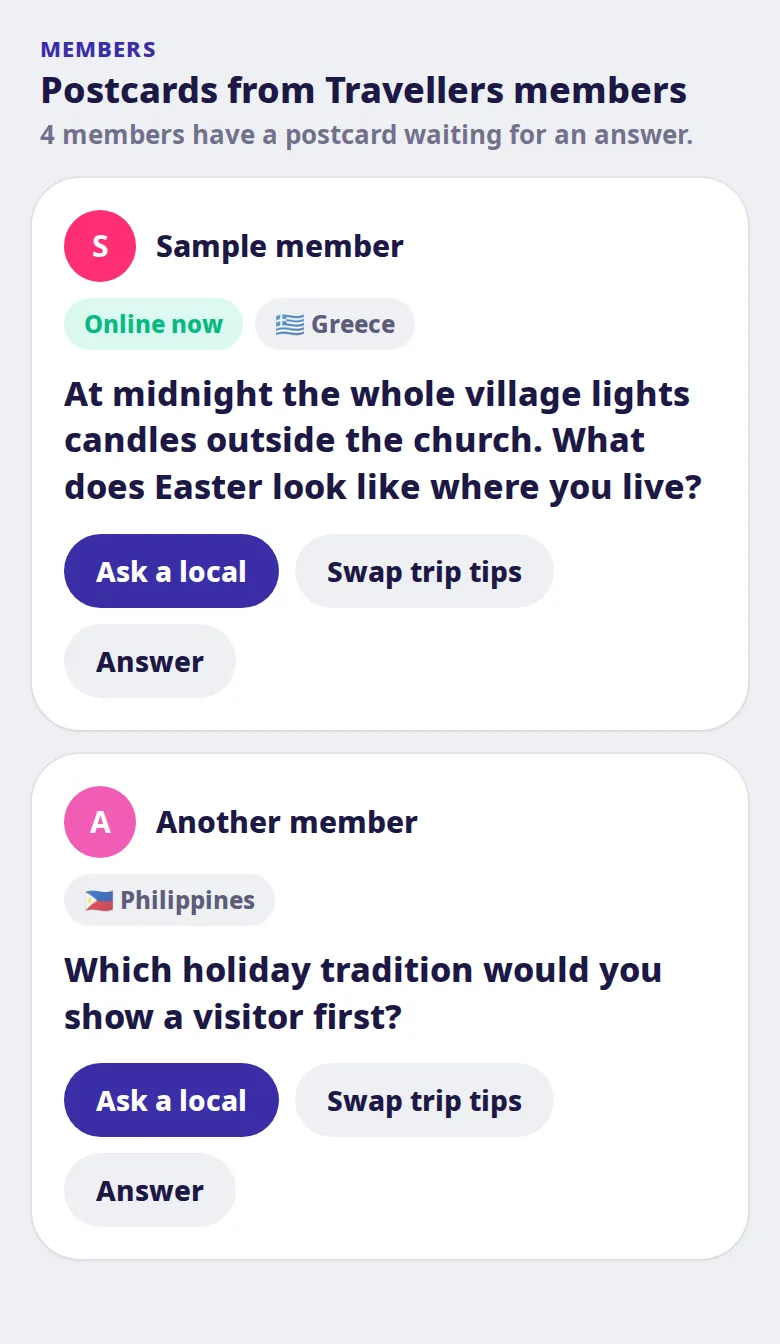 Example screen with sample members, not real people.
- Every message is translated both ways, with the original visible, so you can ask someone in Thessaloniki or Seville in your own language.
- Text only. No voice, no video, and contact details are stopped before delivery.
- Small community. Replies can take time, and fewer people may be online over the holiday itself.
- Report and block in every chat. No ads, no paid plan.
Want to get to know a place before you go? Virtual travel chat explains how.
Questions people ask
+How do different countries celebrate Easter?
In very different ways. Spain and Guatemala hold Holy Week processions, Greece lights candles at a midnight service, Poland has basket blessings and a water-splashing Monday, Sweden and Finland have Easter witches, Norway reads crime novels in mountain cabins, Bermuda flies kites, and Australia has the Easter Bilby. Customs vary within every country and by family.
+Why do Orthodox and Western Easter fall on different dates?
Both churches use the same rule, a Sunday after the spring full moon, but Orthodox churches base it on the Julian calendar. Western Easter falls between 22 March and 25 April. Orthodox Easter falls between 4 April and 8 May. The two share a date in some years and otherwise sit one, four or five weeks apart.
+What do people say to each other at Easter?
In many churches, and especially in Orthodox countries, the Easter greeting is 'Christ is risen!' and the reply is 'Truly risen!' In Greek that is 'Christos Anesti! Alithos Anesti!' In Russia and Serbia, people often add a triple kiss on alternating cheeks.
+Is Easter Monday a public holiday?
In many countries, yes. Wikipedia lists Easter Monday as a public holiday in Australia, Italy, the Netherlands, New Zealand, Greece, Ghana, Nigeria, South Africa and Ukraine, among others, and in England, Wales and Northern Ireland. It is not a federal holiday in the United States.
+What is the Easter Bilby?
An Australian alternative to the Easter Bunny. Rabbits were brought to Australia by people and damage the land, so in the 1990s a conservation group promoted the bilby, a threatened native marsupial, instead. Chocolate bilbies are sold to raise money for conservation.
Keep reading
Boarding pass · free
Tap, fly to a random country, and chat with someone who lives there.
Text first, translated both ways, no video, no coins to meet people. Works in your browser.
Take off on OluNew here? Read Ablo App: The Complete Story of the Chat App That Let You Fly Anywhere (2019–2022), the full history in one place.