 Olu
Festivals Around the World: 30 Famous Festivals by Country
Festivals around the world: 30 famous festivals in 30 countries, from Rio Carnival and Diwali to Gion Matsuri and Timkat, with dates and visitor tips.
Updated 19 November 2026 · 11 min read
On this page
On one night in Thailand, decorated baskets float on rivers. On one day in Bali, the whole island goes silent and the airport closes. In Valencia, sculptures that took a year to build go up in flames. All of these are festivals.
This guide covers festivals around the world: 30 famous festivals in 30 countries, what each one is, when it happens and what a visitor should know, with a source for every row. Many are religious occasions, so they are described, never ranked. Every country has far more festivals than one list can hold, and customs vary by region, town and family.
The short answer: famous festivals around the world include Carnival in Rio de Janeiro and Trinidad and Tobago, Diwali in India, the Day of the Dead in Mexico, Las Fallas in Spain, the Gion Matsuri in Japan, the Mid-Autumn Festival in China, Loy Krathong in Thailand, Chuseok in South Korea, Inti Raymi in Peru, Timkat in Ethiopia and Naadam in Mongolia. Many follow lunar calendars, so the dates move every year. Before you go, check the exact dates, expect crowds, and ask someone who lives there what is worth seeing.
Ask someone who lives there which festival to see
30 famous festivals in 30 countries
One festival per country, with dates as the source gives them. Dates that follow the moon or the church calendar change every year.
| Country | Festival | When | What it is | Visitor tip | Source |
|---|---|---|---|---|---|
| Brazil | Carnival in Rio de Janeiro | Every year before Lent | Parades by samba schools, groups of neighbours with floats, costumes and drummers | About two million people a day are on the streets, so plan transport and meeting points | Wikipedia |
| India | Diwali | Between about mid-October and mid-November, five or six days | The Hindu festival of lights, also marked by Jains, Sikhs and some Buddhists. Homes are lit with oil lamps and decorated with rangoli | It is a religious and family festival with fireworks; if invited to a home, follow your host's lead | Wikipedia |
| Mexico | Day of the Dead (Día de Muertos) | 1 and 2 November, with other days in some places | Families remember loved ones who have died, with home altars (ofrendas), marigolds and grave visits | It is about remembering real people; be quiet and respectful near altars and graves | Wikipedia |
| Spain | Las Fallas, Valencia | Main days 15-19 March; the Mascletà runs every day 1-19 March | Neighbourhood groups spend a year building falla sculptures, burned on the last day | The Mascletà is a firecracker show, so expect very loud noise | Wikipedia |
| Japan | Gion Matsuri, Kyoto | July, with float processions on 17 and 24 July | A Shinto festival of the Yasaka Shrine, best known for its processions of huge floats | On the evenings before each procession, central streets close to cars and food stalls open | Wikipedia |
| China | Mid-Autumn Festival | 15th day of the 8th lunar month, between 7 September and 8 October | A harvest festival under the full moon, with lanterns and mooncakes | It is an official holiday in mainland China and Taiwan, and the day after is a holiday in Hong Kong and Macau | Wikipedia |
| Thailand | Loy Krathong | Full moon of the 12th Thai lunar month, usually November | People float krathong, decorated baskets, on rivers and water | The date changes every year; in Chiang Mai the festival runs over three days | Wikipedia |
| South Korea | Chuseok | Full moon of the 8th lunar month; three days in South Korea | A harvest festival: families return to ancestral hometowns, share songpyeon and honour ancestors | It is a family time at home and at family graves, and many people are travelling | Wikipedia |
| Italy | Carnival of Venice | Ends on Shrove Tuesday, the day before Lent | Known for elaborate masks and costumes; revived in 1979 | About 3 million visitors come each year, so book rooms early | Wikipedia |
| United Kingdom | Edinburgh Festival Fringe, Scotland | Every August | The world's largest performing arts festival. Anyone may take part, and comedy is the largest section | In 2025 it had 3,893 shows, so pick a few and leave room for chance finds | Wikipedia |
| Ireland | Saint Patrick's Day | 17 March | A religious and cultural holiday for Ireland's patron saint, with parades, céilithe, green clothes and shamrocks | It is a public holiday in Ireland and Northern Ireland, and some people attend church services | Wikipedia |
| Germany | Cologne Carnival | Opens 11:11 on 11 November; street carnival from Fat Thursday to Ash Wednesday | Costumes in the streets for a week, peaking on Rose Monday, when sweets are thrown to the crowd | The greeting is "Kölle Alaaf!" | Wikipedia |
| Netherlands | King's Day (Koningsdag) | 27 April, or 26 April if the 27th is a Sunday | The king's birthday, known for a nationwide street market of used items | Wear orange: the day is known for "oranjegekte", orange craze | Wikipedia |
| France | Fête de la Musique | 21 June, every year since 1982 | People are urged to play music outside, and free concerts are held | It has spread to about 120 countries, so look for it in your own city too | Wikipedia |
| Belgium | Carnival of Binche | Sunday, Monday and Tuesday before Ash Wednesday | Performers called Gilles wear red, black and yellow costumes and throw oranges to the crowd. UNESCO-recognised since 2003 | It is one of several carnivals held at the same time in Wallonia | Wikipedia |
| Peru | Inti Raymi, Cusco | Late June, at the southern winter solstice | The Inca festival of the sun god Inti, once the most important festival of the Inca Empire, still celebrated today | It is the biggest event of the year in Cusco and draws visitors from Peru, Ecuador, Bolivia and around the world | Wikipedia |
| Bolivia | Carnival of Oruro | Carnival season | A religious and cultural festival for the Virgin of Socavón, with 48+ groups of folk dancers; the Diablada leads | The dancers' parade is a pilgrimage to a shrine, so treat it as devotion as well as a show | Wikipedia |
| Trinidad and Tobago | Carnival | Monday and Tuesday before Ash Wednesday | Costume bands ("mas"), calypso and soca, steelpan and limbo competitions | Many events lead up to the street parade, so arrive early in the season | Wikipedia |
| Canada | Quebec Winter Carnival | Before Lent, in winter | A winter festival in Quebec City held every year since 1955, with the snowman mascot Bonhomme Carnaval | It is the largest winter festival in the Western Hemisphere, so dress for deep cold | Wikipedia |
| United States | Albuquerque International Balloon Fiesta | Nine days from the first full week of October | More than 500 hot air balloons in Albuquerque, New Mexico | Hundreds of thousands of visitors come each year | Wikipedia |
| Nepal | Dashain | 15 days in September or October | The longest and most important Hindu festival in Nepal, celebrated by Nepalese of all religions | People return home from across the country and abroad to celebrate with family | Wikipedia |
| Sri Lanka | Kandy Esala Perahera | July and August | A procession honouring the Sacred Tooth Relic of the Buddha, with fire dances and whip dances | It is a religious event; it ends with a water-cutting ceremony at the Mahaweli River | Wikipedia |
| Indonesia | Nyepi, Bali | Balinese new year | The Day of Silence: silence, fasting and meditation for Balinese Hindus | Visitors must stay indoors too: no one may go onto beaches or streets, and Bali's airport is closed all day | Wikipedia |
| Ethiopia | Timkat | 19 January (20 in a leap year) | The Orthodox celebration of Epiphany, with processions carrying the Tabot and water blessed at dawn | The liturgy starts around 2 a.m. near water, and a colourful procession takes the Tabot back to its church later in the day | Wikipedia |
| Australia | Vivid Sydney | Three weeks in May and June | Light art projected on landmarks such as the Opera House and Harbour Bridge | The light art is outdoors and at night, so go after dark | Wikipedia |
| New Zealand | Matariki | Late June or early July | The rising of the Pleiades star cluster, which marks the Māori new year; traditionally a time to remember the dead of the past year | It became an official public holiday in 2022 | Wikipedia |
| Mongolia | Naadam | Midsummer | The "three games": Mongolian wrestling, horse racing and archery | UNESCO-listed since 2010 | Wikipedia |
| Sweden | Midsommar | On or near the summer solstice | A summer celebration across much of Europe, with maypole dancing and feasting | Traditionally reckoned around 23-24 June in much of Europe | Wikipedia |
| Philippines | Sinulog, Cebu | Third Sunday of January | A cultural and religious festival for the Santo Niño, with street parties the night before and the night of | The 2026 event drew over 5.2 million attendees | Wikipedia |
| Russia | Maslenitsa | The last week before Orthodox Great Lent | A religious and folk holiday with blini, sleigh rides and a straw effigy | The date changes every year with the date of Easter | Wikipedia |
Festivals around the world by season
- January and February: Timkat and Sinulog in January. China's Harbin Ice and Snow World, the largest ice and snow festival in the world, runs from late December to late February (Wikipedia). The seven carnivals in the table come before Lent, so their dates move with Easter.
- March to May: Las Fallas and Saint Patrick's Day. Holi, the Hindu festival of colours and spring, falls around mid-March (Wikipedia). In Japan, people plan hanami, cherry blossom viewing, between late March and early May around an official blossom forecast (Wikipedia). King's Day is in late April.
- June to August: Fête de la Musique, Midsommar, Inti Raymi, Matariki, Naadam, the Gion Matsuri, the Esala Perahera and the Edinburgh Fringe. London's Notting Hill Carnival draws around two million people over the August bank holiday weekend (Wikipedia).
- September to December: the Mid-Autumn Festival, Chuseok, Dashain, the Balloon Fiesta, Diwali, the Day of the Dead and Loy Krathong.
For festivals at the turn of the year, see new year traditions around the world, including Lunar New Year, Nowruz and Songkran.
Religious festivals: how to be a good guest
Many famous festivals are religious. Diwali, Timkat, Nyepi, the Esala Perahera and the Carnival of Oruro are times of prayer and devotion for the people who mark them, even when visitors watch. Each means different things to different families.
Some are mostly private. Eid al-Fitr, which marks the end of the Ramadan fast for Muslims worldwide, begins with a communal prayer, then visits to relatives, gifts and shared meals (Wikipedia). Chuseok and Dashain are about going home to family, so a visitor sees little unless invited in.
A few habits help:
- Watch first, then join. Follow what the people around you do, especially at places of worship.
- Ask before you photograph people. A procession is public, but a person praying is not part of a show.
- Dress for the place. Cover up near places of worship, and ask a local what is expected.
- Know the rules that apply to everyone. On Nyepi in Bali, tourists are not exempt: you can do as you wish inside your hotel, but not go outside.
Tips for visiting a festival abroad
- Confirm the dates for your year. Festivals tied to the moon, Easter or Lent move every year. Check an official or local source.
- Book early and plan for crowds. Venice, Rio and Sinulog each draw millions.
- Agree on a meeting point in case you lose your group.
- Learn one greeting. A local greeting like "Kölle Alaaf!" in Cologne goes a long way. For everyday greetings, see greetings around the world.
If you are meeting someone you only know online at a festival, meet in a busy public place, tell a friend where you will be, and never send money to someone you have not met.
Ask a local which festival to visit
A list can tell you that Kyoto has the Gion Matsuri in July. It cannot tell you which evening is calmer. Someone who lives there can.
Olu is a free text chat site for adults 18+ to meet people in other countries, in the browser. Its Travellers planet is about where to go and what it is really like, from people who live there. The ritual is Ask a local: skip the list, name the place, and ask a person who lives there what to skip and what not to miss. You can tap Ask a local, Swap trip tips, or Answer a question about the festivals in your own country. The laws are short: say which country, be curious and never insulting, and remember that locals know best.
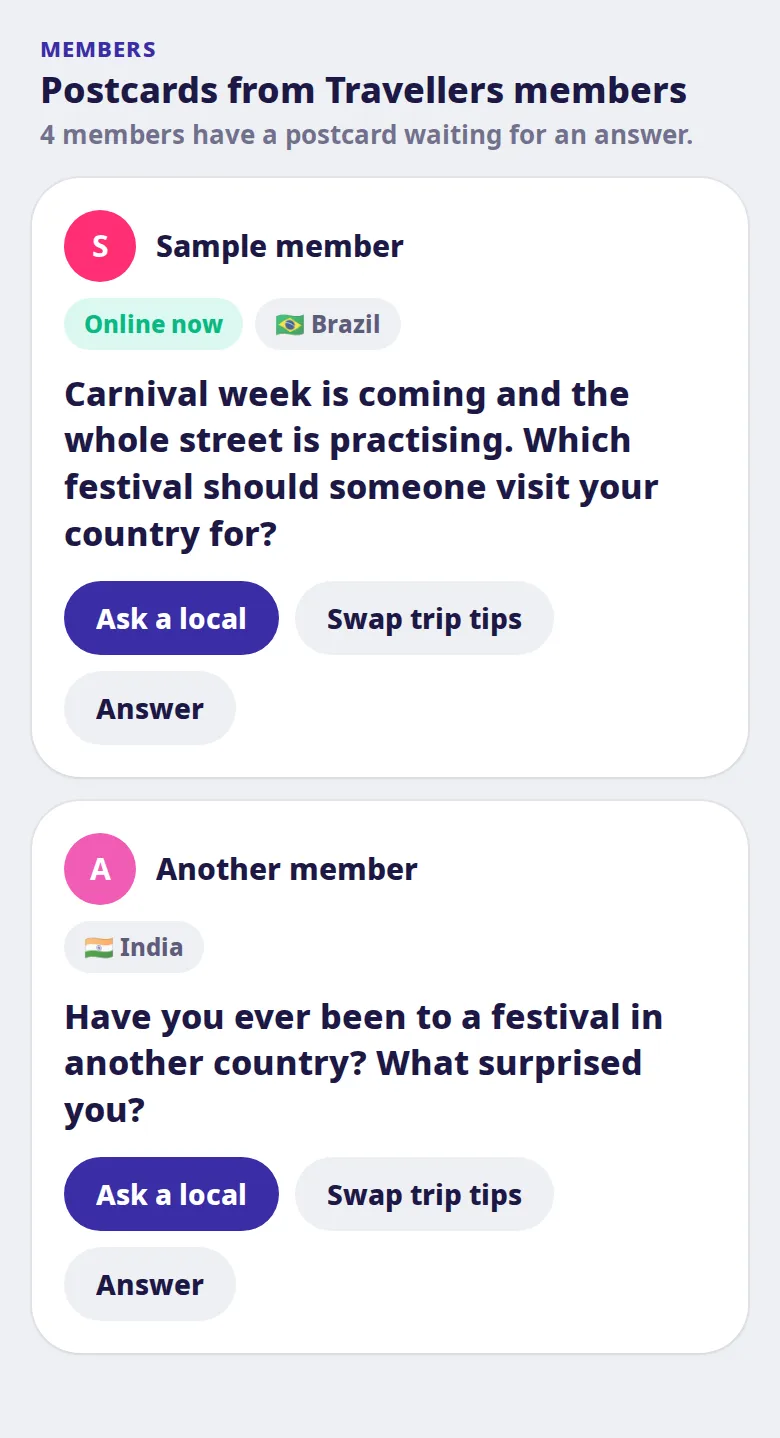 Example screen with sample members, not real people.
- Every message is translated both ways, with the original visible, so you can ask someone in Cusco or Kandy in your own language.
- Text only. No voice, no video, and contact details are stopped before delivery.
- Small community. Replies can take time.
- Report and block in every chat. No ads, no paid plan.
Want to get to know a place before you travel? Virtual travel chat explains how.
Questions people ask
+What are the most famous festivals around the world?
Well-known examples include Carnival in Rio de Janeiro, Diwali in India, the Day of the Dead in Mexico, Las Fallas in Valencia, the Gion Matsuri in Kyoto, the Mid-Autumn Festival in China, Loy Krathong in Thailand, the Edinburgh Festival Fringe in Scotland and Inti Raymi in Cusco. Every country has many more, including small local ones that rarely make lists.
+Which festival has the most people?
Numbers are counted in different ways, so comparisons are rough. Wikipedia describes Rio's Carnival as the biggest Carnival in the world, with two million people a day on the streets, and reports over 5.2 million attendees at Sinulog in Cebu in 2026. The Edinburgh Fringe sold more than 2.6 million tickets in 2025.
+When do festivals like Diwali, Chuseok and Loy Krathong happen?
They follow lunar or lunisolar calendars, so the Western date changes every year. Diwali falls between about mid-October and mid-November, Chuseok on the full moon of the 8th lunar month, and Loy Krathong on the full moon of the 12th Thai lunar month, usually in November. Check the exact dates for the year you travel.
+Can tourists join religious festivals?
Many religious festivals have public processions that visitors watch, such as Timkat in Ethiopia or the Esala Perahera in Kandy. Others are mostly at home with family, like Eid al-Fitr or Chuseok. Dress modestly near places of worship, ask before you take photos of people, and follow the lead of the people around you. In Bali, visitors must stay indoors on Nyepi like everyone else.
+How do I choose a festival to visit?
Start with the season you can travel, then check the exact dates, how crowded it gets and whether rooms book out early. The best advice usually comes from someone who lives there and can tell you which day to go and what to skip.
Keep reading
Boarding pass · free
Tap, fly to a random country, and chat with someone who lives there.
Text first, translated both ways, no video, no coins to meet people. Works in your browser.
Take off on OluNew here? Read Ablo App: The Complete Story of the Chat App That Let You Fly Anywhere (2019–2022), the full history in one place.