 Olu
Lunch Around the World: What People Eat in 30 Countries
Lunch around the world in 30 countries: what people eat at home or work, what time, and whether it is the main meal, from Spain's 2pm table to a Korean dosirak.
Updated 19 November 2026 · 11 min read
On this page
Around noon in Oslo, someone opens a box of open sandwiches at their desk. At 2 pm in Madrid, a table is just sitting down to soup, a main course and dessert. In Nairobi, a group of coworkers walks to a restaurant for a full hour. All three are lunch, and all three are normal where they happen.
This guide shows lunch around the world in 30 countries: what adults commonly eat at home or at work, roughly when, and whether lunch is the main meal of the day. Each row links its sources. Lunch changes with the city, the job, the family and the day, so read each row as "a common lunch there", not "what everyone eats".
The short answer: lunch around the world splits into two big patterns. In much of southern and eastern Europe, Latin America, Morocco and the Arab world, lunch is the main meal: hot, often two or three courses, and usually eaten between noon and 3 pm, sometimes later. In northern Europe, North America, Australia and many Asian offices, lunch is lighter and quicker: open sandwiches, a packed box or a bowl of noodles, with dinner as the bigger meal.
Ask a home cook abroad what is on their lunch plate today
Lunch around the world, country by country
Europe
| Country | A typical home or work lunch | When | Main meal? | Source |
|---|---|---|---|---|
| Spain | Traditionally three courses: a starter such as soup or salad, a meat or fish main (paella, cod or a meat stew), then dessert. In big cities a sandwich or salad is more common on workdays. | 1 pm to 3 pm; restaurant crowds often arrive 2 to 3 pm | Yes, effectively the main meal | Wikipedia, Lovefood, Spoon University |
| Portugal | Usually soup, a meat or fish course, and dessert. Many restaurants close after lunch until about 7:30 pm. | Noon to 2 pm, sometimes up to 3 pm | Yes, throughout the country | Wikipedia, Spoon University |
| Italy | A primo of pasta or risotto, then a secondo of fish or meat with vegetables or salad. Office workers may pick a tavola calda (hot table), pizza al taglio, or a boxed schiscetta at the desk. | About 12:30 in the north, 2 pm in the centre and south; the pausa pranzo often falls between 1:30 and 3 pm | A full meal, but lighter than supper | Wikipedia, Lovefood, The Daily Meal |
| France | Eating out, a fixed-price menu du jour: starter, meat or fish main, dessert. Lighter choices are a ham or cheese baguette or an omelette. | Noon to 2 pm | Not stated in the sources | Wikipedia, Lovefood |
| Germany | Traditionally meat, potatoes and a vegetable or salad, or a casserole or stew. Lighter lunches are now common: soup, pasta, Leberkäse, or sausage with bread. | Not stated | Traditionally yes; modern working hours changed this | Wikipedia, Lovefood |
| United Kingdom | Often a hot meal: a pub lunch such as fish and chips or a ploughman's lunch. On Sundays, a roast. | Early afternoon, often 12 to 1:30 pm in England | On Sundays, usually | Wikipedia, Spoon University |
| Norway | Office workers rarely go out. They bring smørbrød from home: open sandwiches topped with fish, meat, egg or vegetables, often with a glass of milk. | Around noon | Not stated | The Daily Meal, Wikipedia |
| Finland and Sweden | A full hot meal: meat, fish or soup, usually with a small salad first. In Sweden fish such as herring and salmon with bread or potatoes is common. | Not stated | A full hot meal | Wikipedia, Lovefood |
| Poland | A soup and a main dish. | Traditionally between 1 pm and 5 pm | The second of three main meals | Wikipedia |
| Hungary | Soup (leves) is served first. | Not stated | Traditionally yes | Wikipedia |
| Russia | A first course, usually soup (hot in winter, cold in summer), and a second course of meat with a side such as potatoes or pasta. Kompot is a common drink after it. A light lunch is usual at work. | In the afternoon | Typically the biggest meal | Wikipedia, Lovefood |
Middle East and Africa
| Country | A typical home or work lunch | When | Main meal? | Source |
|---|---|---|---|---|
| Saudi Arabia | Meat, rice, vegetables and sauces; lamb or chicken with bread, tabbouleh, mezze and hummus. | Usually 1 pm to 4 pm across most Arab countries | Yes, the main meal | Wikipedia, Lovefood |
| United Arab Emirates | Chicken, beef, lamb or camel. Many workers in Dubai buy cheaper street food such as falafel, musakhan or shawarma, and some eat at their desks. | Usually 1 pm to 4 pm across most Arab countries | The main meal across most Arab countries | The Daily Meal, Wikipedia |
| Morocco | Salads and olives, then a tagine and couscous, followed by mint tea. It can be a long meal. | Not stated | Yes, considered the main meal | Lovefood |
| Kenya | Stews of meat, potatoes and vegetables with ugali, chapati or rice; fish and fish stews at restaurants. Coworkers often go out in groups of three to eight. | A full hour's break | A large lunch after a small breakfast | The Daily Meal, Lovefood |
| Nigeria | Jollof rice with suya (spiced grilled meat), or a regional soup with yam, cassava or plantain. | Not stated | Not stated | Lovefood |
Asia
| Country | A typical home or work lunch | When | Main meal? | Source |
|---|---|---|---|---|
| Japan | A bento: rice, fish or meat, and pickled or cooked vegetables in a partitioned box, taken to work or bought at a store or on a train. Ramen, soba and udon bowls are common too. | 11 am to 2 pm | Usually a light, quick meal | Wikipedia, The Daily Meal, Spoon University |
| South Korea | A dosirak, rice with side dishes such as seaweed, lotus root, egg and kimchi, often with gochujang. Out, a soup or stew with rice and banchan. | Not stated | Not stated | The Daily Meal, Lovefood |
| China | Rice or noodles with vegetables or meat, at a restaurant or from a container. Many workers in China and Taiwan buy a biandang, a boxed lunch with rice, meat or egg and small sides. | Noon to 2 pm | Often a quick meal | Wikipedia, The Daily Meal, Spoon University |
| India | A home-cooked tiffin in a steel box: rice, roti or chapati, dal, a vegetable curry, pickles. In Mumbai, dabbawalas carry tiffins from homes to offices. | Varies by region; often about four hours after breakfast | Not stated | The Daily Meal, Wikipedia, Spoon University |
| Philippines | Rice is nearly always on the plate, with a dish such as adobo or sinigang. | Not stated | Not stated | Lovefood |
The Americas and Oceania
| Country | A typical home or work lunch | When | Main meal? | Source |
|---|---|---|---|---|
| Mexico | Rice, noodles or pasta, a guisado (stew) with sides, tortillas or bolillo bread, and dessert. Tacos for people on the go. | Usually 2 pm to 4 pm | Usually the main meal | Wikipedia, Lovefood |
| Colombia | Often three courses: soup or salad, a hot main, dessert. Ajiaco and sancocho are well-known lunch soups. | Not stated | Described as the most cherished meal of the day | Lovefood |
| Costa Rica | A casado: one plate of rice and beans with plantain, meat and vegetables. | Not stated | Not stated | Lovefood |
| Brazil | Rice and beans with meat or eggs, salad, and sometimes farofa or fries. Many workers go out, often to a pay-by-weight (por quilo) restaurant; on busy weekdays a sandwich is common. | 11:30 am to 2 pm | Yes, the main meal | Wikipedia, The Daily Meal, Lovefood |
| Argentina | Chicken, beef, pasta or salads. At work, often a sandwich from home or fast food, sandwiches de miga or empanadas. | Noon to 2 pm | Usually the main meal | Wikipedia, Lovefood |
| United States and Canada | A sandwich, soup, salad or leftovers. Most adults do not go home; many bring food or go out for a quick bite. | 11 am to 1 pm | Usually moderate in size | Wikipedia, The Daily Meal |
| Australia | Sandwiches, wraps or leftovers, or a food court plate. Many eat at the office in a break of 30 minutes or less. | Noon to 2 pm | Lighter fare | Wikipedia, The Daily Meal, Lovefood |
Is lunch the main meal? Two patterns
Lunch as the main meal. Sources call lunch the main meal in Spain, Portugal, Hungary, Mexico, Brazil, Argentina, Morocco and most Arab countries, and the biggest meal in Russia. These lunches tend to have courses: soup first in Poland, Hungary and Russia, a starter and a dessert in Spain, Portugal and Colombia.
Lunch as a lighter meal. In Denmark, Wikipedia calls lunch a light meal of rye bread with toppings. In Japan it is usually light and quick. In the United States and Canada it is moderate in size, and in Italy it is a full meal but still lighter than supper.
The line moves over time. In Germany lunch was traditionally the main meal, but modern working hours changed that, and in big Spanish cities a workday sandwich or salad is now common.
What time is lunch in different countries?
Lunch hours from the sources, earliest to latest:
- 11 am to 1 pm: United States and Canada.
- 11 am to 2 pm: Japan.
- 11:30 am to 2 pm: Brazil.
- Noon to 2 pm: France, Portugal (sometimes to 3 pm), Argentina, China, Australia.
- About 12:30 pm in the north, 2 pm in the centre and south: Italy.
- 1 pm to 3 pm: Spain, with restaurants busiest from 2 pm.
- 1 pm to 4 pm: the Middle East and most Arab countries.
- 2 pm to 4 pm: Mexico.
- 1 pm to 5 pm, traditionally: Poland.
In India, times vary by region; lunch usually comes about four hours after breakfast. If you are travelling, these hours matter: in Portugal many restaurants close after lunch until about 7:30 pm, so a late-afternoon meal can be hard to find.
Home lunch, packed lunch or lunch out
At home. A study cited by The Daily Meal found 74.3% of people in Italy eat lunch at home.
Packed from home. Japan's bento and Korea's dosirak are boxed meals of rice and sides. In Mumbai, dabbawalas collect home-cooked tiffins in the late morning, deliver them to workplaces by bicycle and train, and bring the empty boxes back; Wikipedia gives a figure of about 175,000 to 200,000 lunchboxes a day, from around 2002. In Norway, it is bread from home; in the United States, a sandwich and fruit in a paper bag is the classic picture.
Lunch out. In Brazil many workers leave the office to eat, often at pay-by-weight restaurants. In Kenya, coworkers often walk to a restaurant together for a full hour. In China and Taiwan, a boxed biandang from a kiosk is a cheap choice, and in Dubai, street food is part of a normal workday lunch.
To see what people eat a few hours earlier, read breakfast around the world. For one dish per country, see national dishes of different countries, and to trade recipes with friends, try hosting a recipe exchange.
Ask a home cook abroad: the Home cooks planet
Olu is a free text chat site for adults 18+ to meet people in other countries, in your browser. Its Home cooks planet is for "real home cooking from real kitchens". It has three laws: say where the dish is from, real home cooking only, and never mock a recipe from someone's home.
Its ritual is Same dish, two kitchens. Name what you are making today and a cook in another country tells you how their kitchen does it, and what they would never change. Buttons let you Ask for a dish, Swap a recipe or Answer someone else's question. A Swap a recipe request stays open for 48 hours, so cooks in other time zones can see it.
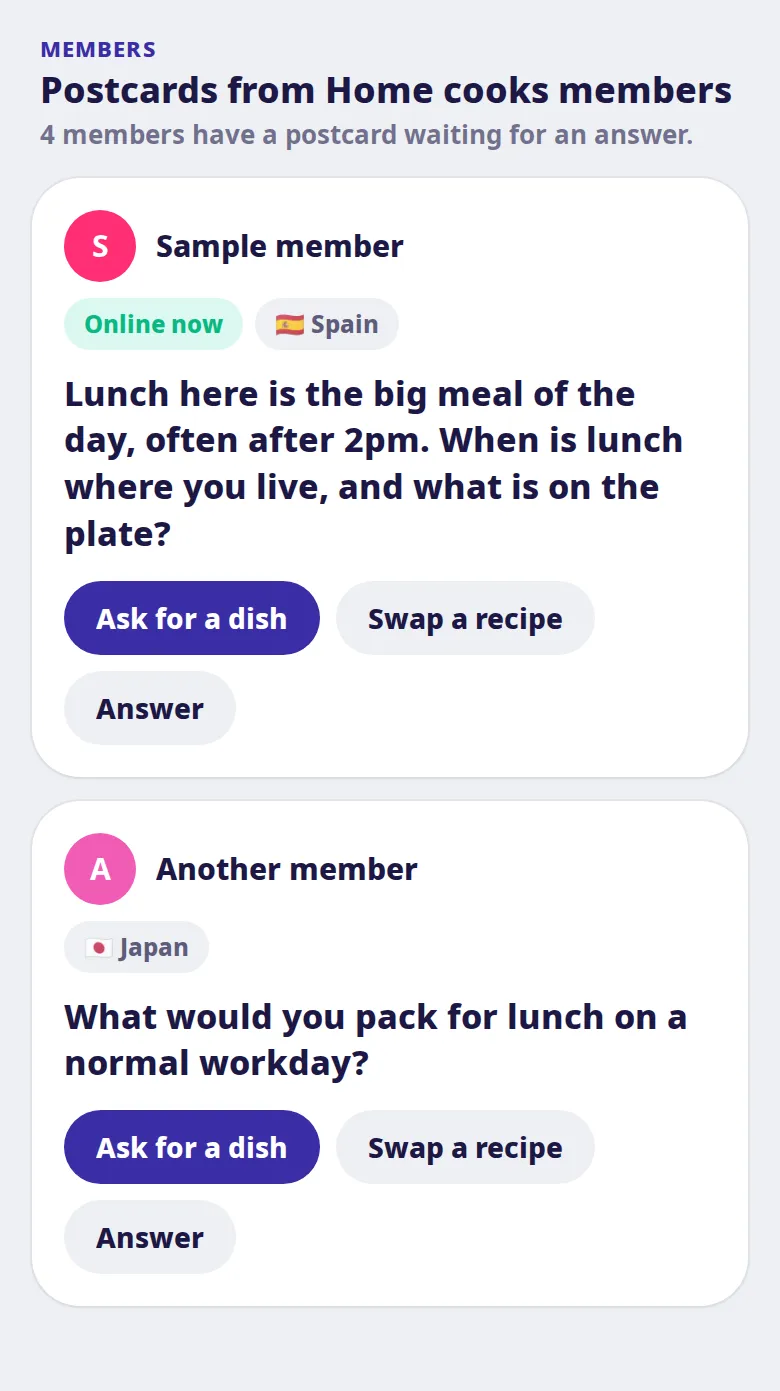 Example screen with sample members, not real people.
A few honest details:
- Every message is translated both ways, with the original visible, so each cook writes in their own language.
- It is text only. No voice and no video. Contact details are stopped before delivery, and report and block are in every chat.
- Adults 18+ only. Birth year is asked at join; there is no ID check.
- No ads and no paid plan. The community is still small, so at quiet hours an answer can take a while.
Questions to ask someone about lunch in their country
- What did you eat for lunch today, and where did you eat it?
- Is lunch the big meal where you live, or is dinner?
- What would you pack for a normal workday?
- Which lunch from your country should a visitor try first?
Questions people ask
+In which countries is lunch the main meal of the day?
Sources describe lunch as the main meal in Spain, Portugal, Hungary, Mexico, Brazil, Argentina, Morocco, and the Middle East and most Arab countries. In Russia it is typically the biggest meal, and in Germany it was traditionally the main meal, though modern working hours have changed that for many people.
+What time do people eat lunch in Spain?
Lunch in Spain is usually eaten between 1 pm and 3 pm, and restaurant lunch crowds often arrive between 2 pm and 3 pm. It is traditionally three courses and works as the main meal of the day, although sandwiches and salads are more common in big cities on workdays.
+What do office workers in Asia take for lunch?
In Japan many people eat a bento, a boxed meal of rice with fish or meat and vegetables. In South Korea it is a dosirak, rice with side dishes such as kimchi and egg. Workers in China and Taiwan often buy a biandang box, and in India a home-cooked tiffin, which dabbawalas deliver to offices in Mumbai.
+Which countries eat a light lunch?
Lunch is described as light or moderate in Denmark (rye bread with toppings), Japan (a quick meal), and the United States and Canada (a sandwich, soup or leftovers). In Italy it is a full meal but lighter than supper. In Russia a light lunch is usually taken at work.
+Do people go home for lunch?
It depends on the country and the job. One study cited by The Daily Meal found 74.3% of people in Italy eat lunch at home. In the United States and Canada most adults do not go home for lunch, and in Norway office workers usually bring bread from home rather than go out.
Keep reading
Boarding pass · free
Tap, fly to a random country, and chat with someone who lives there.
Text first, translated both ways, no video, no coins to meet people. Works in your browser.
Take off on OluNew here? Read Ablo App: The Complete Story of the Chat App That Let You Fly Anywhere (2019–2022), the full history in one place.