 Olu
Tea Around the World: How People Drink It in 29 Countries
Tea around the world in 29 countries: how people make and serve it at home, from Indian masala chai and Turkish çay to Tibetan butter tea, each sourced.
Updated 19 November 2026 · 11 min read
On this page
Tea comes from one plant, but the cup changes a lot from one kitchen to the next. In one home the leaves are boiled with milk, ginger and cardamom. In another, strong tea is churned with butter and salt, or poured from a height until it foams, or brewed in a stacked pot and diluted glass by glass. For many families it is the first thing a guest is offered.
This guide shows tea around the world in 29 countries, grouped by region. Each row says how people commonly make and serve tea there and links its sources: UNESCO, encyclopedias and food and travel publications. Every country has many habits, and they change by region, family and generation. Read each row as "a common way there", not "how everyone does it".
The short answer: tea around the world falls into a few families. China and Japan brew green and oolong teas carefully in small pots or whisk matcha in a bowl. South Asia boils black tea with milk, sugar and often spices. Turkey, Iran and Russia brew a strong concentrate and dilute it to taste. North and West Africa pour sweet green tea with mint in three rounds. The Himalayas and Mongolia add milk, butter or salt. The UK and Ireland drink black tea with milk, and the US South drinks it sweet and iced.
Ask a home cook abroad how they make their tea
Tea around the world, country by country
East Asia
| Country | How tea is made and served | Source |
|---|---|---|
| China | Tea is part of daily life at home, at work, in teahouses and restaurants. Gongfu tea ("making tea with skill") brews loose leaves in a small clay pot and pours them into tiny cups. Greeting guests with tea is shared by many ethnic groups. | UNESCO, Euronews |
| Japan | Everyday green tea is often served free in restaurants, and cold barley tea (mugi-cha) is a summer drink. In the tea ceremony (chanoyu), matcha is whisked with a bamboo chasen and served with wagashi sweets. | Wikipedia, Wikipedia |
| South Korea | Darye, "etiquette for tea", is the Korean tea rite. It has fewer fixed rules than other East Asian tea ceremonies. | Wikipedia |
| Taiwan | Pearl milk tea (boba), invented in the 1980s: sweet tea, often with milk, and tapioca balls at the bottom of the cup. Gongfu tea is also common. | Euronews, The Daily Meal |
| Hong Kong | Milk tea at the cha chaan teng (tea restaurant): a blend of black teas brewed through a cotton "silk stocking" filter, with evaporated milk. Its making technique was listed as local intangible heritage in 2017. Lemon tea and dim sum teas are common too. | Wikipedia, Wikipedia |
| Mongolia | Suutei tsai: brick tea boiled with milk, water and salt, sometimes with fried millet or butter. It is served to guests as soon as they arrive in a home or ger, often with boortsog or buuz. | Wikipedia, Wikipedia |
South and Central Asia
| Country | How tea is made and served | Source |
|---|---|---|
| India | Chai: black tea boiled with milk, sugar and spices such as ginger, cardamom and cinnamon. Recipes change by region and kitchen. Chai wallahs sell it at the roadside, sometimes in clay kulhad cups, and visitors are almost always offered tea. | Wikipedia, The Daily Meal |
| Pakistan | Milk chai at breakfast, work breaks and in the evening, often with biscuits. Green kahwah is popular, and pink Kashmiri chai is made with green tea, baking soda, milk and salt, often served with sugar and nuts. | Wikipedia, Wikipedia |
| Bangladesh | Tea stalls are social centres in villages. Milk tea, black tea, malai chai and lemon tea are common, and guests are served tea, often at breakfast. | Wikipedia |
| Sri Lanka | Black tea with warmed milk and sugar; some rural homes use jaggery. A cup is offered to guests. | Wikipedia |
| Afghanistan | Usually green tea, flavoured with cardamom, saffron or blocks of sugar, normally without milk. Teahouses are called chai-khana. | Wikipedia |
| Bhutan and Tibet | Butter tea (po cha): strong tea churned with butter and salt. Hosts refill the bowl after each sip so it is never empty. In Bhutan it is served at weddings and Losar. | Wikipedia, Wikipedia |
| Kazakhstan | Syi-ayak, a welcome for guests that starts with washing hands. Black tea is served in a piyala bowl, the head of the family first, and everyone stays seated until the last person finishes. | Wikipedia |
Southeast Asia
| Country | How tea is made and served | Source |
|---|---|---|
| Malaysia | Teh tarik, "pulled tea": strong black tea with condensed and evaporated milk, poured back and forth from a height until it foams. Common at mamak stalls, often with roti canai at breakfast. | Wikipedia, Wikipedia |
| Thailand | Cha yen, Thai iced tea: strong black tea with spices such as star anise, sweetened with sugar and condensed milk and poured over ice. | The Daily Meal, Wikipedia |
| Vietnam | Trà đá, iced green tea, comes free with many meals. The north tends to prefer strong green tea, the south a lighter brew. | Wikipedia |
| Myanmar | Tea is also eaten: lahpet, pickled tea leaves, is served in a lacquer dish or as a salad. Sweet milk tea is the cafe drink, and green tea is often poured free when you sit down. | Wikipedia |
| Indonesia | Teh poci is brewed in a clay pot and sweetened with rock sugar. In West Sumatra, teh talua mixes tea with egg, sugar and citrus. | Wikipedia |
Middle East and Europe
| Country | How tea is made and served | Source |
|---|---|---|
| Turkey | Çay brews in a two-tier çaydanlık: strong tea on top, hot water below, so each glass is diluted to taste, from koyu (dark) to açık (light). Served in small tulip-shaped glasses with sugar cubes, almost never with milk. Offering it to guests is part of hospitality. | Wikipedia, Euronews |
| Iran | Black tea, often sipped with a lump of rock sugar (nabāt) held in the mouth. Teahouses (chāykhāne) are still places to meet. | Wikipedia |
| Russia | A small pot of strong concentrate (zavarka) is diluted with hot water in each cup. Sugar, lemon, honey or jam go in to taste. The samovar was the family water heater until kettles took over in the 20th century. | Wikipedia, Wikipedia |
| United Kingdom | Mostly black tea, loose or in tea bags, with milk and sometimes sugar, often in a mug. Afternoon tea with sandwiches, scones and cakes is for special occasions. Milk first or tea first is a long-running family debate. | Wikipedia, Euronews |
| Ireland | Strong black tea with milk, from local blends such as Barry's and Bewley's. About 2.19 kg per person per year. | Wikipedia |
| Germany (East Frisia) | Strong tea poured over kluntje (rock sugar), topped with a spoon of cream that forms a "cloud", and drunk unstirred. Guests are expected to have at least three cups. | Wikipedia |
Africa and the Americas
| Country | How tea is made and served | Source |
|---|---|---|
| Morocco | Gunpowder green tea with fresh mint and sugar, poured from a height into small glasses to make foam. Served at almost every meal and offered to visitors; the leaves stay in the pot, so each glass tastes different. | Wikipedia, Wikipedia, Euronews |
| Libya | Tea in small glasses with foam, in three rounds, with mint or basil. Peanuts or almonds come with the last round. | Wikipedia, Wikipedia |
| Egypt | Shai. Light koshary tea comes with mint and cane sugar; Saiidi tea from the south is boiled strong and very sweet. Karkade, a hibiscus drink, is popular too. | Wikipedia |
| Senegal | Attaya: green tea boiled with mint and plenty of sugar over a charcoal stove, poured between pot and glass until it foams, and served in three rounds, often after meals with friends. Similar customs exist in Mali, Guinea, Gambia and Mauritania. | Wikipedia |
| United States | About 85% of tea is drunk cold or iced. In the South, sweet tea is black tea with sugar stirred in while hot, served over ice. | Wikipedia, Wikipedia |
What about mate? In Argentina, Paraguay and Uruguay the everyday hot drink is yerba mate, made from a different plant, not the tea bush. Dried leaves are steeped in a gourd and sipped through a metal straw (bombilla). One person refills the gourd and passes it around the circle, and a "gracias" means you have had enough (Wikipedia, Euronews).
What changes from one country to the next
Four choices explain most of these cups.
Steeped or boiled. China, Japan and the UK steep leaves in hot water and stop. South Asia boils the leaves with milk in one pan. Mongolia, Tibet and Kashmir boil tea for a long time before anything else goes in.
One pot or a concentrate. Turkey and Russia brew a strong concentrate and each person dilutes it with hot water, so one pot suits both dark and light drinkers.
What goes in. Milk in South Asia, the UK, Ireland, Sri Lanka and Hong Kong. Condensed milk in Malaysia and Thailand. Mint in North and West Africa. Salt and butter in Mongolia and the Himalayas. Lemon or jam in Russia. Rock sugar in Iran, Indonesia and East Frisia. Nothing at all in much of China and Japan.
Hot or iced. Thailand, Vietnam and the US South drink much of their tea cold. Japan switches to cold barley tea in summer.
Tea for guests: what a visitor is offered
In many of these countries, tea is the first thing a guest is offered. UNESCO describes greeting guests with tea as a practice shared across China's ethnic groups. In Mongolia, suutei tsai is poured as soon as visitors step into the home. In Morocco and across the Maghreb, mint tea is traditionally made in front of guests and at least three glasses are served. In Tibet, the host keeps topping up the butter tea after every sip. A guest who has had enough can leave the bowl full and finish it on the way out, according to the Wikipedia article on butter tea.
There are small manners too. In Kazakhstan, everyone stays seated until the last person finishes. In East Frisia, three cups is the polite minimum. As a guest somewhere new, ask "how do you make it here?" and let your host show you.
Tea at home vs tea out
Lists often show the teahouse or the ceremony, but much of this tea is made at home: chai on the family stove, çay in the stacked pot, attaya over a small charcoal stove, a mug of black tea in a UK kitchen. Other cups belong outside: a roadside chai wallah in India, teh tarik at a mamak stall in Malaysia, milk tea at a Hong Kong cha chaan teng, free trà đá with a meal in Vietnam. For the other big hot drink, read coffee around the world, and for what goes on the plate next to the cup, breakfast around the world.
How to make a tea from another country at home
Most of these need only a pan and a few things from the shop:
- Chai (India). Heat equal parts water and milk with grated ginger, a crushed cardamom pod and sugar to taste. When it boils, add a spoon of loose black tea, simmer for a minute or two, then strain into cups.
- Mint tea (Morocco). Put gunpowder green tea, fresh mint and sugar in a pot, add boiling water, let it steep, then pour from as high as you safely can into small glasses.
- Teh tarik (Malaysia). Brew strong black tea, stir in condensed milk (and evaporated milk if you have it), then pour it carefully between two jugs a few times until a layer of foam forms.
- Sweet tea (US South). Brew black tea strong, stir in sugar while it is still hot, cool it, and serve over plenty of ice.
If you like collecting recipes, hosting a recipe exchange has easy ways to swap them with friends.
Ask a home cook abroad: the Home cooks planet
Olu is a free text chat site for adults 18+ to meet people in other countries, in your browser. Its Home cooks planet is for "real home cooking from real kitchens". The planet has three laws: say where the dish is from, real home cooking only, and never mock a recipe from someone's home.
Its ritual is Same dish, two kitchens. Name what you are making, even this afternoon's pot of tea, and a cook in another country tells you how their kitchen does it, and what they would never change. Buttons let you Ask for a dish, Swap a recipe or Answer someone else's question. A Swap a recipe request stays open for 48 hours, so cooks in other time zones have time to see it.
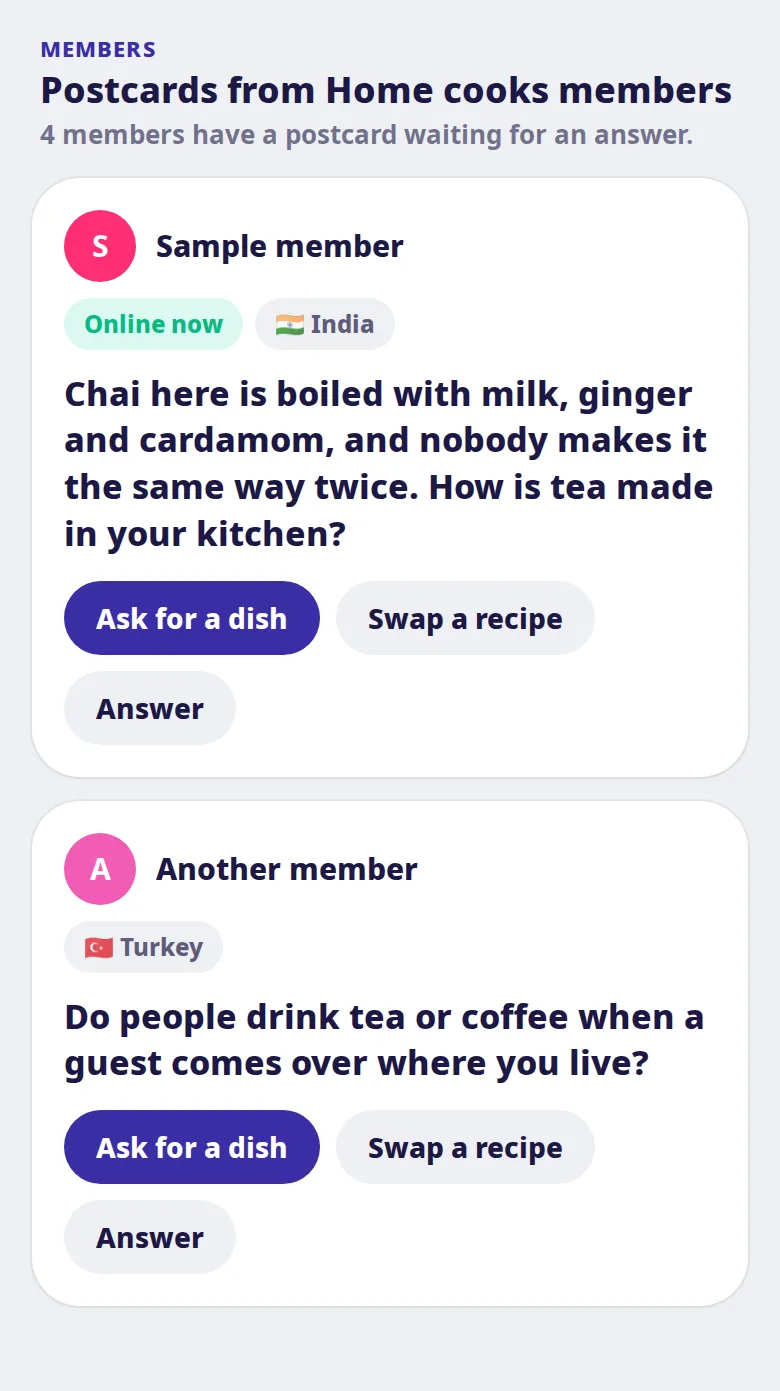 Example screen with sample members, not real people.
A few honest details:
- Every message is translated both ways, with the original visible, so each cook writes in their own language.
- It is text only. No voice and no video. Contact details are stopped before delivery, and report and block are in every chat.
- Adults 18+ only. Birth year is asked at join; there is no ID check.
- No ads and no paid plan. The community is still small, so at quiet hours an answer can take a while.
Questions to ask someone about tea in their country
- How did you make your tea today: bag, loose leaves, or boiled in a pan?
- What goes in it: milk, sugar, lemon, mint, spices, salt?
- What do you make when a guest arrives: tea, coffee, or something else?
- How many cups is polite to drink as a guest where you live?
- What is the one thing about your family's tea you would never change?
Questions people ask
+Is all tea made from the same plant?
Green, oolong and black tea all come from one plant, Camellia sinensis. The difference is in how the leaves are processed. Drinks such as yerba mate in Argentina or hibiscus karkade in Egypt are often called tea, but they come from other plants.
+Which country drinks the most tea per person?
Rankings change by source and year. The Wikipedia tea culture page gives about 3.16 kg of tea per person in Turkey (2016), 2.19 kg in Ireland and 1.9 kg in the United Kingdom, so all three are big tea-drinking countries.
+Is any tea tradition on the UNESCO heritage list?
Yes. In 2022 UNESCO added China's traditional tea processing techniques and the social practices around them to its list of the intangible cultural heritage of humanity. The listing notes that greeting guests with tea is shared by many ethnic groups in China.
+Why is tea served in three rounds in some countries?
In North and West Africa, green tea with mint and sugar is often served in three rounds from the same leaves, so each glass tastes different. Senegal's attaya, Maghrebi mint tea and Libyan tea all follow this pattern, and the long preparation leaves time to talk.
+What is the easiest tea from another country to make at home?
Masala chai needs black tea, milk, sugar and a few spices such as ginger and cardamom, boiled in one pan. Moroccan-style mint tea needs gunpowder green tea, fresh mint and sugar. Southern sweet tea needs only black tea, sugar and ice.
Keep reading
Boarding pass · free
Tap, fly to a random country, and chat with someone who lives there.
Text first, translated both ways, no video, no coins to meet people. Works in your browser.
Take off on OluNew here? Read Ablo App: The Complete Story of the Chat App That Let You Fly Anywhere (2019–2022), the full history in one place.