 Olu
Desserts Around the World: Famous Desserts from 35 Countries
Desserts around the world: a table of famous desserts from 35 countries, what each one is, which belong to a festival, and why no country has only one sweet.
Updated 19 November 2026 · 10 min read
On this page
- Famous desserts by country: 35 countries in one table
- What desserts around the world have in common
- Desserts tied to festivals and seasons
- Why one dessert per country is never the whole story
- Traditional desserts you can try at home
- Questions to ask a home cook about their dessert
- Swap a dessert recipe with a home cook abroad
- The short version
Ask people from different countries to name the sweet they grew up with and you hear about fried dough rolled in sugar, rice cooked slowly in milk, shaved ice piled with beans, and cakes that take a whole day to build. Every kitchen has its own idea of what ends a good meal.
This guide lists desserts around the world: one well-known dessert from each of 35 countries, what it is made of, and the custom around it where a source shows one. Every row links to the page it came from.
The short answer: famous desserts by country include tiramisu (Italy), pastel de nata (Portugal), Sachertorte (Austria), brigadeiro (Brazil), mochi (Japan), gulab jamun (India), mango sticky rice (Thailand), Om Ali (Egypt), malva pudding (South Africa) and pavlova (Australia and New Zealand). But no country has just one. Each row below is one example among many, and every family makes it a little differently.
Ask a home cook abroad which sweet every family makes
Famous desserts by country: 35 countries in one table
One dessert per country, grouped by region. Most of these countries have dozens of others that could take the same spot.
| Country | Dessert | What it is |
|---|---|---|
| Austria | Sachertorte | Chocolate sponge with apricot jam and a chocolate glaze, created by confectioner Franz Sacher in the mid-19th century |
| Denmark | Risalamande | Cold rice pudding with whipped cream, vanilla and chopped almonds, served with cherry sauce at Christmas dinner |
| France | Tarte Tatin | Apples caramelised in butter and sugar before the tart is baked; named after the Tatin sisters, who served it in their hotel |
| Germany | Black Forest cake | Cocoa sponge with cherries, Kirsch and whipped cream; a 1927 recipe is kept in an archive in Radolfzell |
| Greece | Galaktoboureko | Custard between layers of filo and covered in syrup; also popular in Cyprus and Turkey's eastern Black Sea region |
| Hungary | Dobos torte | Sponge layers with chocolate buttercream and a hard caramel top, created by a Budapest chef in the late 19th century to keep longer |
| Italy | Tiramisu | Coffee-soaked ladyfingers under a cream of egg yolks, sugar and mascarpone; the name means "pick me up" |
| Poland | Pączki | Filled doughnuts from Polish cuisine |
| Portugal | Pastel de nata | Egg custard tart, sometimes dusted with cinnamon; also loved in Brazil, Mozambique, Macau and Goa |
| Russia | Medovik | Honey layer cake with sour cream or condensed milk filling, known for its long preparation |
| Spain | Crema catalana | Catalan custard of milk, egg yolks and sugar, flavoured with lemon zest or cinnamon, under a crisp caramel crust |
| Sweden | Prinsesstårta | Sponge, pastry cream and a dome of whipped cream, covered in (usually green) marzipan |
| United Kingdom | Sticky toffee pudding | Moist sponge in toffee sauce with custard or ice cream; a culinary symbol of the Lake District in England |
| Argentina | Alfajor | A traditional confection that came from Spain and is now found across much of South America |
| Brazil | Brigadeiro | Condensed milk, cocoa powder and butter cooked to a soft caramel and coated in chocolate sprinkles |
| Canada | Butter tart | Small pastry shell filled with butter, brown sugar, maple syrup and egg; recipes vary from family to family |
| Peru | Suspiro de limeña | A Peruvian dessert whose name means "sigh of the lady from Lima" |
| United States | Brownie | Chocolate baked bar, fudgy or cakey, developed in the United States at the end of the 19th century |
| China | Mooncake | Baked pastry eaten and shared with friends and family during the Mid-Autumn Festival |
| India | Gulab jamun | Sweet from the Indian subcontinent, also popular in Bangladesh, Nepal and Pakistan |
| Indonesia | Klepon | Green glutinous rice balls filled with palm sugar and rolled in grated coconut; the centre melts as they boil |
| Iran | Sholezard | Saffron rice pudding with rose water, cinnamon and cardamom, often made in large amounts for religious ceremonies |
| Japan | Mochi | Steamed glutinous rice pounded into a paste and shaped; a traditional food for the Japanese New Year |
| Philippines | Halo-halo | Crushed ice with evaporated milk, ube jam, sweet beans, fruit and often ube ice cream, served in a tall glass |
| South Korea | Bingsu | Shaved ice dessert; the most common kind, patbingsu, is topped with sweet red beans |
| Thailand | Mango sticky rice | Khao niao mamuang: sticky rice cooked with coconut milk, with fresh mango on top |
| Vietnam | Chè | A whole family of sweet drinks and puddings with beans, tapioca, fruit or coconut cream, served hot or cold |
| Egypt | Om Ali | Described as a national dessert of Egypt, with many variations; often eaten at iftar during Ramadan |
| Morocco | Chebakia | Maghrebi pastry: dough strips shaped like a rose, fried, coated in honey and orange blossom syrup and sprinkled with sesame |
| Nigeria | Puff-puff | Fried yeast dough, sometimes rolled in sugar, eaten across West and Central Africa |
| Palestine | Knafeh | Spun pastry layered with cheese and soaked in syrup; the Nabulsi style comes from the city of Nablus |
| South Africa | Malva pudding | Spongy baked pudding with apricot jam; a cream sauce is poured over it while hot |
| Turkey | Baklava | Filo layered with chopped nuts and sweetened with syrup or honey |
| Australia and New Zealand | Pavlova | Baked meringue with a crisp crust and soft inside, topped with fruit and whipped cream |
A table can only hold one sweet per place. Ask two people from the same country and you may get two different answers, and both would be right.
What desserts around the world have in common
Put the table side by side and the same few ideas keep showing up, just with local ingredients.
- Rice cooked in milk. Kheer is a rice pudding popular across the Indian subcontinent, boiled with milk and sugar or jaggery. Iran's sholezard uses saffron and rose water. Denmark's risalamande folds whipped cream and almonds into cold rice pudding.
- Fried dough. Churros come from Spanish and Portuguese cuisine and are now found across Latin America and the Philippines. Puff-puff, pączki and chebakia are other takes on the same idea.
- Shaved ice. Bingsu in Korea, halo-halo in the Philippines and ais kacang, sold at coffee shops and hawker centres in Malaysia, Singapore and Brunei, all build on a base of ice.
- Custard under caramel. Encyclopedias describe crema catalana as "virtually identical" to crème brûlée. The custard is the same idea; the flavouring changes.
- Pastry and syrup. Baklava, galaktoboureko and knafeh all pair thin pastry with syrup, across a wide region that shares many recipes.
- Rice cakes and sticky rice. Mochi, klepon and mango sticky rice start with glutinous rice, steamed, pounded or boiled. Korean tteok are rice cakes made from glutinous or non-glutinous rice.
Desserts tied to festivals and seasons
Plenty of desserts are not everyday food. They belong to one day or one season, which is often what makes them matter at home.
- Mid-Autumn Festival: mooncakes are offered between friends and at family gatherings.
- New Year in Japan: mochi is eaten all year but is a traditional New Year food, traditionally made in a ceremony called mochitsuki.
- Christmas: risalamande closes Christmas dinner in Denmark, and turrón, a nougat of honey, sugar, egg white and almonds, is eaten around Christmas in Spain and Italy.
- Ramadan: Om Ali is common at iftar in Egypt, chebakia is typically eaten during Ramadan in the Maghreb, sholezard is used to break the fast in Iran, and knafeh is often served on holidays and in Ramadan.
- Diwali and Holi: barfi, a milk-based sweet, is often served at these festivals.
- Mango season: mango sticky rice is usually eaten in Thailand's peak mango season, April and May.
- A cake with its own day: Sweden's kladdkaka, a sticky chocolate cake made without baking powder, has had an official day on 7 November since 2008.
If you are planning a trip, a festival dessert is one of the easiest ways into a conversation with a local cook.
Why one dessert per country is never the whole story
Lists of famous desserts by country make it look simple. It is not, for three reasons.
Recipes cross borders. Pastel de nata is popular in Brazil, Mozambique, Macau and Goa. Gulab jamun is eaten across South Asia and wherever South Asian families live. Alfajores came from Spain and spread across South America. Galaktoboureko is shared by Greece, Cyprus and part of Turkey.
Origins are argued over. Pavlova is said to come from either Australia or New Zealand. Baklava has several origin theories, and even the origin of its name is unsettled. The origins of Black Forest cake and its name are disputed too. These are friendly arguments, and the dessert is loved on both sides of them.
Every family changes it. The butter tart entry notes that recipes vary according to the family baking them, so the pastry and filling differ from kitchen to kitchen. Chè is not one dish at all but a large family of them, and medovik has many recipes and variations.
The same is true of main courses. Our guide to national dishes of different countries shows that only a few dishes are official, and most are national by custom.
Traditional desserts you can try at home
If you want to start cooking desserts from different countries, pick ones with short ingredient lists:
- Brigadeiro (Brazil): condensed milk, cocoa powder and butter, cooked on the stove or in the microwave, then coated in chocolate sprinkles.
- Kladdkaka (Sweden): flour, eggs, butter, sugar, vanilla and cocoa, with no baking powder, so it stays dense and soft inside.
- Nanaimo bar (Canada): a no-bake bar of a crumb base, custard icing and a chocolate layer.
- Mango sticky rice (Thailand): sticky rice cooked with coconut milk and topped with ripe mango.
Then ask someone who makes it at home what you got wrong. That is usually where the real recipe starts.
Questions to ask a home cook about their dessert
These questions tend to get warmer answers than "what is your national dessert?":
- "What sweet does every family make where you live?"
- "Is there a dessert you only eat on one holiday?"
- "Who made it in your family, and do you make it the same way?"
- "What would you teach someone from another country first?"
- "Which ingredient would be hard to find abroad, and what could replace it?"
- "What do restaurants always get wrong about it?"
Share one from your own kitchen too. A swap feels fairer than an interview, and you learn more when both sides cook.
Swap a dessert recipe with a home cook abroad
On Olu, a free text chat site for meeting people in other countries, people who love to cook join the Home cooks planet: real home cooking from real kitchens. Its ritual is Same dish, two kitchens. Cook the same dish as someone in another country: name tonight's dish, and a cook abroad tells you how their kitchen does it and what they would never change. For a dessert you want to learn, post a Swap a recipe request, which stays live for 48 hours.
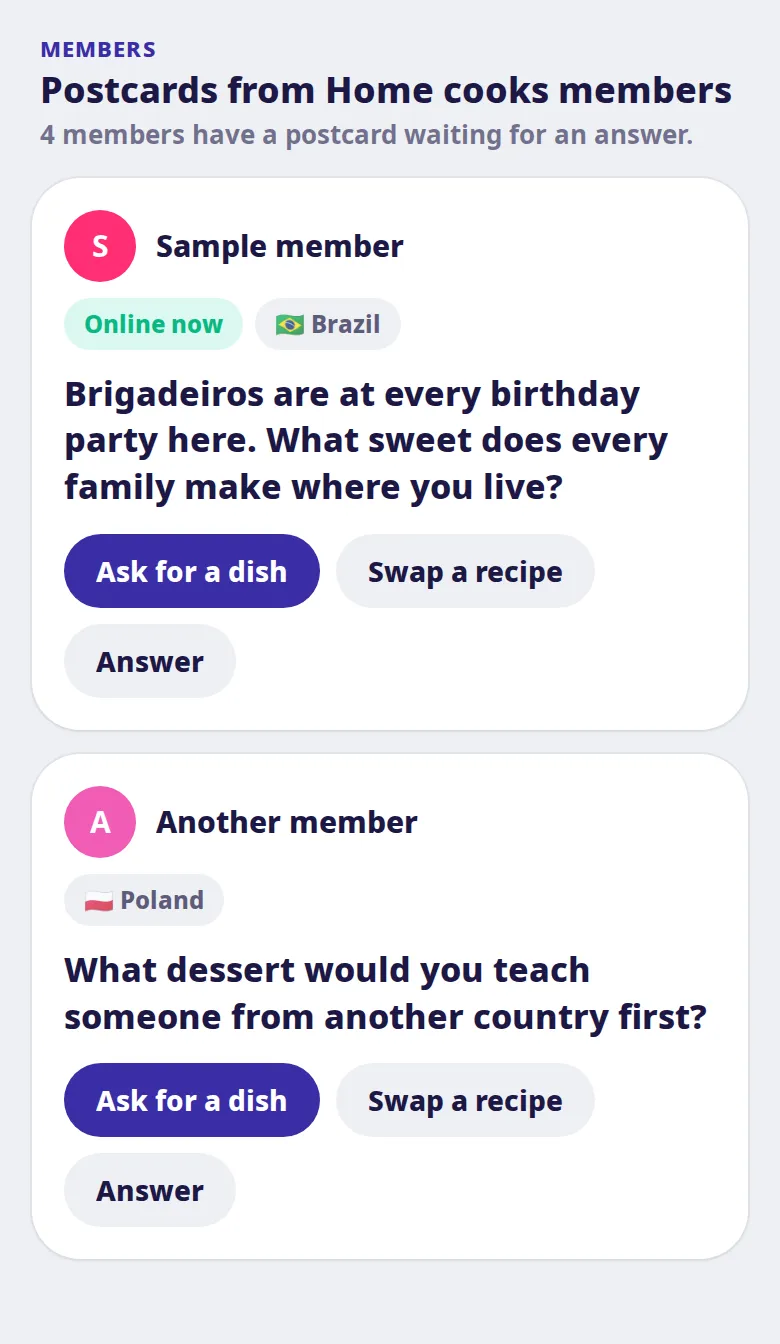 Example screen with sample members, not real people.
Every postcard has three buttons: Ask for a dish, Swap a recipe and Answer. The planet keeps three laws: say where the dish is from, real home cooking only, and never mock a recipe from someone's home.
Honest limits: Olu runs in the browser and is text only, with no voice or video. Every message is translated both ways with the original visible, which helps with dessert names, but check oven temperatures, units and amounts with the other cook. It is for adults 18+ (birth year is asked at join, with no ID check), it is free, and it has no ads and no paid plan. Contact details are stopped before delivery, and you can report and block in every chat. For more on trading recipes, read our recipe exchange guide.
The short version
Desserts around the world share a handful of ideas: rice cooked in milk, fried dough, shaved ice, custard under caramel, and pastry soaked in syrup. Each country gives them its own ingredients, from saffron in Iran to maple syrup in Canada. Many sweets belong to a festival, many cross borders, and a few have origins that two countries still argue about. The table above shows one famous dessert from each of 35 countries, but every country has many more, and the best version is usually the one a home cook makes.
Questions people ask
+What are some famous desserts around the world?
A few that are known far beyond their home country: tiramisu from Italy, pastel de nata from Portugal, baklava, which is traditional across West Asia, Southeast Europe, Central Asia and North Africa, mochi from Japan, gulab jamun from the Indian subcontinent, brigadeiro from Brazil and pavlova from Australia or New Zealand. The table in this guide covers 35 countries.
+Does every country have one national dessert?
No. Most countries have many traditional desserts, and very few have one that everyone agrees on. The desserts in this guide are well-known examples, not official choices. Some, like Om Ali in Egypt or halo-halo in the Philippines, are described as a national dessert, but usually by custom rather than by any law.
+Which desserts are made for festivals?
Many. Mooncakes are eaten during the Mid-Autumn Festival in China, mochi is a traditional food for the Japanese New Year, and risalamande is served at Christmas dinner in Denmark. Om Ali, chebakia and sholezard are all linked to Ramadan, and barfi is often served at Diwali and Holi.
+Why do some countries argue about where a dessert comes from?
Recipes travel with trade, empires and families, so the same sweet often belongs to several places. Pavlova is said to come from either Australia or New Zealand, baklava has several origin theories, and the origin of Black Forest cake is disputed. Crema catalana and crème brûlée are described as virtually identical.
+How can I learn a dessert from someone in another country?
Ask a home cook who grew up with it. A recipe online gives one version, but a cook can tell you how their family makes it, when they serve it and what they would never change. Ask about ingredients that are hard to find where you live, and check units and amounts together.
Keep reading
Boarding pass · free
Tap, fly to a random country, and chat with someone who lives there.
Text first, translated both ways, no video, no coins to meet people. Works in your browser.
Take off on OluNew here? Read Ablo App: The Complete Story of the Chat App That Let You Fly Anywhere (2019–2022), the full history in one place.